Categories
Cathedral of Mren
 From Wikipedia - Reading time: 8 min
| Cathedral of Mren | |
|---|---|
 Mren in the early 20th century | |
| Religion | |
| Affiliation | Armenian Apostolic Church |
| Location | |
| Location | Digor District |
  Shown within Turkey | |
| Geographic coordinates | 40°14′32″N 43°39′47″E / 40.242125°N 43.662953°E |
| Architecture | |
| Type | Three-nave basilica with dome |
| Style | Armenian |
| Groundbreaking | 631 |
| Completed | 639 |
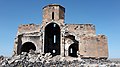
The Cathedral of Mren is a 7th-century Armenian church in an abandoned medieval town site called Mren. It is located in the Kars region of Turkey, near the border with Armenia, about 1.5 km west of the Akhurian River.[1]
Architecture
[edit]The Cathedral of Mren is a domed triple-nave basilica, believed, on the basis of an inscription on its west facade and on stylistic features, to have been built 631–639. It was built by David Saharuni, an Armenian ally of the Byzantine emperor Heraclius, to celebrate the latter's entry into Jerusalem in 628.[2] Following construction, the name of the Byzantine Emperor, Emperor Theodosius II was inscribed in the cathedral as well as listing him as "Prince of Armenia and Syria". It also featured the name of the Bishop Theophilus and the Prince of Armenia Nerses Kamsarakan.[2] The cathedral has a number of frescos covering the return of the True Cross to Jerusalem by Emperor Heraclius. It was noted as being a rare example at the time of showing the Emperor in Byzantine art as being dismounted from his horse and wearing plain clothing, a reference to the story that Heraclius tried to carry the cross in on horseback in his robes but it was too heavy but when he removed his crown and dismounted then it became miraculously light.[2] It also contains early examples of mediaeval wall paintings depicting Jesus and the Twelve Apostles.[2] Following the decline of the Byzantine Empire, the cathedral came under Muslim control for two centuries. When Christian rule was returned to the area in the 10th-11th century, the cathedral was reconsecrated.[3]
It is the largest surviving domed basilica from seventh century Armenian architecture.[4] Over the years, it had eventually become abandoned due to its remote location and due to it being located near the Armenia–Turkey border which had been closed, requiring official Turkish government permission to visit the site, which was rarely given.[1] In 2008, the south wall collapsed, leaving the cathedral's structure unstable.[5][6] In 2014, the World Monuments Fund surveyed the site with the Turkish Ministry of Culture in order to protect it.[7]
Gallery
[edit]-
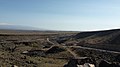 Path leading from village Karabağ to city of Mren
 -
 Collapsed side aisle
 -

-
-

-
 Portal with relief
 -
 Facade with khachkars
 -
 Lintel with relief
 -
 Side aisle
 -
 Apse
Apse


See also
[edit]- Odzun Church, an architecturally similar and contemporaneous three-nave basilica with dome in Odzun, Armenia
- Ani Cathedral, another ruined Armenian church near Mren
References
[edit]- ^ a b "A Cathedral on the Verge of Collapse: The Campaign to Save Mren". MassisPost. 17 February 2013. Retrieved 2 April 2025.
- ^ a b c d Schwartz, Ellen (2021). The Oxford Handbook of Byzantine Art and Architecture. Oxford University Press. pp. 178–180. ISBN 9780190277352.
- ^ Jevtic, Ivana (2025). Religious Buildings Made in Byzantium: Old Monuments, New Interpretations. Springer Nature. p. 10. ISBN 9783031688690.
- ^ Mirror-Spectator, The Armenian (9 April 2021). "Diversity or Disappearance? The Situation of Christian Architectural Heritage in Turkey". Retrieved 2 April 2025.
- ^ "A Monument in Peril Reveals its Secrets". WMF. Retrieved 2 April 2025.
- ^ Avakian, Florence (22 August 2016). "Armenian Churches in Danger: Mren on Verge of Collapse". The Armenian Weekly. Retrieved 2 April 2025.
- ^ "Cathedral of Mren". WMF. Retrieved 2 April 2025.
Further reading
[edit]- Kouymjian, Dickran. "Index of Armenian Art: Armenian Architecture – Mren". Armenian Studies Program. California State University, Fresno. Archived from the original on 20 June 2008.
- Maranci, Christina, "New Observations on the Frescoes at Mren," Revue des Études Arméniennes 35 (2013): 203–225.
- Thierry, Michel and Nicole, "La cathédral de Mren et sa decoration," Cahiers Archaéologiques 21 (1971): 43–77.
External links
[edit]
- The Cathedral of Mren on VirtualAni.org
- Mren Cathedral Archived 2020-06-26 at the Wayback Machine at the Rensselaer Digital Collections
- 3D model of Mren Archived 2012-10-13 at the Wayback Machine



| International | |
|---|---|
| Other | |

 EncycloReader
is supported by the
EncycloReader
is supported by the  KSF
KSF