Crown Prince of Greece
 From Wikipedia - Reading time: 9 min
 | You can help expand this article with text translated from the corresponding article in French. (April 2014) Click [show] for important translation instructions.
|

The Crown Prince of Greece (Greek: Διάδοχος, romanized: Diadochos) is the heir apparent or presumptive to the defunct throne of Greece. Since the abolition of the Greek monarchy by the then-ruling military regime on 1 June 1973, it is merely considered a courtesy title.
Title
[edit]Neither the constitution of 1844 or 1864, which served as the basis for other fundamental laws of the Kingdom of Greece, recognised titles of nobility. On the contrary, they prohibited even the sovereign from conferring such titles.[1][a][b]
As a result, the heir apparent was usually referred to simply as "the diadochos" by virtue of his function, rather than as a title. The word diadochos (διάδοχος) simply means "successor, he who collects the estate". This is a deverbal of διαδέχομαι (diadéchomai), "receive by succession",[2] and has been used since the Archaic period for heirs-apparent.[3] The most famous bearers of the title were the Diadochi, the "Successors" of Alexander the Great, who contended with each other for the spoils of his empire.[4]
Only one crown prince, the future Constantine I, bore a separate title of nobility, that of "Duke of Sparta." It was created soon after his birth in 1868. However, that caused a political scandal as many viewed it as a violation of the constitution. In the end, the creation was ultimately ratified by the Greek parliament, while the title's use within Greece continued to be highly restricted.[5]
Succession
[edit]The London Conference of 1832, established a semi-salic line of succession which would pass the crown to Otto I's descendants, or his younger brothers, should he have no issue. It was also decided that in no case would the crowns of Greece and Bavaria be joined in a personal union.[6]
The continued inability of Otto and Queen Amalia to have children was a permanent threat to the stability of Otto's throne: the 1844 constitution insisted that Otto's successor had to be Orthodox, but as the king was childless, the only possible heirs were his younger brothers, Luitpold and Adalbert. The staunch Catholicism of the Wittelsbachs complicated matters, as Luitpold refused to convert and Adalbert married Infanta Amalia of Spain. The sons of Adalbert, and especially the eldest, Ludwig Ferdinand, were now considered the most likely candidates, but due to the issue of religion, no definite arrangements were ever made prior to Otto's deposition in 1862.[7]
Since the establishment of the constitution of 1952, the daughters of the sovereign came after their brothers in the order of succession to the throne.
When Constantine II succeeded Paul I in 1964, his sister became heir presumptive according to the 1952 Constitution but that caused a constitutional crisis because his father's cousin Prince Peter who declared himself heir to the throne on the pretext that female dynasts had been unlawfully granted succession rights, but Prince Peter lost his succession rights by marrying Irina Ovtchinnikova in 1939. Also at the time Constantine's older sister Princess Sophia married the future Juan Carlos I in 1962 and cousin Prince Philip married Queen Elizabeth II in 1947 renounced their rights for their descendants.
Personal standard
[edit]-
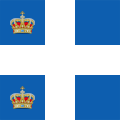 1914 version
 -
 1935 version
.svg)
.svg)
List of heirs to the Greek throne
[edit]| Monarch | Heir | Relationship to monarch | Became heir; reason | Ceased to be heir; reason | Next in succession, relation to heir |
|---|---|---|---|---|---|
| Otto I | Luitpold Karl | Younger brother | 27 May 1832; Formation of Kingdom of Greece |
18 March 1844; Non-Orthodox dynasts excluded from succession |
Adalbert Wilhelm, brother |
| None, 1844–1862 | |||||
| None 1862–1863 | |||||
| George I | None, 1863–1868 | ||||
| Crown Prince Constantine | Son | 2 August 1868 Born |
18 March 1913 Father assassinated, became king |
None, 1868–1869 | |
| Prince George, 1869–1890, brother | |||||
| Prince George, 1890–1913, son | |||||
| Constantine I | Crown Prince George | Son | 18 March 1913 Father became king |
11 June 1917 Father deposed, younger brother selected as king |
Prince Alexander, brother |
| Alexander I | None, 1917–1920[c] | ||||
| Constantine I | Crown Prince George | Son | 19 December 1920 Father restored as king by referendum |
27 September 1922 Father abdicated, became king |
Prince Paul, brother |
| George II | Prince Paul | Brother | 27 September 1922 Brother became king |
25 March 1924 Monarchy abolished, confirmed by referendum |
Prince George, uncle |
| None 1924–1935 | |||||
| George II | Prince Paul | Brother | 25 November 1935 Monarchy restored by referendum |
1 April 1947 Brother died, became king |
Prince George, 1935–1940, uncle |
| Prince Constantine, 1940–1947, son | |||||
| Paul I | Crown Prince Constantine | Son | 1 April 1947 Father became king |
6 March 1964 Father died, became king |
Prince George, 1947–1952, granduncle |
| Princess Sophia[d], 1952–1962, sister | |||||
| Princess Irene[e], 1962–1964, sister | |||||
| Constantine II | Princess Irene | Sister | 6 March 1964 Brother became king |
10 July 1965 Daughter born to king |
Prince Michael, 1964–1965, first cousin once-removed |
| None, 1965 | |||||
| Princess Alexia | Daughter | 10 July 1965 Born |
20 May 1967 Son born to king |
Princess Irene, aunt | |
| Crown Prince Pavlos | Son | 20 May 1967 Born |
1 June 1973 Monarchy abolished, confirmed by 1973 and 1974 referenda |
Princess Alexia, 1967–1969, sister | |
| Prince Nikolaos, 1969–1973, brother | |||||
See also
[edit]Notes
[edit]- ^ Article XXXIII of the Constitution of 1844 states: "The King has the right to confer the insignia of existing orders, in accordance with the laws which have been established. But can not give titles of nobility or recognise those who would be given by a foreign power to Greek citizens."
- ^ Article III of the Constitution of 1864 states: "Titles of nobility and distinction are neither conferred nor recognised for Greek citizens."
- ^ On 11 June 1917, King Constantine I was deposed from the throne, and his second son, Prince Alexander was selected by the Allies of World War I to act as a puppet king, after the refusal of both Constantine I's eldest son (Crown Prince George) and brother (Prince George). Eventually all the members of the royal family went into exile, except for Alexander himself. King Alexander considered himself as merely a regent in the name of his father, as neither he nor his elder brother had abdicated. On 25 October 1920, Alexander died of sepsis after being bit by a monkey on 2 October. Still unwilling to restore Constantine I to the throne, the government of Eleftherios Venizelos offered the crown to his third son (Prince Paul), receiving another refusal on the same grounds of loyalty to Constantine I. On 14 November, Venizelos was defeated in the 1920 Greek legislative election and the new government of Dimitrios Rallis asked Queen Dowager Olga (who was allowed to return to Greece as Alexander was dying) to assume the regency until Constantine I's restoration on 19 December, after a referendum.
- ^ In 1952, the law of succession was changed from agnatic primogeniture to male-preference primogeniture.
- ^ In 1962, Princess Sophia renounced her claim to the throne, in order to marry Juan Carlos, Prince of Asturias.
References
[edit]- ^ Greek Constitution of 1844 at Heraldica.org (in French). Retrieved on 1 April 2014.
- ^ Anatole Bailly, Greek-French Dictionary, Librairie Hachette, 1952, pp. 466–468.
- ^ L.H. Jeffery, Archaic Greece: The City States C. 700-500 B.C., Ernest Benn, 1971. p. 39
- ^ Dictionnaire alphabétique et analogique de la langue française, vol. 2, Le Robert, 1972, p. 208 (in French).
- ^ Markezinis, Spyridon (1968). Πολιτική Ιστορία της Νεωτέρας Ελλάδος (1828 - 1964). Τόμος Β′: Η Συνταγματική Βασιλεία, 1863 - 1909 (in Greek). Athens: Papyros. p. 67.
- ^ Succession Laws of the Greek Monarchy at Heraldica.org. Retrieved on 1 April 2014.
- ^ Jelavich 1961, pp. 126–127.
Bibliography
[edit]- Jelavich, Barbara (1961). "Russia, Bavaria and the Greek Revolution of 1862/1863". Balkan Studies. 2 (1): 125–150. ISSN 2241-1674.
- Palmer, Alan W.; Michael of Greece (1990). The Royal House of Greece. Weidenfeld & Nicolson. ISBN 0297830600.
.svg)
.svg)
 EncycloReader
is supported by the
EncycloReader
is supported by the  KSF
KSF