Ecclesiastes 8
 From Wikipedia - Reading time: 7 min
| Ecclesiastes 8 | |
|---|---|
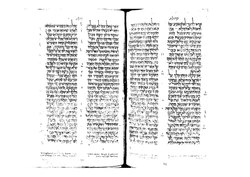 Hebrew Bible, MS Sassoon 1053, images 464-467 (Ecclesiastes). | |
| Book | Book of Ecclesiastes |
| Category | Ketuvim |
| Christian Bible part | Old Testament |
| Order in the Christian part | 21 |
Ecclesiastes 8 is the eighth chapter of the Book of Ecclesiastes in the Hebrew Bible or the Old Testament of the Christian Bible.[1][2] The book contains philosophical speeches by a character called '(the) Qoheleth' ("the Teacher"), composed probably between the 5th and 2nd centuries BCE.[3] Peshitta, Targum, and Talmud attribute the authorship of the book to King Solomon.[4] This chapter concerns human and divine authority with the advice that fearing God is the wisest course.[5]
Text
[edit]The original text was written in Hebrew. This chapter is divided into 17 verses.
Textual witnesses
[edit]Some early manuscripts containing the text of this chapter in Hebrew are of the Masoretic Text, which includes Codex Leningradensis (1008).[6][a]
There is also a translation into Koine Greek known as the Septuagint, made in the last few centuries BCE. Extant ancient manuscripts of the Septuagint version include Codex Vaticanus (B; B; 4th century), Codex Sinaiticus (S; BHK: S; 4th century), and Codex Alexandrinus (A; A; 5th century).[8] The Greek text is probably derived from the work of Aquila of Sinope or his followers.[3]

Structure
[edit]The New King James Version has two sections within this chapter:
- Ecclesiastes 8:1–8 = Obey Authorities for God's Sake
- Ecclesiastes 8:9–17 = Death Comes to All
Royal authority (8:1–9)
[edit]Verse 1 closes the theme from chapter 7.[9] and may be read as part of that section, leaving verses 2-9 as a group dealing with authority. Qoheleth then uses the previous observation of human authority to form a basis for understanding the divine authority but Weeks notes that verses 2 and 3 present "several difficulties", and their sentence division is unclear.[5]
Verse 1
[edit]- Who is like the wise?
- And who knows the interpretation of a thing?
- A man's wisdom makes his face shine,
- and the hardness of his face is changed.[10]
- "Make his face shine": in the Jerusalem Talmud, a story is related on how Rabbi Abbahu went down to Tiberias. [When he arrived there], the students of Rabbi Johanan noticed that his face was aglow. They then said to their master, Rabbi Johanan, that Rabbi Abbahu had presumably found a treasure. He responded to them, saying: "Why do you say so?" They replied to him: "It is because his face is all-shining." He said to them: "Perhaps it is because he heard a new instruction out of the Book of the Law." He went unto him, and enquired: "What new instruction have you heard out of the Law?" He said to him: "It was an old Tosefta." He then said concerning him: "A man's wisdom makes his face to shine" (Ecclesiastes 8:1).[11]
- "Hardness" (KJV: "boldness"; NKJV: "sternness"): literally, "strength".[12]
Fearing God is the wisest course (8:10–17)
[edit]Echoing the idea in Ecclesiastes 3:16–17, Qoheleth affirms that it is still 'safer to stand in fear before God', even as the righteous are sometimes regarded as wicked and the punishment of the wicked seems lacking.[13]
Verse 15
[edit]- So I commended enjoyment, because a man has nothing better under the sun than to eat, drink, and be merry; for this will remain with him in his labor all the days of his life which God gives him under the sun.[14]
"To eat, drink, and be merry" refers to Ecclesiastes 2:23-24; 3:13; 5:18-20; 9:7,[15] as the remedy that Qoheleth offers, that is, to accept God's gift and place oneself in his hands.[16]
See also
[edit]- Related Bible parts: Numbers 6
Notes
[edit]- ^ Since the anti-Jewish riots in Aleppo in 1947 the whole book has been missing from the Aleppo Codex.[7]
References
[edit]- ^ Halley 1965, p. 275.
- ^ Holman Illustrated Bible Handbook. Holman Bible Publishers, Nashville, Tennessee. 2012.
- ^ a b Weeks 2007, p. 423.
- ^
 Jastrow, Morris; Margoliouth, David Samuel (1901–1906). "Ecclesiastes, Book of". In Singer, Isidore; et al. (eds.). The Jewish Encyclopedia. New York: Funk & Wagnalls.
- ^ a b Weeks 2007, p. 426.
- ^ Würthwein 1995, pp. 35–37.
- ^ P. W. Skehan (2003), "BIBLE (TEXTS)", New Catholic Encyclopedia, vol. 2 (2nd ed.), Gale, pp. 355–362
- ^ Würthwein 1995, pp. 73–74.
- ^ Eaton 1994, pp. 615–616.
- ^ Ecclesiastes 8:1 ESV
- ^ Rozenboim, David Yonah, ed. (2010). Jerusalem Talmud תלמוד ירושלמי עוז והדר [Talmud Yerushalmi] (in Hebrew). Vol. 4 (Oz ve-Hadar ed.). New York: Friedman–Oz ve-Hadar. p. 66b (Shabbat 8:1). OCLC 695123759.
- ^ Note [a] on Ecclesiastes 8:1 in NKJV
- ^ Weeks 2007, pp. 426–427.
- ^ Ecclesiastes 8:15 NKJV
- ^ Coogan 2007, p. 953 Hebrew Bible.
- ^ Eaton 1994, p. 616.
Sources
[edit]- Coogan, Michael David (2007). Coogan, Michael David; Brettler, Marc Zvi; Newsom, Carol Ann; Perkins, Pheme (eds.). The New Oxford Annotated Bible with the Apocryphal/Deuterocanonical Books: New Revised Standard Version, Issue 48 (Augmented 3rd ed.). Oxford University Press. ISBN 9780195288810.
- Eaton, Michael A. (1994). "Ecclesiastes". In Carson, D. A.; France, R. T.; Motyer, J. A.; Wenham, G. J. (eds.). New Bible Commentary: 21st Century Edition (4, illustrated, reprint, revised ed.). Inter-Varsity Press. pp. 609–618. ISBN 9780851106489.
- Halley, Henry H. (1965). Halley's Bible Handbook: an abbreviated Bible commentary (24th (revised) ed.). Zondervan Publishing House. ISBN 0-310-25720-4.
- Weeks, Stuart (2007). "20. Ecclesiastes". In Barton, John; Muddiman, John (eds.). The Oxford Bible Commentary (first (paperback) ed.). Oxford University Press. pp. 423–429. ISBN 978-0199277186. Retrieved February 6, 2019.
- Würthwein, Ernst (1995). The Text of the Old Testament. Translated by Rhodes, Erroll F. Grand Rapids, MI: Wm. B. Eerdmans. ISBN 0-8028-0788-7. Retrieved January 26, 2019.
External links
[edit]

- Jewish translations:
- Kohelet – Ecclesiastes - Chapter 8 (Judaica Press) translation [with Rashi's commentary] at Chabad.org
- Christian translations:
- Online Bible at GospelHall.org (ESV, KJV, Darby, American Standard Version, Bible in Basic English)
- Ecclesiastes Chapter 8 King James Version
 Ecclesiastes public domain audiobook at LibriVox Various versions
 EncycloReader
is supported by the
EncycloReader
is supported by the  KSF
KSF