Enthalpy of neutralization
 From Wikipedia - Reading time: 3 min
In chemistry and thermodynamics, the enthalpy of neutralization (ΔHn) is the change in enthalpy that occurs when one equivalent of an acid and a base undergo a neutralization reaction to form water and a salt. It is a special case of the enthalpy of reaction. It is defined as the energy released with the formation of 1 mole of water. When a reaction is carried out under standard conditions at the temperature of 298 K (25 degrees Celsius) and 1 atm of pressure and one mole of water is formed, the heat released by the reaction is called the standard enthalpy of neutralization (ΔHn⊖).
The heat (Q) released during a reaction is
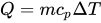
where m is the mass of the solution, cp is the specific heat capacity of the solution, and ∆T is the temperature change observed during the reaction. From this, the standard enthalpy change (∆H) is obtained by division with the amount of substance (in moles) involved.

When a strong acid, HA, reacts with a strong base, BOH, the reaction that occurs is

as the acid and the base are fully dissociated and neither the cation B+ nor the anion A− are involved in the neutralization reaction.[1] The enthalpy change for this reaction is -57.62 kJ/mol at 25 °C.
For weak acids or bases, the heat of neutralization is pH-dependent.[1] In the absence of any added mineral acid or alkali, some heat is required for complete dissociation. The total heat evolved during neutralization will be smaller.
- e.g. at 25°C

The heat of ionization for this reaction is equal to (–12 + 57.3) = 45.3 kJ/mol at 25 °C.[2]
References[edit]
- ^ a b Clark, Jim (July 2013). "Enthalpy Change of Neutralization". chemguide.co.uk. Retrieved 4 September 2019.
- ^ "Enthalpy of Neutralization" (PDF). Community College of Rhode Island. Archived from the original (PDF) on 13 December 2016. Retrieved 24 February 2014.
 EncycloReader
is supported by the
EncycloReader
is supported by the  KSF
KSF