Erythrina zeyheri
 From Wikipedia - Reading time: 5 min
| Ploughbreaker | |
|---|---|

| |
Scientific classification 
| |
| Kingdom: | Plantae |
| Clade: | Tracheophytes |
| Clade: | Angiosperms |
| Clade: | Eudicots |
| Clade: | Rosids |
| Order: | Fabales |
| Family: | Fabaceae |
| Subfamily: | Faboideae |
| Genus: | Erythrina |
| Species: | E. zeyheri
|
| Binomial name | |
| Erythrina zeyheri | |
Erythrina zeyheri, commonly known as the ploughbreaker, is a deciduous, geoxylic subshrub and member of the Fabaceae, which is endemic to southern Africa. It grows no more than 60 cm tall[1] and occurs naturally in the higher elevation grasslands of South Africa's central plateau, and that of adjacent Lesotho.[2] They favour deep clay soil in the vicinity of creeks and marshes, and often form colonies.[1] Its specific name commemorates the 19th century botanist, Karl Zeyher.
Description
[edit]It is a geoxylic plant, sometimes called an "underground tree",[3] that produces annual stems, some 50 to 60 cm long.[4] It has glabrous, leathery, trifoliolate leaves with large leaflets. The rachis and main leaf venation, which are prominently raised below, are armed with recurved spines on both leaf surfaces.[5] The petioles and stems are likewise armed to discourage browsers. The shoots and leaves are deciduous, dying away during harsh highveld winters,[1] when the plant survives as an extensive woody, tuberous rootstock.
The upright inflorescences appear in summer, with the leaves,[4] from October to January.[1] The drooping scarlet, or rarely white flowers,[5] are capped by a red calyxes. Their fruit are smooth black pods when mature, each containing a few large (1.0 to 1.7 cm long) seeds.[4] These are hard and orange-red in colour.[1][5]
Foodplant
[edit]It is a foodplant for the moth Terastia margaritis.[6]
Gallery
[edit]-
 Abaxial leaf surface armed with recurved spines on main veins
 -
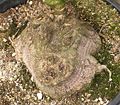 The perennial tuberous rootstock
 -
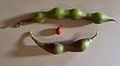 Green pods and seed


References
[edit]- ^ a b c d e Elliot Lithudzha; K Behr. "Erythrina zeyheri". PlantZAfrica.com. South African National Biodiversity Institute. Retrieved 19 December 2012.
- ^ Reports of its occurrence in Botswana and Zimbabwe are suspect, see: "Erythrina latissima E. Mey. (Notes)". Flora Zambesiaca. kew.org. Retrieved 21 December 2012.
- ^ Barras, Colin. "Why some trees evolved to live underground". BBC. Retrieved 27 April 2017.
- ^ a b c Schmidt, Ernst; Lötter, Mervyn; McCleland, Warren (2002). Trees and shrubs of Mpumalanga and Kruger National Park. Johannesburg: Jacana Media. p. 488. ISBN 9781919777306.
- ^ a b c van Wyk, Braam; et al. (1988). Veldgids tot die Veldblomme van die Witwatersrand en Pretoria. Cape Town: Struik. pp. 206–207. ISBN 0-86977-815-3.
- ^ Goff, R. "Terastia margaritis". African Moths. Retrieved 21 December 2012.
External links
[edit]- Colony of Erythrina zeyheri after a grass-fire Archived 2012-09-02 at the Wayback Machine, Operation wildflower
 Media related to Erythrina zeyheri at Wikimedia Commons
 EncycloReader
is supported by the
EncycloReader
is supported by the  KSF
KSF