Categories
Erythrolamprus cobella
 From Wikipedia - Reading time: 5 min
| Erythrolamprus cobella | |
|---|---|
_(10649904814).jpg)
| |
Scientific classification 
| |
| Domain: | Eukaryota |
| Kingdom: | Animalia |
| Phylum: | Chordata |
| Class: | Reptilia |
| Order: | Squamata |
| Suborder: | Serpentes |
| Family: | Colubridae |
| Genus: | Erythrolamprus |
| Species: | E. cobella
|
| Binomial name | |
| Erythrolamprus cobella | |
| Synonyms | |
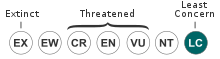
Erythrolamprus cobella, commonly known as the mangrove snake, is a species of small semi-aquatic snake, which is endemic to South America.[4]
Geographic range[edit]
It is found in northern South America east of the Andes,[5] in the Guianas, eastern Venezuela, and Trinidad and Tobago.[6]
Description[edit]
Adults may attain a total length of 73 cm (29 in), which includes a tail 12.5 cm (4.9 in) long.[7]
Dorsally, it is black or dark brown with white crossbands. Ventrally it is red with black crossbands. The upper labials are white or yellowish.[7]
There are 8 upper labials, the 4th and 5th entering the eye. The dorsal scales, which are smooth and without apical pits, are arranged in 17 rows at midbody. Ventrals 143–163; anal plate divided; subcaudals 45–57, also divided (in two rows).[7]
Habitat[edit]
It lives in lowland rainforest river floodplains and coastal mangrove swamps.[6]
Diet[edit]
It feeds on frogs, geckos, and fish.[6]
References[edit]
- ^ Hoogmoed, M., Rivas, G., Nogueira, C. & Murphy, J. 2019. Erythrolamprus bizona. The IUCN Red List of Threatened Species 2019: e.T15179222A15179229. https://www.iucnredlist.org/species/15179222/15179229 Downloaded on 02 October 2018.
- ^ a b The Reptile Database. www.reptile-database.org
- ^ Dahms Tierleben. www.dahmstierleben.de
- ^ ITIS (Integrated Taxonomic Information System). www.itis.gov.
- ^ Freiberg, M. 1982. Snakes of South America. T.F.H. Publications. Hong Kong. 189 pp. ISBN 0-87666-912-7. (Liophis cobella, p. 102.)
- ^ a b c Boos, Hans E.A. (2001). The Snakes of Trinidad and Tobago. Texas A&M University Press. College Station, Texas. xvi + 328 pp. ISBN 1-58544-116-3.
- ^ a b c Boulenger, G.A. 1894. Catalogue of the Snakes in the British Museum (Natural History). Volume II., Containing the Conclusion of the Colubridæ Aglyphæ. Trustees of the British Museum (Natural History). (Taylor and Francis, Printers.) London. xi + 382 pp. + Plates I.- XX. (Rhadinæa cobella, pp. 166-167.)
Further reading[edit]
- Linnaeus, C. 1758. Systema naturae per regna tria naturæ, secundum classes, ordines, genera, species, cum characteribus, differentiis, synonymis, locis. Tomus I. Editio Decima, Reformata. L. Salvius. Stockholm. 824 pp. (Coluber cobella, p. 218.)
.jpg) | This article relating to Dipsadinae is a stub. You can help Wikipedia by expanding it. |
 EncycloReader
is supported by the
EncycloReader
is supported by the  KSF
KSF