Eupatorium rotundifolium
 From Wikipedia - Reading time: 4 min
| Roundleaf thoroughwort | |
|---|---|

| |
Scientific classification 
| |
| Kingdom: | Plantae |
| Clade: | Tracheophytes |
| Clade: | Angiosperms |
| Clade: | Eudicots |
| Clade: | Asterids |
| Order: | Asterales |
| Family: | Asteraceae |
| Genus: | Eupatorium |
| Species: | E. rotundifolium
|
| Binomial name | |
| Eupatorium rotundifolium | |
| Synonyms[2] | |
|
Synonymy
| |

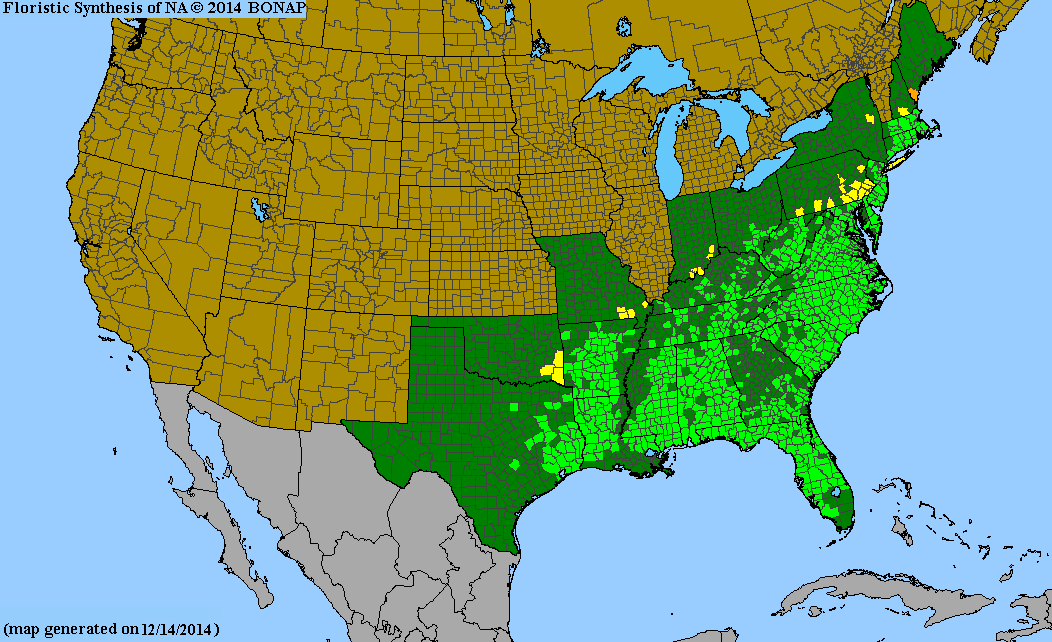
Eupatorium rotundifolium, commonly called roundleaf thoroughwort, is a North American species of plant in the family Asteraceae. It native to the eastern and central United States, in all the coastal states from Maine to Texas, and inland as far as Missouri and the Ohio Valley.[3] It is found in low, moist habitats such as wet savannas and bogs.[4][5]
Description[edit]
The stems up to 100 cm (40 inches) tall and are produced from short rhizomes. The inflorescences are composed of a large number of small white flower heads, each with 5 disc florets but no ray florets. Plants can be highly variable due to hybridization.[4]
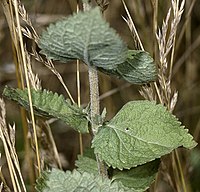
Detail of stem and leaves. (Photo by Robert H. Mohlenbrock)

Taxonomy[edit]
Three varieties of Eupatorium rotundifolium are recognized. They are:[2]
- Eupatorium rotundifolium var. ovatum (Bigelow) Torr.
- Eupatorium rotundifolium var. rotundifolium
- Eupatorium rotundifolium var. scabridum (Elliott) A.Gray
The plants known as Eupatorium rotundifolium var. saundersii have often been treated as a variety of E. rotundifolium. They can be distinguished based on morphology,[6] and molecular evidence also suggests that these plants may be different enough from E. rotundifolium to recognize them as a species, Eupatorium pilosum.[7]
Hybridization[edit]
As is common in Eupatorium, E. rotundifolium can form hybrids with other species in the genus. In particular, Eupatorium godfreyanum is a hybrid of E. rotundifolium and Eupatorium sessilifolium.[7]
Chemical constituents[edit]
Eupatorium rotundifolium contains sesquiterpene lactones of the guaianolide type including euparotin acetate and eupachlorin acetate, both of which inhibit tumor growth in vitro when isolated from the plant.[8][9]
References[edit]
- ^ "Eupatorium rotundifolium". NatureServe Explorer. NatureServe. Retrieved 2010-09-12.
- ^ a b The Plant List, Eupatorium rotundifolium L.
- ^ Biota of North America Program 2014 county distribution map
- ^ a b Flora of North America, Eupatorium rotundifolium Linnaeus, 1753. Roundleaf thoroughwort
- ^ Alan Weakley (2015). "Flora of the Southern and Mid-Atlantic States".
- ^ "18. Eupatorium pilosum Walter".
- ^ a b Kunsiri Chaw Siripun & Edward E. Schilling (2006). "Molecular confirmation of the hybrid origin of Eupatorium godfreyanum (Asteraceae)". American Journal of Botany. 93 (2): 319–325. doi:10.3732/ajb.93.2.319. PMID 21646192.
- ^ Kupchan SM, Kelsey JE, Maruyama M, Cassady JM (June 1968). "Eupachlorin acetate, a novel chloro-sesquiterpenoid lactone tumor inhibitor from Eupatorium rotundifolium". Tetrahedron Lett. 9 (31): 3517–3520. doi:10.1016/S0040-4039(01)99098-7. PMID 5649802.
- ^ Kupchan SM, Hemingway JC, Cassady JM, Knox JR, McPhail AT, Sim GA (18 January 1967). "The isolation and structural elucidation of euparotin acetate, a novel guaianolide tumor inhibitor from Eupatorium rotundifolium". J Am Chem Soc. 89 (2): 465–466. doi:10.1021/ja00978a061. PMID 6031638.
 | This Eupatorieae article is a stub. You can help Wikipedia by expanding it. |
 EncycloReader
is supported by the
EncycloReader
is supported by the  KSF
KSF