Hill-country (hieroglyph)
 From Wikipedia - Reading time: 4 min

| ||
| 3-Hills " hilly-country " in hieroglyphs | ||
|---|---|---|

The ancient Egyptian Hill-country or "Foreign land" hieroglyph (𓈉) is a member of the sky, earth, and water hieroglyphs. A form of the hieroglyph in color, has a green line-(banding) at the base of the hieroglyph. The hieroglyph refers to the hills, and mountains, on both sides of the Nile River, and thus the green references the verdant black farming land adjacent to the river proper. It is coded N25 in Gardiner's sign list, and U+13209 in Unicode. It is a determinative hieroglyph, simply conveying a meaning, and has no phonetic value.[1]
Various colors, and patterning,[2] may adorn the rest of the hieroglyph when the bottom is green.
Three major uses
[edit]ny.gif)
The ancient language hilly land hieroglyph has three major uses:
- 1 – hill country, or hills
- 2 – a reference to arid, desert land
- 3 – Determinative, for foreign lands
The language meaning of the hieroglyph is as an ideogram or a determinative in the word khast (khaset), and is often translated as hilly land, desert, foreign land, or district.[3][4]
Use as determinative
[edit]
One major use of the hill-country hieroglyph is as the determinative for land, but especially the names of foreign lands. For example in the Merneptah Stele, foreign lands are mentioned, including the name of Hatti.
Partial list with land determinative
[edit]List of uses of the foreign land determinative:
-
 Parthia (𓊪𓃭𓍘𓇋𓍯𓈉, P-rw-t-i-wꜣ), as one of the 24 subjects of the Achaemenid Empire, in the Egyptian Statue of Darius I.
 -
![Representation of Bactria of the Egyptian Statue of Darius I.[5][6]](https://upload.wikimedia.org/wikipedia/commons/thumb/7/76/Darius_I_statue_Bactria.jpg/60px-Darius_I_statue_Bactria.jpg)
-

-
![Hindush among the Achaemenid satrapies on the Statue of Darius I.𓉔𓈖𓂧𓍯𓇌𓈉 H-n-d-wꜣ-y Hindush/India[7]](https://upload.wikimedia.org/wikipedia/commons/thumb/8/88/Darius_I_statue_India.jpg/60px-Darius_I_statue_India.jpg)

![Representation of Bactria of the Egyptian Statue of Darius I.[5][6]](https://en.wikipedia.org/wiki/File:Darius_I_statue_Bactria.jpg)

![Hindush among the Achaemenid satrapies on the Statue of Darius I.𓉔𓈖𓂧𓍯𓇌𓈉 H-n-d-wꜣ-y Hindush/India[7]](https://en.wikipedia.org/wiki/File:Darius_I_statue_India.jpg)
The Nine bows (foreigners or rebels)
[edit]
| |||
| the Nine foreign lands in hieroglyphs | |||
|---|---|---|---|


One spelling of the foreign peoples, the Nine bows, is represented by the Hill country hieroglyph, "t", and nine single strokes.[8][9] The nine foreign lands used for the Nine Bows are also iconographically shown inside of cartouches, with their names. The cartouches are the 'bodies' of the "prisoner", or "captive", arms tied behind the back, the name of the land/city inside the cartouche.
-
 Pharaonic ring
 -
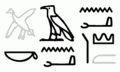 Canaan-(K-a-n-a-n-a)
 -


See also
[edit]
References
[edit]- ^ "Like many Egyptian words in hieroglyphics, the word “Israel” includes an additional sign that lacks any phonetic value. Scholars call such signs determinatives because they indicate the kind of word to which they are attached."Bible Review. Biblical Archaeology Society. 1997. p. 38.
- ^ Betrò, pg 158
- ^ Budge, An Egyptian Hieroglyphic Dictionary, "kh", 'khast', pg 533b
- ^ Betrò, "Hilly Terrain", pg 158
- ^ "Susa, Statue of Darius - Livius". www.livius.org.
- ^ Yar-Shater, Ehsan (1982). Encyclopaedia Iranica. Routledge & Kegan Paul. p. 10. ISBN 9780933273955.
- ^ "Arachosia, Sattagydia, and India are represented and named among the subject nations sculptured on the base of the Egyptian statue of Darius I from Susa."Yar-Shater, Ehsan (1982). Encyclopaedia Iranica. Routledge & Kegan Paul. p. 10. ISBN 9780933273955.
- ^ Budge, pg 533b
- ^ Budge, pg lxxvii, "IV, 480", (Urkunden der 18 Dynastic, Bande III und IV bearbeitet von K. Sethe)-(Kurt Heinrich Sethe)
- Betrò, Maria Carmela. Hieroglyphics: The Writings of Ancient Egypt, c. 1995, 1996-(English), Abbeville Press Publishers, New York, London, Paris (hardcover, ISBN 0-7892-0232-8)
- Budge. An Egyptian Hieroglyphic Dictionary, E.A.Wallace Budge, (Dover Publications), c 1978, (c 1920), Dover edition, 1978. (In two volumes) (softcover, ISBN 0-486-23615-3)
 EncycloReader
is supported by the
EncycloReader
is supported by the  KSF
KSF