Categories
Hyperolius hutsebauti
 From Wikipedia - Reading time: 4 min
| Hyperolius hutsebauti | |
|---|---|
Scientific classification 
| |
| Domain: | Eukaryota |
| Kingdom: | Animalia |
| Phylum: | Chordata |
| Class: | Amphibia |
| Order: | Anura |
| Family: | Hyperoliidae |
| Genus: | Hyperolius |
| Species: | H. hutsebauti
|
| Binomial name | |
| Hyperolius hutsebauti Laurent, 1956
| |
| Synonyms[2] | |
|
Hyperolius tuberculatus hutsebauti Laurent, 1956 | |
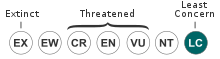
Hyperolius hutsebauti is a species of frog in the family Hyperoliidae.[1][2][3][4] It is found widely in the eastern Democratic Republic of the Congo and has recently (2016) been recorded in Burundi.[1] The specific name hutsebauti honours Franz Joseph Hutsebaut (1886–1954), a Catholic missionary in what was then Belgian Congo. Common names Ibembo reed frog[5] and Hutsebaut's reed frog have been coined for it.[2][4]
Taxonomy and systematics[edit]
Hyperolius hutsebauti was first described as a subspecies of Hyperolius tuberculatus.[2] It is now recognized as a distinct species within the so-called Hyperolius tuberculatus complex, which includes Hyperolius dintelmanni as the third species.[6]
Description[edit]
Males grow to 32 mm (1.3 in) and females to 36 mm (1.4 in) in snout–vent length.[4] Hyperolius hutsebauti is similar to Hyperolius tuberculatus but phase F ("female phase") has diffuse darker marbling on a light ground colour. The pupil is horizontal.[3]
Habitat and conservation[edit]
Hyperolius hutsebauti occurs in savanna and degraded forests[4] as well as at the edges of villages in modified haitats (e.g., artificial fish ponds and flooded cow pastures) at elevations of 414–2,030 m (1,358–6,660 ft) above sea level. It is a widespread and locally abundant species that is unlikely to be facing significant threats.[1]
References[edit]
- ^ a b c d IUCN SSC Amphibian Specialist Group (2018). "Hyperolius hutsebauti". IUCN Red List of Threatened Species. 2018: e.T56144A18375290. doi:10.2305/IUCN.UK.2018-1.RLTS.T56144A18375290.en. Retrieved 16 November 2021.
- ^ a b c d Frost, Darrel R. (2021). "Hyperolius hutsebauti Laurent, 1956". Amphibian Species of the World: An Online Reference. Version 6.1. American Museum of Natural History. doi:10.5531/db.vz.0001. Retrieved 25 February 2021.
- ^ a b "Hyperolius hutsebauti". AmphibiaWeb. University of California, Berkeley. 2008. Retrieved 13 January 2018.
- ^ a b c d Channing, Allan & Rödel, Mark-Oliver (2019). Field Guide to the Frogs & other Amphibians of Africa. Cape Town: Struik Nature. p. 206. ISBN 978-1-77584-512-6.
- ^ Beolens, Bo; Watkins, Michael & Grayson, Michael (2013). The Eponym Dictionary of Amphibians. Pelagic Publishing. p. 57. ISBN 978-1-907807-42-8.
- ^ Bell, Rayna C.; Parra, Juan L.; Badjedjea, Gabriel; Barej, Michael F.; Blackburn, David C.; Burger, Marius; Channing, Alan; Dehling, Jonas Maximilian; Greenbaum, Eli; et al. (2017). "Idiosyncratic responses to climate-driven forest fragmentation and marine incursions in reed frogs from Central Africa and the Gulf of Guinea Islands". Molecular Ecology. 26 (19): 5223–5244. doi:10.1111/mec.14260. PMID 28753250.
 EncycloReader
is supported by the
EncycloReader
is supported by the  KSF
KSF