Categories
Jin (mass)
 From Wikipedia - Reading time: 13 min
| Jin | |
|---|---|
| Unit system | Chinese |
| Unit of | Mass |
| Symbol | 斤 |
| Conversions | |
| 1 斤 in ... | ... is equal to ... |
| Mainland China | 0.5 kg |
| Japan, Korea, Taiwan, Thailand | 0.6 kg |
| Vietnam | 0.6045 kg |
| Hong Kong | 0.60478982 kg |
| Malaysia | 0.60479 kg |
| Singapore | 0.6048 kg |
| Conversions (imperial) | |
| 1 imp 斤 in ... | ... is equal to ... |
| Hong Kong, Malaysia, Singapore | 1+1/3 lb |
| Jin | |||||||||||||||||||
|---|---|---|---|---|---|---|---|---|---|---|---|---|---|---|---|---|---|---|---|
| Chinese name | |||||||||||||||||||
| Chinese | 斤 | ||||||||||||||||||
| |||||||||||||||||||
| Vietnamese name | |||||||||||||||||||
| Vietnamese | cân | ||||||||||||||||||
| Korean name | |||||||||||||||||||
| Hangul | 근 | ||||||||||||||||||
| Hanja | 斤 | ||||||||||||||||||
| |||||||||||||||||||
| Japanese name | |||||||||||||||||||
| Kanji | 斤 | ||||||||||||||||||
| Hiragana | きん | ||||||||||||||||||
| |||||||||||||||||||
| Malay name | |||||||||||||||||||
| Malay | kati | ||||||||||||||||||
| Manchu name | |||||||||||||||||||
| Manchu script | ᡤᡳᠩᡤᡝᠨ | ||||||||||||||||||
| Möllendorff | ginggen | ||||||||||||||||||
The jin (Chinese: 斤; pinyin: jīn)[a] or catty (from Malay kati) is a traditional Chinese unit of mass used across East and Southeast Asia, notably for weighing food and other groceries. Related units include the picul (dan/shi), equal to 100 catties, and the tael (liang), which is 1⁄16 of a catty. A stone (also dan/shi) is a former unit used in Hong Kong equal to 120 catties and a gwan (鈞) is 30 catties. Catty or kati is still used in Southeast Asia as a unit of measurement in some contexts especially by the significant Overseas Chinese populations across the region, particularly in Malaysia and Singapore.
The catty is traditionally equivalent to around 1+1⁄3 pound avoirdupois, formalised as 604.78982 grams in Hong Kong,[1] 604.5 grams historically in Vietnam,[2] 604.79 grams in Malaysia[3] and 604.8 grams in Singapore.[4] In some countries, the weight has been rounded to 600 grams (Taiwan,[5] Japan, Korea[6] and Thailand). In mainland China, the catty (more commonly translated as jin within China) has been rounded to 500 grams and is referred to as the market catty (市斤 shìjīn) in order to distinguish it from the kilogram, called the common catty (公斤 gōngjīn), and it is subdivided into 10 taels rather than the usual 16.
History
[edit]In ancient China, there was an official post called "Sima" (司馬) in charge of the military affairs. Because the management of military grain and fodder involved plenty of weighing, the units of jin, liang, qian, fen etc. were also called as "Sima Jin" (司馬斤), "Sima Liang", etc., and the measuring tools were called "Sima Scales" (司馬秤). This is still true in today's Hong Kong. One Sima jin is equal to sixteen Sima liang, which is where the idiom "half a jin vs eight liang"[b][7] comes from.[8][9]
| Dynasty | Metric grams (g) |
|---|---|
| Pre-Qin[10] | 250 |
| Qin | 253 |
| Western Han | 248 |
| Eastern Han, Three Kingdoms, Jin | 220 |
| Northern and Southern dynasties |
|
| Sui | 661 ("large system"), 220 ("small system") |
| Tang dynasty | 661 |
| Song dynasty, Yuan dynasty | 633 |
| Ming dynasty, Qing dynasty | 590 |
The actual mass of the jin has changed in different eras and regions, but its ratio to other relevant units remains unchanged: One jin is equal to sixteen liangs, or 1/120 of a dan. Starting from the late Qing Dynasty, jin was also written in English as catty or kan based on the sounds of Malay language.[11]
Before the Qing Dynasty, various regions and industries in China had their own weight standards for jin and liang. During the Qing Dynasty, unified weights and measures were implemented. One late-Qing jin was 596.816 grams according to the Beiyang government, which equaled 16 liangs.[12]
China Mainland
[edit]Chinese mass units promulgated in 1915
[edit]On 7 January 1915, the Beiyang government promulgated a measurement law to use not only metric system as the standard but also a set of Chinese-style measures based directly on the Qing dynasty definitions (营造尺库平制).[12][13]
| Pinyin | Character | Relative value | Metric value | Imperial value | Notes |
|---|---|---|---|---|---|
| háo | 毫 | 1⁄10000 | 3.7301 mg | 0.0001316 oz | |
| lí | 釐 | 1⁄1000 | 37.301 mg | 0.001316 oz | cash |
| fēn | 分 | 1⁄100 | 373.01 mg | 0.01316 oz | candareen |
| qián | 錢 | 1⁄10 | 3.7301 g | 0.1316 oz | mace or Chinese dram |
| liǎng | 兩 | 1 | 37.301 g | 1.316 oz | tael or Chinese ounce |
| jīn | 斤 | 16 | 596.816 g | 1.316 lb | catty or Chinese pound |
where liang is the base unit.
Mass units in the Republic of China since 1930
[edit]| Market-unit system | |||||||||
|---|---|---|---|---|---|---|---|---|---|
 A traditional Chinese scale | |||||||||
| Chinese | 市制 | ||||||||
| Literal meaning | market system | ||||||||
| |||||||||
| Alternative Chinese name | |||||||||
| Chinese | 市用制 | ||||||||
| Literal meaning | market-use system | ||||||||
| |||||||||
On 16 February 1929, the Nationalist government adopted and promulgated The Weights and Measures Act[14] to adopt the metric system as the official standard and to limit the newer Chinese units of measurement to private sales and trade, effective on 1 January 1930. These newer "market" units are based on rounded metric numbers. And jin became the base unit.[15]
| Pinyin | Character | Relative value | Metric value | Imperial value | Notes |
|---|---|---|---|---|---|
| sī | 絲 | 1⁄1600000 | 312.5 μg | 0.00001102 oz | |
| háo | 毫 | 1⁄160000 | 3.125 mg | 0.0001102 oz | |
| lí | 市釐 | 1⁄16000 | 31.25 mg | 0.001102 oz | cash |
| fēn | 市分 | 1⁄1600 | 312.5 mg | 0.01102 oz | candareen |
| qián | 市錢 | 1⁄160 | 3.125 g | 0.1102 oz | mace or Chinese dram |
| liǎng | 市兩 | 1⁄16 | 31.25 g | 1.102 oz | tael or Chinese ounce |
| jīn | 市斤 | 1 | 500 g | 1.102 lb | catty or Chinese pound |
| dàn | 擔 | 100 | 50 kg | 110.2 lb | picul or Chinese hundredweight |
Mass units in the People's Republic of China since 1959
[edit]On June 25, 1959, the State Council of the People's Republic of China issued the Order on the Unified Measurement System, retaining the market system, with the statement of "The market system originally stated that sixteen liangs are equal to one jin. Due to the trouble of conversion, it should be changed to ten liangs per jin."[16]
| Pinyin | Character | Relative value | Metric value | Imperial value | Notes |
|---|---|---|---|---|---|
| lí | 市厘 | 1⁄10000 | 50 mg | 0.001764 oz | cash |
| fēn | 市分 | 1⁄1000 | 500 mg | 0.01764 oz | candareen |
| qián | 市錢 | 1⁄100 | 5 g | 0.1764 oz | mace or Chinese dram |
| liǎng | 市兩 | 1⁄10 | 50 g | 1.764 oz | tael or Chinese ounce |
| jīn | 市斤 | 1 | 500 g | 1.102 lb | catty or Chinese pound |
| dàn | 市擔 | 100 | 50 kg | 110.2 lb | picul or Chinese hundredweight |
Legally, 1 jin equals 500 grams, and 10 liang equals 1 jin (that is, 1 liang equals 50 grams). The traditional Chinese medicine measurement system remains unchanged.[16]
Mass units in traditional Chinese medicine
[edit]Until 1979, traditional Chinese medicine (TCM) generally kept the division of 16 liang in 1 (500-gram) jin. In 1979, the State Council of China issued an order to switch to metric units for the trade of TCM. Previously-used qian is to be treated as exactly 3 grams, with other units derived from the 1/16-jin liang scaled accordingly.[17]
Weight units in ancient TCM prescriptions should be interpreted using the metric (gram) conversions appropriate for the era (see above), not any modern version of these units.[18]
Taiwan
[edit]
The jin, or kin, in Taiwan is called "Taiwan jin" or Taijin (台斤). The so-called Taijin is actually the jin used throughout China during the Qing Dynasty. In 1895, Taiwan was ceded to Japan. The Japanese implemented the metric system, but Taiwan continued to use the old weights and measures. When mainland China no longer used the old system of the Qing Dynasty, the old system of weights used in Taiwan naturally became the so-called "Taiwan system." 1 Taiwan jin is 600 grams, which is equal to 16 Taiwan liang, and 1 Taiwan liang is equal to 37.5 grams.[19]
| Unit | Relative value | Metric | US & Imperial | Notes | |||||
|---|---|---|---|---|---|---|---|---|---|
| Taiwanese Hokkien | Hakka | Mandarin | Character | Legal | Decimal | Exact | Approx. | ||
| Lî | Lî | Lí | 釐 | 1⁄1000 | 3/80,000 kg | 37.5 mg | 3750/45,359,237 lb | 0.5787 gr | Cash; Same as Japanese Rin |
| Hun | Fûn | Fēn | 分 | 1⁄100 | 3/8000 kg | 375 mg | 37,500/45,359,237 lb | 5.787 gr | Candareen; Same as Japanese Fun |
| Chîⁿ | Chhièn | Qián | 錢 | 1⁄10 | 3/800 kg | 3.75 g | 375,000/45,359,237 lb | 2.116 dr | Mace; Same as Japanese Momme (匁) |
| Niú | Liông | Liǎng | 兩 | 1 | 3/80 kg | 37.5 g | 3,750,000/45,359,237 lb | 21.16 dr | Tael |
| Kin/Chin | Kîn | Jīn | 斤 | 16 | 3/5 kg | 600 g | 60,000,000/45,359,237 lb | 1.323 lb | Catty; Same as Japanese Kin |
| Tàⁿ | Tâm | Dàn | 擔 | 1600 | 60 kg | 6,000,000,000/45,359,237 lb | 132.3 lb | Picul; Same as Japanese Tan | |
Hong Kong and Macau
[edit]Hong Kong and Macau mass units
[edit]According to the original Hong Kong law, Article 22 of 1884, one jin is 1 and 1⁄3 British pounds (that is, 3 jins is equal to 4 pounds). Currently, Hong Kong law stipulates that one jin is equal to one hundredth of a dan or sixteen liangs, which is 0.604 789 82 kilograms.[1] (0.604 789 82 kg divided by 4⁄3 is 0.453 592 65 kg, the 1878 definition of the British Avoirdupois pound.)
| Jyutping | Character | English | Portuguese | Relative value | Relation to the Traditional Chinese Units (Macau) | Metric value | Imperial value | Notes |
|---|---|---|---|---|---|---|---|---|
| lei4 | 厘 | li, cash | liz | 1⁄16000 | 1⁄10 condorim | 37.79931 mg | 0.02133 dr | |
| fan1 | 分 | fen, candareen (fan) | condorim | 1⁄1600 | 1⁄10 maz | 377.9936375 mg | 0.2133 dr | |
| cin4 | 錢 | qian, mace (tsin) | maz | 1⁄160 | 1⁄10 tael | 3.779936375 g | 2.1333 dr | |
| loeng2 | 兩 | liang, leung, tael | tael | 1⁄16 | 1⁄16 cate | 37.79936375 g | 1.3333 oz | 604.78982/16=37.79936375 |
| gan1 | 斤 | jin, kan, catty | cate | 1 | 1⁄100 pico | 604.78982 g | 1.3333 lb | Hong Kong and Macau share the definition. |
| daam3 | 擔 | dan, tam, picul | pico | 100 | None | 60.478982 kg | 133.3333 lb | Hong Kong and Macau share the definition. |
Hong Kong troy units
[edit]These are used for trading precious metals such as gold and silver, defined around the British troy weight system.
| English | Character | Relative value | Metric value | Imperial value | Notes |
|---|---|---|---|---|---|
| fen (candareen) troy | 金衡分 | 1⁄100 | 374.29 mg | 0.096 drt | |
| qian (mace) troy | 金衡錢 | 1⁄10 | 3.7429 g | 0.96 drt | |
| liang (tael) troy | 金衡兩 | 1 | 37.429 g | 1.2 ozt |
Malaysia and Singapore
[edit]Malaysia has the same regulations as it is a former British colony. The rounding is slightly different, as 0.604 79 kg.
Similarly, Singapore law stipulates that one jin, or "catty", is also equal to 1 1⁄3 pounds, which is equal to sixteen liangs (or "taels") or 0.6048 kg.[4]
Japan
[edit]| Unit | Kan | Metric | US & Imperial | |||||||||
|---|---|---|---|---|---|---|---|---|---|---|---|---|
| Romanised | Kanji | Legal | Decimal | Exact | Approx. | |||||||
| Mō | 毛 or 毫 | 1⁄1,000,000 | 3/800,000 kg | 3.75 mg | 375/45,359,237 lb | 8.267 μlb | ||||||
| Rin | 厘 | 1⁄100,000 | 3/80,000 kg | 37.5 mg | 3750/45,359,237 lb | 0.5787 gr | ||||||
| Fun | 分 | 1⁄10,000 | 3/8000 kg | 375 mg | 37,500/45,359,237 lb | 5.787 gr | ||||||
| Momme Monme |
匁 | 1⁄1000 | 3/800 kg | 3.75 g | 375,000/45,359,237 lb | 2.116 dr | ||||||
| Hyakume | 百目 | 1⁄10 | 3/8 kg | 375 g | 37,500,000/45,359,237 lb | 13.23 oz | ||||||
| Kin | 斤 | 4⁄25 | 3/5 kg | 600 g | 60,000,000/45,359,237 lb | 1.323 lb | ||||||
| Kan(me) | 貫(目) | 1 | 15/4 kg | 3.75 kg | 375,000,000/45,359,237 lb | 8.267 lb | ||||||
| Maru | 丸 | 8 | 30 kg | 3,000,000,000/45,359,237 lb | 66.14 lb | |||||||
| Tan | 担 or 擔 | 16 | 60 kg | 6,000,000,000/45,359,237 lb | 132.3 lb | |||||||
Notes:
| ||||||||||||
In Japan, 1 jin, or kin in Japanese pronunciation, is equal to 600 grams, but it is rarely used. The exception is the jin that is currently measured by the large piece of bread (food bread) before slicing the toast. According to the fair competition regulations of the Japanese Bread Fair Trade Council, a jin only needs to be more than 340 grams. Therefore, 510 grams can be called 1.5 jins.[24]
Korea
[edit]The base unit of Korean weight is the gwan.[25] At the time of Korea's metrification, however, the Geun or Korean pound, was in more common use. It was usually taken as equivalent to 600 g.[26] The nyang also sees some use among Korea's vendors of traditional Chinese medicine.[27]
| Romanization | Korean | English | Equivalents | ||||
|---|---|---|---|---|---|---|---|
| RR | MR | Other | Gwan[28] | Other countries | Global | ||
| Ho | Ho | 호(毫) | 1⁄1,000,000 | 3.75 mg (0.0579 gr) | |||
| Mo | Mo | 모(毛) | |||||
| Ri | Ri | 리(釐/厘) | 1⁄100,000 | 0.0375 g (0.00132 oz) | |||
| Pun | P'un | 푼 | 1⁄10,000 | 0.375 g (0.0132 oz) | |||
| Bun | Pun | 분(分) | |||||
| Don[29] | Ton | 돈 | 1⁄1,000 | Momme[28] | 3.75 g (0.132 oz)[28] | ||
| Nyang | Nyang | Ryang[30]Yang[28] | 냥(兩) | Korean ounce | 1⁄100 | Tael | 37.5 g (1.32 oz)[28] |
| Geun | Kŭn | Keun[28] Kon[31] | 근(斤) | Korean pound | 4⁄25 (meat),
1⁄10 (others) |
Jin, Catty[31] | 600 g (21 oz) (meat),[28][32]375 g (13.2 oz) (others) |
| Gwan | Kwan | 관(貫) | 1 | 3.75 kg (8.3 lb)[28][32] | |||
Vietnam
[edit]In Vietnam, the unit of jin is called "cân ta": 1 Sima jin (cân ta) = 0.6046 kilograms = 604.6 grams. The following table lists common units of weight in Vietnam in the early 20th century:[33]
| Name in Chữ Quốc ngữ | Hán/Nôm name | Traditional value | Traditional conversion | Modern value | Modern conversion |
|---|---|---|---|---|---|
| tấn | 擯 | 604.5 kg | 10 tạ | 1,000 kg | 10 tạ |
| quân[34] | 302.25 kg | 5 tạ | 500 kg | obsolete | |
| tạ | 榭 | 60.45 kg | 10 yến | 100 kg | 10 yến |
| bình[34] | 30.225 kg | 5 yến | 50 kg | obsolete | |
| yến | 6.045 kg | 10 cân | 10 kg | 10 cân | |
| cân | 斤 | 604.5 g | 16 lạng | 1 kg | 10 lạng |
| nén | 378 g | 10 lạng | |||
| lạng | 兩 | 37.8 g | 10 đồng | 100 g | |
| đồng or tiền | 錢 | 3.78 g | 10 phân | ||
| phân | 分 | 0.38 g | 10 ly | ||
| ly or li | 厘 | 37.8 mg | 10 hào | ||
| hào | 毫 | 3.8 mg | 10 ti | ||
| ti | 絲 | 0.4 mg | 10 hốt | ||
| hốt | 忽 | 0.04 mg | 10 vi | ||
| vi | 微 | 0.004 mg |
Notes:
- The cân (lit. "scale") is also called cân ta ("our scale") to distinguish it from the kilogram (cân tây, "Western scale").[35]
Jin, pound and kilogram
[edit]The three mass units of "jin", "pound" and "kilogram" are all currently used in China. Their meanings and conversions in Mainland China are as follows:[36]
- 市斤 (Chinese jin; character-by-character translation: "market jin"): Or simply called jin, also called "Chinese pound", is a traditional Chinese unit of weight. In the "market unit" (市制) adopted since 1930 in Mainland China, a jin equals 500 grams.
- 公斤 (kilogram, literally "common jin"): An international metric unit, equivalent to 1000 grams.[36]
- 磅 (pound, "pound"): A British Imperial unit, about 453.6 grams.
1 Chinese jin = 0.5 kilograms = 1.1023 pounds in Mainland China.[36]
Society and culture
[edit]Etymology
[edit]The word catty comes from Malay kati, meaning 'the weight'. It has also been borrowed into English as caddy, meaning a container for storing tea.
Chinese idioms
[edit]- wikt:幾斤幾兩 (jǐjīnjǐliǎng)
- wikt:半斤八兩 (bànjīnbāliǎng)
- wikt:缺斤少兩 (quējīnshǎoliǎng)
- wikt:斤斤計較 (jīnjīnjìjiào)
Gallery
[edit]-
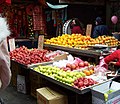 Fruit sold in catties in a market in Sanchong, New Taipei, Taiwan.
 -
 Tea priced by the catty in Dadaocheng, Taipei, Taiwan.
 -
 A spring scale in Hong Kong shows conversions between metric system (in red), traditional Chinese unit (in green) and British Imperial Units (in blue).


See also
[edit]- Chinese units of measurement
- Japanese units of measurement
- Korean units of measurement
- Taiwanese units of measurement
- Vietnamese units of measurement
Notes
[edit]References
[edit]- ^ a b c "Weights and Measures Ordinance". Laws of Hong Kong.
- ^ "Vietnam, weights". Historical Vietnamese measurements of mass.
- ^ "Weights and Measures Act 1972". Laws of Malaysia. Archived from the original on 2014-02-01.
- ^ a b "Weights and Measures Act". Statutes of the Republic of Singapore.
- ^ Weights and Measures in Use in Taiwan Archived 2010-12-29 at the Wayback Machine from the Republic of China Yearbook – Taiwan 2001.
- ^ "Regulation on Approval and Notification of Herbal (crude) Medicinal Preparations, Etc". Ministry of Food and Drug Safety.
- ^ https://en.wiktionary.org/wiki/半斤八兩
- ^ "司马 (Sima)" (in Chinese). 在线新华字典 (Xinhua Dictionary on Line).
- ^ 黄文照,张云然编 (Huang Wenzhao and Zhang Yuenran., ed. (2007). 中外计量换算手册[M] (Handbook of conversion between measurement units in China and abroad) (in Chinese). Beijing: Commercial Press.
- ^ 《中国钱币大辞典》编纂委 (Editorial Committee of the Chinese Coin Dictionary) (December 1995). 中国钱币大辞典·先秦篇 (Chinese Coin Dictionary·Pre-Qin Period). 中华书局 (Zhonghua Book Company). ISBN 9787101012415.
- ^ 莫文暢 (Mo Wenchang). 唐字音英語 (Chinese chareacter pronunciation in English) (in Chinese). Event occurs at Early 20th century.
- ^ a b c "權度法 [Quándù Fǎ]", 政府公報 [Zhèngfǔ Gōngbào, Government Gazette], vol. 957, Beijing: Office of the President, 7 January 1915, pp. 85–94 (in Chinese)
- ^ the Statistical Office of the United Nations in collaboration with the Food and Agriculture Organization of the United Nations (ed.). "World weights and measures; handbook for statisticians". p. 48.
- ^ "The Weights and Measures Act: Legislative History". Ministry of Justice (Republic of China).
- ^ a b "The Weights and Measures Act (1929)". Legislative Yuan. Archived from the original on 2014-04-25.
- ^ a b c the State Council of the People's Republic of China (1959). "国务院关于统一我国计量制度的命令 (Order of the State Council on unifying the national measurement system, No. 180 )" (PDF) (in Chinese). pp. 311–312. HTML
- ^ ZHENG, Ying; CHEN, Ang; LIU, Haipeng. "以北京为例简述上世纪 70 年代中医处方用药计量单位改革情形" [Taking Beijing as an example, a brief description of the reform of TCM prescription measurement units in the 1970s] (PDF). weighment.com (in Chinese).
- ^ "古今中药计量换算". 中国药业官方网站.
- ^ Andrade, Tonio (2005). "Appendix A: Weights, Measures, and Exchange Rates". How Taiwan Became Chinese: Dutch, Spanish, and Han Colonization in the Seventeenth Century. Columbia University Press.
- ^ "第14/92/M號法律 (Law No. 14/92/M)" (in Chinese). Government of Macau.
- ^ Cap. 68 WEIGHTS AND MEASURES ORDINANCE
- ^ Iwata, Shigeo. "Weights and Measures in Japan"
- ^ *Nagase-Reimer, Keiko (2016), Copper in the Early Modern Sino-Japanese Trade, Monies, Markets, and Finance in East Asia, 1600–1900, Vol. VII, Leiden: Brill, p. xiii, ISBN 9789004304512
- ^ 日本パン公正取引協議会:包装食パンの斤表示の義務化 (Japan Bread Fair Trade Council: Labeling of loaf size on packaged bread mandatory). www.pan-koutorikyo.jp (in Japanese). Archived from the original on 2020-11-01. Retrieved 2018-08-17.
- ^ Kim, Jun Hee (March 2007), "Taking Measure", Invest Korea Journal, vol. 25, Seoul: Korea Trade–Investment Promotion Agency
- ^ "S. Korea Determined to Introduce Metric System", The Hankyoreh, Seoul: The Hankyoreh Media Co, 22 July 2007
- ^ B., Paul (21 February 2011), "Measurements", An Acorn in the Dog's Food, LiveJournal.
- ^ a b c d e f g h World Weights and Measures: Handbook for Statisticians, ST/STAT/SER. M/21, UN Publication No. 1955.XVII.2, New York, NY: Statistical Office of the United Nations, 1955, p. III-59.
- ^ Fessley, Susanna (2009), "Weights and Measures in East Asian Studies" (PDF), Albany: State University of New York, p. 7
- ^ Grayson, James Huntley (2001). Myths and Legends from Korea: An Annotated Compendium of Ancient and Modern Materials. Abingdon: Routledge. p. 219. ISBN 9780700712410.
- ^ a b Rowlett, Russ (2002). "How Many? A Dictionary of Units of Measurement". Chapel Hill: University of North Carolina. p. K.
- ^ a b Fessley (2009), p. 7.
- ^ "Vietnam, units of mass". Sizes. Sizes, Inc. 2005-12-28.
- ^ a b Manuel de conversation française-annamite [French-Annamite conversation manual] (in French). Saigon: Imprimerie de la Mission. 1911. pp. 175–178.
- ^ "binh". Sizes. Sizes, Inc. 2004-01-23.
- ^ a b c Language Institute, Chinese Academy of Social Sciences (2016). 现代汉语词典 (附錄:計量單位表) [Contemporary Chinese Dictionary (Appendix: Measure units)] (in Chinese) (7th ed.). Beijing: Commercial Press. p. 1790. ISBN 978-7-100-12450-8.
External links
[edit]From Chinese Wikipedia:
 EncycloReader
is supported by the
EncycloReader
is supported by the  KSF
KSF