Categories
Kenai Peninsula wolf
 From Wikipedia - Reading time: 8 min
| Kenai Peninsula wolf | |
|---|---|
_C._l._alces_%E2%99%82.jpg)
| |
Scientific classification 
| |
| Kingdom: | Animalia |
| Phylum: | Chordata |
| Class: | Mammalia |
| Order: | Carnivora |
| Family: | Canidae |
| Genus: | Canis |
| Species: | |
| Subspecies: | †C. l. alces
|
| Trinomial name | |
| †Canis lupus alces | |
_%26_MSW3_(2005).png)
| |
| Historical and present range of gray wolf subspecies in North America | |
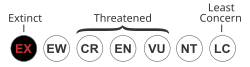
The Kenai Peninsula wolf (Canis lupus alces), also known as the Kenai Peninsula grey wolf,[5] is an extinct subspecies of the gray wolf that lived on the Kenai Peninsula in southern Alaska.[6]
Taxonomy
[edit]The subspecies was classified in 1941 by Edward Alphonso Goldman based on five skulls from two adult females and three immature males obtained from Kachemak Bay.[3] It is recognized as a subspecies of Canis lupus in the taxonomic authority Mammal Species of the World (2005).[7]
Description
[edit]Goldman, who only had skulls to go by, described the subspecies in the following terms:
Size large — perhaps the largest of North American wolves; ... No skins available and color undetermined. ... [The skull is] Similar in general to that of pambasileus, but apparently larger, more elongated;... No body measurements available.[3]
The Kenai Peninsula wolf was dependent on the very large moose of the region (hence the trinomial alces, or moose) and Goldman proposed that its large size was an adaption to this.[8][9] Geologist Fred Howard Moffit wrote in 1907 that the wolves of the Kenai Peninsula were typically silver-gray and brindle-black in color.[10]
History
[edit]Wolves were common on the Peninsula before 1900, however, gold was discovered there in 1895. Miners, fearing rabies, commenced poisoning, hunting and trapping the wolves and by 1915 they had been extirpated.[11][12][13] The Kenai Peninsula wolf went extinct in 1925[2] or 1955.[14]
Re-population of wolves from other areas onto the peninsula did not occur until the 1960s. It has been shown through DNA studies that, at minimum, the current population of wolves on the Kenai Peninsula mated with other Alaskan subspecies, as the structure of the current wolf population's DNA is similar to other mainland Alaskan subspecies.[15]
References
[edit]- ^ Boitani, L.; Phillips, M.; Jhala, Y. (2018). "Canis lupus". IUCN Red List of Threatened Species. 2018: e.T3746A163508960. doi:10.2305/IUCN.UK.2018-2.RLTS.T3746A163508960.en. Retrieved 19 November 2021.
- ^ a b Charles Bergman (2003). Wild Echoes: Encounters With the Most Endangered Animals in North America. University of Illinois Press. pp. 256–. ISBN 978-0-252-07125-6.
- ^ a b c Goldman, E. A. 1941 Sep 30. Proceedings of the Biological Society of Washington. 54: 109.
- ^ "Canis lupus alces Goldman, 1941". Integrated Taxonomic Information System.
- ^ Murray Wrobel (2007). Elsevier's Dictionary of Mammals: In Latin, English, German, French and Italian. Elsevier. pp. 68–. ISBN 978-0-444-51877-4.
- ^ Weckworth, Byron V.; Talbot, Sandra; Sage, George K.; Person, David K.; Cook, Joseph (2005). "A Signal for Independent Coastal and Continental histories among North American wolves" (PDF). Molecular Ecology. 14 (4): 917–31. Bibcode:2005MolEc..14..917W. doi:10.1111/j.1365-294X.2005.02461.x. PMID 15773925. S2CID 12896064.
- ^ Wozencraft, W. C. (2005). "Order Carnivora". In Wilson, D. E.; Reeder, D. M. (eds.). Mammal Species of the World: A Taxonomic and Geographic Reference (3rd ed.). Johns Hopkins University Press. pp. 575–577. ISBN 978-0-8018-8221-0. OCLC 62265494. url=https://books.google.com/books?id=JgAMbNSt8ikC&pg=PA576
- ^ Goldman EA. 1944. Classification of wolves: part II. Pages 389–636 in Young SP, Goldman EA, editors. The wolves of North America. Washington, D.C.: The American Wildlife Institute.
- ^ L. David Mech, The Wolf: The Ecology and Behavior of an Endangered Species, The Natural History Press, 1970, Appendix A page 2
- ^ Collier, Arthur James; Butts, Charles; Moffit, Fred Howard; Prindle, Louis Marcus; Gannett, Samuel Stinson; Dale, Thomas Nelson; Hess, Frank Lee (1907). Mineral Resources of Kenai Peninsula, Alaska: Gold Fields of the Turnagain Arm Region. U.S. Government Printing Office. p. 51.
- ^ Peterson, R.O. and J.D. Woolington. 1982. The apparent extirpation and reappearance of wolves on the Kenai Peninsula, Alaska. Pages 334-344 in Harrington, F.H. and P.C. Paquet (eds.). Wolves of the world. Noyes Publications, Park Ridge, New Jersey. 474 pp
- ^ Palmer, L. J. 1938. Kenai Peninsula moose. Research Project Report, Bureau of Biological Survey-Sept.-Oct. 1938. Unpubl. report, Kenai National Wildlife Refuge files, 24 pp, typewritten
- ^ Effects of Increased Human Populations on. Wildlife Resources of the Kenai Peninsula, Alaska. Edward E. Bangs. U.S. Fish and Wildlife Service 1982 [1]
- ^ H. A. Goodwin ; J. M Goodwin ; List of mammals which have become extinct or are possibly extinct since 1600; International Union for Conservation of Nature and Natural Resources. Survival Service Commission. ; 1973; p. 13
- ^ Rolf O. Peterson, James D. Woolington and Theodore N. Bailey (1984). "Wolves of the Kenai Peninsula, Alaska". Wildlife Monographs. 88 (88): 3–52. JSTOR 3830728.
.png)


_-_N._donnezani.png)
_-_V._praeglacialis.png)
.jpg)

_-_C._a._europaeus.png)
_-_C._mosbachensis.png)
_-_C._l._spelaeus.png)
 EncycloReader
is supported by the
EncycloReader
is supported by the  KSF
KSF