List of largest exoplanets
 From Wikipedia - Reading time: 116 min

Below is a list of the largest exoplanets so far discovered, in terms of physical size, ordered by radius.
Limitations
[edit]This list of extrasolar objects may and will change over time due to diverging measurements published between scientific journals, varying methods used to examine these objects, and the notably difficult task of discovering extrasolar objects in general. These objects are not stars, and are quite small on a universal or even stellar scale. Furthermore, these objects might be brown dwarfs, sub-brown dwarfs, or not even exist at all. Because of this, this list only cites the most certain measurements to date and is prone to change.
Maximum mass limitation
[edit]Different space organisations have different maximum masses for exoplanets. The NASA Exoplanet Archive (NASA EA) states that an object with a minimum mass lower than 30 MJ, not being a free-floating object, is qualified as an exoplanet.[5] On the other hand, the official working definition by the International Astronomical Union (IAU) allows only exoplanets with a maximum mass of 13 MJ, that are orbiting a host object at a mass ratio of less than 0.04.[6][7] For the purpose of the comparison of large planets, this article includes several of those listed by NASA EA up to the maximum 30 MJ with possible brown dwarfs among them of ≳ 13 MJ as stated by IAU.[8]
Classification of Sub-brown Dwarf and Rogue Objects
[edit]Sub-brown dwarfs are formed in the manner of stars, through the collapse of a gas cloud (perhaps with the help of photo-erosion) but that has a planetary mass, therefore by definition below the limiting mass for thermonuclear fusion of deuterium (~ 13 MJ).[7] However, there is no consensus amongst astronomers on whether the formation process should be taken into account when classifying an object as a planet.[9] Free-floating sub-brown dwarfs can be observationally indistinguishable from rogue planets, which originally formed around a star and were ejected from orbit. Similarly, a sub-brown dwarf formed free-floating in a star cluster may be captured into orbit around a star, making distinguishing sub-brown dwarfs and large planets also difficult. A definition for the term "sub-brown dwarf" was put forward by the IAU Working Group on Extra-Solar Planets (IAU WGESP), which defined it as a free-floating body found in young star clusters below the lower mass cut-off of brown dwarfs.[10]
List
[edit]The sizes are listed in units of Jupiter radii (RJ, 71 492 km). This list is designed to include all exoplanets that are larger than 1.6 times the size of Jupiter. Some well-known exoplanets that are smaller than 1.6 RJ (17.93 R🜨 or 114387 km) and are gas giant have been included for the sake of comparison.
For the exoplanets with uncertain radii that could be below or above the adopted cut-off of 1.6 RJ, see the list of exoplanets with uncertain radii.
| * | Probably brown dwarfs (≳ 13 MJ) (based on mass) |
|---|---|
| † | Probably sub-brown dwarfs (≲ 13 MJ) (based on mass and location) |
| ? | Status uncertain (inconsistency in age or mass of planetary system) |
| ! | Uncertain status while probably brown dwarfs (≳ 13 MJ) |
| ‽ | Uncertain status while probably sub-brown dwarfs (≲ 13 MJ) |
| ← | Probably exoplanets (≲ 13 MJ) (based on mass) |
| → | Planets with grazing transit, hindering radius determination |
| # | Notable non-exoplanets reported for reference |
| – | Theoretical planet size restrictions |
| Artist's impression | |
|---|---|
| Artist's size comparison | |
| Artist's impression size comparison | |
| Direct imaging telescopic observation | |
| Direct image size comparison | |
| Composite image of direct observations | |
| Transiting telescopic observation | |
| Rendered image | |
| Orbit size comparison | |
| Illustration | Name (Alternates) |
Radius (RJ) |
Key | Mass (MJ) |
Notes |
|---|---|---|---|---|---|

|
Sun (Sol) |
9.731 (1 R☉)[11] (695 700 km)[a] |
# | 1047.569 (1 M☉)[11] (1.988 416 × 1030 kg)[b] |
The only star in the Solar System. Responsible for life on Earth and keeping the planets on orbit. Age: 4.6 Gyr.[16] Reported for reference. |

|
Toliman (Toliman Centauri, Alpha Centauri B) |
8.360 ± 0.035[17] (0.8591 ± 0.0036 R☉) |
# | 952.450 ± 2.619[17] (0.9092 ± 0.0025 M☉) |
One of first two stars (other being Rigil Kentaurus / Alpha Centauri A) to have its stellar parallax measured.[18] Nearest (inner) binary star system and nearest star system to the Sun at the distance of 4.344 ± 0.002 ly (1.33188 ± 0.00061 pc). A member of Alpha Centauri System, the nearest system to the Sun. Age: 5.3 ± 0.3 Gyr.[19] Reported for reference. |

|
Maximum size of planetary-mass object | 8[20] | – | ~ 5[20] | Maximum theoretical size limit assumed for a ~ 5 MJ mass object right after formation, however, for 'arbitrary initial conditions'. |

|
Proplyd 133-353 | ≲ 7.82 ± 0.81[21][c] (≲ 0.804 ± 0.083 R☉) |
† | (≲) 13[21] | A candidate sub-brown dwarf or rogue planet with a photoevaporating disk, located in the Orion Nebula Cluster. At a probable age younger than 500 000 years, it is one of the youngest free-floating planetary-mass candidates known.[21] More information about Proplyd 133-353 and estimates of its radius are available:[h] |

|
2M0535-05 A (V2384 Orionis A) |
6.71 ± 0.11[22] (0.690 ± 0.011 R☉) |
# | 59.9 ± 3.5[22] (0.0572 ± 0.0033 M☉) |
First eclipsing binary brown dwarf system to be discovered, orbiting around 9.8 days.[23][24] Age: ~1 Myr[25] Reported for reference. |
| 2M0535-05 B (V2384 Orionis B) |
5.25 ± 0.09[22] (0.540 ± 0.009 R☉) |
# | 38.3 ± 2.3[22] (0.0366 ± 0.0022 M☉) | ||
| KPNO-Tau-4 | 4.1[26][27] | † | 10.5[26] | A member of Taurus-Auriga star-forming region.[27] | |
| Cha J1110-7633 | 3.8[28] | † | 5 – 10[28] | Rogue planet | |

|
GQ Lupi b (GQ Lupi Ab, GQ Lupi B) |
3.70[29] | * | 20 ± 10;[29] ~ 20 (1 – 39)[30] |
First confirmed exoplanet candidate to be directly imaged. It is believed to be several times more massive than Jupiter. Because the theoretical models which are used to predict planetary masses for objects in young star systems like GQ Lupi b are still tentative, the mass cannot be precisely determined, giving the masses of 1 – 39 MJ;[30] in the higher half of this range, it may be classified as a young brown dwarf. It should not be confused with the star GQ Lup C (2MASS J15491331), 2400 AU away, sometimes referred to as GQ Lup B.[31] Other sources of the radius include 3.7 ± 0.7 RJ,[32] 3.0 ± 0.5 RJ,[30] 3.77 RJ,[33] 3.5 +1.50 −1.03 RJ,[34] 4.6 ± 1.4 RJ, 6.5 ± 2.0 RJ.[35] |

|
2M1207 (TWA 27) |
3.41[36] | * | 19.9 ± 6.3[36] | Host object of the first planetary body in an orbit discovered via direct imaging. |

|
HD 100546 b (KR Muscae b) |
3.4[37] | * | 1.65[38] – 25[37] | Sometimes the initially reported 6.9 +2.7 −2.9 RJ for the emitting area due to the diffuse dust and gas envelope or debris disk surrounding the planet[39] is confused with the actual radius. HD 100546 is the closest planetary system that contains a Herbig Ae/Be star.[40] |
| 2MASS J0437+2331 | 3.30[41][i] | † | 7.1 +1.1 −1.0[41] |
May be a sub-brown dwarf or a rogue planet | |

|
EV Lacertae | 3.221 ± 0.127[42] (0.331 ± 0.013 R☉) |
# | 335.2 ± 8.38[42] (0.32 ± 0.008 M☉) |
Responsible for the most powerful stellar flare so far observed. Its fast rotation, with its convective interior, produces a powerful magnetic field that is believed to play a role in the star's ability to produce such flares.[43] Reported for reference. |

|
OTS 44 | 3.2 – 3.6[44] | † | 11.5[45] | First discovered rogue planet, and the coolest and faintest object in Chamaeleon I as well as the least massive known member of the cluster at the time of confirmation;[46] very likely a brown dwarf[47] or sub-brown dwarf.[48] It is surrounded by a circumstellar disk of dust and particles of rock and ice. The currently preferred radius estimate is done by SED modelling including substellar object and disk model.[44] |

|
FU Tauri b (FU Tau b) |
3.2 ± 0.3[49] | * | ~ 15.7,[50] 20 ± 4,[51] 19 ± 4[49] |
Likely a part of a binary brown dwarfs or sub-brown dwarfs. |
| Cha J1110-7721 | 3.1[28] | † | 5 – 10[28] | Rogue planet | |

|
2MASS J044144b (2M 0441+23 Bb) |
3.06[52][i] | † | 9.8 ± 1.8[52] | Based on the mass ratio to 2M J044145 A (2M 0441+23 Aa) it is likely not a planet according to the IAU's exoplanet working definition.[7] Part of the lowest mass quadruple 2M 0441+23 system of 0.26 M☉.[52] |
| UGCS J0422+2655 | 2.9[28] | † | 5 – 10[28] | Rogue planet | |
| UGCS J0433+2251 | 2.9[28] | † | 5 – 10[28] | Rogue planet | |

|
Kapteyn's Star | 2.83 ± 0.24[53] (0.291 ± 0.025 R☉) |
# | 294.4 ± 14.7[53] (0.2810 ± 0.014 M☉) |
The closest halo star and nearest red subdwarf, at the distance of 12.82 ly (3.93 pc), and second-highest proper motion of any stars of more than 8 arcseconds per year (after the Barnard's Star). Age: 11.5 +0.5 −1.5 Gyr.[54] Reported for reference. |

|
Cha 1107−7626 (Cha J11070768−7626326) |
2.8[28] | † | 6 – 10[55] | Rogue planet; Lowest-mass object with hydrocarbons detected in its disk[55] |

|
AB Aurigae b (AB Aur b) |
< 2.75[56][j] | ! | 20 (~ 4 Myr),[57] 10 – 12 (1 Myr), 9, < 130[56] |
More likely a (proto-)brown dwarf. Assuming a hot-start evolution model and a planetary mass, AB Aurigae b would be younger than 2 Myr to have its observed large luminosity, which is inconsistent with the age of AB Aurigae of 6.0 +2.5 −1.0 Myr, which could be caused by delayed planet formation in the disk.[58] Other system ages include 1 - 5 Myr,[56] 4 ± 1 Myr[59] and 4 Myr.[60] Another source gives a higher mass of 20 MJ in the brown dwarf regime for an age of 4 Myr, arguing since gravitational instability of the disk (preferred formation mechanism in the discovery publication)[56] operates on very short time scales, the object might be as old as AB Aur.[57] A more recent study also support the latter source, given the apparent magnitude was revised upwards.[61] |

|
CT Chamaeleontis b (CT Cha b) |
2.6 +1.2 −0.2[44] |
* | 17 ± 6[62] | Likely a brown dwarf[63] or a planetary mass companion.[64] The NASA Exoplanet Archive considers it as an exoplanet, the most distant to be directly imaged at the distance of 622 ly (190.71 pc).[65] |

|
DH Tauri b (DH Tau b) |
2.6 ± 0.6[32] | ← | 11 ± 3;[35] 12 ± 4[32] |
First planet to have a confirmed circumplanetary disk, detected with polarimetry at the VLT[66] and youngest confirmed planet at an age of 0.7 Myr (700000 years).[32] DH Tauri b is suspected to have an exomoon candidate orbiting it every 320 years, with about the same mass as Jupiter.[67] Other sources give the radii: 2.7 ± 0.8 RJ,[35] 2.49 RJ[44][i] and masses: 14.2 +2.4 −3.5 MJ,[68] 17 ± 6 MJ.[69] |
| HIP 79098 b (HIP 79098 (AB)b) |
2.6 ± 0.6[32] | * | 16 – 25,[70] 28 ± 13[32] |
The mass ratio between HIP 79098 b and the central binary HIP 79098 AB is estimated at 0.3–1%. The value lower than 4% suggests that HIP 79098 b represents the upper end of the planet population, as opposed to having been formed as a star.[70] | |
| UGCS J0439+2642 | 2.5[28] | † | 5 – 10[28] | Rogue planet | |

|
CM Draconis A (Gliese 630.1 Aa) |
2.4437 ± 0.0002[71] (0.25113 ± 0.00016 R☉) |
# | 235.8 ± 0.3[71] (0.22507 ± 0.00024 M☉) |
Second eclipsing binary red dwarf system discovered after YY Geminorum (Castor Cab).[72] One of the lightest stars with precisely measured masses and radii, orbiting around 1.268 days. The members of Gliese 630.1 triple system. Age: 4.1 ± 0.8 Gyr.[73] Reported for reference. |
.jpg)
|
PZ Telescopii b (PZ Tel b, HD 174429 b) |
2.42 +0.28 −0.34[74] |
* | 27 +25 −9[75] |
Likely a brown dwarf. If PZ Tel b is a planet, it would be first large Jupiter-like planet to be directly imaged.[76] |

|
TWA 5 B (TWA 5 A (AB) b) |
2.34 – 3.02[77] | * | 25 +120 −20[78] |
First brown dwarf companion around a pre-main sequence star confirmed by both spectrum and proper motion. Exhibits strong Hα emission.[79] |
|
|
CM Draconis B (Gliese 630.1 Ab) |
2.3094 ± 0.0001[71] (0.23732 ± 0.00014 R☉) |
# | 220.2 ± 0.3[71] (0.21017 ± 0.00028 M☉) |
Second eclipsing binary red dwarf system discovered after YY Geminorum (Castor C).[72] One of the lightest stars with precisely measured masses and radii, orbiting around 1.268 days. The members of Gliese 630.1 triple system. Age: 4.1 ± 0.8 Gyr.[73] Reported for reference. |
| o005 s41280 | 2.30[80] | † | 8.4[80] | May be a sub-brown dwarf or a rogue planet[80] | |

|
Eta Telescopii B (η Tel B, HR 7329 B) |
2.28 ± 0.03[81] | * | 29 +16 −13[81] |
Part of a triple star system. |
| TWA 29 | 2.222 +0.082 −0.081[82] |
† | 6.6 +5.2 −2.9[82] |
Rogue planet | |

|
ROXs 12 b (2MASS J1626-2526 b, WDS J16265-2527 Ab) |
2.20 ± 0.35[32] | * | 16 ± 4,[83] 19 ± 5[32] |
In 2005, ROXs 12 b was discovered/detected on a wide separation by direct imaging,[84] the same year DH Tauri b, GQ Lupi b, 2M1207b, and AB Pictoris b were confirmed, and was confirmed in 2013.[83] ROXs 12 b and 2MASS J1626–2527 (WDS J16265-2527 B) inclination misalignment with ROXs 12 (WDS J16265-2527 A) was interpreted as either formation similar to fragmenting binary stars or ROXs 12 b formed in an equatorial disk that was torqued by 2MASS J1626–2527. |
| UHW J247.95-24.78 | 2.2[28] | † | 5 – 10[28] | Rogue planet | |

|
Hot Jupiter limit | 2.2[85] | – | ≳ 0.4[86] | Theoretical size limit for hot Jupiters close to a star, that are limited by tidal heating, resulting in 'runaway inflation' |

|
HAT-P-67 Ab | 2.140 ± 0.025[87] | ← | 0.45 ± 0.15[87] | A very puffy Hot Jupiter which is among planets with lowest densities of ~0.061 g/cm3. Largest known planet with a precisely measured radius, as of 2025.[87] |
| PSO J077.1+24 | 2.14[41][i] | † | 5.9 +0.9 −0.8[41] |
Rogue planet | |
| CAHA Tau 1 | 2.12[88][89][i] | † | 10 ± 5[88][89] | Rogue planet | |

|
ROXs 42 Bb | 2.10 ± 0.35[32] | ← | 13 ± 5[32] | The formation is unclear; ROXs 42Bb may formed via core accretion, by disk (gravitational) instability, or more like a binary star. Older estimates include 1.9 – 2.4, 1.3 – 4.7 RJ[90] and 2.43±0.18, 2.55±0.2 RJ.[91] Other sources of masses include 3.2 – 27 MJ,[92] 9 +6 −3 MJ,[93] 10 ± 4 MJ.[94] |
| HATS-15b | 2.019 +0.202 −0.160[95] |
← | 2.17 ± 0.15[95] | ||

|
Proto-Jupiter | 2.0 – 2.59[96][97] | # | ≲ 1;[98][99][100] 1[101] |
Jupiter is most likely formed first and underwent planetary migration, impacting the whole Solar System. During the migration, Jupiter was briefly as close as 1.5 AU to the Sun, likely influencing the formation of Mars, before migrating back to near the ice line by Saturn's gravity.[102][103] Jupiter, as well as Saturn and Neptune, may also be responsible for ejecting fifth giant (or hypothetical Planet Nine if confirmed)[104][105] due to orbital instability between the five giant planets.[106] Due to its radiation emitting more heat than incoming through solar radiation via the Kelvin–Helmholtz mechanism within its contracting interior,[107][108] Jupiter is currently shrinking by about 1 mm (0.039 in) per year.[109][110] Through this, at the time of its formation, Jupiter was hotter and was about twice its current diameter[111] with smaller mass[100] or the same as the current mass.[101] Reported for reference. |
.png)
|
Cha 110913-773444 (Cha 110913) |
2.0 – 2.1[44] | † | 8 +7 −3[112] |
A rogue planet/sub-brown dwarf that is surrounded by a protoplanetary disk, the first one to be confirmed. It is one of youngest free-floating substellar objects with 0.5–10 Myr. The currently preferred radius estimate is done by SED modelling including substellar object and disk model.[44] |
| CFHTWIR-Oph 90 (Oph 90) |
2.00 +0.09 −0.12;[113] 3[114][115] |
† | 10.5[114] | May be rogue planet or brown dwarf | |
| SSTB213 J041757 A (J041757 A) |
2[116] | † | 3.5[116] | In a binary with a smaller 1.7 RJ proto-rogue planet/brown dwarf. It is not clear how proto-brown dwarfs J041757 AB are formed; the observations of the outflow momentum rate of these two proto-BD candidates suggest they formed as a scaled-down version of low-mass stars.[117] | |

|
Kepler-435b (KOI-680 b) |
1.99 ± 0.18[118] | ← | 0.84 ± 0.15[118] | |

|
PDS 70 c | 1.98 +0.39 −0.31[119] |
← | 7.5 +4.7 −4.2, 7.8 +5.0 −4.7, ~1 − ~15 (total)[120] |
Second multiplanetary system to be directly imaged (after HR 8799 System). PDS 70 b is first protoplanet to have been ever detected with certainty[121][122] while PDS 70 c is first confirmed directly imaged exoplanet still embedded in the natal gas and dust from which planets form (protoplanetary disk), and the second protoplanet to have a confirmed circumplanetary disk (after DH Tauri b).[123] |
| PDS 70 b | 1.96 +0.20 −0.17,[119] 2.7[58] |
← | 3.2 +3.3 −1.6, 7.9 +4.9 −4.7, < 10 (2 σ), ≲ 15 (total)[120] | ||

|
OGLE2-TR-L9b | 1.958 +0.174 −0.111[95] |
← | 4.5 ± 1.5[95] | First discovered planet orbiting a fast-rotating hot star, OGLE2-TR-L9.[124] |

|
CFHTWIR-Oph 98 A | 1.95 +0.11 −0.10;[113] 2.14[114][125] |
* | 15.4 ± 0.8;[126] 10.5[114] |
Either a M-type brown dwarf or sub-brown dwarf with a sub-brown dwarf/planet companion CFHTWIR-Oph 98 b. Other sources of masses includes: 9.6 – 18.4 MJ.[126] |
| WASP-178b (KELT-26 b, HD 134004 b) |
1.940 +0.060 −0.058[127] |
← | 1.41 +0.43 −0.51[127] |
An ultra-hot Jupiter. Initially, the planet's atmosphere was discovered having silicon monoxide, making this exoplanet the first one to have the compound on its atmosphere,[128] now the atmosphere is more likely dominated by ionized magnesium and iron.[129] | |

|
WASP-12Ab | 1.937 ± 0.056[130] | ← | 1.476 +0.076 −0.069[131] |
This planet is so close to WASP-12 A that its tidal forces are distorting it into an egg-like shape.[132] First planet observed being consumed by its host star;[133] it will be destroyed in 3.16 ± 0.10 Ma due to tidal interactions.[134][135] WASP-12b is suspected to have one exomoon due to a curve of change of shine of the planet observed regular variation of light.[136] |
| BD-14 3065b (TOI-4987 b) |
1.926 ± 0.094[137] | * | 12.37 ± 0.92[137] | Might be a brown dwarf fusing deuterium at its core, which could explain its anomalous high radius. Also the fourth hottest known exoplanet, measuring 3,520 K (3,250 °C; 5,880 °F).[137] | |
.jpg)
|
Kepler-13 Ab | 1.91 ± 0.25 – 2.57 ± 0.26[138] | ← | 9.28(16)[139] | Discovered by Kepler in first four months of Kepler data.[140] A more recent analysis argues that a third-light correction factor of 1.818 is needed, to correct for the light blending of Kepler-13 B, resulting in higher radii results.[138] |

|
KELT-9b (HD 195689 b) |
1.891 +0.061 −0.055[141] |
← | 2.17 ± 0.56[142] | Hottest confirmed exoplanet, with a temperature of 4050±180 K (3777 ± 180 °C; 6830 ± 324 °F).[143] First exoplanet with detection of the rare-earth element terbium in atmosphere.[144] |
| TOI-1518 b | 1.875 ± 0.053[145] | ← | 1.83 ± 0.47[146] | ||
.jpg)
|
HAT-P-70b | 1.87 +0.15 −0.10[147] |
← | < 6.78 (3 σ)[147] | Has a retrograde orbit.[147] |
| 2MASS J1935-2846 | 1.869 ± 0.053[148] | † | 7.4 +6.3 −3.4[148] |
May be a sub-brown dwarf or rogue planet. | |
| HATS-23b | 1.86 +0.30 −0.40[149] |
→ | 1.470 ± 0.072[149] | Grazing planet. | |
|
|
CFHTWIR-Oph 98 b (Oph 98 b, CFHTWIR-Oph 98 B) |
1.86 ± 0.05[126][125] | † | 7.8 +0.7 −0.8[126] |
Its formation as an exoplanet is challenging or impossible.[126] If its formation scenario is known, it may explain the formation of Planet Nine. Planetary migration may explain its formation, or it may be a sub-brown dwarf. Other sources of mass includes 4.1 – 11.6 MJ.[126] |
| KELT-8b (HD 343246 b) |
1.86 +0.18 −0.16[150] |
← | 0.867 +0.065 −0.061[150] |
||
.jpg)
|
WASP-76b | 1.842 ± 0.024[151] | ← | 0.921 ± 0.032[152] | A glory effect in the atmosphere of WASP-76b might be responsible for the observed increase in brightness of its eastern terminator zone which if confirmed, it would become the first glory-like phenomenon to be discovered on an exoplanet.[153][154] WASP-76b is suspected to have an exomoon analogue to Jupiter's Io due to the detection of sodium via absorption spectroscopy.[155] |

|
KPNO-Tau 12 (2MASS J0419012+280248) |
1.84,[26] 2.22 +0.11 −0.17[113] |
† | 11.5[114] | A low-mass brown dwarf or free-floating planetary-mass object surrounded by a protoplanetary disk. A member of Taurus-Auriga star-forming region.[26] Other sources of masses include: 14.6 MJ,[26] 13.6 MJ,[156] 6-7 MJ,[157] 16.5 MJ,[158] 17.8 +6.7 −4.6 MJ,[159] 12.7 +1.6 −1.8 MJ[113] |

|
TrES-4 (GSC 06200-00648 Ab) |
1.838 +0.240 −0.238[95] |
← | 0.78 ± 0.19[160] | Largest confirmed exoplanet ever found at the time of discovery.[161] This planet has a density of 0.17 g/cm3, comparable to that of balsa wood, less than Saturn's 0.7 g/cm3.[95] |
| HIP 78530 b (HIP 78530 B) |
1.83 +0.16 −0.14[162] |
* | 28 ± 10[162] | Most likely a brown dwarf. Because HIP 78530 b's characteristics blend the line between whether or not it is a brown dwarf or a planet, astronomers have tried to determine what HIP 78530 b is by predicting whether it was created in a planet-like or star-like manner.[163] | |
| HAT-P-33b | 1.827 ± 0.29,[164][k] 1.85 ± 0.49,[160] 1.686 ± 0.045[164][l] |
← | 0.72 +0.13 −0.12[165] |
Due to high level of jitter, it is difficult to constrain both planets' eccentricities with accuracy. Most of their defined characteristics are based on the assumption that HAT-P-32b and HAT-P-33b have their elliptical orbits, although their discoverers have also derived the planets' characteristics on the assumption that they have their circular orbits. The elliptical model has been chosen because it is considered to be the more likely scenario.[164] | |
| HAT-P-32b (HAT-P-32 Ab) |
1.822 +0.350 −0.236,[95] 2.04 ± 0.10,[164][k] 1.789 ± 0.025[164][l] |
← | 0.941 ± 0.166, 0.860 ± 0.164[164] | ||
.png)
|
KELT-20b (MASCARA-2b) |
1.821±0.045[152] | ← | 3.355+0.062 −0.063[152] |
An ultra-hot Jupiter. |

|
YSES 1 b (TYC 8998-760-1 b) |
1.82 ± 0.08,[166] 3.0 +0.2 −0.7[167] |
* | 21.8 ± 3[168] | Likely a brown dwarf. First substellar object to have an isotope variant of stable element (13C) detected in its atmosphere.[169][166] First directly imaged planetary system having multiple bodies orbiting a Sun-like star.[170][171] |

|
Barnard's Star (Proxima Ophiuchi) |
1.82 ± 0.01[172] (0.187 ± 0.001 R☉) |
# | 168.7 +3.8 −3.7[172] (0.1610 +0.0036 −0.0035 M☉) |
Second nearest planetary system to the Sun at the distance of 5.97 ly (1.83 pc) and closest star in the northern celestial hemisphere. Also the highest proper motion of any stars of 10.3 arcseconds per year relative to the Sun. Has 4 confirmed planet, Barnard b (Barnard's Star b),[173] c, d and e,[174] making this system second closest planetary system to host multiple planets after Proxima System.[175] Reported for reference. |

|
CoRoT-1b | 1.805 +0.132 −0.131[95] |
← | 1.03 ± 0.12[95] | First exoplanet for which optical (as opposed to infrared) observations of phases were reported.[176] |
| WTS-2b | 1.804 +0.144 −0.158[95] |
← | 1.12 ± 0.16[95] | ||
| UGCS J0417+2832 | 1.8[28] | † | 5 – 10[28] | Rogue planet | |

|
Saffar (υ And Ab) |
~1.8[177] | ← | 1.70 +0.33 −0.24[178] |
Radius estimated using the phase curve of reflected light. The planet orbits very close to Titawin (υ And A) at the distance of 0.0595 AU, completing an orbit in 4.617 days.[179] First multiple-planet system to be discovered around a main-sequence star, and first multiple-planet system known in a multiple-star system. |
| HAT-P-40b | 1.799 +0.237 −0.260[95] |
← | 0.48 ± 0.13[95] | A very puffy hot Jupiter | |
| WASP-122b (KELT-14b) |
1.795 +0.107 −0.079[95] |
← | 1.284 ± 0.032[180] | ||
| KELT-12b | 1.79 +0.18 −0.17[181] |
← | 0.95 ± 0.14[181] | ||

|
Tylos (WASP-121b) |
1.773 +0.041 −0.033[182] |
← | 1.157 ± 0.07[182] | First exoplanet found to contain water on its stratosphere. Tylos is suspected to have an exomoon analogous to Jupiter's Io due to the detection of sodium absorption spectroscopy around it.[183] |
| TOI-640 Ab | 1.771 +0.060 −0.056[184] |
← | 0.88 ± 0.16[184] | This planet orbits its host star nearly over poles, misalignment between the orbital plane and equatorial plane of the star been equal to 104 ± 2°[185] | |
| WASP-187b | 1.766 ± 0.036[186] | ← | 0.801 +0.084 −0.083[186] |
||
| WASP-94 Ab | 1.761 +0.194 −0.191[95] |
← | 0.5±0.13[95] | ||
| TOI-2669b | 1.76 ± 0.16[187] | ← | 0.61 ± 0.19[187] | ||
| WISE J0528+0901 | 1.752 +0.292 −0.195[188] |
† | 13 +3 −6[188] |
Brown dwarf or rogue planet | |
| HATS-26b | 1.75 ± 0.21[189] | ← | 0.650 ± 0.076[189] | ||
| Kepler-12b | 1.7454 +0.076 −0.072[190] |
← | 0.431 ± 0.041[191] | Least-irradiated of four Hot Jupiters at the time of discovery | |
| HAT-P-65b | 1.744 +0.165 −0.215[95] |
← | 0.527 ± 0.083[192] | This planet has been suffering orbital decay due to its close proximity to HAT-P-65; 0.04 AU.[193] | |
| 2MASS J2352-1100 | 1.742 +0.035 −0.036[148] |
† | 12.4 +9.4 −5.5[148] |
Brown dwarf or rogue planet | |
| KELT-15b | 1.74 ± 0.20[160] | ← | 1.31 ± 0.43[160] | ||
| HAT-P-57b | 1.74 ± 0.36[160] | ← | 1.41 ± 1.52[160] | ||
| WASP-93b | 1.737 +0.121 −0.170[95] |
← | 1.47 ± 0.29[95] | ||
| WASP-82b | 1.726 +0.163 −0.195[95] |
← | 1.17 ± 0.20[95] | ||

|
Ditsö̀ (WASP-17b) |
1.720 +0.004 −0.005, 1.83 ± 0.01[194] |
← | 0.512 ± 0.037[195] | First planet discovered to have a retrograde orbit[196] and first to have quartz (crystalline silica, SiO2) in its clouds.[197] Has an exteremely low density of 0.08 g/cm3,[196] the lowest of any exoplanet when it was discovered, and was possibly the largest exoplanet at the time of discovery, with a radius of 1.92 RJ.[198] |
| KELT-19 Ab | 1.717 +0.094 −0.093[152] |
← | 3.98+0.32 −0.33[152] |
First exoplanet found to have its orbit flipped (obliquity of 155 +17 −21°) due to constraints on stellar rotational velocity, sky-projected obliquity and limb-darkening coefficients (see Kozai–Lidov mechanism).[199] | |
| HAT-P-39b | 1.712+0.140 −0.115[95] |
← | 0.60±0.10[95] | ||
| KELT-4Ab | 1.706 +0.085 −0.076[200] |
← | 0.878 +0.070 −0.067[200] |
Fourth planet found in triple star system.[201] KELT-4A is the brightest host (V~10) of a Hot Jupiter in a hierarchical triple stellar system found.[202] | |
| Pollera (WASP-79b) |
1.704 +0.195 −0.180,[95] 2.09 ± 0.14[203] |
← | 0.850 +0.180 −0.180[95] |
This planet is orbiting the host star at nearly-polar orbit with respect to star's equatorial plane, inclination being equal to −95.2+0.9 −1.0°.[204] | |
| HAT-P-64b | 1.703 ± 0.070[205] | ← | 0.58 +0.18 −0.13[205] |
||
| WASP-78b | 1.70 ± 0.04,[203] 1.93 ± 0.45[160] |
← | 0.89 ± 0.08[203] | This planet has likely undergone in the past a migration from the initial highly eccentric orbit.[206] | |
| Qatar-7b | 1.70 ± 0.03[207] | ← | 1.88 ± 0.25[207] | ||
| SSTB213 J041757 B (J041757 B) |
1.70[116] | † | 1.50[116] | In a binary with a larger 2 RJ proto-rogue planet/brown dwarf. It is not clear how proto-brown dwarfs J041757 AB are formed; the observations of the outflow momentum rate of these two proto-BD candidates suggest they formed as a scaled-down version of low-mass stars.[117] | |
| CoRoT-17b | 1.694 +0.139 −0.193[95] |
← | 2.430±0.300[95] | Hot Jupiter | |
| TOI-615b | 1.69+0.06 −0.05[208] |
← | 0.43+0.09 −0.08[208] |
||
| CoRoT-35b | 1.68 ± 0.11[209] | ← | 1.10 ± 0.37[209] | ||

|
1RXS 1609 b (1RXS J160929.1−210524 b, 1RXS J1609 b) |
~ 1.664,[210] 1.7[211] |
! | 14 +2 −3,[212] 12.6 – 15.7,[211] 12 ± 2[51] |
Thought to be the lightest known exoplanet at the time of announcement orbiting its host at a large separation of 330 AU and third announced directly imaged exoplanet orbiting a sun-like star (after GQ Lup b and AB Pic b). 1RXS 1609 b's location far from 1RXS 1609 presents serious challenges to current models of planetary formation: the timescale to form a planet by core accretion at this distance from the star would be longer than the age of the system itself. One possibility is that the planet may have formed closer to the star and migrated outwards as a result of interactions with the disk or with other planets in the system. An alternative is that the planet formed in situ via the disk instability mechanism, where the disk fragments because of gravitational instability, though this would require an unusually massive protoplanetary disk.[210] With the upward revision in the age of the Upper Scorpius group from 5 million to 11 million years, the estimated mass of 1RXS J1609b is approximately 14 MJ, i.e. above the deuterium-burning limit.[212] An older age for the J1609 system implies that the luminosity of J1609b is consistent with a much more massive object, making more likely that J1609b may be simply a brown dwarf which formed in a manner similar to that of other low-mass and substellar companions.[211] |
| TOI-1855 b | 1.65 +0.52 −0.37[213] |
← | 1.133 ± 0.096[213] | ||
| TOI-3807 b | >1.65 (95% lower limit)[214] | → | 1.04 +0.15 −0.14[214] |
Grazing planet, a large radius of 2.00 RJ derived from transit data is unreliable due to its grazing nature. | |

|
HAT-P-7b (Kepler-2b) |
1.64 ± 0.11[215] | ← | 1.806 ± 0.036[195] | Second planet discovered to have a retrograde orbit (after Ditsö̀)[216][217] and first exoplanet to be detected by ellipsoidal light variations[218] |
| NGTS-33 b | 1.64 ± 0.07[219] | ← | 3.6 ± 0.3[219] | ||
| HAT-P-64b | 1.631 ± 0.070[205] | ← | 0.574 ± 0.038[205] | ||
| WASP-82b | 1.62 ± 0.13[160] | ← | 1.17 ± 0.20[160] | ||
| KELT-8b | 1.62 ± 0.10[160] | ← | 0.66 ± 0.12[160] | ||
| WASP-189 b | 1.619 ± 0.021[220] | ← | 1.99 +0.16 −0.14[220] |
Fifth hottest known exoplanet, at an temperature of 3,435 K (3,162 °C; 5,723 °F). | |
| HAT-P-65b | 1.611 ± 0.024[221] | ← | 0.554 +0.092 −0.091[221] |
This planet has been suffering orbital decay due to its proximity.[193] | |
| K2-52b | 1.61 ± 0.20[222] | ← | 0.40 ± 0.35[222] | ||
| NGTS-31 b | 1.61 ± 0.16[223] | ← | 1.12 ± 0.12[223] | ||
| HATS-11b (EPIC 216414930b) |
1.609 ± 0.064[224] | ← | 0.85[224] | ||
| KELT-7b | 1.60 ± 0.06[160] | ← | 1.39 ± 0.22[160] | ||
| A few notable examples with radii below 1.6 RJ (17.93 R🜨). | |||||
b_HST_WFC3.jpg)
|
Delorme 1b (2MASS J0103-5515 (AB) b, 2MASS0103(AB)b) |
~ 1.59[225] | ? | 13 ± 1[226] | The formation is unclear. The high accretion is in better agreement with a formation via disk fragmentation, hinting that it might have formed from a circumstellar disk.[227] Giant planets and brown dwarfs are thought to form via disk fragmentation in rare cases in the outer regions of a disk (r > 50 AU).[228] Teasdale & Stamatellos modelled three formation scenarios in which the planet could have formed. In the first two scenarios the planet forms in a massive disk via gravitational instability. The first two scenarios produce planets that have accretion and separation comparable to the observed ones, but the resulting planets are more massive than Delorme 1 b. In a third scenario the planet forms via core accretion in a less massive disk much closer to the binary. In this third scenario the mass and accretion are similar to the observed ones, but the separation is smaller.[229] |
_b,_a_planet_in_a_perpendicular_orbit_around_two_brown_dwarfs_(eso2508a).jpg)
|
2M1510 A (2MASS J1510–28 A, 2M1510 Aa)[m] |
1.575[230] (0.16185 R☉) |
# | 34.676 ± 0.076[231] (0.033101(73) M☉) |
Second eclipsing binary brown dwarf system discovered and first kind of system to be directly imaged, orbiting around 20.9 days.[232][230] The members of 2M1510 triple (likely)[231] or quadruple system.[232] Age: 45 ± 5 Myr Have a strong candidate planet, 2M1510 b (2M1510Aab b), that orbits polar around 2M1510AB (or 2M1510Aab),[m] making this planet the first planet discovered orbiting polar around a binary system.[231][233][234] Reported for reference. |
| 2M1510 B (2MASS J1510–28 B, 2M1510 Ab)[m] |
# | 34.792 ± 0.072[231] (0.033212(69) M☉) | |||
.jpg)
|
Kepler-7b | 1.574 +0.075 −0.071[190] |
← | 0.433 +0.040 −0.041[235] |
One of the first five exoplanets to be confirmed by the Kepler spacecraft, within 34 days of Kepler's science operations,[236] and the first exoplanet to have a crude map of cloud coverage.[237][238][239] |

|
WASP-103b | 1.528 +0.073 −0.047[195] |
← | 1.455 +0.090 −0.091[195] |
First exoplanet to have a deformation detected.[240] (see Jacobi ellipsoid) |

|
HIP 99770 b (29 Cygni b) |
1.5 ± 0.3[241] | * | 17 +6 −5[241] |
First joint direct imaging and astrometric discovery of a planetary mass companion and the first planetary mass companion discovered using precision astrometry from the Gaia mission.[242] Likely a brown dwarf. |

|
2MASS J1115+1937 | 1.5 ± 0.1[243] | † | 6 +8 −4[243] |
Nearest rogue planet surrounded by planetary disk at the distance of 147 ± 7 ly (45.1 ± 2.1 pc).[243] |

|
Proxima (Proxima Centauri, Alpha Centauri C) |
1.50 ± 0.04[244] (0.1542 ± 0.0045 R☉) |
# | 127.9 ± 2.3[244] (0.1221 ± 0.0022 M☉) |
Nearest (flare) star and planetary system to the Sun, at a distance of 4.24 ly (1.30 pc), orbiting around Alpha Centauri AB System, the nearest star system to the Sun. Age: 4.85 Gyr.[245] Has two confirmed planets, Proxima b (Proxima Centauri b)[246] and Proxima d,[175] and a disputed planet, Proxima c,[247] making Proxima the nearest planetary system to host more than one planet, supplanting Barnard System,[n] and nearest one in multi-star system. Reported for reference. |

|
Najsakopajk (HIP 65426 b) |
1.44 ± 0.03[248] | ← | 7.1 ± 1.2, 9.9 +1.1 −1.8, 10.9 +1.4 −2.0[248] |
First exoplanet to be imaged by the James Webb Space Telescope.[249] The JWST direct imaging observations tightly constrained its bolometric luminosity, which provides a robust mass constraint of 7.1 ± 1.2 MJ. The atmospheric fitting of both temperature and radius are in disagreement with evolutionary models. Moreover, this planet is around 14 million years old which is however not associated with a debris disk, despite its young age,[250][251] causing it to not fit current models for planetary formation.[252] |

|
Banksia (WASP-19b) |
1.386 ± 0.032[253] | ← | 1.168 ± 0.023[253] | First exoplanet to have its secondary eclipse and orbital phases observed from the ground-based observations[254] and first to have titanium oxide (TiO) detected in an exoplanet atmosphere.[255][256] |
_(2019-29-4503-Image).jpeg)
|
HD 209458 b ("Osiris") |
1.359 +0.016 −0.019[195] |
← | 0.682 +0.014 −0.015[195] |
Represents multiple milestones in exoplanetary discovery, such as the first exoplanet known observed to transit its host star, the first exoplanet with a precisely measured radius, one of first two exoplanets (other being HD 189733 Ab) to be observed spectroscopically[257][258] and the first to have an atmosphere detected, containing evaporating hydrogen, and oxygen and carbon. First extrasolar gas giant to have its superstorm measured.[259] Also first (indirect) detection of a magnetic field on an exoplanet.[260] This planet is on process of stripping its atmosphere due to extreme "hydrodynamic drag" created by its evaporating hydrogen atmosphere.[261] Nicknamed "Osiris". |

|
TOI-2109 b | 1.347 ± 0.047[262] | ← | 5.02 ± 0.75[262] | Has the shortest orbital period among the hot Jupiters in 0.6725 days (16.14 hours) and highest rotational rate as well as the largest size and mass among the 12 known Jovian ultra-short period planets.[263] TOI-2109 b has the third hottest dayside temperature of 3,631 K (3,358 °C; 6,076 °F), after 55 Cancri e (Janssen) and KELT-9b.[262] |

|
Teide 1 | 1.311 +0.120 −0.075[148] (0.1347 +0.0123 −0.0077 R☉) |
# | 52 +15 −10[148] (0.0496 +0.0143 −0.0095 M☉) |
The first brown dwarf to be confirmed.[264][265] It is located in the Pleiades and has an age of 70 – 140 Myr.[266] Reported for reference. |
.jpg)
|
AF Leporis b (AF Lep b) |
1.30 ± 0.15[267] | ← | 3.74 +0.53 −0.50[268] |
First companion below the deuterium burning limit to be detected with direct imaging after astrometric prediction. |

|
OGLE-TR-56b | 1.30 ± 0.05 | ← | 1.29 ± 0.12 | First discovered exoplanet using the transit method.[269] |

|
BD+60 1417b (W1243) |
1.29 ± 0.06[270] | * | 13.47 ± 5.67[270] | First directly imaged exoplanet discovered by a citizen scientist. This planet orbits around BD+60 1417 at the distance of 1662 AU, making this host star the only main sequence star with about 1 M☉ that is orbited by a planetary-mass object at a separation larger than 1000 AU.[271] Its status of exoplanet is unclear; according to the NASA Exoplanet Archive BD+60 1417b is an exoplanet[272] and it falls within their definition: An object with a minimum mass lower than 30 MJ and a not free-floating object with sufficient follow-up.[5] However, the official working definition by the International Astronomical Union allows only exoplanets with a maximum mass of 13 MJ and according to current knowledge BD+60 1417b could be more massive than this limit and might be a brown dwarf.[6] |

|
TOI-157b | 1.29 ± 0.02[273] | ← | 1.18 ± 0.13[273] | Oldest confirmed planet at an age of 12.9 +1.4 −0.69 Gyr[273] |
.jpg)
|
Bocaprins (WASP-39b) |
1.27 ± 0.04[274] | ← | 0.28 ± 0.03[274] | First exoplanet found to contain carbon dioxide[275][276] and sulfur dioxide[277] in its atmosphere. |

|
TrES-2 (Kepler-1 Ab) |
1.265 +0.054 −0.051[190] |
← | 1.199 ± 0.052[278] | Darkest known exoplanet due to an extremely low geometric albedo of 0.0136, absorbing 99% of light. |

|
Dimidium (51 Pegasi b) |
1.2 ± 0.1[279] | ← | 0.46 +0.06 −0.01[280] |
First exoplanet to be discovered orbiting a main-sequence star.[281] Prototype of the hot Jupiters. |

|
Nu Octantis Ab (ν Octantis Ab) |
1.19[282] | ← | 2.19 ± 0.11[283] | Has the tightest orbit around a star in a binary star system. The formation and long-term stability of a planet on such a tight orbit and retrograde orbit relative to the binary's motion are challenging, but with the secondary being a white dwarf that lost most part of its mass during the evolution to a red giant and then to a white dwarf, both can be explained with either the instability of a former circumbinary planetary system that lead one of the planets to migrate inwards or by planetary formation by a second-generation protoplanetary disk that emerged from death of the white dwarf's progenitor.[283] Radius is an estimate.[282] |
.gif)
|
HR 8799 b | 1.2 ± 0.1[284] | ← | 6.0 ± 0.3[285] | First directly imaged planetary system having multiple exoplanets and first directly imaged exoplanets to have their orbital motion confirmed. HR 8799 e is also the first exoplanet to be directly observed using optical interferometry. All four planets will cool and shrink to about the same size as Jupiter, see Kelvin–Helmholtz mechanism. The outer planet orbits inside a dusty disk like the Solar Kuiper belt. |
| HR 8799 c | ← | 8.5 ± 0.4[285] | |||
| HR 8799 d | ← | 9.2 ± 0.1[285] | |||
| HR 8799 e | 1.17 +0.13 −0.11[286] |
← | 9.6 +1.9 −1.8[287] | ||

|
Ahra (WD 0806-661 b) |
1.17 ± 0.07; 1.12 ± 0.07[288] |
‽ | 6.8 – 9.0,[289] 6.3 – 9.4 (2 ± 0.5 Gyr);[288] 0.45 – 1.75 (60 – 180 Myr)[288] |
First exoplanet discovered around a single (as opposed to binary) white dwarf, and the coldest directly imaged exoplanet when discovered.[290] Possibly formed closer to Maru (WD 0806−661) when it was a main sequence star, this object migrated further away as it reached the end of its life (see stellar evolution), with a current separation of about 2500 AU. Alternatively, based on its large distance from the white dwarf, it likely formed like a star rather than in a protoplanetary disk, and it is generally described as a (sub-)brown dwarf in the scientific literature.[291] The planet was observed by the James Webb Space Telescope, which probed the atmosphere of the object, carried out with the Mid-Infrared Instrument medium resolution spectroscopy. The spectrum is dominated by absorption of water vapor, ammonia and methane. The molecules carbon monoxide and carbon dioxide are not detected, but the researchers determine the upper limits of their abundance. The atmosphere of Ahra is mostly consistent with theoretical models. Some results are however at odds with theoretical models, such as the non-detection of water clouds and the mixing ratio of ammonia. The retrieved mass of 0.45 – 1.75 MJ is smaller than expected (6.3 – 9.4 MJ), possibly hinting at a younger age or an incorrect retrieved mass.[288] Might be considered an exoplanet or a sub-brown dwarf, the dimmest sub-brown dwarf. The IAU considers objects below the ~13 MJ limiting mass for deuterium fusion that orbit stars (or stellar remnants) to be planets, regardless on how they formed.[292] |

|
TRAPPIST-1 | 1.16 ± 0.01[293] (0.1192 ± 0.0013 R☉) |
# | 94.1 ± 2.4[293] (0.0898 ± 0.0023 M☉) |
Coldest and smallest known star hosting exoplanets.[294] All seven exoplanets are rocky planets, orbiting closer to the star than Mercury. Their orbits' inclinations of 0.1 degrees[295] makes TRAPPIST-1 system the flattest planetary system.[296] Age: 7.6 ± 2.2 Gyr.[297] Reported for reference. |

|
HD 189733 Ab | 1.138 ± 0.027[195] | ← | 1.123 ± 0.045[195] | First exoplanet to have its thermal map constructed,[298] its overall color (deep blue) determined,[299][300] its transit viewed in the X-ray spectrum, one of first two exoplanets (other being "Osiris") to be observed spectroscopically[257][258] and first to have carbon dioxide confirmed as being present in its atmosphere. Such the rich cobalt blue[301][302] colour of HD 189733 Ab may be the result of Rayleigh scattering. The wind can blow up to 8,700 km/h (5,400 mph) from the day side to the night side.[303] |

|
VHS 1256 b (VHS 1256-1257 b) |
1.13 – 1.21[304] | * | 19 ± 5;[305] 12.0 ± 0.1 – 16 ± 1[305] |
VHS 1256 b has its rotational axis tilted at 90°±25° which is same as that of Uranus. However, unlike Uranus, its origin rules out planet-like scenarios such as collisions and spin-orbit resonances. This suggests that VHS 1256 b more likely formed via core/filament fragmentation.[306] This is also further proven by the presence of methane and water which if reacted each other, release hydrogen and carbon monoxide, both being common in the atmosphere of brown dwarfs, and silicate clouds within the atmosphere of VHS 1256 b with silicate clouds being the first direct detected in a planetary-mass object's atmosphere.[307] |

|
SWEEPS-11 | 1.13 ± 0.21[308] | ← | 9.7 ± 5.6[308] | One of two most distant planets (other being SWEEPS-04) discovered at a distance of 27 710 ly (8500 pc).[309] |
|
|
2M1207 b (TWA 27b) |
1.13[310] | † | 5.5 ± 0.5[310] | First planetary body in an orbit discovered via direct imaging, and the first around a brown dwarf.[311][312] It could be considered a sub-brown dwarf due to its large mass in relation to its host: 2M1207 b is around six times more massive than Jupiter, but orbits a 26 MJ brown dwarf, a ratio much larger than the 1:1000 of Jupiter and Sun for example. The IAU defined that exoplanets must have a mass ratio to the central object less than 0.04,[313][7] which would make 2M1207b a sub-brown dwarf. Nevertheless, 2M1207b has been considered an exoplanet by press media and websites,[314][315][316] exoplanet databases[317][318] and alternative definitions.[319] It will shrink to a size slightly smaller than Jupiter as it cools over the next few billion years, see Kelvin–Helmholtz mechanism. |

|
WASP-47 b | 1.128 ± 0.013[320] | ← | 1.144 ± 0.023[321] | Super Earth WASP-47 e orbits even closer than hot Jupiter WASP-47 b and both hot Neptune WASP-47 d and outer gas planet WASP-47 c orbit further than the hot Jupiter, making WASP-47 system the only planetary system to have both planets near the hot Jupiter and another planet much further out.[322] |

|
2MASS J0523−1403 | 1.126 ± 0.063[323] (0.116 ± 0.006 R☉) |
# | 73.3[324] (0.07 M☉) |
Coolest main sequence star with effective temperature 1939 K (1666 °C; 3031 °F)[325] and one of the smallest stars, in both radius and mass.[326] Reported for reference. |

|
CoRoT-3 Ab | 1.08 ± 0.05[327] | * | 21.66 ± 1.00[328] | Might be considered either a planet or a brown dwarf, depending on the definition chosen for these terms. If the brown dwarf/planet limit is defined by mass regime using the deuterium burning limit as the delimiter (i.e. 13 MJ), CoRoT-3 Ab is a brown dwarf.[329] If formation is the criterion, CoRoT-3 Ab may be a planet given that some models of planet formation predict that planets with masses up to 25–30 Jupiter masses can form via core accretion.[330] However, it is unclear which method of formation created CoRoT-3 Ab. The issue is clouded further by the orbital properties of CoRoT-3 Ab: brown dwarfs located close to their stars are rare, while the majority of the known massive close-in planets (e.g, XO-3b, HAT-P-2b and WASP-14b) are in highly eccentric orbits, in contrast to the circular orbit of CoRoT-3 Ab.[328] |

|
Gliese 504 b (59 Virginis b) |
1.08 +0.04 −0.03[331] |
! | 1.0 +1.8 −0.3 – 17[331] |
First directly imaged planet containing methane absorption in the infrared H band[332] and ammonia in the atmosphere.[331] The mass of Gliese 504 b is hard to measure, as it depends on the host star's age, which is poorly known. The discoverers adopted an age value 0.16+0.35 −0.06 Gyr and estimated mass as 4.0 +4.5 −1.0 MJ[333] while other astronomers obtained an age value of 4.5 +2.0 −1.5 Gyr, which corresponds to 20 – 30 MJ. In this case, the object is a brown dwarf rather than a planet.[334] Intermediate ages were proposed in 2025, ranging from 400 million to one billion years, which would imply a mass between one and 17 MJ, still not sufficient to confirm the nature of GJ 504 b. Measuring the abundance of ammonia in the planet's atmosphere could constrain its mass, current measurements suggest a mass likely within the planetary-mass regime, while the mid-infrared brightness seems to place the object at a higher age and mass.[331] Ages between 360 million and 2.5 billion years were proposed in another 2025 study.[335] |
.png)
|
Epsilon Indi Ab (ε Ind b) |
1.08[336][i] | ← | 6.31 +0.60 −0.56[336] |
Nearest and one of the two coldest extrasolar planets directly imaged.[337] Second closest Jovian exoplanet to the Solar System, after AEgir (ε Eridani b). |
_b.png)
|
Kepler-1647 b | 1.05932 ± 0.01228[338] | ← | 1.52 ± 0.65[338] | Longest transit orbital period of any confirmed transiting exoplanet discovered at the duration of 1107 days[339] and largest circumbinary planet discovered.[340] This planet is located within the habitable zone of binary star system Kepler-1647 and thus could theoretically have a habitable Earth-like exomoon.[341] |
.png)
|
14 Herculis c (14 Her c) |
1.03 ± 0.01[342] | ← | 7.9 +1.6 −1.2[342] |
One of the two coldest extrasolar planets directly imaged and possibly the oldest at age 4.6 +3.8 −1.3 Gyr, comparable to the age of the Solar System.[342] |

|
Kepler-90h | 1.01 ± 0.09[343] | ← | 0.639 ± 0.016[344] | Located in the Kepler-90 system with eight known exoplanets, whose architecture is similar to that of the Solar System, with rocky planets being closer to the star and gas giants being more distant. This planet is located at 1.01 AU from its star, which is within the habitable zone of Kepler-90 and thus could theoretically have a habitable Earth-like exomoon. |

|
Jupiter | 1 (11.209 R🜨)[o][11] (71 492 km) |
# | 1 (317.827 M🜨)[345] (1.898 125 × 1027 kg) |
Oldest, largest and most massive planet in the Solar System;[346] this planet hosts 95 known moons including the Galilean moons. Reported for reference. |

|
Luhman 16 B (WISE 1049−5319 B) |
0.99 ± 0.05[347] | * | 29.4 ± 0.2[348] | Closest brown dwarfs found since the measurement of the proper motion of Barnard's Star,[349][350] and the third-closest-known system and closest true binary star system to the Sun at a distance of 6.51 ly (2.00 pc) (after the Alpha Centauri system and Barnard's Star). While Luhman 16 B is commonly seen as brown dwarf, NASA Exoplanet Archive list Luhman 16 B as exoplanet that is orbiting around Luhman 16 A, being the most massive among the list.[8] |
_(2024-113).png)
|
WASP-107b | 0.96 ± 0.03[351] | ← | 0.096 ± 0.005[351] | One of lowest-density exoplanets found.[351] First exoplanet with helium detection in atmosphere.[352] |
.jpg)
|
IRAS 04125+2902 b (TIDYE-1 b) |
0.958 +0.077 −0.075[353] |
← | < 0.3[353] (< 90 M🜨) |
Youngest transiting exoplanet discovered, with an age of just three Myr.[353] This planet will shed its outer layers during its evolution, becoming either a sub-Neptune, super-Earth or a sub-Saturn, with the radius shrinking to 1.5 – 4 R🜨 if the planet becomes a super-Neptune or 4 – 7 R🜨 if it becomes a sub-Saturn.[354] |
.jpg)
|
WD 1856+534 b (TOI-1690 b, WDS J18576+5331 Ab) |
0.946 ± 0.017[355] | ← | 0.84[356] – 5.2 +0.7 −0.8[355] |
Coldest exoplanet directly detected at a temperature of 186 +6 −7 K[357] and first and only transiting true planet to be observed orbiting a white dwarf.[355] This gas giant orbits its host star closely at a distance of 0.02 AU. This indicates that the planet may have migrated inward after its host star evolved from a red giant to a white dwarf, otherwise it would have been engulfed by its star.[355] This migration may be related to the fact that WD 1856+534 belongs to a hierarchical triple-star system: the white dwarf and its planet are gravitationally bound to a distant companion, G 229–20AB, which itself is a binary system of two red dwarf stars.[355] Gravitational interactions with the companion stars may have triggered the planet's migration through the Lidov–Kozai mechanism[358][359][360] in a manner similar to some hot Jupiters. Another alternative hypothesis is that the planet instead has survived a common envelope phase.[361] In the latter scenario, other planets engulfed before may have contributed to the expulsion of the stellar envelope.[362] JWST observations seem to disfavour the formation via common envelope and instead favour high eccentricity migration.[363] |

|
WISE 0855−0714 | 0.89[364] | † | ~3 – 10[364] | Coldest (sub-)brown dwarf discovered, having a temperature of about 285 K (12 °C; 53 °F). It is also the fourth-closest star and closest sub-brown dwarf (or possibly rogue planet) to the Sun at the distance of 7.43 ± 0.04 ly (2.278 ± 0.012 pc).[364] The mass and age of WISE 0855−0714 are neither known with certainty.[365] Also deuterium was detected, confirming it to be less massive than the deuterium burning limit.[366] |
.jpg)
|
Saturn | 0.84298 (9.449 R🜨)[o][367] |
# | 0.299 42 (95.16 M🜨)[367] |
Second oldest and least dense planet in the Solar System;[368] this planet hosts the most number of moons of 274 known moons including Rhea and Titan. While the gas giants do have ring systems, Saturn is the most notable for its visible ring system. Reported for reference. |
| For smaller exoplanets, see the list of smallest exoplanets or other lists of exoplanets. For exoplanets with milestones, see the list of exoplanet extremes and list of exoplanet firsts. | |||||
Notes
[edit]- ^ The measured radius from 2003 to 2006 was 696,342 ± 65 kilometers, calculated by timing transits of Mercury across the surface.[12] while some in 2018 measured 695,660 ± 140 kilometers which is consistent with helioseismic estimates.[13] To avoid confusion, International Astronomical Union set the solar radius to exactly 695700 km.[14]
- ^ The best estimate mass is (1.988 475 ± 0.000 092) × 1030 kg.[11] Another estimate mass gave 1.988 420 × 1030 kg (based on the ratio of the mass of Earth to the Sun of 1⁄332946).[15] To simplify the solar mass, International Astronomical Union set it to exactly 1.988 416 × 1030 kg.[14]
- ^ Applying the Stefan–Boltzmann law with a nominal solar effective temperature of 5,772 K:
- .
- ^ Using PMS evolutionary models and a potential higher age of 1 Myr, the luminosity would be lower, and the planet would be smaller. However, this would require for the object to be closer as well, which is unlikely. Another distance estimate to the Orion Nebula Cluster would result in a luminosity 1.14 times lower and also a smaller radius.
- ^ Instead of a photo-evaporating disk it may be an evaporating gaseous globule (EGG). If so, it has a final mass of 2 - 28 MJ.[21]
- ^ A calculated radius thus does not need to be the radius of the (dense) core.
- ^ Proplyd 133-353 is proposed to have formed in a very low-mass dusty cloud or an evaporating gas globule as a second generation of star formation, which can explain both its young age and the presence of its disk.
- ^ [d] [e] [f] [g] [21]
- ^ a b c d e f Based on the estimated temperature and luminosity via the Stefan-Boltzmann law.
- ^ This radius estimate might have been affected by the planet's circumplanetary disk, as the spectrum not necessarily corresponds to a planet photosphere.
- ^ a b Assuming elliptical orbit (most likely)
- ^ a b Assuming circular orbit
- ^ a b c While inner binaries commonly use lower cases, planets also do use lower cases. For the case of 2M1510 inner binary, the binary is used as 2M1510AB.
- ^ minus the disputed planet
- ^ a b Refers to the level of 1 bar atmospheric pressure

Candidates for largest exoplanets
[edit]Exoplanets with uncertain radii
[edit]This list contains planets with uncertain radii that could be below or above the adopted cut-off of 1.6 RJ, depending on the estimate.
| * | Probably brown dwarfs (≳ 13 MJ) (based on mass) |
|---|---|
| † | Probably sub-brown dwarfs (≲ 13 MJ) (based on mass and location) |
| ← | Probably planets (≲ 13 MJ) (based on mass) |
| ? | Status uncertain (inconsistency in age or mass of planetary system) |
| → | Planets with grazing transit, hindering radius determination |
| Artist's impression | |
|---|---|
| Direct imaging telescopic observation | |
| Composite image of direct observations | |
| Artist's impression size comparison | |
| Illustration | Name (Alternates) |
Radius (RJ) |
Key | Mass (MJ) |
Notes |
|---|---|---|---|---|---|
| TOI-1408 b | 2.23 ± 0.36,[a] 2.4 ± 0.5,[369] > 1, 1.5,[b][370] |
→ | 1.86 ± 0.02[369] | A large radius of 2.23–2.4 RJ has been derived from transit photometry,[369] but this value is likely inaccurate due to the grazing transit of TOI-1408 b; it transits only part of the star's surface, thus hindering a precise measurement of planet-to-star size ratio.[370] The study revealed a clear transit timing variations (TTV) signal for TOI-1408 b, discovering super-Neptune TOI-1408 c which orbits closer to TOI-1408, and claims that their photodynamical modeling could constrain TOI-1408 b's radius more reliably, which needs to be confirmed.[369] | |

|
SR 12 c (SR 12 (AB) b, ROX 21 c) |
1.6[64] – 2.38 +0.27 −0.32[113] |
? | 13 ± 2[113] | The planet is at the very edge of the deuterium burning limit. This object orbits around SR 12 AB at a separation of 980 AU but has a circumplanetary disk, detected in sub-mm with ALMA.[64] The nature of the disk is unclear: Assuming the disk has only 1 mm grains, the dust mass of the disk is 0.012 M🜨 (0.95 M☾). For a disk only made of 1 μm grains, it would have a dust mass of 0.054 M🜨 (4.4 M☾). The disk also contains gas, as is indicated by the accretion of hydrogen, with the gas mass being on the order of 0.03 MJ (about 9.5 M🜨).[64] Other sources of masses includes 14 +7 −8 MJ,[371] 12 – 15 MJ[372] and 11 ± 3 MJ.[64] |

|
AB Pictoris b (AB Pic b) |
1.57 ± 0.07 – 1.8 ± 0.3,[373] 1.4 – 2.2[77] |
← | 10 ± 1[373] | Previously believed to be a likely brown dwarf, with mass estimates of 13–14 MJ[374] to 70 MJ,[375] its mass is now estimated to be 10±1 MJ, with an age of 13.3+1.1 −0.6 million years.[376] |
| TOI-2193 Ab | > 1.55[c][377] | → | 0.94 ± 0.18[377] | Grazing planet, a large reported radius of 1.77 RJ is unreliable. Whether it is larger than 1.6 RJ is unknown. | |

|
XO-6b | 1.517 ± 0.176[378] – 2.17 ± 0.2[186] | ← | 4.47 ± 0.12[186] | A very puffy Hot Jupiter. Large size needs confirmation due to size discrepancy. |

|
GSC 06214-00210 b | 1.49 +0.10 −0.12 – 2.0,[379] 1.91 ± 0.07[113] |
* | 21 ± 6[32] 15.5 ± 0.5[379] |
Has a circumsubstellar disk found by polarimetry.[66] |

|
Beta Pictoris b (β Pic b) |
1.46 ± 0.01[380] – 1.65 ± 0.06[381] | ← | 11.729 +2.337 −2.135[382] |
First exoplanet to have its rotation rate measured[383][384] and fastest-spinning planet discovered at the equator speed of 19.9 ± 1.0 km/s (12.37 ± 0.62 mi/s) or 71,640 ± 3,600 km/h (44,520 ± 2,240 mph).[385] Beta Pictoris b is suspected to have an exomoon due to the former's predicted obliquity misalignment.[386] |

|
HD 135344 Ab (SAO 206463 b) |
1.45 +0.06 −0.03 – 1.60 +0.07 −0.06[387] |
← | ~ 10 +1.4 −1.9[387] |
Youngest directly imaged planet that has fully formed and orbits on Solar System scale. This planet formed in the vicinity of the snowline and later migrated to current position during its formation phase.[387] Part of binary system HD 135344. |
| TOI-3540 b | > 1.44[c][377] | → | 1.18 ± 0.14[377] | Grazing planet, a large reported radius of 2.10 RJ is unreliable. Whether it is larger than 1.6 RJ is unknown. | |

|
Kappa Andromedae b (κ And b, HR 8976 b) |
1.3 – 1.6[388] | ? | 12.8,[389] 13 +12 −2[390] |
Uncertainties in the system age translate into uncertainties in the object's mass. The discovery paper for Kappa Andromedae b argued that the primary's kinematics are consistent with membership in the Columba association, which would imply a system age of 20 to 50 Myr and a mass of about 12.8 MJ.[389] These results were later questioned by those who argued that the primary star's position on the Hertzsprung–Russell diagram favors a much older age of 220 ± 100 Myr, provided that the star, Kaffalmusalsala (Kappa Andromedae), is not a fast rotator viewed pole-on.[391][392] However, direct measurements of the star later showed that Kaffalmusalsala is in fact a rapid rotator viewed pole-on, which is the highest stellar rotational velocity of 283.8 km/s (176.3 mi/s),[393] and yield a best-estimated age of 47 +27 −40 Myr favoring a mass between 13 and 30 MJ. A revised luminosity and detailed empirical comparisons with other substellar objects with known ages favor a mass of 13 +12 −2 MJ.[388] |
_of_the_11-Jupiter-mass_exoplanet_HD_106906_b.png)
|
HD 106906 b | 1.30 ± 0.06 – 1.74 ± 0.06,[394] 1.54 +0.04 −0.05[113] |
† | 11 ± 2[395] | This planet orbits around HD 106906 at the separation of 738 AU, a distance much larger than what is possible for a planet formed within a protoplanetary disk.[396] Observations made by the Hubble Space Telescope strengthened the case for the planet having an unusual orbit that perturbed it from its host star's debris disk causing NASA and several news outlets to compare it to the hypothetical Planet Nine.[397][398][d] It was later found that its carbon-to-oxygen ratio is similar to the stellar association it is located in, suggesting that HD 106906 b could have been captured into the system as a planetary-mass free-floating object. This does not rule out formation in a star-like manner.[403] |
| GSC 08047-00232 b | 1.17 – 1.85[77] | * | 25 ± 10[404] |
Notes
[edit]- ^ Converted from 25±4 R🜨.
- ^ estimate
- ^ a b 95% lower limit
- ^ Hypothetical Planet Nine may be challenged by the discovery of 2017 OF201[399] which its orbit is anti-aligned to the calculated orbit of Planet Nine. The existence of 2017 OF201, which also means that there are likely many other similar objects that are just obscured from earth observation, challenges one of the leading arguments for Planet Nine, that its gravity causes trans-Neptunian objects to cluster into a distinct region.[400]
It is suggested hypothetical Planet Nine would have ejected 2017 OF201 from its current orbit over times scales of less than 100 million years, though it could be in a temporary orbit.[399][401]
Nevertheless, it is possible that Planet Nine's existence is still there as the simulations do not disprove Planet Nine.[402]
Unconfirmed exoplanets/objects
[edit]These planets are also larger than 1.6 times the size of the largest planet in the Solar System, Jupiter, but have yet to be confirmed or are disputed.
Note: Some data may be unreliable or incorrect due to unit or conversion errors and some objects are candidate exoplanets such as TOI-7081 b and TOI-7018 b[405]
| * | Probably brown dwarfs (≳ 13 MJ) (based on mass) |
|---|---|
| † | Probably sub-brown dwarfs (≲ 13 MJ) (based on mass and location) |
| ← | Probably planets (≲ 13 MJ) (based on mass) |
| X | Unclassified object (unknown mass) |
| ↘ | Destroyed planet |
| – | Theoretical planet size restrictions |
| Artist's impression | |
|---|---|
| Direct imaging telescopic observation | |
| Composite image of direct observations | |
| Graphic chart | |
| Rendered image | |
| Illustration | Name (Alternates) (Status) |
Radius (RJ) |
Key | Mass (MJ) |
Notes |
|---|---|---|---|---|---|
|
|
New born planet limit | ~ 30[406] | – | ≤ 20 (≤ 13)[406] |
Theoretical size limit of a newly-formed planet. |

|
Young Hot Jupiter limit | ~ 20[407] | – | ≤ 10[407] | Theoretical size limit of a newly-formed planet that needed 104 – 105 (10000 – 100000) years to migrate close to the host star, but has not yet interacted with it beforehand. |

|
FU Orionis North b (FU Ori Ab) (unconfirmed) |
~ 9.8[406] (~ 1.0 R☉) |
← | ~ 3[406] | Discovered using a variation of disk kinematics.[408] Tidal disruption and extreme evaporation made the planet radius shrink from the beginning of the burst (14 RJ) in 1937[407] to the present year by ~30 per cent and its mass is around half of its initial mass of 6 MJ.[407][406] |
| UCAC4 174-179953 b (unclassified) |
8.14 ± 0.40[409] (0.84 R☉) |
X | Unknown | Object cannot be classified as brown dwarf or exoplanet without a mass estimate. | |
| UCAC4 220-040923 b (unclassified) |
4.65 ± 0.20[409] | X | Unknown | ||
| UCAC4 223-042828 b (unclassified) |
3.33 ± 0.50[409] | X | Unknown | ||
| UCAC4 185-192986 b (unclassified) |
3.3 ± 0.2[409] | X | Unknown | ||
| UCAC4 118-126574 b (unclassified) |
3.12 ± 0.10[409] | X | Unknown | ||
| UCAC4 171-187216 b (unclassified) |
2.75 ± 0.20[409] | X | Unknown | ||
| KOI-7073 b (unclassified) |
2.699 +0.473 −0.794[410] |
X | Unknown | ||
| UCAC4 175-188215 b (unclassified) |
2.69 ± 0.50[409] | X | Unknown | ||
| UCAC4 116-118563 b (unclassified) |
2.62 ± 0.10[409] | X | Unknown | ||
| 19g-2-01326 b (unclassified) |
2.29 +0.13 −0.61[411] |
X | Unknown | ||
| SOI-2 b (unclassified) |
2.22[412] | X | Unknown | ||
| TIC 332350266 b (unclassified) |
2.21±3.18[413] | X | Unknown | ||

|
Old Hot Jupiter limit | 2.2[85] | – | > ~0.4[86] | Theoretical limit for hot Jupiters close to a star, that are limited by tidal heating, resulting in 'runaway inflation' |
| TIC 138664795 b (unclassified) |
2.16 ± 0.16[413] | X | Unknown | Object cannot be classified as brown dwarf or exoplanet without a mass estimate. | |
| UCAC4 221-041868 b (unclassified) |
2.1 ± 0.20[409] | X | Unknown | ||
| TOI-496 b (unclassified) |
2.05 +0.63 −0.29[414] |
X | Unknown | ||
.jpg)
|
HD 135344 Bb (SAO 206462 b) (Unconfirmed) |
~2[415][416] | ← | 2[415] | First directly imaged planet that is actively forming within protoplanetary disk, specifically at the root of one of the disk's spiral arms[415][416] in which the structure of the disk is the first one that exhibited a high degree of clarity and was observed using several space telescopes and ground-based telescopes, through an international research program of young stars and of stars with planets.[417] Part of binary system HD 135344. |
| SOI-7 b (unclassified) |
1.96[412] | X | Unknown | Object cannot be classified as brown dwarf or exoplanet without a mass estimate. | |
| UCAC4 121-140615 b (unclassified) |
1.94 ± 0.20[409] | X | Unknown | ||
| UCAC4 123-150641 b (unclassified) |
1.93 ± 0.20[409] | X | Unknown | ||
| TIC 274508785 b (unclassified) |
1.92±2.37[413] | X | Unknown | ||
| W74 b (unclassified) |
1.9[418] | X | Unknown | ||
| TIC 116307482 b (unclassified) |
1.89 ± 1.46[413] | X | Unknown | ||
| UCAC4 122-142653 b (unclassified) |
1.85 ± 0.10[409] | X | Unknown | ||
| TIC 77173027 b (unclassified) |
1.84 ± 1.12[413] | X | Unknown | ||
| TOI-159 Ab (unclassified) |
1.80 ± 0.77[419] | X | Unknown | ||
| TIC 82205179 b (unclassified) |
1.76 ± 0.56[413] | X | Unknown | ||
| UCAC4 124-144273 b (unclassified) |
1.71 ± 0.10[409] | X | Unknown | ||
| TOI-710 b (unclassified) |
1.66 ± 1.10[420] | X | Unknown | ||

|
TOI-7081 b (unclassified or unconfirmed) |
1.65 ± 0.05[405] | X | Unknown | While TOI-7081 b cannot be classified as brown dwarf or exoplanet without a mass estimate, the study found TOI-7081 b and TOI-7018 b are puffy but cool Jupiters which may be caused by delayed contraction due to inefficient internal heat transport, where composition gradients or layered convection slow cooling and prolong inflation. Future radial velocity observations can constrain eccentricities and test tidal heating as a possible factor.[405] |

|
CVSO 30 c (PTFO 8-8695 c) (disputed) |
1.63 +0.87 −0.34[421] |
← | 4.7 +5.5 −2.0[421] |
CVSO 30 c was discovered by direct imaging, with a calculated mass equal to 4.7 MJ.[422] However, the colors of the object suggest that it may actually be a background star, such as a K-type giant or a M-type subdwarf.[423] If confirmed in the future, it would be the furthest planet to be directly imaged at a dstance of about 1200 ly. Moreover, the phase of "dips" caused by suspected planet CVSO 30 b had drifted nearly 180 degrees from the expected value, thus ruling out the existence of the planet. CVSO 30 is also suspected to be a stellar binary, with the previously reported planetary orbital period equal to the rotation period of the companion star.[424] |
|
|
TOI-7018 b (unclassified or unconfirmed) |
1.61 ± 0.04[405] | X | Unknown | While TOI-7018 b cannot be classified as brown dwarf or exoplanet without a mass estimate, the study found TOI-7081 b and TOI-7018 b are puffy but cool Jupiters which may be caused by delayed contraction due to inefficient internal heat transport, where composition gradients or layered convection slow cooling and prolong inflation. Future radial velocity observations can constrain eccentricities and test tidal heating as a possible factor.[405] |
| Exoplanets with known mass of ≥1 MJ but unknown radius | |||||

|
CHXR 73 b (CHXR 73 Ab) (unconfirmed) |
Unknown | ← | 12.6 +8.4 −5.2[425] |
The common proper motion with respect to the host star is not yet proven, however, the probability that CHXR 73 and b are unrelated members of Chamaeleon I is ~0.1%.[425] A radius is not yet published, but could be determined. Other members of the same star-forming region in this list, Cha 110913, CT Cha b, OTS 44, all have radii > 2 RJ. |

|
JuMBO 29 a (unconfirmed) |
Unknown | † | 12.5 + 3[364] | The pair orbit around at the separation by 135 AU.[364] |
| JuMBO 29 b (unconfirmed) |
† | ||||

|
JuMBO 24 a (disputed) |
Unknown | † | 11.5[426] | The pair orbit around at the separation by 28 AU.[426] |
| JuMBO 24 b (disputed) |
† | ||||
.png)
|
SLRN-2020 (planet) (ZTF 20aazusyv (planet)) (destroyed) |
Unknown | ↘ | ≲10[427] | Either a former hot Jupiter or a hot Neptune. Third planet observed to be engulfed by its host and first one in an older age star.[428] This planet accreted mass from the star and launched some of this mass away in jets. As the planet orbited closer to the star, the star removed the accreted mass and formed a disk around the star and launched jets.[428] |

|
J1407b ("Super Saturn") (disputed) |
Unknown[a] | † | < 6[429] | First exoplanet discovered with a ring system;[430] its circumplanetary disk or ring system has been frequently compared to that of Saturn's, which has led popular media outlets to dub it as a "Super Saturn"[431][430] First detected by automated telescopes in 2007 when its disk eclipsed the star 1SWASP J1407–39 (J1407) and later discovered in 2010 and announced in 2012.[432] Its status is disputed as while the properties of the ALMA object appear to match those of J1407b, it has only been observed once, making it uncertain whether its motion aligns with the expected direction and speed.[429] Recent studies found J1407b likely does not orbit V1400 Centauri and is instead a free-floating object[433][429] with circumplanetary disk,[432][434] or a large ring system composed of mainly dust.[429] |
|
|
PDS 70 d (unconfirmed) |
Unknown | ← | 5.2 +3.3 −3.5[435] |
In 2019, a third object was detected 0.12 arcseconds from the star. Its spectrum is very blue, possibly due to star light reflected in dust which could be a feature of the inner disk. The possibility does still exist that this object is a planetary mass object enshrouded by a dust envelope. For this second scenario the mass of the planet would be on the order of a few tens M🜨.[436] In 2025 a team[b] detected Keplerian motion of the candidate. The orbit could be in resonance with the PDS 70 b and PDS 70 c. The spectrum in the infrared is mostly consistent with the star PDS 70, but beyond 2.3 μm an infrared excess was detected. This excess could be produced by the thermal emission of the protoplanet, by circumplanetary dust, variability or contamination. The source may not be a point-like source. The source is therefore interpreted as an outer spiral wake from protoplanet PDS 70 d with a dusty envelope. A feature of the inner disk is an alternative explanation of candidate PDS 70 d.[435] PDS 70 is the second multi-planet system to be directly imaged (after HR 8799). |
|
|
HR 8799 f (unconfirmed) |
Unknown | ← | 4 – 7[437] | All four confirmed HR 8799 planets orbit inside and outside of dusty disks like the Solar Kuiper belt and asteroid belt, which leaves room for HR 8799 f to be discovered inside the inner disk.[438] It is difficult to find planet(s) inside inner disks as these planets at smaller semi-major axes have much shorter orbital periods according to Kepler's third law. At a separation of ~5 au, a planet in this system would move fast enough that observations taken more than a few months apart would start to blur the planet. Nonetheless, the evidence for HR 8799 f is found by a deep targeted search in the HR 8799 system and recovery of the known HR 8799 planets.[437] HR 8799 is the first multi-planet system to be directly imaged. |

|
V391 Pegasi b (V391 Peg b, HS 2201+2610 b) (unconfirmed) |
Unknown | ← | > 3.2 ± 0.7[437] | First planet candidate to claim to be detected using variable star timing and first candidate planet orbiting around a subdwarf B star. If confirmed, its survival would indicate that planets at Earth-like separations can survive their star's red-giant phase, though this is a much larger planet than Earth (about the same size as Jupiter and Saturn).[439] However, subsequent research found evidence both for and against the exoplanet's existence. Although the planet's existence was not disproven, the case for its existence is now certainly weaker, and the authors stated that it "requires confirmation with an independent method".[440] |

|
Sirius Bb (α CMa Bb, WD 0642-166 b) (uncomfirmed) |
Unknown | ← | 1.5,[441] 0.8 – 2.4[442] | In 1986, the Sirius stellar system emitted a higher than expected level of infrared radiation, as measured by the IRAS space-based observatory. This might be an indication of dust in the system, which is considered somewhat unusual for a binary star.[443][444] The Chandra X-ray Observatory image shows Sirius B outshining Sirius A as an X-ray source,[445] indicating that Sirius B may have its own exoplanet(s). |
|
|
Jupiter-mass Binary Objects (JuMBOs) (unconfirmed and/or disputed) |
Unknown | † | 0.7 − 13[446] | Total of 42 JuMBO systems among 540 free-floating Jupiter-mass objects of which contains 40 binary systems and 2 triplet systems, discovered in Orion Cluster as of 2025. Their wide separations also differ markedly from typical brown dwarf binaries, which have much closer separations around 4 astronomical units.[447] These JuBO binary pairs have separations ranging from 28 to 384 astronomical units.[446] Current formation theories suggest JuMBOs may form when radiation from massive stars erodes fragmenting pre-stellar cores through a process called photoerosion. In this scenario, Lyman continuum radiation from massive stars drives an ionization shock front into a prestellar core that was already beginning to fragment into a binary system. This process simultaneously compresses the inner layers while evaporating the outer layers, resulting in a very low-mass binary system. The process appears most effective within HII regions created by massive stars, though many observed JuMBOs lie outside these regions in the Orion Nebula Cluster. This distribution suggests the objects may have migrated from their formation sites through dynamical interactions over time.[447] Another study argued that JuMBOs formed in situ, like stars. The JuMBOs most likely form directly alongside stars in the cluster, rather than through ejection from planetary systems or capture events. The other proposed mechanisms - ejection of planet pairs from stars, ejection of planet-moon systems, or capture of free-floating planets - failed to produce enough binaries or required unrealistic initial conditions.[448] The most successful model shows that JuMBOs form best about 0.2 million years after the stars, when the cluster environment has partially stabilized. This timing allows enough JuMBOs to survive to match the observed 8% binary fraction. The model also correctly predicts the observed orbital separations of 25-380 astronomical units and mass distributions. The lack of JuMBOs in older star clusters like Upper Scorpius is explained by their gradual destruction through gravitational interactions over time, with simulations predicting that only about 2% of the original pairs survive after 10 million years.[448] An astronomer found that most JuMBOs did not appear in his sample of substellar objects as the color was consistent with reddened background sources or low signal-to-noise sources with only JuMBO 29 being a good candidate for a binary planetary-mass system.[364] |
Notes
[edit]- ^ Its disk spans a radius of ~ 90 million kilometers (~ 1259 RJ).
- ^ presents VLT/SPHERE, VLT/NaCo, VLT/SINFONI and JWST/NIRcam observations
Chronological list of largest exoplanets
[edit]These exoplanets were the largest at the time of their discovery.
Present day: 3 August 2025
| * | Identified to be a probable/confirmed brown dwarf (≳ 13 MJ) or a star (≳ 78.5 MJ) |
|---|---|
| ⇗ | Assumed largest exoplanet, but later identified to be probable/confirmed brown dwarf (≳ 13 MJ) or a star (≳ 78.5 MJ) |
| ↓ | Assumed largest exoplanet, but later identified to be smaller in radius than originally determined |
| ↑ | Not assumed largest exoplanet, but later identified to be larger in radius than originally determined |
| † | Candidate for largest exoplanet (currently or in time span) |
| ? | Status uncertain (inconsistency in age or mass of planetary system) while being candidate for largest exoplanet |
| → | Assumed largest exoplanet, while unconfirmed, later retracted and/or confirmed |
| ← | Largest exoplanet (≲ 13 MJ) at the time |
| – | Largest confirmed exoplanet (in radius and mass), while discovered candidates might be larger |
| # | Non-exoplanets reported for reference |
| Artist's impression | |
|---|---|
| Artist's impression size comparison | |
| Direct Imaging telescopic observation | |
| Transiting telescopic observation | |
| Rendered image | |
| Graphic chart | |
| Discovery/Confirmation observatory | |
| Constellation star chart | |
| Years largest discovered | Illustration | Name (Alternates) |
Radius at that time (RJ) |
Key | Mass (MJ) |
Notes |
|---|---|---|---|---|---|---|
| 2025 – present |
|
HAT-P-67 Ab | 2.140 ± 0.025[87] | – | 0.45 ± 0.15[87] | A very puffy Hot Jupiter which is among planets with lowest densities of ~0.061 g/cm3. Largest known planet with a precisely measured radius, as of 2025.[87] |
| (2025 – present) | _(2022-016).jpg)
|
AB Aurigae b (AB Aur b, HD 31293 b) |
< 2.75[56][a] | * | 20[57][61] | The commonly favored model for gas giant planet formation – core accretion – has significant difficulty forming massive gas giant planets at AB Aur b's very large separation from its host AB Aur. Instead, AB Aur b may be forming by disk (gravitational) instability,[449] where as a massive disk around a star cools, gravity causes the disk to rapidly break up into one or more planet-mass fragments.[450] A more recent study revised the apparent magnitude, making AB Aur b more likely to be brown dwarf.[61] |
| (2024 – present) | .jpg)
|
XO-6b | 2.17 ± 0.20[186] | † | 4.47 ± 0.12[186] | A very puffy Hot Jupiter. is consistent, but is either given as about 1.93 R☉ or about 1.42 R☉ in newer references.[451] Large size needs confirmation due to size discrepancy. |
| 1.517 ± 0.176[378] | ||||||
| 2.08 ± 0.18[452] | ||||||
| 1.57[453] | ||||||
| (2024 – present) |
|
GQ Lupi b (GQ Lup Ab, GQ Lup B) |
3.70[29] | * | 20 ± 10[29] | First confirmed exoplanet candidate to be directly imaged. It is believed to be several times more massive than Jupiter. Because the theoretical models which are used to predict planetary masses for objects in young star systems like GQ Lupi b are still tentative, the mass cannot be precisely specified, giving the masses of 1 – 39 MJ.[30] |
| 2024 – 2025 | 
|
HAT-P-67 Ab | 2.038 +0.067 −0.068[186] |
– | 0.418 ± 0.012[186] | A very puffy Hot Jupiter. At discovery the largest known planet with an accurately and precisely measured radius.[454] |
| 2.165 +0.024 −0.022[b][455] | ||||||
| (2022 – 2025) |
|
AB Aurigae b (AB Aur b, HD 31293 b) |
2.75[56] | ⇗ | 9, < 130, 10 – 12 (1 Myr)[56] 20 (~ 4 Myr)[57] |
The commonly favored model for gas giant planet formation – core accretion – has significant difficulty forming massive gas giant planets at AB Aur b's very large separation from its host AB Aur. Instead, AB Aur b may be forming by disk (gravitational) instability,[449] where as a massive disk around a star cools, gravity causes the disk to rapidly break up into one or more planet-mass fragments.[450] |
| (2020 – present) | 
|
PDS 70b | 2.7[58] | † | 3.2 +3.3 −1.6, 7.9 +4.9 −4.7, < 10 (2 σ), ≲ 15 (total)[120] |
Has been later measured to have a radius of only 1.96 RJ,[119] and then 2.7 RJ in 2022.[58] Large size needs confirmation due to this discrepancy. |
| 1.96 +0.20 −0.17[119] | ||||||
| 2.09 +0.23 −0.31 – 2.72 +0.15 −0.17[456] | ||||||
| (2020 – present) | 
|
SR 12 c (SR 12 (AB) c, SR 12 C) |
2.38 +0.27 −0.32[113] |
? | 13 ± 2[113] | The planet is at the very edge of the deuterium burning limit. Mass being below it needs confirmation. Other sources of masses includes 14 +7 −8 MJ,[371] 12 – 15 MJ.[372] |
| (2019 – present) | 
|
HD 114762 Ab ("Latham's Planet") |
Unknown | * | 306.93[457] (0.293 M☉) |
It was thought to be the first discovered exoplanet until 2019, when it was confirmed to be a low-mass star with the mass of 107 +20 −27 MJ[458] (and later reviewed up to 147.0 +39.3 −42.0 MJ in 2020[459] and 306.93 MJ (0.293 M☉) in 2022).[457] |
| 147.0 +39.3 −42.0[459][c] | ||||||
| 107 +20 −27[458][d] | ||||||
| (2019 – present) |
|
Kepler-13 Ab | 1.91 ± 0.25 – 2.57 ± 0.26[138] | † | 9.28(16)[139] | Discovered by Kepler in first four months of Kepler data.[140] A more recent analysis argues that a third-light correction factor of 1.818 is needed, to correct for the light blending of Kepler-13 B, resulting in higher radii results.[138] |
| (2018 – 2024) | .png)
|
WASP-76b | 1.842±0.024[151] | ↓ | 0.921±0.032[152] | A very puffy Hot Jupiter. |
| 2.083 +0.083 −0.063[95] | ||||||
| 2017 – 2024 |
|
HAT-P-67 Ab | 2.085 +0.096 −0.071[460] |
– | 0.34 +0.25 −0.19[461] |
A very puffy Hot Jupiter. At discovery the largest known planet with an accurately and precisely measured radius.[454] |
| (2017 – 2017) |
|
XO-6b | 1.550 ± 0.194[95] | ↓ | 4.47 ± 0.12[186] | A very puffy Hot Jupiter. |
| 2.07 ± 0.22[462] | ||||||
| (2015 – 2017) | .jpg)
|
Dimidium (51 Peg b) |
1.9 ± 0.3[280] | → | 0.46 +0.06 −0.01[280] |
First convincing exoplanet discovered orbiting a main-sequence star. A prototype hot Jupiter. In 2015, a study allegedly detected visible light spectrum from Dimidium using the High Accuracy Radial Velocity Planet Searcher (HARPS) instrument.[281] This suggested a high albedo for the planet, hence a large radius up to 1.9 ± 0.3 RJ, which could suggest 51 Pegasi b would be an inflated hot Jupiter.[280] However, recent studies found no evidence of reflected light, ruling out the previous radii and albedo estimates from previous studies with Dimidium being likely a low-albedo planet with a radius around 1.2±0.1 RJ.[279][463] |
| (2015 – 2017) | _(cropped).jpg)
|
Saffar (υ Andromedae Ab) |
~1.8[177] | † | 1.70 +0.33 −0.24[178] |
New reference finds ~1.8 RJ more likely, but the original[464] ~1.36 RJ are also given. Large size needs confirmation. |
| (2014 – present) |
|
ROXs 42B b | 2.10 ± 0.35[32] | † | 9 +6 −3;[93] 10 ± 4[94] |
Large size needs confirmation. Other estimates include 1.9 – 2.4 RJ, 1.3 – 4.7 RJ.[90] Other recent sources of masses include 3.2 – 27 MJ,[92] 13 ± 5 MJ.[32] |
| 2.43 ± 0.18 – 2.55 ± 0.2[91] | ||||||
| (2012 – 2018) | 
|
Pollera (WASP-79b) |
1.704 +0.195 −0.180[95] |
↓ | 0.850 +0.180 −0.180[95] |
This planet is orbiting the host star at nearly-polar orbit with respect to star's equatorial plane, inclination being equal to −95.2+0.9 −1.0°.[204] |
| 1.70 ± 0.11 – 2.09 ± 0.14[203] | ||||||
| (2012 – 2017) | 
|
WASP-78b | 1.59 ± 0.10[465] | † | 0.89 ± 0.08[203] | Large size needs confirmation due to size discrepancy. |
| 1.93 ± 0.45[160] | ||||||
| 2.06 ± 0.10[466] | ||||||
| 1.70 ± 0.04[203] | ||||||
| (2011 – 2017) |
|
HAT-P-32b (HAT-P-32 Ab) |
1.822 +0.350 −0.236[95] |
† | 0.941 ± 0.166, 0.860 ± 0.164[164] |
The radius is dependent on whether the orbit is circular or eccentric. Later shown to be most likely close to the lower end of the originally possible radius range. |
| 1.789 ± 0.025 – 2.04 ± 0.10[164] | ||||||
| 2011 – 2017 | 
|
HAT-P-33b | 1.85 ± 0.49[160] | ↑ | 0.72 +0.13 −0.12[165] |
Later proven to be most likely the largest at the time. The radius is dependent on whether the orbit is circular or eccentric. |
| 1.686 ± 0.045 – 1.827 ± 0.290[164] | ||||||
| 2010 – 2011 |
|
Ditsö̀ (WASP-17b) |
1.74 +0.26 −0.23[196] |
– | 0.512 ± 0.037[195] | First planet discovered to have a retrograde orbit[196] and first to have quartz (crystalline silica, SiO2) in the clouds of an exoplanet.[197] Puffiest and possibly largest exoplanet at the time of discovery.[198] Extremely low density of 0.08 g/cm3.[196] |
| (2008 – present) |
|
CT Chamaeleontis b (CT Cha b) |
~2.4[467] | * | 17 ± 6[62] | Possibly the largest planet.[62] |
| 2.6 +1.2 −0.2[44] | ||||||
| 3.3 – 5.4[77] | ||||||
| 2.20 +0.81 −0.60[62] | ||||||
| 2007 – 2010 | 
|
TrES-4 (GSC 02620-00648 Ab) |
1.674 ± 0.094[161] | – | 0.78 ± 0.19[160][95] | Largest confirmed exoplanet ever found and least dense planet of 0.17 g/cm3, about that of balsa wood, less than Saturn's 0.7 g/cm3, at the time of discovery.[161][95] |
| 2007 – 2007 | 
|
WASP-1 Ab | 1.484 +0.059 −0.091[468] |
↑ | 0.860 ± 0.072[468] | Later proven to be the largest at the time.[468] |
| ≥1.33[469] | ||||||
| 2007 – 2007 | 
|
HAT-P-1b (ADS 16402 Bb) |
1.319 ± 0.019[470] | – | 0.529 ± 0.020[471] | The planet appears to be at least as large in radius, and smaller in mean density, than any previously known planet.[472] |
| ~1.36[472] | ||||||
| (2007 – 2024) |
|
GQ Lupi b (GQ Lup Ab, GQ Lup B) |
3.0 ± 0.5[30] | * | ~ 20 (1 – 39)[30] | First confirmed exoplanet candidate to be directly imaged. |
| 3.50 +1.50 −1.03[34] |
~ 25 (4 – 155)[34] | |||||
| (2006 – present) |
|
DH Tauri b (DH Tau b) |
2.7 ± 0.8[35] | † | 11.5 +10.5 −3.1[425] |
Mass being below the deuterium burning limit needs confirmation. Temperature originally given as 2700 – 2800 K.[473] Other sources give the radii: 2.49 RJ,[44][e] 2.68 RJ,[474] and 2.6 ± 0.6 RJ[32] and masses: 11 ± 3 MJ,[35] 14.2 +2.4 −3.5 MJ,[68] 17 ± 6 MJ[69] and 12 ± 4 MJ[32] |
| 1.75[425][473][e] | ||||||
| 2006 – 2007 | _planet_illustration.jpeg)
|
HD 209458 b ("Osiris") |
1.27 ± 0.02[475] | – | 0.682 +0.014 −0.015[195] |
First known transiting exoplanet, first precisely measured planet available, first to have its orbital speed measured, determining its mass directly,[476] one of first two exoplanets (other being HD 189733 Ab) to be observed spectroscopically[257][258] and first to have an atmosphere, containing evaporating hydrogen, and first to have contained oxygen and carbon. This planet is on process of stripping its atmosphere due to extreme "hydrodynamic drag" created by its evaporating hydrogen atmosphere.[261] Nicknamed "Osiris". |
| (2005 – 2007) |
|
GQ Lupi b (GQ Lup B) |
~ 2[477][478] | ⇗ | ~ 2[478][477] | First confirmed exoplanet candidate to be directly imaged. |
| 1999 – 2006 | 
|
HD 209458 b ("Osiris") |
1.27 ± 0.02[475] | ← | 0.682 +0.014 −0.015[195] |
First known transiting exoplanet, first precisely measured radius available, first to have its orbital speed measured, determining its mass directly,[476] and first to have an atmosphere, containing evaporating hydrogen, and first to have contained oxygen and carbon. First extrasolar gas giant to have its superstorm measured. Nicknamed "Osiris". |
| (1996 – 1999) | 
|
Saffar (υ Andromedae Ab) |
Unknown | † | 0.74 ± 0.07[479] | About 20 – 25 planets including Saffar were found within this time span via the radial velocity method, none of them had radius measurements shortly after their discoveries. As expected, Dimidium is larger than Poltergeist, whether one of the additional planets found till 1999 is larger than Dimidium is not clear to this day. Saffar has a phase curve measurement (see 2015), but confirmation of being larger than Dimidium is still needed. 16 Cygni Bb is the first eccentric Jupiter and first in a double star system to be discovered while Taphao Thong (47 UMa b) is the first long-period planet around a main sequence star to be discovered. Gliese 876 b is also the first planet to be discovered orbiting a red dwarf. |

|
various | Unknown | † | 0.49 – 8.35 | ||
| 1996 – 1999 | 
|
Dimidium (51 Peg b) |
Unknown | – | 0.46 +0.06 −0.01[280] |
First convincing exoplanet discovered orbiting a main-sequence star. A prototype hot Jupiter. |
| 1995 – 1996 | Dimidium (51 Peg b) |
Unknown | ← | 0.46 +0.06 −0.01[280] |
First convincing exoplanet discovered orbiting a main-sequence star. A prototype hot Jupiter. | |
| (1993 – 1995) | 
|
PSR B1620−26 b ("Methuselah") |
Unknown | → | 2.5 ± 1[480] | Likely larger than Poltergeist, but not confirmed as planet until 2003. First circumbinary planet, first planet to be found in a globular cluster and the oldest planet to be discovered (until 2020) at the age of 11.2–12.7 billion years old,[481] hence the nickname, "Methuselah".[480][482] |
| 1992 – 1995 | 
|
Poltergeist (PSR B1257+12 c) |
Unknown | ← | 0.01353 ± 0.00063 (4.3 ± 0.2 M🜨)[483] |
First confirmed planet ever discovered outside the Solar System together with the less massive Phobetor (PSR B1257+12 d), one of three pulsar planets known to be orbiting the pulsar Lich (PSR B1257+12).[484][485] Lich planets are likely to form in a second round of planet formation as a result of merger of two white dwarfs into a pulsar star and a resulting disk of material in orbit around the star.[486] |
| (1991 – 1992) | 
|
PSR 1829−10 b (PSR B1829−10 b) |
Unknown | → | 0.031 46[487] (10 M🜨) |
First found "orbiting the neutron star PSR 1829-10"[487] but in 1992 retracted before the discovery of Lich planets due to errors in calculations.[488] |
| (1989 – 1995) |
|
HD 114762 Ab ("Latham's Planet") |
Unknown | ⇗ | 11.069 ± 0.063,[489] ~63.2[490] |
Discovered in 1989 by Latham to have a minimum mass of 11.069 ± 0.063 MJ (at 90°) and a probable mass of approximately 63.2 MJ (at 10°),[490] making the former planet the first to be spotted,[491] and confirmed in 1991, it was thought to be the first discovered exoplanet (or second if it included Tadmor during its evidence) until 2019 when it was confirmed to be a low-mass star with the mass of 107 +20 −27 MJ[458] (and later reviewed up to 147.0 +39.3 −42.0 MJ in 2020[459] and 306.93 MJ (0.293 M☉) in 2022),[457] making one of the Lich planets the first exoplanet confirmed ever, or Dimidium, if the planet should have secured been formed in a first round of planet formation with the star. |
| (1988 – 1992) | 
|
Tadmor (Gamma Cephei Ab, γ Cep Ab) |
Unknown | → | 6.6 +2.3 −2.8[492] |
First evidence for exoplanet to receive later confirmation. First reported in 1988,[493] making it arguably the first true exoplanet discovered, and independently in 1989,[494] however, retracted in 1992[495] due to the possibility that the stellar activity of the star mimics a planet not allowing a solid discovery claim and then finally confirmed in 2003.[496] |
| (Antiquity – 1992, 1988 or 1995) | 
|
Jupiter | 1 (11.209 R🜨)[f][11] (71 492 km) |
# | 1 (317.827 M🜨)[345] (1.898 125 × 1027 kg) |
Oldest, largest and most massive planet in the Solar System[346] Observations date back to 7th or 8th century BC. Using an early telescope the Galilean moons were discovered in 1610, the planet hosts 95 known moons. Photograph took in 1879, making Jupiter the first planet to have recognisable photo of a planet. Reported for reference. |
| For earlier entries, see early speculations and discredited claims. | ||||||


Notes
[edit]- ^ This radius estimate might have been affected by the planet's circumplanetary disk, as the spectrum not necessarily corresponds to a planet photosphere.
- ^ Calculated using Rp/R⋆ multiplied by R⋆. The value is later multiplied by (142984 km ÷ 1391400 km) to convert from R☉ to RJ.
- ^ convert to: 0.140 +0.038
−0.040 M☉ - ^ coverts to: 0.102 +0.019
−0.026 M☉ - ^ a b Based on the estimated temperature and luminosity via the Stefan-Boltzmann law.
- ^ Refers to the level of 1 bar atmospheric pressure
See also
[edit]- Lists of planets
- List of smallest exoplanets
- List of largest cosmic structures
- List of largest galaxies
- List of largest nebulae
- List of largest known stars
- List of transiting exoplanets
- List of directly imaged exoplanets
- Lists of astronomical objects
- List of most massive stars
References
[edit]- ^ "Observing Exoplanets: What Can We Really See?". NASA Science. 28 October 2019. Retrieved 2024-08-16.
- ^ "Stanford scientists describe a gravity telescope that could image exoplanets". Stanford University - Stanford Report. Retrieved 2024-08-16.
- ^ "Just a few pixels would let astronomers map surface features like oceans and deserts on an exoplanet". Phys.org - (Universe Today). Retrieved 2024-08-16.
- ^ Jerry Coffey (8 July 2008). "What is the Biggest Planet in the Solar System?". Universe Today. Archived from the original on 16 November 2014. Retrieved 7 November 2014.
- ^ a b "Exoplanet Criteria for Inclusion in the Exoplanet Archive". exoplanetarchive.ipac.caltech.edu. Retrieved 2022-08-10.
- ^ a b "International Astronomical Union | IAU". www.iau.org. Retrieved 2022-08-10.
- ^ a b c d Lecavelier des Etangs, A.; Lissauer, Jack J. (June 2022). "The IAU working definition of an exoplanet". New Astronomy Reviews. 94 101641. arXiv:2203.09520. Bibcode:2022NewAR..9401641L. doi:10.1016/j.newar.2022.101641. S2CID 247065421.
- ^ a b "Planetary Systems Composite Data". NASA Exoplanet Archive. Retrieved 15 May 2025.
- ^ Britt, Robert Roy (2 November 2000). "What is a Planet? Debate Forces New Definition". Space.com. Archived from the original on 2 May 2001.
- ^ "Position Statement on the Definition of "Planet"". IAU WGESP. 28 February 2003.
- ^ a b c d e Prša, Andrej; Harmanec, Petr; Torres, Guillermo; Mamajek, Eric; Asplund, Martin; Capitaine, Nicole; Christensen-Dalsgaard, Jørgen; Depagne, Éric; Haberreiter, Margit; Hekker, Saskia; Hilton, James; Kopp, Greg; Kostov, Veselin; Kurtz, Donald W.; Laskar, Jacques (2016-08-01). "NOMINAL VALUES FOR SELECTED SOLAR AND PLANETARY QUANTITIES: IAU 2015 RESOLUTION B3 * †". The Astronomical Journal. 152 (2): 41. arXiv:1605.09788. Bibcode:2016AJ....152...41P. doi:10.3847/0004-6256/152/2/41. ISSN 0004-6256.
- ^ Emilio, Marcelo; Kuhn, Jeff R.; Bush, Rock I.; Scholl, Isabelle F. (2012), "Measuring the Solar Radius from Space during the 2003 and 2006 Mercury Transits", The Astrophysical Journal, 750 (2): 135, arXiv:1203.4898, Bibcode:2012ApJ...750..135E, doi:10.1088/0004-637X/750/2/135, S2CID 119255559
- ^ Haberreiter, M; Schmutz, W; Kosovichev, A.G. (2008), "Solving the Discrepancy between the Seismic and Photospheric Solar Radius", Astrophysical Journal, 675 (1): L53 – L56, arXiv:0711.2392, Bibcode:2008ApJ...675L..53H, doi:10.1086/529492, S2CID 14584860
- ^ a b Mamajek, E.E.; Prsa, A.; Torres, G.; et, al. (2015), IAU 2015 Resolution B3 on Recommended Nominal Conversion Constants for Selected Solar and Planetary Properties, arXiv:1510.07674, Bibcode:2015arXiv151007674M
- ^ Leverington, David (2003). Babylon to Voyager and beyond: a history of planetary astronomy. Cambridge University Press. p. 126. ISBN 978-0-521-80840-8.
- ^ Bonanno, A.; Schlattl, H.; Paternò, L. (2002). "The age of the Sun and the relativistic corrections in the EOS". Astronomy and Astrophysics. 390 (3): 1115–1118. arXiv:astro-ph/0204331. Bibcode:2002A&A...390.1115B. doi:10.1051/0004-6361:20020749. S2CID 119436299.
- ^ a b Akeson, Rachel; Beichman, Charles; Kervella, Pierre; Fomalont, Edward; Benedict, G. Fritz (20 April 2021). "Precision millimeter astrometry of the α Centauri AB system". The Astronomical Journal. 162 (1): 14. arXiv:2104.10086. Bibcode:2021AJ....162...14A. doi:10.3847/1538-3881/abfaff. S2CID 233307418.
- ^ Henderson, Thomas (1839). "On the Parallax of α Centauri". Monthly Notices of the Royal Astronomical Society. 4 (19): 168–170. Bibcode:1839MNRAS...4..168H. doi:10.1093/mnras/4.19.168.
- ^ Joyce, M.; Chaboyer, B. (2018). "Classically and asteroseismically constrained 1D stellar evolution models of α Centauri A and B using empirical mixing length calibrations". The Astrophysical Journal. 864 (1): 99. arXiv:1806.07567. Bibcode:2018ApJ...864...99J. doi:10.3847/1538-4357/aad464. S2CID 119482849.
- ^ a b Chabrier, G.; Johansen, A.; Janson, M.; Rafikov, R. (2014). "Giant Planet and Brown Dwarf Formation". Protostars and Planets VI. arXiv:1401.7559. doi:10.2458/azu_uapress_9780816531240-ch027. ISBN 978-0-8165-3124-0. S2CID 67776527.
- ^ a b c d e Fang, Min; Kim, Jinyoung Serena; Pascucci, Ilaria; Apai, Dániel; Manara, Carlo Felice (2016-12-12). "A candidate planetary-mass object with a photoevaporating disk in Orion". The Astrophysical Journal. 833 (2): L16. arXiv:1611.09761. Bibcode:2016ApJ...833L..16F. doi:10.3847/2041-8213/833/2/L16. ISSN 2041-8213.
- ^ a b c d Gómez Maqueo Chew, Yilen; Stassun, Keivan G.; Prša, Andrej; Mathieu, Robert D. (2009-07-10). "Near-Infrared Light Curves of the Brown Dwarf Eclipsing Binary 2Mass J05352184-0546085: Can Spots Explain the Temperature Reversal?". The Astrophysical Journal. 699 (2): 1196–1208. arXiv:0905.0491. Bibcode:2009ApJ...699.1196G. doi:10.1088/0004-637X/699/2/1196. ISSN 0004-637X.
- ^ Stassun, Keivan G.; Mathieu, Robert D.; Valenti, Jeff A. (March 2006). "Discovery of two young brown dwarfs in an eclipsing binary system". Nature. 440 (7082): 311–314. Bibcode:2006Natur.440..311S. doi:10.1038/nature04570. PMID 16541067.
- ^ "Astronomers Measure Precise Mass of a Binary Brown Dwarf". hubblesite.org. STScI. 15 March 2006. Retrieved 8 May 2024.
- ^ Gómez Maqueo Chew, Yilen; Stassun, Keivan G.; Prša, Andrej; Mathieu, Robert D. (2009-07-10). "Near-Infrared Light Curves of the Brown Dwarf Eclipsing Binary 2Mass J05352184-0546085: Can Spots Explain the Temperature Reversal?". The Astrophysical Journal. 699 (2): 1196–1208. arXiv:0905.0491. Bibcode:2009ApJ...699.1196G. doi:10.1088/0004-637X/699/2/1196. ISSN 0004-637X.
- ^ a b c d e Kraus, Adam L.; White, Russel J.; Hillenbrand, Lynne A. (2006-09-20). "Multiplicity and Optical Excess across the Substellar Boundary in Taurus". The Astrophysical Journal. 649 (1): 306–318. arXiv:astro-ph/0602449. Bibcode:2006ApJ...649..306K. doi:10.1086/503665. ISSN 0004-637X.
- ^ a b "Planet KPNO-Tau 4". Encyclopaedia of exoplanetary systems / Exoplanet.eu. Retrieved 2024-08-15.
- ^ a b c d e f g h i j k l m n o Damian, Belinda; Scholz, Aleks; Jayawardhana, Ray; Almendros-Abad, V.; Flagg, Laura; Mužić, Koraljka; Natta, Antonella; Pinilla, Paola; Testi, Leonardo (2025), Spectroscopy of Free-Floating Planetary-Mass Objects and their disks with JWST, arXiv:2507.05155, retrieved 2025-07-11
- ^ a b c d Sun, Xilei; Huang, Pinghui; Dong, Ruobing; Liu, Shang-Fei (2024). "Observational characteristics of circum-planetary-mass-object disks in the era of James Webb Space Telescope". Astrophysical Journal. 972 (1): 25. arXiv:2406.09501. Bibcode:2024ApJ...972...25S. doi:10.3847/1538-4357/ad57c2.
- ^ a b c d e f Neuhäuser, R.; Mugrauer, M.; Seifahrt, A.; Schmidt, T. O. B.; Vogt, N. (2008-06-01). "Astrometric and photometric monitoring of GQ Lupi and its sub-stellar companion". Astronomy and Astrophysics. 484 (1): 281–291. arXiv:0801.2287. Bibcode:2008A&A...484..281N. doi:10.1051/0004-6361:20078493. ISSN 0004-6361.
- ^ Alcalá, J. M.; et al. (2020). "2MASS J15491331-3539118: a new low-mass wide companion of the GQ Lup system". Astronomy & Astrophysics. 635: L1. arXiv:2001.10879. Bibcode:2020A&A...635L...1A. doi:10.1051/0004-6361/201937309. S2CID 210942917.
- ^ a b c d e f g h i j k l m n o Xuan, Jerry W.; Hsu, Chih-Chun; Finnerty, Luke; Wang, Jason; Ruffio, Jean-Baptiste; Zhang, Yapeng; Knutson, Heather A.; Mawet, Dimitri; Mamajek, Eric E.; Inglis, Julie; Wallack, Nicole L.; Bryan, Marta L.; Blake, Geoffrey A.; Mollière, Paul; Hejazi, Neda (2024-07-01). "Are These Planets or Brown Dwarfs? Broadly Solar Compositions from High-resolution Atmospheric Retrievals of ~10–30 M Jup Companions". The Astrophysical Journal. 970 (1): 71. arXiv:2405.13128. Bibcode:2024ApJ...970...71X. doi:10.3847/1538-4357/ad4796. ISSN 0004-637X.
- ^ Stolker, Tomas; Haffert, Sebastiaan Y.; Kesseli, Aurora Y.; van Holstein, Rob G.; Aoyama, Yuhiko; Brinchmann, Jarle; Cugno, Gabriele; Girard, Julien H.; Marleau, Gabriel-Dominique; Meyer, Michael R.; Milli, Julien; Quanz, Sascha P.; Snellen, Ignas A. G.; Todorov, Kamen O. (2021-12-01). "Characterizing the Protolunar Disk of the Accreting Companion GQ Lupi B*". The Astronomical Journal. 162 (6): 286. arXiv:2110.04307. Bibcode:2021AJ....162..286S. doi:10.3847/1538-3881/ac2c7f. ISSN 0004-6256. S2CID 238582841.
- ^ a b c Seifahrt, A.; Neuhäuser, R.; Hauschildt, P. H. (2007-02-01). "Near-infrared integral-field spectroscopy of the companion to GQ Lupi". Astronomy & Astrophysics. 463 (1): 309–313. arXiv:astro-ph/0612250. Bibcode:2007A&A...463..309S. doi:10.1051/0004-6361:20066463. ISSN 0004-6361. S2CID 119456238.
- ^ a b c d e Zhou, Yifan; Herczeg, Gregory J; Kraus, Adam L; Metchev, Stanimir; Cruz, Kelle L (2014). "Accretion onto Planetary Mass Companions of Low-mass Young Stars". The Astrophysical Journal Letters. 783 (1): L17. arXiv:1401.6545. Bibcode:2014ApJ...783L..17Z. doi:10.1088/2041-8205/783/1/L17. S2CID 119255447.
- ^ a b Venuti, L.; Stelzer, B.; Alcalá, J. M.; Manara, C. F.; Frasca, A.; Jayawardhana, R.; Antoniucci, S.; Argiroffi, C.; Natta, A.; Nisini, B.; Randich, S.; Scholz, A. (December 2019). "X-shooter spectroscopy of young stars with disks: The TW Hydrae association as a probe of the final stages of disk accretion". Astronomy & Astrophysics. 632: A46. arXiv:1909.06699. Bibcode:2019A&A...632A..46V. doi:10.1051/0004-6361/201935745. ISSN 0004-6361.
- ^ a b Sissa, Elena (2017). "Observation of extrasolar planets at various ages". PhD Thesis, University of Padua, 2017. Bibcode:2017PhDT.......406S.
- ^ Pineda, Jaime E.; Szulágyi, Judit; Quanz, Sascha P.; Van Dishoeck, Ewine F.; Garufi, Antonio; Meru, Farzana; Mulders, Gijs D.; Testi, Leonardo; Meyer, Michael R.; Reggiani, Maddalena (2019). "High-resolution ALMA Observations of HD 100546: Asymmetric Circumstellar Ring and Circumplanetary Disk Upper Limits". The Astrophysical Journal. 871 (1): 48. arXiv:1811.10365. Bibcode:2019ApJ...871...48P. doi:10.3847/1538-4357/aaf389.
- ^ Quanz, Sasch P.; Amara, Adam; Meyer, Michael P.; Kenworthy, Matthew P.; et al. (2014). "Confirmation and characterization of the protoplanet HD100546 b - Direct evidence for gas giant planet formation at 50 au". Astrophysical Journal. 807 (1). 64. arXiv:1412.5173. Bibcode:2015ApJ...807...64Q. doi:10.1088/0004-637X/807/1/64. S2CID 119119314.
- ^ Grady, C. A.; et al. (2001). "The Disk and Environment of the Herbig Be Star HD 100546". The Astronomical Journal. 122 (6): 3396–3406. Bibcode:2001AJ....122.3396G. doi:10.1086/324447.
- ^ a b c d Best, William M. J.; Liu, Michael C.; Magnier, Eugene A.; Bowler, Brendan P.; Aller, Kimberly M.; Zhang, Zhoujian; Kotson, Michael C.; Burgett, W. S.; Chambers, K. C.; Draper, P. W.; Flewelling, H.; Hodapp, K. W.; Kaiser, N.; Metcalfe, N.; Wainscoat, R. J. (2017-03-01). "A Search for L/T Transition Dwarfs with Pan-STARRS1 and WISE. III. Young L Dwarf Discoveries and Proper Motion Catalogs in Taurus and Scorpius–Centaurus". The Astrophysical Journal. 837 (1): 95. arXiv:1702.00789. Bibcode:2017ApJ...837...95B. doi:10.3847/1538-4357/aa5df0. ISSN 0004-637X.
- ^ a b Pineda, J. Sebastian; et al. (September 2021). "The M-dwarf Ultraviolet Spectroscopic Sample. I. Determining Stellar Parameters for Field Stars". The Astrophysical Journal. 918 (1): 23. arXiv:2106.07656. Bibcode:2021ApJ...918...40P. doi:10.3847/1538-4357/ac0aea. S2CID 235435757. 40.
- ^ Dunbar, Brian (May 20, 2008). Smith, Yvette (ed.). "Pipsqueak Star Unleashes Monster Flare". NASA. Retrieved 2010-06-12.
- ^ a b c d e f g h Bonnefoy, M.; Chauvin, G.; Lagrange, A.-M.; Rojo, P.; Allard, F.; Pinte, C.; Dumas, C.; Homeier, D. (February 2014). "A library of near-infrared integral field spectra of young M–L dwarfs". Astronomy & Astrophysics. 562: A127. arXiv:1306.3709. Bibcode:2014A&A...562A.127B. doi:10.1051/0004-6361/201118270. ISSN 0004-6361.
- ^ Joergens, V.; Bonnefoy, M.; Liu, Y.; Bayo, A.; Wolf, S.; Chauvin, G.; Rojo, P. (October 2013). "OTS 44: Disk and accretion at the planetary border". Astronomy & Astrophysics. 558: L7. arXiv:1310.1936. Bibcode:2013A&A...558L...7J. doi:10.1051/0004-6361/201322432. ISSN 0004-6361.
- ^ Luhmann, K. L.; Peterson, D. E.; Megeath, S. T. (2004). "Spectroscopic Confirmation of the Least Massive Known Brown Dwarf in Chamaeleon". The Astrophysical Journal. 617 (1): 565–568. arXiv:astro-ph/0411445. Bibcode:2004ApJ...617..565L. doi:10.1086/425228. S2CID 18157277.
- ^ Luhman, K. L.; et al. (February 2005), "Spitzer Identification of the Least Massive Known Brown Dwarf with a Circumstellar Disk", The Astrophysical Journal, 620 (1): L51 – L54, arXiv:astro-ph/0502100, Bibcode:2005ApJ...620L..51L, doi:10.1086/428613, S2CID 15340083
- ^ Joergens, V.; Bonnefoy, M.; Liu, Y.; Bayo, A.; Wolf, S.; Chauvin, G.; Rojo, P. (2013). "OTS 44: Disk and accretion at the planetary border". Astronomy & Astrophysics. 558 (7): L7. arXiv:1310.1936. Bibcode:2013A&A...558L...7J. doi:10.1051/0004-6361/201322432. S2CID 118456052.
- ^ a b Wu, Ya-Lin; Cheng, Yu-Chi; Huang, Li-Ching; Bowler, Brendan P.; Close, Laird M.; Tseng, Wei-Ling; Chen, Ning; Chen, Da-Wei (2023-10-01). "Monitoring Hα Emission from the Wide-orbit Brown-dwarf Companion FU Tau B". The Astronomical Journal. 166 (4): 143. arXiv:2309.07114. Bibcode:2023AJ....166..143W. doi:10.3847/1538-3881/acedb0. ISSN 0004-6256.
- ^ Luhman, K. L.; Mamajek, E. E.; Allen, P. R.; Muench, A. A.; Finkbeiner, D. P. (2009-02-01). "Discovery of a Wide Binary Brown Dwarf Born in Isolation". The Astrophysical Journal. 691 (2): 1265–1275. arXiv:0902.0425. Bibcode:2009ApJ...691.1265L. doi:10.1088/0004-637X/691/2/1265. ISSN 0004-637X.
- ^ a b Wu, Ya-Lin; Bowler, Brendan P.; Sheehan, Patrick D.; Andrews, Sean M.; Herczeg, Gregory J.; Kraus, Adam L.; Ricci, Luca; Wilner, David J.; Zhu, Zhaohuan (2020-05-01). "ALMA 0.88 mm Survey of Disks around Planetary-mass Companions". The Astronomical Journal. 159 (5): 229. arXiv:2003.08658. Bibcode:2020AJ....159..229W. doi:10.3847/1538-3881/ab818c. ISSN 0004-6256.
- ^ a b c Bowler, Brendan P.; Hillenbrand, Lynne A. (2015-09-28). "Near-Infrared Spectroscopy of 2M0441+2301 AabBab: A Quadruple System Spanning the Stellar to Planetary Mass Regimes". The Astrophysical Journal. 811 (2): L30. arXiv:1509.01658. Bibcode:2015ApJ...811L..30B. doi:10.1088/2041-8205/811/2/L30. ISSN 2041-8213.
- ^ a b Guinan, Edward F.; Engle, Scott G.; Durbin, Allyn (2016-04-20). "LIVING WITH A RED DWARF: ROTATION AND X-RAY AND ULTRAVIOLET PROPERTIES OF THE HALO POPULATION KAPTEYN'S STAR*". The Astrophysical Journal. 821 (2): 81. arXiv:1602.01912. Bibcode:2016ApJ...821...81G. doi:10.3847/0004-637X/821/2/81. ISSN 0004-637X.
- ^ Anglada-Escudé, Guillem; et al. (2014), "Two planets around Kapteyn's star : a cold and a temperate super-Earth orbiting the nearest halo red-dwarf", Monthly Notices of the Royal Astronomical Society: Letters, 443: L89 – L93, arXiv:1406.0818, Bibcode:2014MNRAS.443L..89A, doi:10.1093/mnrasl/slu076, S2CID 67807856.
- ^ a b Flagg, Laura; Scholz, Aleks; Almendros-Abad, V.; Jayawardhana, Ray; Damian, Belinda; Muzic, Koraljka; Natta, Antonella; Pinilla, Paola; Testi, Leonardo (2025), "Detection of Hydrocarbons in the Disk around an Actively-Accreting Planetary-Mass Object", The Astrophysical Journal, 986 (2): 200, arXiv:2505.13714, Bibcode:2025ApJ...986..200F, doi:10.3847/1538-4357/add71d, retrieved 2025-07-11
- ^ a b c d e f g Currie, Thayne; Lawson, Kellen; Schneider, Glenn; Lyra, Wladimir; Wisniewski, John; Grady, Carol; Guyon, Olivier; Tamura, Motohide; Kotani, Takayuki; Kawahara, Hajime; Brandt, Timothy; Uyama, Taichi; Muto, Takayuki; Dong, Ruobing; Kudo, Tomoyuki (2022-04-04). "Images of embedded Jovian planet formation at a wide separation around AB Aurigae". Nature Astronomy. 6 (6): 751–759. arXiv:2204.00633. Bibcode:2022NatAs...6..751C. doi:10.1038/s41550-022-01634-x. hdl:1887/3561800. ISSN 2397-3366.
- ^ a b c d Ginski, Christian (2022-05-09). "A massive gas giant caught in formation". Nature Astronomy. 6 (6): 639–640. Bibcode:2022NatAs...6..639G. doi:10.1038/s41550-022-01665-4. hdl:1887/3561614. ISSN 2397-3366.
- ^ a b c d Zhou, Yifan; Sanghi, Aniket; Bowler, Brendan P.; Wu, Ya-Lin; Close, Laird M.; Long, Feng; Ward-Duong, Kimberly; Zhu, Zhaohuan; Kraus, Adam L.; Follette, Katherine B.; Bae, Jaehan (2022-07-01). "HST/WFC3 Hα Direct-imaging Detection of a Pointlike Source in the Disk Cavity of AB Aur". The Astrophysical Journal Letters. 934 (1): L13. arXiv:2207.06525. Bibcode:2022ApJ...934L..13Z. doi:10.3847/2041-8213/ac7fef. ISSN 2041-8205.
- ^ Rodríguez, Luis F.; Zapata, Luis A.; Dzib, Sergio A.; Ortiz-León, Gisela N.; Loinard, Laurent; Macías, Enrique; Anglada, Guillem (2014-09-09). "An Ionized Outflow from Ab Aur, A Herbig Ae Star with a Transitional Disk". The Astrophysical Journal. 793 (1): L21. arXiv:1408.7068. Bibcode:2014ApJ...793L..21R. doi:10.1088/2041-8205/793/1/L21. ISSN 2041-8213.
- ^ Herczeg, Gregory J.; Hillenbrand, Lynne A. (2014-04-22). "An Optical Spectroscopic Study of T Tauri Stars. I. Photospheric Properties". The Astrophysical Journal. 786 (2): 97. arXiv:1403.1675. Bibcode:2014ApJ...786...97H. doi:10.1088/0004-637X/786/2/97. ISSN 0004-637X.
- ^ a b c Shibaike, Yuhito; Hashimoto, Jun; Dong, Ruobing; Mordasini, Christoph; Fukagawa, Misato; Muto, Takayuki (2025-01-15). "Predictions of Dust Continuum Emission from a Potential Circumplanetary Disk: A Case Study of the Planet Candidate AB Aurigae b". The Astrophysical Journal. 979 (1): 24. arXiv:2412.03923. Bibcode:2025ApJ...979...24S. doi:10.3847/1538-4357/ad9b21. ISSN 0004-637X.
- ^ a b c d Schmidt, T. O. B.; Neuhäuser, R.; Seifahrt, A.; Vogt, N.; Bedalov, A.; Helling, Ch.; Witte, S.; Hauschildt, P. H. (2008). "Direct evidence of a sub-stellar companion around CT Chamaeleontis". Astronomy & Astrophysics. 491 (1): 311–320. arXiv:0809.2812. Bibcode:2008A&A...491..311S. doi:10.1051/0004-6361:20078840. S2CID 17161561.
- ^ Wu, Ya-Lin; Close, Laird M.; Males, Jared R.; Barman, Travis S.; Morzinski, Katie M.; Follette, Katherine B.; Bailey, Vanessa; Rodigas, Timothy J.; Hinz, Philip; Puglisi, Alfio; Xompero, Marco; Briguglio, Runa (2015). "New Extinction and Mass Estimates from Optical Photometry of the Very Low Mass Brown Dwarf Companion CT Chamaeleontis B with the Magellan AO System". The Astrophysical Journal. 801 (1): 4. arXiv:1501.01396. Bibcode:2015ApJ...801....4W. doi:10.1088/0004-637X/801/1/4. S2CID 96467798.
- ^ a b c d e Wu, Ya-Lin; Bowler, Brendan P.; Sheehan, Patrick D.; Close, Laird M.; Eisner, Joshua A.; Best, William M. J.; Ward-Duong, Kimberly; Zhu, Zhaohuan; Kraus, Adam L. (2022-05-01). "ALMA Discovery of a Disk around the Planetary-mass Companion SR 12 c". The Astrophysical Journal Letters. 930 (1): L3. arXiv:2204.06013. Bibcode:2022ApJ...930L...3W. doi:10.3847/2041-8213/ac6420. ISSN 2041-8205.
- ^ "Planetary Systems Composite Data". NASA Exoplanet Archive. Retrieved 12 December 2021.
- ^ a b van Holstein, R.G.; Stolker, T.; Jensen-Clem, R.; Ginski, C.; Milli, J.; de Boer, J.; Girard, J.H.; Wahhaj, Z.; Bohn, A.J.; Millar-Blanchaer, M.A.; Benisty, M.; Bonnefoy, M.; Chauvin, G.; Dominik, C.; Hinkley, S. (March 2021). "A survey of the linear polarization of directly imaged exoplanets and brown dwarf companions with SPHERE-IRDIS: First polarimetric detections revealing disks around DH Tau B and GSC 6214-210 B". Astronomy & Astrophysics. 647: A21. arXiv:2101.04033. Bibcode:2021A&A...647A..21V. doi:10.1051/0004-6361/202039290. ISSN 0004-6361.
- ^ Lazzoni, C.; Zurlo, A.; Desidera, S.; Mesa, D.; Fontanive, C.; Bonavita, M.; Ertel, S.; Rice, K.; Vigan, A.; Boccaletti, A.; Bonnefoy, M.; Chauvin, G.; Delorme, P.; Gratton, R.; Houllé, M. (September 2020). "The search for disks or planetary objects around directly imaged companions: a candidate around DH Tauri B". Astronomy & Astrophysics. 641: A131. arXiv:2007.10097. Bibcode:2020A&A...641A.131L. doi:10.1051/0004-6361/201937290. ISSN 0004-6361.
- ^ a b Xuan, Jerry W.; Bryan, Marta L.; Knutson, Heather A.; Bowler, Brendan P.; Morley, Caroline V.; Benneke, Björn (2020-03-01). "A Rotation Rate for the Planetary-mass Companion DH Tau b". The Astronomical Journal. 159 (3): 97. arXiv:2001.01759. Bibcode:2020AJ....159...97X. doi:10.3847/1538-3881/ab67c4. ISSN 0004-6256.
- ^ a b Martinez, Raquel A.; Kraus, Adam L. (2021-12-23). "A Mid-infrared Study of Directly Imaged Planetary-mass Companions Using Archival Spitzer/IRAC Images". The Astronomical Journal. 163 (1): 36. arXiv:2111.03087. Bibcode:2022AJ....163...36M. doi:10.3847/1538-3881/ac3745. ISSN 0004-6256.
- ^ a b Janson, Markus; Asensio-Torres, Ruben; André, Damien; Bonnefoy, Mickaël; Delorme, Philippe; Reffert, Sabine; Desidera, Silvano; Langlois, Maud; Chauvin, Gaël; Gratton, Raffaele; Bohn, Alexander J.; Eriksson, Simon C.; Marleau, Gabriel-Dominique; Mamajek, Eric E.; Vigan, Arthur (June 2019). "The B-Star Exoplanet Abundance Study: a co-moving 16–25 MJup companion to the young binary system HIP 79098". Astronomy & Astrophysics. 626: A99. arXiv:1906.02787. Bibcode:2019A&A...626A..99J. doi:10.1051/0004-6361/201935687. ISSN 0004-6361.
- ^ a b c d Martin, David V.; Sethi, Ritika; et al. (February 2024). "The benchmark M dwarf eclipsing binary CM Draconis with TESS: spots, flares, and ultra-precise parameters". Monthly Notices of the Royal Astronomical Society. 528 (1): 963–975. arXiv:2301.10858. Bibcode:2024MNRAS.528..963M. doi:10.1093/mnras/stae015.
- ^ a b Lacy, C. H. (December 1977). "Absolute dimensions and masses of the remarkable spotted dM4e eclipsing binary flare star CM Draconis". Astrophysical Journal. 218: 444–460. Bibcode:1977ApJ...218..444L. doi:10.1086/155698.
- ^ a b Morales, Juan Carlos; Ribas, Ignasi; Jordi, Carme; Torres, Guillermo; Gallardo, José; Guinan, Edward F.; Charbonneau, David; Wolf, Marek; Latham, David W.; Anglada-Escudé, Guillem; Bradstreet, David H.; Everett, Mark E.; O'Donovan, Francis T.; Mandushev, Georgi; Mathieu, Robert D. (2009-02-01). "Absolute Properties of the Low-Mass Eclipsing Binary Cm Draconis". The Astrophysical Journal. 691 (2): 1400–1411. arXiv:0810.1541. Bibcode:2009ApJ...691.1400M. doi:10.1088/0004-637X/691/2/1400. ISSN 0004-637X.
- ^ Schmidt, T. O. B.; Mugrauer, M.; Neuhäuser, R.; Vogt, N.; Witte, S.; Hauschildt, P. H.; Helling, Ch.; Seifahrt, A. (June 2014). "First spectroscopic observations of the substellar companion of the young debris disk star PZ Telescopii". Astronomy & Astrophysics. 566: A85. arXiv:1404.2870. Bibcode:2014A&A...566A..85S. doi:10.1051/0004-6361/201321625. ISSN 0004-6361.
- ^ Franson, Kyle; Bowler, Brendan P. (2023-06-01). "Dynamical Mass of the Young Brown Dwarf Companion PZ Tel B". The Astronomical Journal. 165 (6): 246. arXiv:2304.01302. Bibcode:2023AJ....165..246F. doi:10.3847/1538-3881/acca18. ISSN 0004-6256.
- ^ Jenkins, J. S.; Pavlenko, Y. V.; Ivanyuk, O.; Gallardo, J.; et al. (2012). "Benchmark Cool Companions: Ages and Abundances for the PZ Telescopii System". Monthly Notices of the Royal Astronomical Society. 420 (4): 3587–98. arXiv:1111.7001. Bibcode:2012MNRAS.420.3587J. doi:10.1111/j.1365-2966.2011.20280.x. S2CID 18735984.
- ^ a b c d Patience, J.; King, R. R.; De Rosa, R. J.; Vigan, A.; Witte, S.; Rice, E.; Helling, Ch.; Hauschildt, P. (April 2012). "Spectroscopy across the brown dwarf/planetary mass boundary: I. Near-infrared JHK spectra⋆⋆⋆". Astronomy & Astrophysics. 540: A85. arXiv:1201.3921. Bibcode:2012A&A...540A..85P. doi:10.1051/0004-6361/201118058. ISSN 0004-6361.
- ^ Neuhäuser, R.; Schmidt, T. O. B.; Hambaryan, V. V.; Vogt, N. (June 2010). "Orbital motion of the young brown dwarf companion TWA 5 B". Astronomy and Astrophysics. 516: A112. arXiv:1005.1244. Bibcode:2010A&A...516A.112N. doi:10.1051/0004-6361/200913917. ISSN 0004-6361.
- ^ Neuhaeuser, R.; Guenther, E. W.; Petr, M. G.; Brandner, W.; Huelamo, N.; Alves, J. (2000), "Spectrum and proper motion of a brown dwarf companion of the T Tauri star CoD-33 7795", Astronomy and Astrophysics, 360: L39 – L42, arXiv:astro-ph/0007301, Bibcode:2000A&A...360L..39N
- ^ a b c Tu, Zhijun; Wang, Shu; Chen, Xiaodian; Liu, Jifeng (2025). "Three Brown Dwarfs Masquerading as High-Redshift Galaxies in JWST Observations". The Astrophysical Journal. 980 (2): 230. arXiv:2501.16648. Bibcode:2025ApJ...980..230T. doi:10.3847/1538-4357/adaf9f.
- ^ a b Chai, Yiwei; Chen, Christine H.; Worthen, Kadin; Li, Alexis; Sefilian, Antranik A.; Balmer, William; Hines, Dean C.; Law, David R.; Sargent, B. A.; Wyatt, Mark; Lu, Cicero X.; Perrin, Marshall D.; Rebollido, Isabel; Rickman, Emily; Sloan, G. C. (2024-12-01). "A JWST MIRI MRS View of the η Tel Debris Disk and Its Brown Dwarf Companion". The Astrophysical Journal. 976 (2): 167. arXiv:2408.11692. Bibcode:2024ApJ...976..167C. doi:10.3847/1538-4357/ad74f4. ISSN 0004-637X.
- ^ a b Hurt, Spencer A.; Liu, Michael C.; Zhang, Zhoujian; Phillips, Mark; Allers, Katelyn N.; Deacon, Niall R.; Aller, Kimberly M.; Best, William M. J. (2024-01-01). "Uniform Forward-modeling Analysis of Ultracool Dwarfs. III. Late-M and L Dwarfs in Young Moving Groups, the Pleiades, and the Hyades". The Astrophysical Journal. 961 (1): 121. arXiv:2311.04268. Bibcode:2024ApJ...961..121H. doi:10.3847/1538-4357/ad0b12. ISSN 0004-637X.
- ^ a b Kraus, Adam L.; Ireland, Michael J.; Cieza, Lucas A.; Hinkley, Sasha; Dupuy, Trent J.; Bowler, Brendan P.; Liu, Michael C. (2013-12-31). "THREE WIDE PLANETARY-MASS COMPANIONS TO FW TAU, ROXs 12, AND ROXs 42B". The Astrophysical Journal. 781 (1): 20. arXiv:1311.7664. Bibcode:2014ApJ...781...20K. doi:10.1088/0004-637X/781/1/20. ISSN 0004-637X.
- ^ Ratzka, T.; Köhler, R.; Leinert, Ch. (July 2005). "A multiplicity survey of the ρ Ophiuchi molecular clouds". Astronomy & Astrophysics. 437 (2): 611–626. arXiv:astro-ph/0504593. Bibcode:2005A&A...437..611R. doi:10.1051/0004-6361:20042107. ISSN 0004-6361.
- ^ a b Hou, Qiang; Wei, Xing (2022). "Why hot Jupiters can be large but not too large". Monthly Notices of the Royal Astronomical Society. 511 (3): 3133–3137. arXiv:2201.07008. doi:10.1093/mnras/stac169.
- ^ a b Winn, Joshua N.; Fabrycky, Daniel; Albrecht, Simon; Johnson, John Asher (2010-08-01). "Hot Stars with Hot Jupiters Have High Obliquities". The Astrophysical Journal. 718 (2): L145 – L149. arXiv:1006.4161. Bibcode:2010ApJ...718L.145W. doi:10.1088/2041-8205/718/2/L145. ISSN 2041-8205.
- ^ a b c d e f Wang, Gavin; Balmer, William O.; Pueyo, Laurent; Thorngren, Daniel; Schmidt, Stephen P.; Wang, Le-Chris; Schlaufman, Kevin C.; Stefánsson, Guðmundur; Rustamkulov, Zafar; Sing, David K. (2025-06-02). "A Revised Density Estimate for the Largest Known Exoplanet, HAT-P-67 b". The Astronomical Journal. 169 (6): 336. arXiv:2504.13997. Bibcode:2025AJ....169..336W. doi:10.3847/1538-3881/adcec9. ISSN 0004-6256.
- ^ a b Quanz, Sascha P.; Goldman, Bertrand; Henning, Thomas; Brandner, Wolfgang; Burrows, Adam; Hofstetter, Lorne W. (2010-01-01). "Search for Very Low-Mass Brown Dwarfs and Free-Floating Planetary-Mass Objects in Taurus". The Astrophysical Journal. 708 (1): 770–784. arXiv:0911.1925. Bibcode:2010ApJ...708..770Q. doi:10.1088/0004-637X/708/1/770. ISSN 0004-637X.
- ^ a b "Planet CAHA Tau 1". Encyclopaedia of exoplanetary systems / exoplanet.eu. Retrieved 9 September 2024.
- ^ a b Daemgen, Sebastian; Todorov, Kamen; Silva, Jasmin; Hand, Derek; Garcia, Eugenio V.; Currie, Thayne; Burrows, Adam; Stassun, Keivan G.; Ratzka, Thorsten; Debes, John H.; Lafreniere, David; Jayawardhana, Ray; Correia, Serge (2017-05-01). "Mid-infrared characterization of the planetary-mass companion ROXs 42B b". Astronomy & Astrophysics. 601: A65. arXiv:1702.06549. Bibcode:2017A&A...601A..65D. doi:10.1051/0004-6361/201629949. ISSN 0004-6361.
- ^ a b Currie, Thayne; Burrows, Adam; Daemgen, Sebastian (2014-05-08). "A FIRST-LOOK ATMOSPHERIC MODELING STUDY OF THE YOUNG DIRECTLY IMAGED PLANET-MASS COMPANION, ROXS 42Bb". The Astrophysical Journal. 787 (2): 104. arXiv:1404.0131. Bibcode:2014ApJ...787..104C. doi:10.1088/0004-637X/787/2/104. ISSN 0004-637X.
- ^ a b Inglis, Julie; Wallack, Nicole L.; Xuan, Jerry W.; Knutson, Heather A.; Chachan, Yayaati; Bryan, Marta L.; Bowler, Brendan P.; Iyer, Aishwarya; Kataria, Tiffany; Benneke, Björn; et al. (15 April 2024). "Atmospheric Retrievals of the Young Giant Planet ROXs 42B b from Low- and High-resolution Spectroscopy". The Astronomical Journal. 167 (5): 19. arXiv:2402.09533. Bibcode:2024AJ....167..218I. doi:10.3847/1538-3881/ad2771. ISSN 1538-3881. S2CID 267681834.
- ^ a b Currie, Thayne; Daemgen, Sebastian; Debes, John; Lafreniere, David; Itoh, Yoichi; Jayawardhana, Ray; Ratzka, Thorsten; Correia, Serge (2013-12-19). "Direct Imaging and Spectroscopy of a Candidate Companion Below/Near the Deuterium-Burning Limit in the Young Binary Star System, ROXs 42B". The Astrophysical Journal. 780 (2): L30. arXiv:1310.4825. Bibcode:2014ApJ...780L..30C. doi:10.1088/2041-8205/780/2/L30. ISSN 2041-8205.
- ^ a b Kraus, Adam L.; Ireland, Michael J.; Cieza, Lucas A.; Hinkley, Sasha; Dupuy, Trent J.; Bowler, Brendan P.; Liu, Michael C. (2013-12-31). "Three Wide Planetary-Mass Companions to FW Tau, ROXs 12, and ROXs 42B". The Astrophysical Journal. 781 (1): 20. arXiv:1311.7664. Bibcode:2014ApJ...781...20K. doi:10.1088/0004-637X/781/1/20. ISSN 0004-637X.
- ^ a b c d e f g h i j k l m n o p q r s t u v w x y z aa ab ac ad ae af ag ah Johns, Daniel; Marti, Connor; Huff, Madison; McCann, Jacob; Wittenmyer, Robert A.; Horner, Jonathan; Wright, Duncan J. (2018-11-01). "Revised Exoplanet Radii and Habitability Using Gaia Data Release 2". The Astrophysical Journal Supplement Series. 239 (1): 14. arXiv:1808.04533. Bibcode:2018ApJS..239...14J. doi:10.3847/1538-4365/aae5fb. ISSN 0067-0049.
- ^ Batygin, Konstantin; Adams, Fred C. (2025-05-20). "Determination of Jupiter's primordial physical state". Nature Astronomy. 9 (6): 835–844. arXiv:2505.12652. Bibcode:2025NatAs...9..835B. doi:10.1038/s41550-025-02512-y. ISSN 2397-3366.
- ^ Richards, Tricia (16 June 2025). "4.5 billion years ago, Jupiter was 2.5 times its current size, scientists discover". Think Stewartville. Retrieved 18 June 2025.
- ^ Kruijer, Thomas S.; Burkhardt, Christoph; Budde, Gerrit; Kleine, Thorsten (June 2017). "Age of Jupiter inferred from the distinct genetics and formation times of meteorites". Proceedings of the National Academy of Sciences. 114 (26): 6712–6716. Bibcode:2017PNAS..114.6712K. doi:10.1073/pnas.1704461114. PMC 5495263. PMID 28607079.
- ^ D'Angelo, G.; Weidenschilling, S. J.; Lissauer, J. J.; Bodenheimer, P. (2021). "Growth of Jupiter: Formation in disks of gas and solids and evolution to the present epoch". Icarus. 355 114087. arXiv:2009.05575. Bibcode:2021Icar..35514087D. doi:10.1016/j.icarus.2020.114087. S2CID 221654962.
- ^ a b Guillot, Tristan (1999). "Interiors of Giant Planets Inside and Outside the Solar System" (PDF). Science. 286 (5437): 72–77. Bibcode:1999Sci...286...72G. doi:10.1126/science.286.5437.72. PMID 10506563. Archived (PDF) from the original on October 9, 2022. Retrieved April 24, 2022.
- ^ a b Lissauer, J. J.; Hubickyj, O.; D'Angelo, G.; Bodenheimer, P. (2009). "Models of Jupiter's growth incorporating thermal and hydrodynamic constraints". Icarus. 199 (2): 338–350. arXiv:0810.5186. Bibcode:2009Icar..199..338L. doi:10.1016/j.icarus.2008.10.004. S2CID 18964068.
- ^ Fesenmaier, Kimm (23 March 2015). "New research suggests Solar system may have once harbored super-Earths". Caltech. Retrieved 5 November 2015.
- ^ Morbidelli, Alessandro; Crida, Aurélien (2007). "The dynamics of Jupiter and Saturn in the gaseous protoplanetary disk". Icarus. 191 (1): 158–171. arXiv:0704.1210. Bibcode:2007Icar..191..158M. doi:10.1016/j.icarus.2007.04.001. S2CID 17672873.
- ^ Mustill, Alexander J.; Raymond, Sean N.; Davies, Melvyn B. (21 July 2016). "Is there an exoplanet in the Solar System?". Monthly Notices of the Royal Astronomical Society: Letters. 460 (1): L109 – L113. arXiv:1603.07247. Bibcode:2016MNRAS.460L.109M. doi:10.1093/mnrasl/slw075.
- ^ Kenyon, Scott J.; Bromley, Benjamin C. (2016). "Making Planet Nine: Pebble Accretion at 250–750 AU in a Gravitationally Unstable Ring". The Astrophysical Journal. 825 (1): 33. arXiv:1603.08008. Bibcode:2016ApJ...825...33K. doi:10.3847/0004-637X/825/1/33. S2CID 119212968.
- ^ Nesvorný, David (2011). "Young Solar System's Fifth Giant Planet?". The Astrophysical Journal Letters. 742 (2): L22. arXiv:1109.2949. Bibcode:2011ApJ...742L..22N. doi:10.1088/2041-8205/742/2/L22. S2CID 118626056.
- ^ Elkins-Tanton, Linda T. (2011). Jupiter and Saturn (revised ed.). New York: Chelsea House. ISBN 978-0-8160-7698-7.
- ^ Irwin, Patrick (2003). Giant Planets of Our Solar System: Atmospheres, Composition, and Structure. Springer Science & Business Media. p. 62. ISBN 978-3-540-00681-7. Archived from the original on June 19, 2024. Retrieved April 23, 2022.
- ^ Irwin, Patrick G. J. (2009) [2003]. Giant Planets of Our Solar System: Atmospheres, Composition, and Structure (Second ed.). Springer. p. 4. ISBN 978-3-642-09888-8. Archived from the original on June 19, 2024. Retrieved March 6, 2021.
the radius of Jupiter is estimated to be currently shrinking by approximately 1 mm/yr
. - ^ Guillot, Tristan; Stevenson, David J.; Hubbard, William B.; Saumon, Didier (2004). "Chapter 3: The Interior of Jupiter". In Bagenal, Fran; Dowling, Timothy E.; McKinnon, William B. (eds.). Jupiter: The Planet, Satellites and Magnetosphere. Cambridge University Press. ISBN 978-0-521-81808-7.
- ^ Bodenheimer, P. (1974). "Calculations of the early evolution of Jupiter". Icarus. 23. 23 (3): 319–325. Bibcode:1974Icar...23..319B. doi:10.1016/0019-1035(74)90050-5.
- ^ Luhman, K. L.; Adame, Lucía; D'Alessio, Paola; Calvet, Nuria; Hartmann, Lee; Megeath, S. T.; Fazio, G. G. (2005-12-10). "Discovery of a Planetary-Mass Brown Dwarf with a Circumstellar Disk". The Astrophysical Journal. 635 (1): L93 – L96. arXiv:astro-ph/0511807. Bibcode:2005ApJ...635L..93L. doi:10.1086/498868. ISSN 0004-637X.
- ^ a b c d e f g h i j Bryan, Marta L.; Ginzburg, Sivan; Chiang, Eugene; Morley, Caroline; Bowler, Brendan P.; Xuan, Jerry W.; Knutson, Heather A. (2020-12-01). "As the Worlds Turn: Constraining Spin Evolution in the Planetary-mass Regime". The Astrophysical Journal. 905 (1): 37. arXiv:2010.07315. Bibcode:2020ApJ...905...37B. doi:10.3847/1538-4357/abc0ef. ISSN 0004-637X.
- ^ a b c d e Rilinger, Anneliese M.; Espaillat, Catherine C. (November 2021). "Disk Masses and Dust Evolution of Protoplanetary Disks around Brown Dwarfs". The Astrophysical Journal. 921 (2): 182. arXiv:2106.05247. Bibcode:2021ApJ...921..182R. doi:10.3847/1538-4357/ac09e5. ISSN 0004-637X.
- ^ "Planet CFHTWIR-Oph 90". Encyclopaedia of exoplanetary systems / Exoplanet.eu. Retrieved 2024-08-15.
- ^ a b c d Barrado, D.; Morales-Calderón, M.; Palau, A.; Bayo, A.; I., de Gregorio-Monsalvo; Eiroa, C.; Huélamo1, N.; Bouy, H.; Morata, O.; Schmidtobreick, L. (21 October 2009). "A proto brown dwarf candidate in Taurus". Astronomy & Astrophysics. 508 (2): 859–867. Bibcode:2009A&A...508..859B. doi:10.1051/0004-6361/200912276.
{{cite journal}}: CS1 maint: numeric names: authors list (link) - ^ a b Palau, Aina; Durán-García, Mariano; Fernández-López, Manue; Zapata, Luis A.; Morata, Oscar; de Gregorio-Monsalvo, Itziar; Barrado, David; Huelamo, Nuria; Bayo, Amelia; Ruiz, Maria Teresa; Bouy, Herve; Ribas, Alvaro; Morales-Calderon, Maria; Rodriguez, Luis Felipe (January 31, 2023). "Confirmation of the proto-brown dwarf SSTB213-J041757B and discovery of a nearby new candidate with ALMA and CARMA". Zenodo. doi:10.5281/zenodo.7593206.
- ^ a b Almenara, J. M; Damiani, C; Bouchy, F; Havel, M; Bruno, G; Hébrard, G; Diaz, R. F; Deleuil, M; Barros, S. C. C; Boisse, I; Bonomo, A. S; Montagnier, G; Santerne, A (2015). "SOPHIE velocimetry of Kepler transit candidates. XV. KOI-614b, KOI-206b, and KOI-680b: A massive warm Jupiter orbiting a G0 metallic dwarf and two highly inflated planets with a distant companion around evolved F-type stars". Astronomy & Astrophysics. 575: A71. arXiv:1501.01486. Bibcode:2015A&A...575A..71A. doi:10.1051/0004-6361/201424291. S2CID 118701259.
- ^ a b c d Wang, J. J.; et al. (2021). "Constraining the Nature of the PDS 70 Protoplanets with VLTI/GRAVITY ∗". The Astronomical Journal. 161 (3): 148. arXiv:2101.04187. Bibcode:2021AJ....161..148W. doi:10.3847/1538-3881/abdb2d. S2CID 231583118.
- ^ a b c Wang 王, J. J. 劲飞; Vigan, A.; Lacour, S.; Nowak, M.; Stolker, T.; De Rosa, R. J.; Ginzburg, S.; Gao, P.; Abuter, R.; Amorim, A.; Asensio-Torres, R.; Bauböck, M.; Benisty, M.; Berger, J. P.; Beust, H. (2021-03-01). "Constraining the Nature of the PDS 70 Protoplanets with VLTI/GRAVITY ∗". The Astronomical Journal. 161 (3): 148. arXiv:2101.04187. Bibcode:2021AJ....161..148W. doi:10.3847/1538-3881/abdb2d. ISSN 0004-6256.
- ^ "First confirmed image of newborn planet caught with ESO's VLT - Spectrum reveals cloudy atmosphere". EurekAlert!. 2 July 2018. Retrieved 2 July 2018.
- ^ Keppler, M; et al. (2018). "Discovery of a planetary-mass companion within the gap of the transition disk around PDS 70". Astronomy & Astrophysics. 617: A44. arXiv:1806.11568. Bibcode:2018A&A...617A..44K. doi:10.1051/0004-6361/201832957. S2CID 49562730.
- ^ Benisty, Myriam; Bae, Jaehan; Facchini, Stefano; Keppler, Miriam; Teague, Richard; Isella, Andrea; Kurtovic, Nicolas T.; Pérez, Laura M.; Sierra, Anibal; Andrews, Sean M.; Carpenter, John; Czekala, Ian; Dominik, Carsten; Henning, Thomas; Menard, Francois (2021-07-01). "A Circumplanetary Disk around PDS70c". The Astrophysical Journal Letters. 916 (1): L2. arXiv:2108.07123. Bibcode:2021ApJ...916L...2B. doi:10.3847/2041-8213/ac0f83. ISSN 2041-8205.
- ^ Snellen; Koppenhoefer, J.; Van Der Burg, R. F. J.; Dreizler, S.; Greiner, J.; De Hoon, M. D. J.; Husser, T. O.; Krühler, T.; Saglia, R. P.; Vuijsje, F. N. (2009). "OGLE2-TR-L9b: an exoplanet transiting a rapidly rotating F3 star" (PDF). Astronomy and Astrophysics. 497 (2): 545–550. arXiv:0812.0599. Bibcode:2009A&A...497..545S. doi:10.1051/0004-6361/200810917. S2CID 15639369.
- ^ a b "Planet CFHTWIR-Oph 98 b". Encyclopaedia of exoplanetary systems / Exoplanet.eu. Retrieved 2024-08-15.
- ^ a b c d e f Fontanive, Clémence; Allers, Katelyn N.; Pantoja, Blake; Biller, Beth; Dubber, Sophie; Zhang, Zhoujian; Dupuy, Trent; Liu, Michael C.; Albert, Loïc (2020-12-01). "A Wide Planetary-mass Companion to a Young Low-mass Brown Dwarf in Ophiuchus". The Astrophysical Journal Letters. 905 (2): L14. arXiv:2011.08871. Bibcode:2020ApJ...905L..14F. doi:10.3847/2041-8213/abcaf8. ISSN 2041-8205.
- ^ a b Martínez, Romy Rodríguez; Gaudi, B. Scott; Rodriguez, Joseph E.; Zhou, George; Labadie-Bartz, Jonathan; Quinn, Samuel N.; Penev, Kaloyan; Tan, Thiam-Guan; Latham, David W.; Paredes, Leonardo A.; Kielkopf, John F.; Addison, Brett; Wright, Duncan J.; Teske, Johanna; Howell, Steve B. (2020-09-01). "KELT-25 b and KELT-26 b: A Hot Jupiter and a Substellar Companion Transiting Young A Stars Observed by TESS*". The Astronomical Journal. 160 (3): 111. arXiv:1912.01017. Bibcode:2020AJ....160..111R. doi:10.3847/1538-3881/ab9f2d. ISSN 0004-6256.
- ^ Lothringer, Joshua D.; Sing, David K.; Rustamkulov, Zafar; Wakeford, Hannah R.; Stevenson, Kevin B.; Nikolov, Nikolay; Lavvas, Panayotis; Spake, Jessica J.; Winch, Autumn T. (2022-04-07). "UV absorption by silicate cloud precursors in ultra-hot Jupiter WASP-178b". Nature. 604 (7904): 49–52. arXiv:2204.03639. Bibcode:2022Natur.604...49L. doi:10.1038/s41586-022-04453-2. ISSN 0028-0836. PMID 35388193.
- ^ Damasceno, Y. C.; et al. (2024). "The atmospheric composition of the ultra-hot Jupiter WASP-178 b observed with ESPRESSO". Astronomy & Astrophysics. 689. EDP Sciences: A54. arXiv:2406.08348. Bibcode:2024A&A...689A..54D. doi:10.1051/0004-6361/202450119. ISSN 0004-6361.
- ^ Chakrabarty, Aritra; Sengupta, Sujan (2019-07-01). "Precise Photometric Transit Follow-up Observations of Five Close-in Exoplanets: Update on Their Physical Properties". The Astronomical Journal. 158 (1): 39. arXiv:1905.11258. Bibcode:2019AJ....158...39C. doi:10.3847/1538-3881/ab24dd. ISSN 0004-6256.
- ^ Collins, Karen A; Kielkopf, John F; Stassun, Keivan G (2017). "Transit Timing Variation Measurements of WASP-12b and Qatar-1b: No Evidence for Additional Planets". The Astronomical Journal. 153 (2): 78. arXiv:1512.00464. Bibcode:2017AJ....153...78C. doi:10.3847/1538-3881/153/2/78. S2CID 55191644.
- ^ Li, Shu-lin; Miller, N.; Lin, Douglas N. C. & Fortney, Jonathan J. (2010). "WASP-12b as a prolate, inflated and disrupting planet from tidal dissipation". Nature. 463 (7284): 1054–1056. arXiv:1002.4608. Bibcode:2010Natur.463.1054L. doi:10.1038/nature08715. PMID 20182506. S2CID 4414948.
- ^ Hubble Finds a Star Eating a Planet nasa.gov. 2010-05-20. Retrieved on 2010-12-10.
- ^ waspplanets (2019-11-26). "The orbit of WASP-12b is decaying". WASP Planets. Retrieved 2020-01-01.
- ^ Wong, Ian; Shporer, Avi; Vissapragada, Shreyas; Greklek-McKeon, Michael; Knutson, Heather A.; Winn, Joshua N.; Benneke, Björn (20 January 2022). "TESS Revisits WASP-12: Updated Orbital Decay Rate and Constraints on Atmospheric Variability". The Astronomical Journal. 163 (4): 175. arXiv:2201.08370. Bibcode:2022AJ....163..175W. doi:10.3847/1538-3881/ac5680. S2CID 246063389.
- ^ Российские астрономы впервые открыли луну возле экзопланеты (in Russian) - "Studying of a curve of change of shine of WASP-12b has brought to the Russian astronomers unusual result: regular splashes were found out.<...> Though stains on a star surface also can cause similar changes of shine, observable splashes are very similar on duration, a profile and amplitude that testifies for benefit of exomoon existence."
- ^ a b c Šubjak, Ján; Latham, David W.; Quinn, Samuel N.; Berlind, Perry; Calkins, Michael L.; Esquerdo, Gilbert A.; Brahm, Rafael; Guenther, Eike; Janík, Jan (2024-03-18), "Evolution of BD-14 3065b (TOI-4987b) from giant planet to brown dwarf as possible evidence of deuterium burning at old stellar ages", Astronomy & Astrophysics, 688: A120, arXiv:2403.12311, Bibcode:2024A&A...688A.120S, doi:10.1051/0004-6361/202349028
- ^ a b c d Howell, Steve B.; Scott, Nicholas J.; Matson, Rachel A.; Horch, Elliott P.; Stephens, Andrew (2019-09-01). "High-resolution Imaging Transit Photometry of Kepler-13AB". The Astronomical Journal. 158 (3): 113. Bibcode:2019AJ....158..113H. doi:10.3847/1538-3881/ab2f7b. ISSN 0004-6256.
- ^ a b Esteves, Lisa J.; Mooij, Ernst J. W. De; Jayawardhana, Ray (2015). "Changing Phases of Alien Worlds: Probing Atmospheres Of Kepler planets with High-Precision Photometry". The Astrophysical Journal. 804 (2) 150. arXiv:1407.2245. Bibcode:2015ApJ...804..150E. doi:10.1088/0004-637X/804/2/150.
- ^ a b Borucki, William J.; et al. (2011). "Characteristics of Planetary Candidates Observed by Kepler. II. Analysis of the First Four Months of Data". The Astrophysical Journal. 736 (1) 19. arXiv:1102.0541. Bibcode:2011ApJ...736...19B. doi:10.1088/0004-637X/736/1/19.
- ^ Gaudi, B. Scott; Stassun, Keivan G; Collins, Karen A; Beatty, Thomas G; Zhou, George; Latham, David W; Bieryla, Allyson; Eastman, Jason D; Siverd, Robert J; Crepp, Justin R; Gonzales, Erica J; Stevens, Daniel J; Buchhave, Lars A; Pepper, Joshua; Johnson, Marshall C; Colon, Knicole D; Jensen, Eric L. N; Rodriguez, Joseph E; Bozza, Valerio; Novati, Sebastiano Calchi; d'Ago, Giuseppe; Dumont, Mary T; Ellis, Tyler; Gaillard, Clement; Jang-Condell, Hannah; Kasper, David H; Fukui, Akihiko; Gregorio, Joao; Ito, Ayaka; et al. (2017). "A giant planet undergoing extreme-ultraviolet irradiation by its hot massive-star host". Nature. 546 (7659): 514–518. arXiv:1706.06723. Bibcode:2017Natur.546..514G. doi:10.1038/nature22392. PMID 28582774. S2CID 205256410.
- ^ Pai Asnodkar, Anusha; Wang 王, Ji 吉; Gaudi, B. Scott; Cauley, P. Wilson; Eastman, Jason D.; Ilyin, Ilya; Strassmeier, Klaus; Beatty, Thomas (2022-02-01). "KELT-9 as an Eclipsing Double-lined Spectroscopic Binary: A Unique and Self-consistent Solution to the System". The Astronomical Journal. 163 (2): 40. arXiv:2110.15275. Bibcode:2022AJ....163...40P. doi:10.3847/1538-3881/ac32c7. ISSN 0004-6256.
- ^ Gaudi, B. Scott; et al. (5 June 2017). "A giant planet undergoing extreme-ultraviolet irradiation by its hot massive-star host" (pdf). Nature. 546 (7659): 514–518. arXiv:1706.06723. Bibcode:2017Natur.546..514G. doi:10.1038/nature22392. ISSN 1476-4687. PMID 28582774. S2CID 205256410. Retrieved 2017-06-06.
- ^ Borsato, N. W.; Hoeijmakers, H. J.; Prinoth, B.; Thorsbro, B.; Forsberg, R.; Kitzmann, D.; Jones, K.; Heng, K. (2023). "The Mantis Network". Astronomy & Astrophysics. 673: A158. arXiv:2304.04285. doi:10.1051/0004-6361/202245121.
- ^ Cabot, Samuel H. C.; Bello-Arufe, Aaron; Mendonça, João M.; Tronsgaard, René; Wong, Ian; Zhou, George; Buchhave, Lars A.; Fischer, Debra A.; Stassun, Keivan G.; Antoci, Victoria; Baker, David; Belinski, Alexander A.; Benneke, Björn; Bouma, Luke G.; Christiansen, Jessie L. (2021-11-01). "TOI-1518b: A Misaligned Ultra-hot Jupiter with Iron in Its Atmosphere". The Astronomical Journal. 162 (5): 218. arXiv:2108.11403. Bibcode:2021AJ....162..218C. doi:10.3847/1538-3881/ac1ba3. ISSN 0004-6256.
- ^ A., Simonnin; V., Parmentier; J.P., Wardenier; G., Chauvin; A., Chiavassa; M., N'Diaye; X., Tan; N., Heidari; B., Prinoth; J., Bean; G., H'ebrard; M., Line; D., Kitzmann; D., Kasper; S., Pelletier; J.V., Seidel; A., Seifhart; B., Benneke; X., Bonfils; M., Brogi; J-M., Désert; S., Gandhi; E.K.H., Hammond; C., Moutou; P., Palma-Bifani; L., Pino; E., Rauscher; M., Weiner Mansfield; J., Serrano Bell; P., Smith (2025-04-08). "Time-resolved absorption of six chemical species with MAROON-X points to a strong drag in the ultra-hot Jupiter TOI-1518 b". Astronomy & Astrophysics. 698: A314. arXiv:2412.01472. Bibcode:2025A&A...698A.314S. doi:10.1051/0004-6361/202453241.
- ^ a b c Zhou, G.; Huang, C. X.; Bakos, G. á.; Hartman, J. D.; Latham, David W.; Quinn, S. N.; Collins, K. A.; Winn, J. N.; Wong, I.; Kovács, G.; Csubry, Z.; Bhatti, W.; Penev, K.; Bieryla, A.; Esquerdo, G. A. (2019-10-01). "Two New HATNet Hot Jupiters around A Stars and the First Glimpse at the Occurrence Rate of Hot Jupiters from TESS ∗". The Astronomical Journal. 158 (4): 141. arXiv:1906.00462. Bibcode:2019AJ....158..141Z. doi:10.3847/1538-3881/ab36b5. ISSN 0004-6256.
- ^ a b c d e f Hurt, Spencer A.; Liu, Michael C.; Zhang, Zhoujian; Phillips, Mark; Allers, Katelyn N.; Deacon, Niall R.; Aller, Kimberly M.; Best, William M. J. (2024-01-01). "Uniform Forward-modeling Analysis of Ultracool Dwarfs. III. Late-M and L Dwarfs in Young Moving Groups, the Pleiades, and the Hyades". The Astrophysical Journal. 961 (1): 121. arXiv:2311.04268. Bibcode:2024ApJ...961..121H. doi:10.3847/1538-4357/ad0b12. ISSN 0004-637X.
- ^ a b Bento, J; Schmidt, B; Hartman, J. D; Bakos, G. Á; Ciceri, S; Brahm, R; Bayliss, D; Espinoza, N; Zhou, G; Rabus, M; Bhatti, W; Penev, K; Csubry, Z; Jordán, A; Mancini, L; Henning, T; De Val-Borro, M; Tinney, C. G; Wright, D. J; Durkan, S; Suc, V; Noyes, R; Lázár, J; Papp, I; Sári, P (2017). "HATS-22b, HATS-23b and HATS-24b: Three new transiting super-Jupiters from the HATSouth project". Monthly Notices of the Royal Astronomical Society. 468 (1): 835–848. arXiv:1607.00688. Bibcode:2017MNRAS.468..835B. doi:10.1093/mnras/stx500. S2CID 119228961.
- ^ a b Fulton, Benjamin J; Collins, Karen A; Gaudi, B. Scott; Stassun, Keivan G; Pepper, Joshua; Beatty, Thomas G; Siverd, Robert J; Penev, Kaloyan; Howard, Andrew W; Baranec, Christoph; Corfini, Giorgio; Eastman, Jason D; Gregorio, Joao; Law, Nicholas M; Lund, Michael B; Oberst, Thomas E; Penny, Matthew T; Riddle, Reed; Rodriguez, Joseph E; Stevens, Daniel J; Zambelli, Roberto; Ziegler, Carl; Bieryla, Allyson; d'Ago, Giuseppe; Depoy, Darren L; Jensen, Eric L. N; Kielkopf, John F; Latham, David W; Manner, Mark; et al. (2015). "KELT-8b: A Highly Inflated Transiting Hot Jupiter and a New Technique for Extracting High-precision Radial Velocities from Noisy Spectra". The Astrophysical Journal. 810 (1): 30. arXiv:1505.06738. Bibcode:2015ApJ...810...30F. doi:10.1088/0004-637X/810/1/30. S2CID 17747458.
- ^ a b Wang, Weilong; Gu, Shenghong; Wang, Xiaobin; Sun, Leilei; Lee, Byeong-Cheol; Kwok, Chi-Tai; Hui, Ho-Keung; Dou, Jiangpei; Xiang, Yue; Cao, Dongtao; Xu, Fukun (2025-06-02). "Observations and Studies on the Transiting Systems HAT-P-36, XO-2 and WASP-76". The Astronomical Journal. 169 (6): 342. Bibcode:2025AJ....169..342W. doi:10.3847/1538-3881/add1de. ISSN 0004-6256.
- ^ a b c d e f Saha, Suman (August 2023). "Precise Transit Photometry Using TESS: Updated Physical Properties for 28 Exoplanets around Bright Stars". The Astrophysical Journal Supplement Series. 268 (1): 2. arXiv:2306.02951. Bibcode:2023ApJS..268....2S. doi:10.3847/1538-4365/acdb6b. ISSN 0067-0049.
- ^ European Space Agency (April 5, 2024). "Astronomers detect potential 'glory effect' on a hellish distant world for the first time". phys.org. Retrieved 2024-04-07.
- ^ Strickland, Ashley (19 April 2024). "Scientists spot 'glory effect' on a world beyond our solar system for the first time". CNN. Archived from the original on 19 April 2024. Retrieved 20 April 2024.
- ^ Seidel, J.V.; Ehrenreich, D.; Wyttenbach, A.; Allart, R.; Lendl, M.; Pino, L.; Bourrier, V.; Cegla, H.M.; Lovis, C.; Barrado, D.; Bayliss, D.; Astudillo-Defru, N.; Deline, A.; Fisher, C.; Heng, K.; Joseph, R.; Lavie, B.; Melo, C.; Pepe, F.; Segransan, D.; Udry, S. (27 March 2019). "Hot Exoplanet Atmospheres Resolved with Transit Spectroscopy (HEARTS)★ II. A broadened sodium feature on the ultra-hot giant WASP-76b". Astronomy & Astrophysics. 623: A166. arXiv:1902.00001. Bibcode:2019A&A...623A.166S. doi:10.1051/0004-6361/201834776. S2CID 119348582.
- ^ Kirk, Helen; Myers, Philip C. (February 2011). "Young Stellar Groups and Their Most Massive Stars". The Astrophysical Journal. 727 (2): 64. arXiv:1011.1416. Bibcode:2011ApJ...727...64K. doi:10.1088/0004-637X/727/2/64. ISSN 0004-637X.
- ^ Canty, J. I.; Lucas, P. W.; Roche, P. F.; Pinfield, D. J. (November 2013). "Towards precise ages and masses of Free Floating Planetary Mass Brown Dwarfs". Monthly Notices of the Royal Astronomical Society. 435 (3): 2650–2664. arXiv:1308.1296. Bibcode:2013MNRAS.435.2650C. doi:10.1093/mnras/stt1477. ISSN 0035-8711.
- ^ Pascucci, I.; Testi, L.; Herczeg, G. J.; Long, F.; Manara, C. F.; Hendler, N.; Mulders, G. D.; Krijt, S.; Ciesla, F.; Henning, Th; Mohanty, S.; Drabek-Maunder, E.; Apai, D.; Szűcs, L.; Sacco, G. (November 2016). "A Steeper than Linear Disk Mass-Stellar Mass Scaling Relation". The Astrophysical Journal. 831 (2): 125. arXiv:1608.03621. Bibcode:2016ApJ...831..125P. doi:10.3847/0004-637X/831/2/125. ISSN 0004-637X.
- ^ Akeson, Rachel L.; Jensen, Eric L. N.; Carpenter, John; Ricci, Luca; Laos, Emily; Nogueira, Natasha F.; Suen-Lewis, Emma M. (February 2019). "Resolved Young Binary Systems and Their Disks". The Astrophysical Journal. 872 (2): 158. arXiv:1901.05029. Bibcode:2019ApJ...872..158A. doi:10.3847/1538-4357/aaff6a. ISSN 0004-637X.
- ^ a b c d e f g h i j k l m n o p Stassun, Keivan G.; Collins, Karen A.; Gaudi, B. Scott (2017-03-01). "Accurate Empirical Radii and Masses of Planets and Their Host Stars with Gaia Parallaxes". The Astronomical Journal. 153 (3): 136. arXiv:1609.04389. Bibcode:2017AJ....153..136S. doi:10.3847/1538-3881/aa5df3. ISSN 0004-6256.
- ^ a b c Mandushev, Georgi; O'Donovan, Francis T.; Charbonneau, David; Torres, Guillermo; Latham, David W.; Bakos, Gáspár Á.; Dunham, Edward W.; Sozzetti, Alessandro; Fernández, José M.; Esquerdo, Gilbert A.; Everett, Mark E.; Brown, Timothy M.; Rabus, Markus; Belmonte, Juan A.; Hillenbrand, Lynne A. (2007-10-01). "TrES-4: A Transiting Hot Jupiter of Very Low Density". The Astrophysical Journal. 667 (2): L195 – L198. arXiv:0708.0834. Bibcode:2007ApJ...667L.195M. doi:10.1086/522115. ISSN 0004-637X.
- ^ a b Petrus, S.; Bonnefoy, M.; Chauvin, G.; Babusiaux, C.; Delorme, P.; Lagrange, A.-M.; Florent, N.; Bayo, A.; Janson, M.; Biller, B.; Manjavacas, E.; Marleau, G.-D.; Kopytova, T. (January 2020). "A new take on the low-mass brown dwarf companions on wide orbits in Upper-Scorpius". Astronomy & Astrophysics. 633: A124. arXiv:1910.00347. Bibcode:2020A&A...633A.124P. doi:10.1051/0004-6361/201935732. ISSN 0004-6361.
- ^ Lafrenière, D.; Jayawardhana, R. (2011). "DISCOVERY OF A ~23 MJup BROWN DWARF ORBITING ~700 AU FROM THE MASSIVE STAR HIP 78530 IN UPPER SCORPIUS". Astrophysical Journal. 730 (1): 42. arXiv:1101.4666. Bibcode:2011ApJ...730...42L. doi:10.1088/0004-637x/730/1/42. S2CID 119113383.
- ^ a b c d e f g h i Hartman, J. D; Bakos, G. Á; Torres, G; Latham, D. W; Kovács, G; Béky, B; Quinn, S. N; Mazeh, T; Shporer, A; Marcy, G. W; Howard, A. W; Fischer, D. A; Johnson, J. A; Esquerdo, G. A; Noyes, R. W; Sasselov, D. D; Stefanik, R. P; Fernandez, J. M; Szklenár, T; Lázár, J; Papp, I; Sári, P (2011). "HAT-P-32b and HAT-P-33b: Two Highly Inflated Hot Jupiters Transiting High-Jitter Stars". The Astrophysical Journal. 742 (1): 59. arXiv:1106.1212. Bibcode:2011ApJ...742...59H. doi:10.1088/0004-637X/742/1/59. S2CID 118590713.
- ^ a b Wang, Yong-Hao; et al. (2017). "Transiting Exoplanet Monitoring Project (TEMP). II. Refined System Parameters and Transit Timing Analysis of HAT-P-33b". The Astronomical Journal. 154 (2). 49. arXiv:1705.08605. Bibcode:2017AJ....154...49W. doi:10.3847/1538-3881/aa7519. S2CID 119245125.
- ^ a b Zhang, Yapeng; Snellen, Ignas A. G.; Bohn, Alexander J.; Mollière, Paul; Ginski, Christian; Hoeijmakers, H. Jens; Kenworthy, Matthew A.; Mamajek, Eric E.; Meshkat, Tiffany; Reggiani, Maddalena; Snik, Frans (2021-07-15). "The 13CO-rich atmosphere of a young accreting super-Jupiter". Nature. 595 (7867): 370–372. arXiv:2107.06297. Bibcode:2021Natur.595..370Z. doi:10.1038/s41586-021-03616-x. hdl:1887/3254588. ISSN 0028-0836. PMID 34262209. S2CID 235829633.
- ^ "The Extrasolar Planet Encyclopaedia - Catalog Listing". Extrasolar Planets Encyclopaedia. 1995.
- ^ Wood, Mackenna L.; Mann, Andrew W.; Barber, Madyson G.; Bush, Jonathan L.; Kraus, Adam L.; Tofflemire, Benjamin M.; Vanderburg, Andrew; Newton, Elisabeth R.; Feiden, Gregory A.; Zhou, George; Bouma, Luke G.; Quinn, Samuel N.; Armstrong, David J.; Osborn, Ares; Adibekyan, Vardan (2023-03-01). "TESS Hunt for Young and Maturing Exoplanets (THYME). IX. A 27 Myr Extended Population of Lower Centaurus Crux with a Transiting Two-planet System". The Astronomical Journal. 165 (3): 85. arXiv:2212.03266. Bibcode:2023AJ....165...85W. doi:10.3847/1538-3881/aca8fc. ISSN 0004-6256.
- ^ Starr, Michelle (14 July 2021). "Isotopes Detected in The Atmosphere of an Exoplanet For The First Time". ScienceAlert. Retrieved 14 July 2021.
- ^ ESO/Bohn (22 July 2020). "First ever image of a multi-planet system around a Sun-like star (uncropped, with annotations)". ESO. European Southern Observatory. Archived from the original on 24 July 2020. Retrieved 24 July 2020.
- ^ Wall, Mike (22 July 2020). "Multiplanet system around sunlike star photographed for 1st time ever - The two newly imaged planets are huge — 14 and 6 times more massive than Jupiter". Space.com. Retrieved 22 July 2020.
- ^ a b Pineda, J. Sebastian; Youngblood, Allison; France, Kevin (2021-09-01). "The M-dwarf Ultraviolet Spectroscopic Sample. I. Determining Stellar Parameters for Field Stars". The Astrophysical Journal. 918 (1): 40. arXiv:2106.07656. Bibcode:2021ApJ...918...40P. doi:10.3847/1538-4357/ac0aea. ISSN 0004-637X.
- ^ González Hernández, J. I.; et al. (October 2024). "A sub-Earth-mass planet orbiting Barnard's star". Astronomy & Astrophysics. 690: A79. arXiv:2410.00569. Bibcode:2024A&A...690A..79G. doi:10.1051/0004-6361/202451311. A79.
{{cite journal}}: CS1 maint: numeric names: authors list (link) - ^ Basant, Ritvik; Luque, Rafael; et al. (March 2025). "Four Sub-Earth Planets Orbiting Barnard's Star from MAROON-X and ESPRESSO". The Astrophysical Journal Letters. 982 (1): L1. arXiv:2503.08095. Bibcode:2025ApJ...982L...1B. doi:10.3847/2041-8213/adb8d5.
- ^ a b Suárez Mascareño, Alejandro; Artigau, Étienne; et al. (29 July 2025). "Diving into the planetary system of Proxima with NIRPS: Breaking the metre per second barrier in the infrared". Astronomy & Astrophysics. 700: A11. doi:10.1051/0004-6361/202553728.
- ^ Ignas A. G. Snellen; Ernst J. W. de Mooij; Simon Albrecht (2009-05-28). "The changing phases of extrasolar planet CoRoT-1b". Nature. 459 (7246): 543–545. arXiv:0904.1208. Bibcode:2009Natur.459..543S. doi:10.1038/nature08045. PMID 19478779. S2CID 4347612.
- ^ a b Deitrick, Russell; Barnes, Rory; McArthur, Barbara; Quinn, Thomas R.; Luger, Rodrigo; Antonsen, Adrienne; Benedict, G. Fritz (2014-12-18). "The 3-dimensional architecture of the Upsilon Andromedae planetary system". The Astrophysical Journal. 798 (1): 46. arXiv:1411.1059. Bibcode:2015ApJ...798...46D. doi:10.1088/0004-637X/798/1/46. ISSN 1538-4357.
- ^ a b Piskorz, Danielle; Benneke, Björn; Crockett, Nathan R.; Lockwood, Alexandra C.; Blake, Geoffrey A.; Barman, Travis S.; Bender, Chad F.; Carr, John S.; Johnson, John A. (2017-08-01). "Detection of Water Vapor in the Thermal Spectrum of the Non-transiting Hot Jupiter Upsilon Andromedae b". The Astronomical Journal. 154 (2): 78. arXiv:1707.01534. Bibcode:2017AJ....154...78P. doi:10.3847/1538-3881/aa7dd8. ISSN 0004-6256.
- ^ Butler, R. P.; et al. (2006). "Catalog of Nearby Exoplanets". The Astrophysical Journal. 646 (1): 505–522. arXiv:astro-ph/0607493. Bibcode:2006ApJ...646..505B. doi:10.1086/504701. S2CID 119067572. (web version)
- ^ Turner, O. D.; Anderson, D. R.; Cameron, A. Collier; Delrez, L.; Evans, D. F.; Gillon, M.; Hellier, C.; Jehin, E.; Lendl, M.; Maxted, P. F. L.; Pepe, F.; Pollacco, D.; Queloz, D.; Ségransan, D.; Smalley, B. (2016-06-01). "WASP-120 b, WASP-122 b, and WASP-123 b: Three Newly Discovered Planets from the WASP-South Survey". Publications of the Astronomical Society of the Pacific. 128 (964): 064401. arXiv:1509.02210. Bibcode:2016PASP..128f4401T. doi:10.1088/1538-3873/128/964/064401. hdl:10023/10795. ISSN 0004-6280.
- ^ a b Stevens, Daniel J; Collins, Karen A; Gaudi, B. Scott; Beatty, Thomas G; Siverd, Robert J; Bieryla, Allyson; Fulton, Benjamin J; Crepp, Justin R; Gonzales, Erica J; Coker, Carl T; Penev, Kaloyan; Stassun, Keivan G; Jensen, Eric L. N; Howard, Andrew W; Latham, David W; Rodriguez, Joseph E; Zambelli, Roberto; Bozza, Valerio; Reed, Phillip A; Gregorio, Joao; Buchhave, Lars A; Penny, Matthew T; Pepper, Joshua; Berlind, Perry; Calchi Novati, Sebastiano; Calkins, Michael L; d'Ago, Giuseppe; Eastman, Jason D; Bayliss, D; et al. (2017). "KELT-12b: A P ˜ 5 day, Highly Inflated Hot Jupiter Transiting a Mildly Evolved Hot Star". The Astronomical Journal. 153 (4): 178. arXiv:1608.04714. Bibcode:2017AJ....153..178S. doi:10.3847/1538-3881/aa5ffb. S2CID 27321568.
- ^ a b Bourrier, V.; Ehrenreich, D.; et al. (March 2020). "Hot Exoplanet Atmospheres Resolved with Transit Spectroscopy (HEARTS). III. Atmospheric structure of the misaligned ultra-hot Jupiter WASP-121b". Astronomy & Astrophysics. 635: A205. arXiv:2001.06836. Bibcode:2020A&A...635A.205B. doi:10.1051/0004-6361/201936640.
- ^ Hoeijmakers, H.J.; Seidel, J.V.; Pino, L.; Kitzmann, D.; Sindel, J.P.; Ehrenreich, D.; Oza, A.V.; Bourrier, V.; Allart, R.; Gebek, A.; Lovis, C.; Yurchenko, S.N.; Astudillo-Defru, N.; Bayliss, D.; Cegla, H.; Lavie, B.; Lendl, M.; Melo, C.; Murgas, F.; Nascimbeni, V.; Pepe, F.; Segransan, D.; Udry, S.; Wyttenbach, A.; Heng, K. (18 September 2020). "Hot Exoplanet Atmospheres Resolved with Transit Spectroscopy (HEARTS) - IV. A spectral inventory of atoms and molecules in the high-resolution transmission spectrum of WASP-121 b". Astronomy & Astrophysics. 641: A123. arXiv:2006.11308. Bibcode:2020A&A...641A.123H. doi:10.1051/0004-6361/202038365. S2CID 219966241.
- ^ a b Rodriguez, Joseph E.; Quinn, Samuel N.; Zhou, George; Vanderburg, Andrew; Nielsen, Louise D.; Wittenmyer, Robert A.; Brahm, Rafael; Reed, Phillip A.; Huang, Chelsea X.; Vach, Sydney; Ciardi, David R.; Oelkers, Ryan J.; Stassun, Keivan G.; Hellier, Coel; Gaudi, B. Scott (2021-04-01). "TESS Delivers Five New Hot Giant Planets Orbiting Bright Stars from the Full-frame Images". The Astronomical Journal. 161 (4): 194. arXiv:2101.01726. Bibcode:2021AJ....161..194R. doi:10.3847/1538-3881/abe38a. ISSN 0004-6256.
- ^ Knudstrup, E.; Albrecht, S. H.; Gandolfi, D.; Marcussen, M. L.; Goffo, E.; Serrano, L. M.; Dai, F.; Redfield, S.; Hirano, T.; Csizmadia, Sz.; Deeg, H. J.; Fridlund, M.; Lam, K. W. F.; Livingston, J. H.; Luque, R.; Narita, N.; Palle, E.; Persson, C. M.; Van Eylen, V.; Vincent Van Eylen (2023), "A puffy polar planet. The low density, hot Jupiter TOI-640 b is on a polar orbit", Astronomy & Astrophysics, 671, arXiv:2302.01702, Bibcode:2023A&A...671A.164K, doi:10.1051/0004-6361/202245301, S2CID 256537549
- ^ a b c d e f g h i Saha, Suman (September 3, 2024). "Precise Transit Photometry Using TESS II: Revisiting 28 Additional Transiting Systems With Updated Physical Properties". The Astrophysical Journal Supplement Series. 274 (1): 13. arXiv:2407.20846v1. Bibcode:2024ApJS..274...13S. doi:10.3847/1538-4365/ad6a60.
- ^ a b Grunblatt, Samuel K.; Saunders, Nicholas; Sun, Meng; Chontos, Ashley; Soares-Furtado, Melinda; Eisner, Nora; Pereira, Filipe; Komacek, Thaddeus; Huber, Daniel; Collins, Karen; Wang, Gavin; Stockdale, Chris; Quinn, Samuel N.; Tronsgaard, Rene; Zhou, George (2022-03-01). "TESS Giants Transiting Giants. II. The Hottest Jupiters Orbiting Evolved Stars". The Astronomical Journal. 163 (3): 120. arXiv:2201.04140. Bibcode:2022AJ....163..120G. doi:10.3847/1538-3881/ac4972. ISSN 0004-6256.
- ^ a b Burgasser, Adam J.; Lopez, Mike A.; Mamajek, Eric E.; Gagné, Jonathan; Faherty, Jacqueline K.; Tallis, Melisa; Choban, Caleb; Tamiya, Tomoki; Escala, Ivanna; Aganze, Christian (2016-03-20). "THE FIRST BROWN DWARF/PLANETARY-MASS OBJECT IN THE 32 ORIONIS GROUP*". The Astrophysical Journal. 820 (1): 32. arXiv:1602.03022. Bibcode:2016ApJ...820...32B. doi:10.3847/0004-637X/820/1/32. ISSN 0004-637X.
- ^ a b Espinoza, N; Bayliss, D; Hartman, J. D; Bakos, G. Á; Jordán, A; Zhou, G; Mancini, L; Brahm, R; Ciceri, S; Bhatti, W; Csubry, Z; Rabus, M; Penev, K; Bento, J; De Val-Borro, M; Henning, T; Schmidt, B; Suc, V; Wright, D. J; Tinney, C. G; Tan, T. G; Noyes, R (2016). "HATS-25b through HATS-30b: A Half-dozen New Inflated Transiting Hot Jupiters from the HATSouth Survey". The Astronomical Journal. 152 (4): 108. arXiv:1606.00023. Bibcode:2016AJ....152..108E. doi:10.3847/0004-6256/152/4/108. S2CID 119104881.
- ^ a b c Berger, Travis A.; Huber, Daniel; Gaidos, Eric; van Saders, Jennifer L. (2018-10-01). "Revised Radii of Kepler Stars and Planets Using Gaia Data Release 2". The Astrophysical Journal. 866 (2): 99. arXiv:1805.00231. Bibcode:2018ApJ...866...99B. doi:10.3847/1538-4357/aada83. ISSN 0004-637X.
- ^ Fortney, Jonathan J; Demory, Brice-Olivier; Desert, Jean-Michel; Rowe, Jason; Marcy, Geoffrey W; Isaacson, Howard; Buchhave, Lars A; Ciardi, David; Gautier, Thomas N; Batalha, Natalie M; Caldwell, Douglas A; Bryson, Stephen T; Nutzman, Philip; Jenkins, Jon M; Howard, Andrew; Charbonneau, David; Knutson, Heather A; Howell, Steve B; Everett, Mark; Fressin, Francois; Deming, Drake; Borucki, William J; Brown, Timothy M; Ford, Eric B; Gilliland, Ronald L; Latham, David W; Miller, Neil; Seager, Sara; Fischer, Debra A; et al. (2011). "Discovery and Atmospheric Characterization of Giant Planet Kepler-12b: An Inflated Radius Outlier". The Astrophysical Journal Supplement Series. 197 (1): 9. arXiv:1109.1611. Bibcode:2011ApJS..197....9F. doi:10.1088/0067-0049/197/1/9. S2CID 688362.
- ^ Hartman, J. D; Bakos, G. Á; Bhatti, W; Penev, K; Bieryla, A; Latham, D. W; Kovács, G; Torres, G; Csubry, Z; De Val-Borro, M; Buchhave, L; Kovács, T; Quinn, S; Howard, A. W; Isaacson, H; Fulton, B. J; Everett, M. E; Esquerdo, G; Béky, B; Szklenar, T; Falco, E; Santerne, A; Boisse, I; Hébrard, G; Burrows, A; Lázár, J; Papp, I; Sári, P (2016). "HAT-P-65b and HAT-P-66b: Two Transiting Inflated Hot Jupiters and Observational Evidence for the Reinflation of Close-in Giant Planets". The Astronomical Journal. 152 (6): 182. arXiv:1609.02767. Bibcode:2016AJ....152..182H. doi:10.3847/0004-6256/152/6/182. S2CID 118546031.
- ^ a b Alvarado-Montes, Jaime A; García-Carmona, Carolina (2019-07-01). "Orbital decay of short-period gas giants under evolving tides". Monthly Notices of the Royal Astronomical Society. 486 (3): 3963–3974. arXiv:1904.07596. doi:10.1093/mnras/stz1081. ISSN 0035-8711.
- ^ Grant, David; Lewis, Nikole K.; Wakeford, Hannah R.; Batalha, Natasha E.; Glidden, Ana; Goyal, Jayesh; Mullens, Elijah; MacDonald, Ryan J.; May, Erin M.; Seager, Sara; Stevenson, Kevin B.; Valenti, Jeff A.; Visscher, Channon; Alderson, Lili; Allen, Natalie H. (2023-10-01). "JWST-TST DREAMS: Quartz Clouds in the Atmosphere of WASP-17b". The Astrophysical Journal Letters. 956 (2): L32. arXiv:2310.08637. Bibcode:2023ApJ...956L..32G. doi:10.3847/2041-8213/acfc3b. ISSN 2041-8205.
- ^ a b c d e f g h i j k Bonomo, A. S.; Desidera, S.; Benatti, S.; Borsa, F.; Crespi, S.; Damasso, M.; Lanza, A. F.; Sozzetti, A.; Lodato, G.; Marzari, F.; Boccato, C.; Claudi, R. U.; Cosentino, R.; Covino, E.; Gratton, R. (2017-06-01). "The GAPS Programme with HARPS-N at TNG . XIV. Investigating giant planet migration history via improved eccentricity and mass determination for 231 transiting planets". Astronomy and Astrophysics. 602: A107. arXiv:1704.00373. Bibcode:2017A&A...602A.107B. doi:10.1051/0004-6361/201629882. ISSN 0004-6361.
- ^ a b c d e Anderson, D. R.; et al. (2010). "WASP-17b: An Ultra-Low Density Planet in a Probable Retrograde Orbit". The Astrophysical Journal. 709 (1): 159–167. arXiv:0908.1553. Bibcode:2010ApJ...709..159A. doi:10.1088/0004-637X/709/1/159. S2CID 53628741.
- ^ a b "Composition of cloud particles - hot gas giant exoplanet WASP-17b". October 20, 2023.
- ^ a b Kaufman, Rachel (17 August 2009). ""Backward" Planet Has Density of Foam Coffee Cups". National Geographic. National Geographic Society. Archived from the original on August 20, 2009. Retrieved 6 February 2011.
- ^ Kawai, Yugo; et al. (20 December 2023). "The flipped orbit of KELT-19Ab inferred from the symmetric TESS transit light curves". Monthly Notices of the Royal Astronomical Society. 528 (1): 270–280. arXiv:2312.11815. doi:10.1093/mnras/stad3915.
- ^ a b Eastman, Jason D; Beatty, Thomas G; Siverd, Robert J; Antognini, Joseph M. O; Penny, Matthew T; Gonzales, Erica J; Crepp, Justin R; Howard, Andrew W; Avril, Ryan L; Bieryla, Allyson; Collins, Karen; Fulton, Benjamin J; Ge, Jian; Gregorio, Joao; Ma, Bo; Mellon, Samuel N; Oberst, Thomas E; Wang, Ji; Gaudi, B. Scott; Pepper, Joshua; Stassun, Keivan G; Buchhave, Lars A; Jensen, Eric L. N; Latham, David W; Berlind, Perry; Calkins, Michael L; Cargile, Phillip A; Colón, Knicole D; Dhital, Saurav; et al. (2016). "KELT-4Ab: An Inflated Hot Jupiter Transiting the Bright (V ˜ 10) Component of a Hierarchical Triple". The Astronomical Journal. 151 (2): 45. arXiv:1510.00015. Bibcode:2016AJ....151...45E. doi:10.3847/0004-6256/151/2/45. S2CID 17613522.
- ^ Bob Yirka (1 April 2016). "Planet with triple-star system found". Phys.org. Retrieved 3 April 2016.
- ^ Nola Taylor Redd (31 March 2016). "New Alien Planet Boasts Rare Triple Suns". Scientific American. Retrieved 2 April 2016.
- ^ a b c d e f Smalley, B; Anderson, D. R; Collier-Cameron, A; Doyle, A. P; Fumel, A; Gillon, M; Hellier, C; Jehin, E; Lendl, M; Maxted, P. F. L; Pepe, F; Pollacco, D; Queloz, D; Ségransan, D; Smith, A. M. S; Southworth, J; Triaud, A. H. M. J; Udry, S; West, R. G (November 2012). "WASP-78b and WASP-79b: Two highly-bloated hot Jupiter-mass exoplanets orbiting F-type stars in Eridanus". Astronomy & Astrophysics. 547: A61. arXiv:1206.1177. Bibcode:2012A&A...547A..61S. doi:10.1051/0004-6361/201219731. S2CID 119233646.
- ^ a b Brown, D. J. A.; Triaud, A. H. M. J.; Doyle, A. P.; Gillon, M.; Lendl, M.; Anderson, D. R.; Collier Cameron, A.; Hébrard, G.; Hellier, C.; Lovis, C.; Maxted, P. F. L.; Pepe, F.; Pollacco, D.; Queloz, D.; Smalley, B. (2016), "Rossiter–Mc Laughlin models and their effect on estimates of stellar rotation, illustrated using six WASP systems", Monthly Notices of the Royal Astronomical Society, 464 (1): 810–839, arXiv:1610.00600, Bibcode:2017MNRAS.464..810B, doi:10.1093/mnras/stw2316
- ^ a b c d Bakos, G. á.; Hartman, J. D.; Bhatti, W.; Csubry, Z.; Penev, K.; Bieryla, A.; Latham, D. W.; Quinn, S.; Buchhave, L. A.; Kovács, G.; Torres, Guillermo; Noyes, R. W.; Falco, E.; Béky, Bence; Szklenár, T. (2021-07-01). "HAT-P-58b–HAT-P-64b: Seven Planets Transiting Bright Stars*". The Astronomical Journal. 162 (1): 7. arXiv:2007.05528. Bibcode:2021AJ....162....7B. doi:10.3847/1538-3881/abf637. ISSN 0004-6256.
- ^ Valsecchi, Francesca (2014), "Planets on the Edge", The Astrophysical Journal, 787 (1): L9, arXiv:1403.1870, Bibcode:2014ApJ...787L...9V, doi:10.1088/2041-8205/787/1/L9, S2CID 118451863
- ^ a b Alsubai, Khalid; Tsvetanov, Zlatan I.; Latham, David W.; Bieryla, Allyson; Pyrzas, Stylianos; Mislis, Dimitris; Esquerdo, Gilbert A.; Esamdin, Ali; Liu, Jinzhong; Ma, Lu; Bretton, Marc; Pallé, Enric; Murgas, Felipe; Vilchez, Nicolas P. E.; Morton, Timothy D. (2019-02-01). "Qatar Exoplanet Survey: Qatar-7b—A Very Hot Jupiter Orbiting a Metal-rich F-Star". The Astronomical Journal. 157 (2): 74. arXiv:1812.05601. Bibcode:2019AJ....157...74A. doi:10.3847/1538-3881/aaf80a. ISSN 0004-6256.
- ^ a b Psaridi, Angelica; Bouchy, François; Lendl, Monika; Akinsanmi, Babatunde; Stassun, Keivan G.; Smalley, Barry; Armstrong, David J.; Howard, Saburo; Ulmer-Moll, Solène; Grieves, Nolan; Barkaoui, Khalid; Rodriguez, Joseph E.; Bryant, Edward M.; Suárez, Olga; Guillot, Tristan (2023-07-01). "Three Saturn-mass planets transiting F-type stars revealed with TESS and HARPS: TOI-615b, TOI-622b, and TOI-2641b". Astronomy and Astrophysics. 675: A39. arXiv:2303.15080. Bibcode:2023A&A...675A..39P. doi:10.1051/0004-6361/202346406. ISSN 0004-6361.
- ^ a b Sebastian, D.; Guenther, E. W.; Deleuil, M.; Dorsch, M.; Heber, U.; Heuser, C.; Gandolfi, D.; Grziwa, S.; Deeg, H. J.; Alonso, R.; Bouchy, F.; Csizmadia, Sz; Cusano, F.; Fridlund, M.; Geier, S.; Irrgang, A.; Korth, J.; Nespral, D.; Rauer, H.; Tal-Or, L. (2022), "Sub-stellar companions of intermediate-mass stars with CoRoT: CoRoT–34b, CoRoT–35b, and CoRoT–36b", Monthly Notices of the Royal Astronomical Society, 516: 636–655, arXiv:2207.08742, doi:10.1093/mnras/stac2131
- ^ a b Lafrenière, David; Jayawardhana, Ray; van Kerkwijk, Marten H. (2008-12-20). "Direct Imaging and Spectroscopy of a Planetary-Mass Candidate Companion to a Young Solar Analog". The Astrophysical Journal. 689 (2): L153 – L156. arXiv:0809.1424. Bibcode:2008ApJ...689L.153L. doi:10.1086/595870. ISSN 0004-637X.
- ^ a b c Wu, Ya-Lin; Close, Laird M.; Males, Jared R.; Barman, Travis S.; Morzinski, Katie M.; Follette, Katherine B.; Bailey, Vanessa P.; Rodigas, Timothy J.; Hinz, Philip; Puglisi, Alfio; Xompero, Marco; Briguglio, Runa (2015-06-30). "New Extinction and Mass Estimates of the Low-Mass Companion 1Rxs 1609 B with the Magellan Ao System: Evidence of an Inclined Dust Disk". The Astrophysical Journal. 807 (1): L13. arXiv:1506.05816. Bibcode:2015ApJ...807L..13W. doi:10.1088/2041-8205/807/1/L13. ISSN 2041-8213.
- ^ a b Pecaut, Mark J.; Mamajek, Eric E.; Bubar, Eric J. (2012-02-20). "A Revised Age for Upper Scorpius and the Star Formation History Among the F-Type Members of the Scorpius-Centaurus Ob Association". The Astrophysical Journal. 746 (2): 154. arXiv:1112.1695. Bibcode:2012ApJ...746..154P. doi:10.1088/0004-637X/746/2/154. ISSN 0004-637X.
- ^ a b Schulte, Jack; Rodriguez, Joseph E.; Bieryla, Allyson; Quinn, Samuel N.; Collins, Karen A.; Yee, Samuel W.; Nine, Andrew C.; Soares-Furtado, Melinda; Latham, David W. (2024-01-11), "Migration and Evolution of giant ExoPlanets (MEEP) I: Nine Newly Confirmed Hot Jupiters from the TESS Mission", The Astronomical Journal, 168 (1): 32, arXiv:2401.05923, Bibcode:2024AJ....168...32S, doi:10.3847/1538-3881/ad4a57
- ^ a b Yee, Samuel W.; Winn, Joshua N.; Hartman, Joel D.; Bouma, Luke G.; Zhou, George; Quinn, Samuel N.; Latham, David W.; Bieryla, Allyson; Rodriguez, Joseph E.; Collins, Karen A.; Alfaro, Owen; Barkaoui, Khalid; Beard, Corey; Belinski, Alexander A.; Benkhaldoun, Zouhair (2023-03-01). "The TESS Grand Unified Hot Jupiter Survey. II. Twenty New Giant Planets*". The Astrophysical Journal Supplement Series. 265 (1): 1. arXiv:2210.15473. Bibcode:2023ApJS..265....1Y. doi:10.3847/1538-4365/aca286. ISSN 0067-0049.
- ^ Rhodes, Michael D.; Puskullu, Caglar; Budding, Edwin; Banks, Timothy S. (2020). "Exoplanet system Kepler-2 with comparisons to Kepler-1 and 13". Astrophysics and Space Science. 365 (4): 77. arXiv:2004.07971. Bibcode:2020Ap&SS.365...77R. doi:10.1007/s10509-020-03789-3. S2CID 215814387.
- ^ Second backwards planet found, a day after the first
- ^ Winn, Joshua N.; et al. (2009). "HAT-P-7: A Retrograde or Polar Orbit, and a Third Body". The Astrophysical Journal Letters. 703 (2): L99 – L103. arXiv:0908.1672. Bibcode:2009ApJ...703L..99W. doi:10.1088/0004-637X/703/2/L99.
- ^ Welsh, William F.; et al. (2010). "The Discovery of Ellipsoidal Variations in the Kepler Light Curve of HAT-P-7". The Astrophysical Journal Letters. 713 (2): L145 – L149. arXiv:1001.0413. Bibcode:2010ApJ...713L.145W. doi:10.1088/2041-8205/713/2/L145.
- ^ a b Alves, Douglas R.; Jenkins, James S.; Vines, Jose I.; Battley, Matthew P.; Lendl, Monika; Bouchy, François; Nielsen, Louise D.; Gill, Samuel; Moyano, Maximiliano; Anderson, D. R.; Burleigh, Matthew R.; Casewell, Sarah L.; Goad, Michael R.; Hawthorn, Faith; Kendall, Alicia; McCormac, James; Osborn, Ares; Smith, Alexis M. S.; Udry, Stéphane; Wheatley, Peter J.; Saha, Suman; Parc, Léna; Nigioni, Arianna; Apergis, Ioannis; Ramsay, Gavin (2024-11-13). "NGTS-33b: A Young Super-Jupiter Hosted by a Fast Rotating Massive Hot Star". Monthly Notices of the Royal Astronomical Society. 536 (2): 1538–1554. arXiv:2411.08960. Bibcode:2025MNRAS.536.1538A. doi:10.1093/mnras/stae2582.
- ^ a b Lendl, M.; Csizmadia, Sz.; Deline, A.; Fossati, L.; Kitzmann, D.; Heng, K.; Hoyer, S.; Salmon, S.; Benz, W.; Broeg, C.; Ehrenreich, D.; Fortier, A.; Queloz, D.; Bonfanti, A.; Brandeker, A. (2020-11-01). "The hot dayside and asymmetric transit of WASP-189 b seen by CHEOPS". Astronomy and Astrophysics. 643: A94. arXiv:2009.13403. Bibcode:2020A&A...643A..94L. doi:10.1051/0004-6361/202038677. ISSN 0004-6361.
- ^ a b Kang, Huiyi; Chen, Guo; Palle, Enric; Murgas, Felipe; Garcia, Nestor Abreu; Leon, Jerome de; Enoc, Gareb; Esparza-Borges, Emma; Fukuda, Izuru (2024-05-29), "Simultaneous multicolour transit photometry of hot Jupiters HAT-P-19b, HAT-P-51b, HAT-P-55b, and HAT-P-65b", Monthly Notices of the Royal Astronomical Society, 528 (2): 1930–1944, arXiv:2401.03715, doi:10.1093/mnras/stae072
- ^ a b Livingston, John H.; Crossfield, Ian J. M.; Werner, Michael W.; Gorjian, Varoujan; Petigura, Erik A.; Ciardi, David R.; Dressing, Courtney D.; Fulton, Benjamin J.; Hirano, Teruyuki; Schlieder, Joshua E.; Sinukoff, Evan; Kosiarek, Molly; Akeson, Rachel; Beichman, Charles A.; Benneke, Björn (2019-03-01). "Spitzer Transit Follow-up of Planet Candidates from the K2 Mission". The Astronomical Journal. 157 (3): 102. arXiv:1901.05855. Bibcode:2019AJ....157..102L. doi:10.3847/1538-3881/aaff69. ISSN 0004-6256.
- ^ a b Vines, Jose I; Jenkins, James S; Anderson, David R; Alves, Douglas R; Moyano, Maximiliano; Acton, Jack S; Apergis, Ioannis; Barkaoui, Khalid; Bayliss, Daniel; Bouchy, Francois; Bryant, Edward M; Burleigh, Matthew R; Casewell, Sarah L; Christiansen, Jessie L; Collins, Karen A (2024-11-28). "NGTS-31b and NGTS-32b: Two Inflated hot Jupiters Orbiting Subgiant Stars". Monthly Notices of the Royal Astronomical Society. 536 (3): 2011–2024. doi:10.1093/mnras/stae2616. ISSN 0035-8711.
- ^ a b Livingston, John H.; Crossfield, Ian J. M.; Petigura, Erik A.; Gonzales, Erica J.; Ciardi, David R.; Beichman, Charles A.; Christiansen, Jessie L.; Dressing, Courtney D.; Henning, Thomas; Howard, Andrew W.; Isaacson, Howard; Fulton, Benjamin J.; Kosiarek, Molly; Schlieder, Joshua E.; Sinukoff, Evan (2018-12-01). "Sixty Validated Planets from K2 Campaigns 5-8". The Astronomical Journal. 156 (6): 277. arXiv:1810.04074. Bibcode:2018AJ....156..277L. doi:10.3847/1538-3881/aae778. ISSN 0004-6256.
- ^ Eriksson, Simon C.; Asensio Torres, Rubén; Janson, Markus; Aoyama, Yuhiko; Marleau, Gabriel-Dominique; Bonnefoy, Mickael; Petrus, Simon (June 2020). "Strong H α emission and signs of accretion in a circumbinary planetary mass companion from MUSE". Astronomy & Astrophysics. 638: L6. arXiv:2005.11725. Bibcode:2020A&A...638L...6E. doi:10.1051/0004-6361/202038131. ISSN 0004-6361.
- ^ Delorme, P.; Gagné, J.; Girard, J. H.; Lagrange, A. M.; Chauvin, G.; Naud, M. -E.; Lafrenière, D.; Doyon, R.; Riedel, A.; Bonnefoy, M.; Malo, L. (2013-05-01). "Direct-imaging discovery of a 12-14 Jupiter-mass object orbiting a young binary system of very low-mass stars". Astronomy and Astrophysics. 553: L5. arXiv:1303.4525. Bibcode:2013A&A...553L...5D. doi:10.1051/0004-6361/201321169. ISSN 0004-6361.
- ^ Betti, S. K.; Follette, K. B.; Ward-Duong, K.; Aoyama, Y.; Marleau, G. -D.; Bary, J.; Robinson, C.; Janson, M.; Balmer, W.; Chauvin, G.; Palma-Bifani, P. (2022-08-01). "Near-infrared Accretion Signatures from the Circumbinary Planetary-mass Companion Delorme 1 (AB)b". The Astrophysical Journal. 935 (1): L18. arXiv:2208.05016. Bibcode:2022ApJ...935L..18B. doi:10.3847/2041-8213/ac85ef. ISSN 0004-637X.
- ^ Rice, Ken; Lopez, Eric; Forgan, Duncan; Biller, Beth (2015-12-01). "Disc fragmentation rarely forms planetary-mass objects". Monthly Notices of the Royal Astronomical Society. 454 (2): 1940–1947. arXiv:1508.06528. Bibcode:2015MNRAS.454.1940R. doi:10.1093/mnras/stv1997. ISSN 0035-8711.
- ^ Teasdale, Matthew; Stamatellos, Dimitris (2024-08-01). "On the potential origin of the circumbinary planet Delorme 1 (AB)b". Monthly Notices of the Royal Astronomical Society. 533 (2): 2294–2302. arXiv:2408.06231. Bibcode:2024MNRAS.533.2294T. doi:10.1093/mnras/stae1964. ISSN 0035-8711.
- ^ a b Triaud, Amaury H. M. J.; Burgasser, Adam J.; Burdanov, Artem; Kunovac Hodžić, Vedad; Alonso, Roi; Bardalez Gagliuffi, Daniella; Delrez, Laetitia; Demory, Brice-Olivier; de Wit, Julien; Ducrot, Elsa; Hessman, Frederic V. (January 2020). "An Eclipsing Substellar Binary in a Young Triple System discovered by SPECULOOS". Nature Astronomy. 4 (7): 650–657. arXiv:2001.07175. Bibcode:2020NatAs...4..650T. doi:10.1038/s41550-020-1018-2. S2CID 210839528.
- ^ a b c d Baycroft, Thomas A.; Sairam, Lalitha; Triaud, Amaury H. M. J.; Correia, Alexandre C. M. (2025-04-16). "Evidence for a polar circumbinary exoplanet orbiting a pair of eclipsing brown dwarfs". Science Advances. 11 (16): eadu0627. arXiv:2504.12209. Bibcode:2025SciA...11..627B. doi:10.1126/sciadv.adu0627. PMC 12002110. PMID 40238865.
- ^ a b Calissendorff, Per; Janson, Markus; Asensio-Torres, Rubén; Köhler, Rainer (July 2019). "Spectral characterization of newly detected young substellar binaries with SINFONI". Astronomy & Astrophysics. 627: A167. arXiv:1906.05871. Bibcode:2019A&A...627A.167C. doi:10.1051/0004-6361/201935319. ISSN 0004-6361. S2CID 189898015.
- ^ information@eso.org. ""Big surprise": astronomers find planet in perpendicular orbit around pair of stars". www.eso.org. Retrieved 2025-04-16.
- ^ "Scientists discover bizarre double-star system with exoplanet on a sideways orbit (video)". SPACE.com. 16 April 2025. Retrieved 17 April 2025.
- ^ Latham, David W.; Borucki, William J.; Koch, David G.; Brown, Timothy M.; Buchhave, Lars A.; Basri, Gibor; Batalha, Natalie M.; Caldwell, Douglas A.; Cochran, William D.; Dunham, Edward W.; Fűrész, Gabor; Gautier, Thomas N.; Geary, John C.; Gilliland, Ronald L.; Howell, Steve B. (2010-04-20). "Kepler-7b: A Transiting Planet With Unusually Low Density". The Astrophysical Journal. 713 (2): L140 – L144. arXiv:1001.0190. Bibcode:2010ApJ...713L.140L. doi:10.1088/2041-8205/713/2/L140. ISSN 2041-8205.
- ^ Latham, David W.; et al. (2010). "Kepler-7b: A Transiting Planet with Unusually Low Density". The Astrophysical Journal Letters. 713 (2): L140 – L144. arXiv:1001.0190. Bibcode:2010ApJ...713L.140L. doi:10.1088/2041-8205/713/2/L140.
- ^ Clavin, Whitney; Johnson, Michele; Cole, Steve (30 September 2013). "NASA Space Telescopes Find Patchy Clouds on Exotic World". NASA. Archived from the original on 17 October 2013. Retrieved 30 September 2013.
- ^ Chu, Jennifer (2 October 2013). "Scientists generate first map of clouds on an exoplanet". MIT. Retrieved 2 January 2014.
- ^ Demory, Brice-Olivier; et al. (2013). "Inference of Inhomogeneous Clouds in an Exoplanet Atmosphere". The Astrophysical Journal Letters. 776 (2): L25. arXiv:1309.7894. Bibcode:2013ApJ...776L..25D. doi:10.1088/2041-8205/776/2/L25. S2CID 701011.
- ^ Barros, S. C. C.; Akinsanmi, B.; Boué, G.; Smith, A. M. S.; Laskar, J.; Ulmer-Moll, S.; Lillo-Box, J.; Queloz, D.; Cameron, A. Collier; Sousa, S. G.; Ehrenreich, D.; Hooton, M. J.; Bruno, G.; Demory, B.-O.; Correia, A. C. M. (January 2022). "Detection of the tidal deformation of WASP-103b at 3 σ with CHEOPS". Astronomy & Astrophysics. 657: A52. arXiv:2201.03328. Bibcode:2022A&A...657A..52B. doi:10.1051/0004-6361/202142196. ISSN 0004-6361.
- ^ a b Winterhalder, T. O.; Kammerer, J.; Lacour, S.; Mérand, A.; Nowak, M.; Stolker, T.; Balmer, W. O.; Marleau, G.-D.; Abuter, R.; Amorim, A.; Asensio-Torres, R.; Berger, J.-P.; Beust, H.; Blunt, S.; Bonnefoy, M. (2025-06-27), "Orbit and atmosphere of HIP 99770 b through the eyes of VLTI/GRAVITY", Astronomy & Astrophysics, arXiv:2507.00117, doi:10.1051/0004-6361/202554766, ISSN 0004-6361
- ^ Andrew Jones (April 17, 2023). "Giant exoplanet found, imaged directly thanks to star-mapping data (photos)". Space.com.
- ^ a b c Viswanath, Gayathri; Ringqvist, Simon C.; Demars, Dorian; Janson, Markus; Bonnefoy, Mickaël; Aoyama, Yuhiko; Marleau, Gabriel-Dominique; Dougados, Catherine; Szulágyi, Judit (2024-09-01). "ExoplaNeT accRetion mOnitoring sPectroscopic surveY (ENTROPY)". Astronomy & Astrophysics. 691: A64. arXiv:2409.12187. doi:10.1051/0004-6361/202450881.
- ^ a b Kervella, P.; Thévenin, F.; Lovis, C. (2017). "Proxima's orbit around α Centauri". Astronomy & Astrophysics. 598: L7. arXiv:1611.03495. Bibcode:2017A&A...598L...7K. doi:10.1051/0004-6361/201629930. ISSN 0004-6361. S2CID 50867264. Separation: 3.1, left column of page 3; Orbital period and epoch of periastron: Table 3, right column of page 3.
- ^ Kervella, Pierre; Thevenin, Frederic (March 15, 2003). "A family portrait of the Alpha Centauri system: VLT interferometer studies the nearest stars with its hue shifted toward red-yellow". European Southern Observatory. Retrieved May 10, 2016.
- ^ Anglada, Guillem; Amado, Pedro J; Ortiz, Jose L; Gómez, José F; Macías, Enrique; Alberdi, Antxon; Osorio, Mayra; Gómez, José L; de Gregorio-Monsalvo, Itziar; Pérez-Torres, Miguel A; Anglada-Escudé, Guillem; Berdiñas, Zaira M; Jenkins, James S; Jimenez-Serra, Izaskun; Lara, Luisa M; López-González, Maria J; López-Puertas, Manuel; Morales, Nicolas; Ribas, Ignasi; Richards, Anita M. S; Rodríguez-López, Cristina; Rodriguez, Eloy (2017). "ALMA Discovery of Dust Belts Around Proxima Centauri". The Astrophysical Journal. 850 (1): L6. arXiv:1711.00578. Bibcode:2017ApJ...850L...6A. doi:10.3847/2041-8213/aa978b. S2CID 13431834.
- ^ Artigau, Étienne; Cadieux, Charles; Cook, Neil J.; Doyon, René; Vandal, Thomas; et al. (June 23, 2022). "Line-by-line velocity measurements, an outlier-resistant method for precision velocimetry". The Astronomical Journal. 164:84 (3) (published August 8, 2022): 18pp. arXiv:2207.13524. Bibcode:2022AJ....164...84A. doi:10.3847/1538-3881/ac7ce6.
- ^ a b Carter, Aarynn L.; Hinkley, Sasha; Kammerer, Jens; Skemer, Andrew; Biller, Beth A.; Leisenring, Jarron M.; Millar-Blanchaer, Maxwell A.; Petrus, Simon; Stone, Jordan M.; Ward-Duong, Kimberly; Wang, Jason J.; Girard, Julien H.; Hines, Dean C.; Perrin, Marshall D.; Pueyo, Laurent (2023-07-06). "The JWST Early Release Science Program for Direct Observations of Exoplanetary Systems I: High Contrast Imaging of the Exoplanet HIP 65426 b from 2-16 μm". The Astrophysical Journal Letters. 951 (1): L20. arXiv:2208.14990. Bibcode:2023ApJ...951L..20C. doi:10.3847/2041-8213/acd93e.
- ^ Alise Fisher, NASA's Webb Takes Its First-Ever Direct Image of Distant World Posted on September 1, blogs.nasa.gov
- ^ "Astronomers Directly Image Super-Jupiter around HIP 65426 | Astronomy | Sci-News.com". Breaking Science News | Sci-News.com. Retrieved 2019-08-02.
- ^ "Holiday Special: Eight nights of Exoplanet Light". Exoplanet Exploration: Planets Beyond our Solar System. NASA. 14 December 2017. Retrieved 2019-08-03.
- ^ "Odd planetary system around fast-spinning star doesn't quite fit existing models of planet formation". phys.org. Retrieved 2019-08-03.
- ^ a b "Notes for planet WASP-19b". Extrasolar Planets Encyclopaedia. Retrieved 2009-12-10.
- ^ Abe, L.; Gonçalves, I.; Agabi, A.; Alapini, A.; Guillot, T.; Mékarnia, D.; Rivet, J.-P.; Schmider, F.-X.; Crouzet, N.; Fortney, J.; Pont, F.; Barbieri, M.; Daban, J.-B.; Fanteï-Caujolle, Y.; Gouvret, C.; Bresson, Y.; Roussel, A.; Bonhomme, S.; Robini, A.; Dugué, M.; Bondoux, E.; Péron, S.; Petit, P.-Y.; Szulágyi, J.; Fruth, T.; Erikson, A.; Rauer, H.; Fressin, F.; Valbousquet, F.; et al. (2013). "The secondary eclipses of WASP-19b as seen by the ASTEP 400 telescope from Antarctica". Astronomy & Astrophysics. 553: A49. arXiv:1303.0973. Bibcode:2013A&A...553A..49A. doi:10.1051/0004-6361/201220351. S2CID 119227468.
- ^ Sedaghati, Elyar; et al. (2017). "Detection of titanium oxide in the atmosphere of a hot Jupiter". Nature. 549 (7671): 238–241. arXiv:1709.04118. Bibcode:2017Natur.549..238S. doi:10.1038/nature23651. PMID 28905896. S2CID 205259502.
- ^ "Inferno World with Titanium Skies" (Press release). European Southern Observatory. September 13, 2017. Retrieved December 24, 2017.
- ^ a b c "NASA's Spitzer First To Crack Open Light of Faraway Worlds". Archived from the original on July 15, 2007.
- ^ a b c Richardson, L. Jeremy; Deming, D; Horning, K; Seager, S; Harrington, J; et al. (2007). "A spectrum of an extrasolar planet". Nature. 445 (7130): 892–895. arXiv:astro-ph/0702507. Bibcode:2007Natur.445..892R. doi:10.1038/nature05636. PMID 17314975. S2CID 4415500.
- ^ Rincon, Paul (23 June 2010). "'Superstorm' rages on exoplanet". BBC News London. Retrieved 2010-06-24.
- ^ Kislyakova, K. G.; Holmstrom, M.; Lammer, H.; Odert, P.; Khodachenko, M. L. (2014). "Magnetic moment and plasma environment of HD 209458b as determined from Ly observations". Science. 346 (6212): 981–4. arXiv:1411.6875. Bibcode:2014Sci...346..981K. doi:10.1126/science.1257829. PMID 25414310. S2CID 206560188.
- ^ a b Ehrenreich, D.; Lecavelier Des Etangs, A.; Hébrard, G.; Désert, J.-M.; Vidal-Madjar, A.; McConnell, J. C.; Parkinson, C. D.; Ballester, G. E.; Ferlet, R. (2008). "New observations of the extended hydrogen exosphere of the extrasolar planet HD 209458b". Astronomy and Astrophysics. 483 (3): 933–937. arXiv:0803.1831. Bibcode:2008A&A...483..933E. doi:10.1051/0004-6361:200809460. S2CID 16787305.
- ^ a b c Wong, Ian; Shporer, Avi; Zhou, George; Kitzmann, Daniel; Komacek, Thaddeus D.; Tan, Xianyu; Tronsgaard, René; Buchhave, Lars A.; Vissapragada, Shreyas; Greklek-McKeon, Michael; Rodriguez, Joseph E.; Ahlers, John P.; Quinn, Samuel N.; Furlan, Elise; Howell, Steve B. (2021-12-01). "TOI-2109: An Ultrahot Gas Giant on a 16 hr Orbit". The Astronomical Journal. 162 (6): 256. arXiv:2111.12074. Bibcode:2021AJ....162..256W. doi:10.3847/1538-3881/ac26bd. ISSN 0004-6256.
- ^ Jaime, A. Alvarado-Montes; Mario, Sucerquia; Jorge, I. Zuluaga; Christian, Schwab (15 July 2025). "Orbital Decay of the Ultra-hot Jupiter TOI-2109b: Tidal Constraints and Transit-timing Analysis". The Astronomical Journal. 988 (1): 66. arXiv:2505.18941. Bibcode:2025ApJ...988...66A. doi:10.3847/1538-4357/ade057.
- ^ Rebolo, Rafael (2014). "Teide 1 and the Discovery of Brown Dwarfs". In Joergens, Viki (ed.). 50 Years of Brown Dwarfs – From Prediction to Discovery to Forefront of Research. Astrophysics and Space Science Library. Vol. 401. Springer. pp. 25–50. Bibcode:2014ASSL..401...25R. doi:10.1007/978-3-319-01162-2_4. ISBN 978-3-319-01162-2.
- ^ Rebolo, R.; Osorio, M. R. Zapatero; Martín, E. L. (1995-09-14). "Discovery of a brown dwarf in the Pleiades star cluster". Nature. 377 (6545): 129–131. Bibcode:1995Natur.377..129R. doi:10.1038/377129a0. ISSN 0028-0836.
- ^ Rebolo, R.; Martín, E. L.; Basri, G.; Marcy, G. W.; Zapatero-Osorio, M. R. (1996-09-20). "Brown Dwarfs in the Pleiades Cluster Confirmed by the Lithium Test". The Astrophysical Journal. 469 (1): L53 – L56. arXiv:astro-ph/9607002. Bibcode:1996ApJ...469L..53R. doi:10.1086/310263.
- ^ Balmer, William O.; Franson, Kyle; Chomez, Antoine; Pueyo, Laurent; Stolker, Tomas; Lacour, Sylvestre; Nowak, Mathias; Nasedkin, Evert; Bonse, Markus J.; Thorngren, Daniel; Palma-Bifani, Paulina; Mollière, Paul; Wang, Jason J.; Zhang, Zhoujian; Chavez, Amanda (2025-01-01). "VLTI/GRAVITY Observations of AF Lep b: Preference for Circular Orbits, Cloudy Atmospheres, and a Moderately Enhanced Metallicity". The Astronomical Journal. 169 (1): 30. arXiv:2411.05917. Bibcode:2025AJ....169...30B. doi:10.3847/1538-3881/ad9265. ISSN 0004-6256.
- ^ Bonse, Markus J.; Gebhard, Timothy D.; Dannert, Felix A.; Absil, Olivier; Cantalloube, Faustine; Christiaens, Valentin; Cugno, Gabriele; Garvin, Emily O.; Hayoz, Jean; Kasper, Markus; Matthews, Elisabeth; Schölkopf, Bernhard; Quanz, Sascha P. (2025-04-01). "Use the 4S (Signal-Safe Speckle Subtraction): Explainable Machine Learning Reveals the Giant Exoplanet AF Lep b in High-contrast Imaging Data from 2011". The Astronomical Journal. 169 (4): 194. arXiv:2406.01809. Bibcode:2025AJ....169..194B. doi:10.3847/1538-3881/adab79. ISSN 0004-6256.
- ^ Harvard University and Smithsonian Institution (2003-01-08). "New World of Iron Rain". Astrobiology Magazine. Archived from the original on 2010-01-10. Retrieved 2010-01-25.
- ^ a b Phillips, Caprice L.; Faherty, Jacqueline K.; Burningham, Ben; Vos, Johanna M.; Gonzales, Eileen; Griffith, Emily J.; Merchan, Sherelyn Alejandro; Calamari, Emily; Visscher, Channon (2024-07-01). "Retrieving Young Cloudy L-Dwarfs: A Nearby Planetary-Mass Companion BD+60 1417B and Its Isolated Red Twin W0047". The Astrophysical Journal. 972 (2): 172. arXiv:2407.01694. Bibcode:2024ApJ...972..172P. doi:10.3847/1538-4357/ad5d57.
- ^ Faherty, Jacqueline K.; Gagné, Jonathan; Popinchalk, Mark; Vos, Johanna M.; Burgasser, Adam J.; Schümann, Jörg; Schneider, Adam C.; Kirkpatrick, J. Davy; Meisner, Aaron M.; Kuchner, Marc J.; Bardalez Gagliuffi, Daniella C.; Marocco, Federico; Caselden, Dan; Gonzales, Eileen C.; Rothermich, Austin; Casewell, Sarah L.; Debes, John H.; Aganze, Christian; Ayala, Andrew; Hsu, Chih-Chun; Cooper, William J.; Smart, R. L.; Gerasimov, Roman; Theissen, Christopher A.; The Backyard Worlds: Planet 9 Collaboration (2021). "A Wide Planetary Mass Companion Discovered through the Citizen Science Project Backyard Worlds: Planet 9". The Astrophysical Journal. 923 (1): 48. arXiv:2112.04678. Bibcode:2021ApJ...923...48F. doi:10.3847/1538-4357/ac2499. S2CID 245005964.
{{cite journal}}: CS1 maint: numeric names: authors list (link) - ^ "BD+60 1417 | NASA Exoplanet Archive". exoplanetarchive.ipac.caltech.edu. Retrieved 2022-08-10.
- ^ a b c Nielsen, L. D.; Brahm, R.; Bouchy, F.; Espinoza, N.; Turner, O.; Rappaport, S.; Pearce, L.; Ricker, G.; Vanderspek, R.; Latham, D. W.; Seager, S.; Winn, J. N.; Jenkins, J. M.; Acton, J. S.; Bakos, G. (July 2020). "Three short-period Jupiters from TESS: HIP 65Ab, TOI-157b, and TOI-169b". Astronomy & Astrophysics. 639: A76. arXiv:2003.05932. Bibcode:2020A&A...639A..76N. doi:10.1051/0004-6361/202037941. ISSN 0004-6361.
- ^ a b "Planet WASP-39 b". Extrasolar Planets Encyclopaedia. 2018. Retrieved 1 March 2018.
- ^ Adkins, Jamie (2022-08-25). "NASA's Webb Detects Carbon Dioxide in Exoplanet Atmosphere". NASA. Retrieved 2022-08-28.
- ^ Overbye, Dennis (26 August 2022). "Webb Telescope Sees a Carbon Dioxide Atmosphere Way Out There - WASP-39b, a distant world with a mass equivalent to Saturn's, is the first exoplanet known to harbor the gas". The New York Times. Retrieved 27 August 2022.
- ^ Alderson, Lili; et al. (2023), "Early Release Science of the exoplanet WASP-39b with JWST NIRSpec G395H", Nature, 614 (7949): 664–669, arXiv:2211.10488, Bibcode:2023Natur.614..664A, doi:10.1038/s41586-022-05591-3, PMC 9946835, PMID 36623549
{{citation}}: CS1 maint: multiple names: authors list (link) - ^ Daemgen, S.; Hormuth, F.; Brandner, W.; Bergfors, C.; Janson, M.; Hippler, S.; Henning, T. (May 2009). "Binarity of transit host stars: Implications for planetary parameters". Astronomy & Astrophysics. 498 (2): 567–574. arXiv:0902.2179. Bibcode:2009A&A...498..567D. doi:10.1051/0004-6361/200810988. ISSN 0004-6361.
- ^ a b Spring, E. F.; Birkby, J. L.; Pino, L.; Alonso, R.; Hoyer, S.; Young, M. E.; Coelho, P. R. T.; Nespral, D.; López-Morales, M. (2022). "Black Mirror: The impact of rotational broadening on the search for reflected light from 51 Pegasi b with high resolution spectroscopy". Astronomy & Astrophysics. 659: A121. arXiv:2201.03600. Bibcode:2022A&A...659A.121S. doi:10.1051/0004-6361/202142314. S2CID 245853836.
- ^ a b c d e f Martins, J. H. C; Santos, N. C; Figueira, P; Faria, J. P; Montalto, M; Boisse, I; Ehrenreich, D; Lovis, C; Mayor, M; Melo, C; Pepe, F; Sousa, S. G; Udry, S; Cunha, D (2015). "Evidence for a spectroscopic direct detection of reflected light from 51 Pegasi b". Astronomy & Astrophysics. 576: A134. arXiv:1504.05962. Bibcode:2015A&A...576A.134M. doi:10.1051/0004-6361/201425298. S2CID 119224213.
- ^ a b "First visible light detected directly from an exoplanet". Physicworld. 2015-04-22.
- ^ a b "Nu Octantis A b". NASA Eyes on Exoplanets. 2023-01-20. Retrieved 2025-06-25.
- ^ a b Cheng, Ho Wan; Trifonov, Trifon; Lee, Man Hoi; Cantalloube, Faustine; Reffert, Sabine; Ramm, David; Quirrenbach, Andreas (May 2025). "A retrograde planet in a tight binary star system with a white dwarf". Nature. 641 (8064): 866–870. Bibcode:2025Natur.641..866C. doi:10.1038/s41586-025-09006-x. ISSN 1476-4687. PMID 40399630.
- ^ Marois, Christian; Macintosh, Bruce; Barman, Travis; Zuckerman, B.; Song, Inseok; Patience, Jennifer; Lafrenière, David; Doyon, René (November 2008). "Direct Imaging of Multiple Planets Orbiting the Star HR 8799". Science. 322 (5906): 1348–1352. arXiv:0811.2606. Bibcode:2008Sci...322.1348M. doi:10.1126/science.1166585. PMID 19008415. S2CID 206516630.
- ^ a b c Nasedkin, E.; Mollière, P.; Lacour, S.; Nowak, M.; Kreidberg, L.; Stolker, T.; Wang, J. J.; Balmer, W. O.; Kammerer, J.; Shangguan, J.; Abuter, R.; Amorim, A.; Asensio-Torres, R.; Benisty, M.; Berger, J.-P. (July 2024). "Four-of-a-kind? Comprehensive atmospheric characterisation of the HR 8799 planets with VLTI/GRAVITY". Astronomy & Astrophysics. 687: A298. arXiv:2404.03776. Bibcode:2024A&A...687A.298N. doi:10.1051/0004-6361/202449328. ISSN 0004-6361.
- ^ Lacour, S.; Nowak, M.; Wang, J.; Pfuhl, O.; Eisenhauer, F.; Abuter, R.; Amorim, A.; Anugu, N.; Benisty, M.; Berger, J. P.; Beust, H.; Blind, N.; Bonnefoy, M.; Bonnet, H.; Bourget, P. (March 2019). "First direct detection of an exoplanet by optical interferometry; Astrometry and K-band spectroscopy of HR8799 e". Astronomy & Astrophysics. 623: L11. arXiv:1903.11903. Bibcode:2019A&A...623L..11G. doi:10.1051/0004-6361/201935253. ISSN 0004-6361. S2CID 85542913.
- ^ Brandt, G. Mirek; Brandt, Timothy D.; Dupuy, Trent J.; Michalik, Daniel; Marleau, Gabriel-Dominique (2021-07-01). "The First Dynamical Mass Measurement in the HR 8799 System". The Astrophysical Journal Letters. 915 (1): L16. arXiv:2105.12820. Bibcode:2021ApJ...915L..16B. doi:10.3847/2041-8213/ac0540. ISSN 2041-8205.
- ^ a b c d Voyer, Maël; Changeat, Quentin; Lagage, Pierre-Olivier; Tremblin, Pascal; Waters, Rens; Güdel, Manuel; Henning, Thomas; Absil, Olivier; Barrado, David; Boccaletti, Anthony; Bouwman, Jeroen; Coulais, Alain; Decin, Leen; Glauser, Adrian; Pye, John; Glasse, Alistair; Gastaud, René; Kendrew, Sarah; Patapis, Polychronis; Rouan, Daniel; Ewine van Dishoeck; Östlin, Göran; Ray, Tom; Wright, Gillian (2025). "MIRI-LRS Spectrum of a Cold Exoplanet around a White Dwarf: Water, Ammonia, and Methane Measurements". The Astrophysical Journal Letters. 982 (2): L38. arXiv:2503.04531. Bibcode:2025ApJ...982L..38V. doi:10.3847/2041-8213/adbd46.
- ^ Dupuy, Trent J.; Kraus, Adam L. (2013-09-27). "Distances, Luminosities, and Temperatures of the Coldest Known Substellar Objects". Science. 341 (6153): 1492–1495. arXiv:1309.1422. Bibcode:2013Sci...341.1492D. doi:10.1126/science.1241917. ISSN 0036-8075. PMID 24009359.
- ^ Leggett, S. K.; Tremblin, P.; Esplin, T. L.; Luhman, K. L.; Morley, Caroline V. (2017-06-20). "The Y-type Brown Dwarfs: Estimates of Mass and Age from New Astrometry, Homogenized Photometry, and Near-infrared Spectroscopy". The Astrophysical Journal. 842 (2): 118. arXiv:1704.03573. Bibcode:2017ApJ...842..118L. doi:10.3847/1538-4357/aa6fb5. ISSN 0004-637X.
- ^ Rodriguez, David R.; Zuckerman, B.; Melis, Carl; Song, Inseok (May 2011). "The Ultra Cool Brown Dwarf Companion of WD 0806-661B: Age, Mass, and Formation Mechanism". The Astrophysical Journal Letters. 732 (2): L29. arXiv:1103.3544. Bibcode:2011ApJ...732L..29R. doi:10.1088/2041-8205/732/2/L29.
- ^ Lecavelier des Etangs, A.; Lissauer, Jack J. (June 2022). "The IAU working definition of an exoplanet". New Astronomy Reviews. 94 101641. arXiv:2203.09520. Bibcode:2022NewAR..9401641L. doi:10.1016/j.newar.2022.101641. IAU website link
- ^ a b Agol, Eric; Dorn, Caroline; Grimm, Simon L.; Turbet, Martin; Ducrot, Elsa; Delrez, Laetitia; Gillon, Michaël; Demory, Brice-Olivier; Burdanov, Artem; Barkaoui, Khalid; Benkhaldoun, Zouhair; Bolmont, Emeline; Burgasser, Adam; Carey, Sean; de Wit, Julien (2021-02-01). "Refining the Transit-timing and Photometric Analysis of TRAPPIST-1: Masses, Radii, Densities, Dynamics, and Ephemerides". The Planetary Science Journal. 2 (1): 1. arXiv:2010.01074. Bibcode:2021PSJ.....2....1A. doi:10.3847/PSJ/abd022. ISSN 2632-3338.
- ^ Delrez, L.; Murray, C. A.; Pozuelos, F. J.; Narita, N.; Ducrot, E.; Timmermans, M.; Watanabe, N.; Burgasser, A. J.; Hirano, T.; Rackham, B. V.; Stassun, K. G.; Van Grootel, V.; Aganze, C.; Cointepas, M.; Howell, S. (November 2022). "Two temperate super-Earths transiting a nearby late-type M dwarf". Astronomy & Astrophysics. 667: A59. arXiv:2209.02831. Bibcode:2022A&A...667A..59D. doi:10.1051/0004-6361/202244041. ISSN 0004-6361.
- ^ Agol et al. 2021, p. 14.
- ^ Heising, Matthew Z.; Sasselov, Dimitar D.; Hernquist, Lars; Luisa Tió Humphrey, Ana (1 June 2021). "How Flat Can a Planetary System Get? I. The Case of TRAPPIST-1". The Astrophysical Journal. 913 (2): 126. Bibcode:2021ApJ...913..126H. doi:10.3847/1538-4357/abf8a8. S2CID 219262616.
- ^ Burgasser, Adam J.; Mamajek, Eric E. (2017-08-20). "On the Age of the TRAPPIST-1 System". The Astrophysical Journal. 845 (2): 110. arXiv:1706.02018. Bibcode:2017ApJ...845..110B. doi:10.3847/1538-4357/aa7fea. ISSN 0004-637X.
- ^ Knutson, Heather A.; Charbonneau, David; et al. (May 2007). "A map of the day-night contrast of the extrasolar planet HD 189733b". Nature. 447 (7141): 183–186. arXiv:0705.0993. Bibcode:2007Natur.447..183K. doi:10.1038/nature05782. PMID 17495920.
- ^ Berdyugina, S.V.; Berdyugin, A.V.; Fluri, D.M.; Piirola, V. (2011). "Polarized reflected light from the exoplanet HD189733b: First multicolor observations and confirmation of detection". Astrophysical Journal Letters. 726 (1): L6 – L9. arXiv:1101.0059. Bibcode:2011ApJ...728L...6B. doi:10.1088/2041-8205/728/1/L6. S2CID 59160192.
- ^ Evans, Thomas M.; Pont, Frédéric; et al. (August 2013). "The Deep Blue Color of HD 189733b: Albedo Measurements with Hubble Space Telescope/Space Telescope Imaging Spectrograph at Visible Wavelengths". The Astrophysical Journal Letters. 772 (2): L16. arXiv:1307.3239. Bibcode:2013ApJ...772L..16E. doi:10.1088/2041-8205/772/2/L16. S2CID 38344760.
- ^ Kramer, Miriam (30 November 2001). "For First Time, Alien Planet's True Color Revealed: 'Deep Cobalt Blue'". SpaceNews. Retrieved 2024-01-28.
- ^ "Exoplanet Catalog - HD 189733 b". Exoplanet Exploration: Planets Beyond our Solar System. 22 April 2019. Retrieved 2024-01-28.
- ^ Klotz, Irene (November 16, 2015). "Exoplanet's Global Winds Let Rip at 5,400 MPH". Space. Retrieved 2015-11-17.
- ^ Zhou, Yifan; Bowler, Brendan P.; Morley, Caroline V.; Apai, Dániel; Kataria, Tiffany; Bryan, Marta L.; Benneke, Björn (August 2020). "Spectral Variability of VHS J1256-1257b from 1 to 5 μm". The Astronomical Journal. 160 (2): 77. arXiv:2004.05168. Bibcode:2020AJ....160...77Z. doi:10.3847/1538-3881/ab9e04. S2CID 215745742. 77.
- ^ a b Dupuy, Trent J.; Liu, Michael C.; Evans, Elise L.; Best, William M. J.; Pearce, Logan A.; Sanghi, Aniket; Phillips, Mark W.; Bardalez Gagliuffi, Daniella C. (2023), "On the masses, age, and architecture of the VHS J1256−1257AB b system", Monthly Notices of the Royal Astronomical Society, 519 (2): 1688–1694, arXiv:2208.08448, Bibcode:2023MNRAS.519.1688D, doi:10.1093/mnras/stac3557
- ^ Poon, Michael; Bryan, Marta L.; et al. (December 2024). "Leaning Sideways: VHS 1256‑1257 b is a Super-Jupiter with a Uranus-like Obliquity". The Astronomical Journal. 168 (6): 270. arXiv:2410.02672. Bibcode:2024AJ....168..270P. doi:10.3847/1538-3881/ad84e5.
- ^ Miles, Brittany E.; Biller, Beth A.; Patapis, Polychronis; Worthen, Kadin; et al. (2023). "The JWST Early-release Science Program for Direct Observations of Exoplanetary Systems II: A 1 to 20 μm Spectrum of the Planetary-mass Companion VHS 1256−1257 B". The Astrophysical Journal Letters. 946 (1): L6. arXiv:2209.00620. Bibcode:2023ApJ...946L...6M. doi:10.3847/2041-8213/acb04a.
- ^ a b Sahu, Kailash C.; et al. (2006). "Transiting extrasolar planetary candidates in the Galactic bulge". Nature. 443 (7111): 534–540. arXiv:astro-ph/0610098. Bibcode:2006Natur.443..534S. doi:10.1038/nature05158. ISSN 0028-0836. PMID 17024085. S2CID 4403395. (web Preprint)
- ^ "HEC: Top 10 Exoplanets". Planetary Habitability Laboratory @ UPR Arecibo. Archived from the original on 17 December 2013. Retrieved 16 July 2018.
- ^ a b Luhman, K. L.; Tremblin, P.; Birkmann, S. M.; Manjavacas, E.; Valenti, J.; Alves de Oliveira, C.; Beck, T. L.; Giardino, G.; Lützgendorf, N.; Rauscher, B. J.; Sirianni, M. (2023-06-01). "JWST/NIRSpec Observations of the Planetary Mass Companion TWA 27B*". The Astrophysical Journal Letters. 949 (2): L36. arXiv:2305.18603. Bibcode:2023ApJ...949L..36L. doi:10.3847/2041-8213/acd635. ISSN 2041-8205.
- ^ "2M1207 b - First image of an exoplanet - NASA Science". science.nasa.gov. 26 April 2010. Retrieved 2025-01-07.
- ^ "2M1207b - first image of an exoplanet". European Southern Observatory. Retrieved 2025-01-07.
- ^ "Official Working Definition of an Exoplanet". IAU position statement. Retrieved 29 November 2020.
- ^ Britt, Robert Roy (April 30, 2005). "Fresh Debate over First Photo of Extrasolar Planet". Space.com. Retrieved June 16, 2008.
- ^ "The brown dwarf 2M1207 and its planetary companion". European Southern Observatory. Retrieved 2025-01-07.
- ^ "Artist's View of a Super-Jupiter around a Brown Dwarf (2M1207)". Esa Hubble. Retrieved 2025-01-07.
- ^ "2MASS J12073346-3932539 Overview". NASA Exoplanet Archive.
- ^ "The Extrasolar Planet Encyclopaedia — 2M1207 b". Extrasolar Planets Encyclopaedia. Paris Observatory.
- ^ Margot, Jean-Luc; Gladman, Brett; Yang, Tony (2024-07-10), "Quantitative Criteria for Defining Planets", The Planetary Science Journal, 5 (7): 159, arXiv:2407.07590, Bibcode:2024PSJ.....5..159M, doi:10.3847/PSJ/ad55f3
- ^ Nascimbeni, V.; et al. (2023). "A new dynamical modeling of the WASP-47 system with CHEOPS observations". Astronomy and Astrophysics. 673 A42. arXiv:2302.01352. Bibcode:2023A&A...673A..42N. doi:10.1051/0004-6361/202245486.
- ^ Vanderburg, Andrew; et al. (2017-11-16). "Precise Masses in the WASP-47 System". The Astronomical Journal. 154 (6) 237. arXiv:1710.00026. Bibcode:2017AJ....154..237V. doi:10.3847/1538-3881/aa918b. S2CID 54750116.
- ^ "WASP-47". exoplanetarchive.ipac.caltech.edu.
- ^ Cifuentes, C.; Caballero, J. A.; Cortés-Contreras, M.; Montes, D.; Abellán, F. J.; Dorda, R.; Holgado, G.; Zapatero Osorio, M. R.; Morales, J. C.; Amado, P. J.; Passegger, V. M.; Quirrenbach, A.; Reiners, A.; Ribas, I.; Sanz-Forcada, J. (October 2020). "CARMENES input catalogue of M dwarfs: V. Luminosities, colours, and spectral energy distributions". Astronomy & Astrophysics. 642: A115. arXiv:2007.15077. Bibcode:2020A&A...642A.115C. doi:10.1051/0004-6361/202038295. ISSN 0004-6361.
- ^ Sebastian, D.; Gillon, M.; Ducrot, E.; Pozuelos, F. J.; Garcia, L. J.; Günther, M. N.; Delrez, L.; Queloz, D.; Demory, B. O.; Triaud, A. H. M. J.; Burgasser, A.; de Wit, J.; Burdanov, A.; Dransfield, G.; Jehin, E. (January 2021). "SPECULOOS: Ultracool dwarf transit survey: Target list and strategy". Astronomy & Astrophysics. 645: A100. arXiv:2011.02069. Bibcode:2021A&A...645A.100S. doi:10.1051/0004-6361/202038827. ISSN 0004-6361.
- ^ Filippazzo, Joseph C.; Rice, Emily L.; Faherty, Jacqueline; Cruz, Kelle L.; Van Gordon, Mollie M.; Looper, Dagny L. (2015). "Fundamental Parameters and Spectral Energy Distributions of Young and Field Age Objects with Masses Spanning the Stellar to Planetary Regime". The Astrophysical Journal. 810 (2): 158. arXiv:1508.01767. Bibcode:2015ApJ...810..158F. doi:10.1088/0004-637X/810/2/158. S2CID 89611607.
- ^ Dieterich, Sergio B.; Henry, Todd J.; Jao, Wei-Chun; Winters, Jennifer G.; Hosey, Altonio D.; Riedel, Adric R.; Subasavage, John P. (May 2014). "The Solar Neighborhood XXXII. The Hydrogen Burning Limit". The Astronomical Journal. 147 (5). article id 94. arXiv:1312.1736. Bibcode:2014AJ....147...94D. doi:10.1088/0004-6256/147/5/94. S2CID 21036959.
- ^ Carmichael, Theron W (2023-01-17). "Improved radius determinations for the transiting brown dwarf population in the era of Gaia and TESS". Monthly Notices of the Royal Astronomical Society. 519 (4): 5177–5190. arXiv:2212.02502. Bibcode:2023MNRAS.519.5177C. doi:10.1093/mnras/stac3720. ISSN 0035-8711.
- ^ a b Deleuil, M.; et al. (2008). "Transiting exoplanets from the CoRoT space mission. VI. CoRoT-Exo-3b: the first secure inhabitant of the brown-dwarf desert". Astronomy and Astrophysics. 491 (3): 889–897. arXiv:0810.0919. Bibcode:2008A&A...491..889D. doi:10.1051/0004-6361:200810625. S2CID 8944836.
- ^ "Definition of a "Planet"". Working Group on Extrasolar Planets (WGESP) of the International Astronomical Union. Archived from the original on 2012-07-02. Retrieved 2009-03-27.
- ^ Mordasini, C.; et al. (2007). "Giant Planet Formation by Core Accretion". arXiv:0710.5667v1 [astro-ph].
- ^ a b c d Mâlin, Mathilde; Boccaletti, Anthony; Perrot, Clément; Baudoz, Pierre; Rouan, Daniel; Lagage, Pierre-Olivier; Waters, Rens; G"udel, Manuel; Henning, Thomas; Vandenbussche, Bart; Absil, Olivier; Barrado, David; Charnay, Benjamin; Choquet, Elodie; Cossou, Christophe (2025-01-01). "First unambiguous detection of ammonia in the atmosphere of a planetary mass companion with JWST/MIRI coronagraphs". Astronomy & Astrophysics. 693: A315. arXiv:2501.00104. Bibcode:2025A&A...693A.315M. doi:10.1051/0004-6361/202452695. ISSN 0004-6361.
- ^ Janson, M.; Brandt, T. D.; Kuzuhara, M.; et al. (2013). "Direct Imaging Detection of Methane in the Atmosphere of GJ 504 b". The Astrophysical Journal Letters. 778 (1): L4. arXiv:1310.4183. Bibcode:2013ApJ...778L...4J. doi:10.1088/2041-8205/778/1/L4. S2CID 53394946.
- ^ Kuzuhara, M.; Tamura, M.; Kudo, T.; Janson, M.; Kandori, R.; Brandt, T. D.; Thalmann, C.; Spiegel, D.; Biller, B.; et al. (2013). "Direct Imaging of a Cold Jovian Exoplanet in Orbit around the Sun-like Star GJ 504". The Astrophysical Journal. 774 (11): 11. arXiv:1307.2886. Bibcode:2013ApJ...774...11K. doi:10.1088/0004-637X/774/1/11. S2CID 53343537.
- ^ Fuhrmann, K.; Chini, R. (2015). "On the age of Gliese 504". The Astrophysical Journal. 806 (2): 163. Bibcode:2015ApJ...806..163F. doi:10.1088/0004-637X/806/2/163. S2CID 5694316.
- ^ Pezzotti, C.; Buldgen, G.; Magaudda, E.; Farnir, M.; Grootel, V. Van; Bellotti, S.; Poppenhaeger, K. (2025-01-13). "Planetary inward migration as the potential cause of GJ 504's fast rotation and bright X-ray luminosity". Astronomy & Astrophysics. 694: A179. arXiv:2501.07402. doi:10.1051/0004-6361/202452580.
- ^ a b Matthews, E. C.; Carter, A. L.; et al. (July 2024). "A temperate super-Jupiter imaged with JWST in the mid-infrared". Nature. 633 (8031): 789–792. arXiv:2503.01599. Bibcode:2024Natur.633..789M. doi:10.1038/s41586-024-07837-8. PMC 11424479. PMID 39048015.
- ^ "NASA's Webb Images Cold Exoplanet 12 Light-Years Away". nasa.gov. NASA Webb Mission Team. 24 July 2024. Retrieved Jul 24, 2024.
- ^ a b "Kepler-1647b – NASA Exoplanet Archive". Retrieved June 14, 2016.
- ^ "New Planet Is Largest Discovered That Orbits Two Suns". NASA. June 13, 2016. Retrieved June 14, 2016.
- ^ Kostov, Veselin B.; Orosz, Jerome A.; Welsh, William F.; Doyle, Laurance R.; Fabrycky, Daniel C.; Haghighipour, Nader; Quarles, Billy; Short, Donald R.; Cochran, William D.; Endl, Michael; Ford, Eric B.; Gregorio, Joao; Hinse, Tobias C.; Isaacson, Howard; Jenkins, Jon M.; et al. (2015). "Kepler-1647b: the largest and longest-period Kepler transiting circumbinary planet". The Astrophysical Journal. 827 (1): 86. arXiv:1512.00189. Bibcode:2016ApJ...827...86K. doi:10.3847/0004-637X/827/1/86. S2CID 55162101.
- ^ Barbosa, G O; Winter, O C; Amarante, A; Macau, E E N (2021-05-25). "Formation of Earth-sized planets within the Kepler-1647 system habitable zone". Monthly Notices of the Royal Astronomical Society. 504 (4): 6144–6156. arXiv:2104.11628. doi:10.1093/mnras/stab1165.
- ^ a b c Bardalez Gagliuffi, Daniella; Balmer, William O.; et al. (June 2025). "JWST Coronagraphic Images of 14 Her c: a Cold Giant Planet in a Dynamically Hot, Multi-planet System". The Astrophysical Journal Letters. 988: L18. arXiv:2506.09201. doi:10.3847/2041-8213/ade30f.
- ^ "Kepler-90 h". NASA Exoplanet Archive. Retrieved 15 July 2016.
- ^ Liang, Yan; Robnik, Jakob; Seljak, Uroš (2021), "Kepler-90: Giant Transit-timing Variations Reveal a Super-puff", The Astronomical Journal, 161 (4): 202, arXiv:2011.08515, Bibcode:2021AJ....161..202L, doi:10.3847/1538-3881/abe6a7, S2CID 226975548
- ^ a b "Planets and Pluto: Physical Characteristics". ssd.jpl.nasa.gov. Jet Propulsion Laboratory. Retrieved 7 September 2024.
- ^ a b Jerry Coffey (8 July 2008). "What is the Biggest Planet in the Solar System?". Universe Today. Archived from the original on 16 November 2014. Retrieved 7 November 2014.
- ^ Lodieu, N.; Zapatero Osorio, M. R.; Rebolo, R.; Béjar, V. J. S.; Pavlenko, Y.; Pérez-Garrido, A. (September 2015). "VLT X-Shooter spectroscopy of the nearest brown dwarf binary". Astronomy & Astrophysics. 581: A73. arXiv:1506.08848. Bibcode:2015A&A...581A..73L. doi:10.1051/0004-6361/201424933. ISSN 0004-6361.
- ^ Bedin, L. R.; Dietrich, J.; Burgasser, A. J.; Apai, D.; Libralato, M.; Griggio, M.; Fontanive, C.; Pourbaix, D. (8 Mar 2024). "HST astrometry of the closest Brown Dwarfs -- II. Improved parameters and constraints on a third body". Astronomische Nachrichten. 345 (1). arXiv:2403.08865. Bibcode:2024AN....34530158B. doi:10.1002/asna.20230158.
- ^ Kennedy, Barbara K. (11 March 2013). "The Closest Star System Found in a Century". Pennsylvania State University Eberly College of Science. Archived from the original on 17 April 2013. Retrieved 11 March 2013.
- ^ Plait, Phil (11 March 2013). "Howdy, Neighbor! New Twin Stars Are Third Closest to the Sun". Slate. Bad Astronomy. Retrieved 11 March 2013.
- ^ a b c Piaulet, Caroline; Benneke, Björn; et al. (2021-01-18). "WASP-107b's Density Is Even Lower: A Case Study for the Physics of Planetary Gas Envelope Accretion and Orbital Migration". The Astronomical Journal. 161 (2): 70. arXiv:2011.13444. Bibcode:2021AJ....161...70P. doi:10.3847/1538-3881/abcd3c. ISSN 1538-3881. S2CID 227208673.
- ^ Witze, Alexandra (2 May 2018). "Astronomers spot helium on exoplanet for first time". Nature. doi:10.1038/d41586-018-05052-w.
- ^ a b c Barber, Madyson G.; Mann, Andrew W.; Vanderburg, Andrew; Krolikowski, Daniel; Kraus, Adam; Ansdell, Megan; Pearce, Logan; Mace, Gregory N.; Andrews, Sean M.; Boyle, Andrew W.; Collins, Karen A.; De Furio, Matthew; Dragomir, Diana; Espaillat, Catherine; Feinstein, Adina D. (November 2024). "A giant planet transiting a 3-Myr protostar with a misaligned disk". Nature. 635 (8039): 574–577. arXiv:2411.18683. Bibcode:2024Natur.635..574B. doi:10.1038/s41586-024-08123-3. ISSN 1476-4687. PMID 39567788.
- ^ Wenz, John (2024-11-20). "Young, shrouded super-Neptune could help teach us how such worlds form". Astronomy Magazine. Retrieved 2024-11-20.
- ^ a b c d e Vanderburg, Andrew; Rappaport, Saul A.; Xu, Siyi; Crossfield, Ian J. M.; Becker, Juliette C.; Gary, Bruce; et al. (September 2020). "A giant planet candidate transiting a white dwarf". Nature. 585 (7825): 363–367. arXiv:2009.07282. Bibcode:2020Natur.585..363V. doi:10.1038/s41586-020-2713-y. PMID 32939071. S2CID 221738865.
- ^ Xu, Siyi; Diamond-Lowe, Hannah; MacDonald, Ryan J.; Vanderburg, Andrew; Blouin, Simon; Dufour, P.; Gao, Peter; Kreidberg, Laura; Leggett, S. K.; Mann, Andrew W.; Morley, Caroline V.; Stephens, Andrew W.; O'Connor, Christopher E.; Thao, Pa Chia; Lewis, Nikole K. (2021-12-01). "Gemini/GMOS Transmission Spectroscopy of the Grazing Planet Candidate WD 1856+534 b". The Astronomical Journal. 162 (6): 296. arXiv:2110.14106. Bibcode:2021AJ....162..296X. doi:10.3847/1538-3881/ac2d26. ISSN 0004-6256.
- ^ Limbach, Mary Anne; Vanderburg, Andrew; et al. (April 2025). "Thermal Emission and Confirmation of the Frigid White Dwarf Exoplanet WD 1856+534b". The Astrophysical Journal Letters. 984 (1): L28. arXiv:2504.16982. Bibcode:2025ApJ...984L..28L. doi:10.3847/2041-8213/adc9ad.
- ^ Muñoz, Diego J.; Petrovich, Cristobal (2020-11-19). "Kozai Migration Naturally Explains the White Dwarf Planet WD1856b". The Astrophysical Journal. 904 (1): L3. arXiv:2010.04724. Bibcode:2020ApJ...904L...3M. doi:10.3847/2041-8213/abc564. ISSN 2041-8213. S2CID 222290559.
- ^ O'Connor, Christopher E.; Liu, Bin; Lai, Dong (2020-11-30). "Enhanced Lidov-Kozai migration and the formation of the transiting giant planet WD1856+534b". Monthly Notices of the Royal Astronomical Society. 501: 507–514. arXiv:2010.04163. doi:10.1093/mnras/staa3723. ISSN 0035-8711. S2CID 222272242.
- ^ Stephan, Alexander P.; Naoz, Smadar; Gaudi, B. Scott (2021). "Giant Planets, Tiny Stars: Producing Short-period Planets around White Dwarfs with the Eccentric Kozai–Lidov Mechanism". The Astrophysical Journal. 922 (1): 4. arXiv:2010.10534. Bibcode:2021ApJ...922....4S. doi:10.3847/1538-4357/ac22a9. S2CID 224819085.
- ^ Lagos, F.; Schreiber, M. R.; Zorotovic, M.; Gänsicke, B. T.; Ronco, M. P.; Hamers, Adrian S. (2021), "WD 1856 b: a close giant planet around a white dwarf that could have survived a common-envelope phase", Monthly Notices of the Royal Astronomical Society, 501 (1): 676–682, arXiv:2010.09747, Bibcode:2021MNRAS.501..676L, doi:10.1093/mnras/staa3703, S2CID 224802868
- ^ Chamandy, Luke; Blackman, Eric G.; Nordhaus, Jason; Wilson, Emily (2021), "Successive common envelope events from multiple planets", Monthly Notices of the Royal Astronomical Society: Letters, 502: L110 – L114, arXiv:2011.11106, doi:10.1093/mnrasl/slab017
- ^ O'Connor, Christopher; Lai, Dong; MacDonald, Ryan; The JWST WD1856b Team (2024-08-01). "The thermal evolution of WD1856b reveals its migration history". AAS Division on Dynamical Astronomy Meeting #55, Id. 401.01. 56 (6): 401.01. Bibcode:2024DDA....5540101O.
{{cite journal}}: CS1 maint: numeric names: authors list (link) - ^ a b c d e f Luhman, K. L.; Tremblin, P.; Alves de Oliveira, C.; Birkmann, S. M.; Baraffe, I.; Chabrier, G.; et al. (January 2024). "JWST/NIRSpec Observations of the Coldest Known Brown Dwarf". The Astronomical Journal. 167 (1): 5. arXiv:2311.17316. Bibcode:2024AJ....167....5L. doi:10.3847/1538-3881/ad0b72. S2CID 265498620.
- ^ Luhman, K. L. (2014-04-21). "DISCOVERY OF A ∼250 K BROWN DWARF AT 2 pc FROM THE SUN". The Astrophysical Journal. 786 (2): L18. arXiv:1404.6501. Bibcode:2014ApJ...786L..18L. doi:10.1088/2041-8205/786/2/L18. ISSN 2041-8205.
- ^ Rowland, Melanie J.; Morley, Caroline V.; Miles, Brittany E.; Suárez, Genaro; Faherty, Jacqueline K.; Skemer, Andrew J.; Beiler, Samuel A.; Line, Michael R.; Bjoraker, Gordon L. (2024-11-21). "Protosolar D-to-H abundance and one part-per-billion PH3 in the coldest brown dwarf". The Astrophysical Journal. 977 (2): L49. arXiv:2411.14541. Bibcode:2024ApJ...977L..49R. doi:10.3847/2041-8213/ad9744.
- ^ a b Williams, David R. (23 December 2016). "Saturn Fact Sheet". NASA. Archived from the original on 17 July 2017. Retrieved 12 October 2017.
- ^ "Saturn – The Most Beautiful Planet of our solar system". Preserve Articles. 23 January 2011. Archived from the original on 20 January 2012. Retrieved 24 July 2011.
- ^ a b c d Korth, Judith; Chaturvedi, Priyanka; Parviainen, Hannu; Carleo, Ilaria; Endl, Michael; Guenther, Eike W.; Nowak, Grzegorz; Persson, Carina M.; MacQueen, Phillip J.; Mustill, Alexander J.; Cabrera, Juan; Cochran, William D.; Lillo-Box, Jorge; Hobbs, David; Murgas, Felipe (August 2024). "TOI-1408: Discovery and Photodynamical Modeling of a Small Inner Companion to a Hot Jupiter Revealed by Transit Timing Variations". The Astrophysical Journal Letters. 971 (2): L28. arXiv:2407.17798. Bibcode:2024ApJ...971L..28K. doi:10.3847/2041-8213/ad65fd. ISSN 2041-8205.
- ^ a b Galazutdinov, G A; Baluev, R V; Valyavin, G; Aitov, V; Gadelshin, D; Valeev, A; Sendzikas, E; Sokov, E; Mitiani, G; Burlakova, T; Yakunin, I; Antonyuk, K A; Vlasyuk, V; Romanyuk, I; Rzaev, A (2023-11-21). "Doppler confirmation of TESS planet candidate TOI−1408.01: grazing transit and likely eccentric orbit". Monthly Notices of the Royal Astronomical Society: Letters. 526 (1): L111 – L115. arXiv:2309.03009. doi:10.1093/mnrasl/slad127. ISSN 1745-3925.
- ^ a b Kuzuhara, M.; Tamura, M.; Ishii, M.; Kudo, T.; Nishiyama, S.; Kandori, R. (2011-04-01). "The Widest-Separation Substellar Companion Candidate to a Binary T Tauri Star". The Astronomical Journal. 141 (4): 119. Bibcode:2011AJ....141..119K. doi:10.1088/0004-6256/141/4/119. ISSN 0004-6256.
- ^ a b Bowler, Brendan P.; Liu, Michael C.; Kraus, Adam L.; Mann, Andrew W. (2014-03-05). "Spectroscopic Confirmation of Young Planetary-Mass Companions on Wide Orbits". The Astrophysical Journal. 784 (1): 65. arXiv:1401.7668. Bibcode:2014ApJ...784...65B. doi:10.1088/0004-637X/784/1/65. hdl:2152/34644. ISSN 0004-637X.
- ^ a b Palma-Bifani, P.; Chauvin, G.; Bonnefoy, M.; Rojo, P. M.; Petrus, S.; Rodet, L.; Langlois, M.; Allard, F.; Charnay, B.; Desgrange, C.; Homeier, D.; Lagrange, A.-M.; Beuzit, J.-L.; Baudoz, P.; Boccaletti, A. (February 2023). "Peering into the young planetary system AB Pic: Atmosphere, orbit, obliquity, and second planetary candidate". Astronomy & Astrophysics. 670: A90. arXiv:2211.01474. Bibcode:2023A&A...670A..90P. doi:10.1051/0004-6361/202244294. ISSN 0004-6361.
- ^ Chauvin, G.; Lagrange, A.-M.; Zuckerman, B.; Dumas, C.; Mouillet, D.; Song, I.; Beuzit, J.-L.; Lowrance, P.; Bessel, M. S. (2005-07-18). "A Companion to AB Pic at the Planet/brown Dwarf Boundary". Letter to the Editor. Astronomy & Astrophysics. 438 (3). EDP Sciences: L29 – L32. arXiv:astro-ph/0504658. Bibcode:2005A&A...438L..29C. doi:10.1051/0004-6361:200500111. Archived from the original on 2024-11-17.
- ^ Neuhaeuser, Ralph (30 Sep 2005). "Homogeneous Comparison of Directly Detected Planet Candidates: GQ Lup, 2M1207, AB Pic". arXiv:astro-ph/0509906.
- ^ Palma-Bifani, P.; et al. (2023), "Peering into the young planetary system AB Pic", Astronomy & Astrophysics, 670: A90, arXiv:2211.01474, Bibcode:2023A&A...670A..90P, doi:10.1051/0004-6361/202244294, S2CID 253265148
- ^ a b c d Yee, Samuel W.; Winn, Joshua N.; Hartman, Joel D.; Rodriguez, Joseph E.; Zhou, George; Quinn, Samuel N.; Latham, David W.; Bieryla, Allyson; Collins, Karen A.; Addison, Brett C.; Angelo, Isabel; Barkaoui, Khalid; Benni, Paul; Boyle, Andrew W.; Brahm, Rafael (2022-08-01). "The TESS Grand Unified Hot Jupiter Survey. I. Ten TESS Planets". The Astronomical Journal. 164 (2): 70. arXiv:2205.09728. Bibcode:2022AJ....164...70Y. doi:10.3847/1538-3881/ac73ff. ISSN 0004-6256.
- ^ a b Gaia Collaboration; Creevey, O. L.; Sarro, L. M.; Lobel, A.; Pancino, E.; Andrae, R.; Smart, R. L.; Clementini, G.; Heiter, U.; Korn, A. J.; Fouesneau, M.; Frémat, Y.; De Angeli, F.; Vallenari, A.; Harrison, D. L. (June 2023). "Gaia Data Release 3: A golden sample of astrophysical parameters". Astronomy & Astrophysics. 674: A39. arXiv:2206.05870. Bibcode:2023A&A...674A..39G. doi:10.1051/0004-6361/202243800. ISSN 0004-6361.
- ^ a b Demars, D.; Bonnefoy, M.; Dougados, C.; Aoyama, Y.; Thanathibodee, T.; Marleau, G.-D.; Tremblin, P.; Delorme, P.; Palma-Bifani, P.; Petrus, S.; Bowler, B. P.; Chauvin, G.; Lagrange, A.-M. (August 2023). "Emission line variability of young 10–30 M Jup companions: I. The case of GQ Lup b and GSC 06214-00210 b". Astronomy & Astrophysics. 676: A123. arXiv:2305.09460. Bibcode:2023A&A...676A.123D. doi:10.1051/0004-6361/202346221. ISSN 0004-6361.
- ^ Chilcote, Jeffrey; Pueyo, Laurent; De Rosa, Robert J.; Vargas, Jeffrey; Macintosh, Bruce; Bailey, Vanessa P.; Barman, Travis; Bauman, Brian; Bruzzone, Sebastian; Bulger, Joanna; Burrows, Adam S.; Cardwell, Andrew; Chen, Christine H.; Cotten, Tara; Dillon, Daren (2017-04-01). "1 to 2.4 micron Near-IR spectrum of the Giant Planet $\beta$ Pictoris b obtained with the Gemini Planet Imager". The Astronomical Journal. 153 (4): 182. arXiv:1703.00011. Bibcode:2017AJ....153..182C. doi:10.3847/1538-3881/aa63e9. ISSN 0004-6256.
- ^ Currie, Thayne; Burrows, Adam; Madhusudhan, Nikku; Fukagawa, Misato; Girard, Julien H.; Dawson, Rebekah; Murray-Clay, Ruth; Kenyon, Scott; Kuchner, Marc; Matsumura, Soko; Jayawardhana, Ray; Chambers, John; Bromley, Ben (2013-09-20). "A COMBINED VERY LARGE TELESCOPE AND GEMINI STUDY OF THE ATMOSPHERE OF THE DIRECTLY IMAGED PLANET, β PICTORIS b". The Astrophysical Journal. 776 (1): 15. arXiv:1306.0610. Bibcode:2013ApJ...776...15C. doi:10.1088/0004-637X/776/1/15. ISSN 0004-637X.
- ^ Feng, Fabo; Butler, R. Paul; Vogt, Steven S.; Clement, Matthew S.; Tinney, C. G.; Cui, Kaiming; Aizawa, Masataka; Jones, Hugh R. A.; Bailey, J.; Burt, Jennifer; Carter, B. D.; Crane, Jeffrey D.; Dotti, Francesco Flammini; Holden, Bradford; Ma, Bo (2022-09-01). "3D Selection of 167 Substellar Companions to Nearby Stars". The Astrophysical Journal Supplement Series. 262 (1): 21. arXiv:2208.12720. Bibcode:2022ApJS..262...21F. doi:10.3847/1538-4365/ac7e57. ISSN 0067-0049.
- ^ "Length of Exoplanet Day Measured for First Time / VLT measures the spin of Beta Pictoris b". April 30, 2014.
- ^ Cowen, R. (April 30, 2014). "First exoplanet seen spinning". Nature. doi:10.1038/nature.2014.15132. S2CID 123849861.
- ^ Landman, R.; Stolker, T.; et al. (February 2024). "β Pictoris b through the eyes of the upgraded CRIRES+. Atmospheric composition, spin rotation, and radial velocity". Astronomy & Astrophysics. 682: A48. arXiv:2311.13527. Bibcode:2024A&A...682A..48L. doi:10.1051/0004-6361/202347846.
- ^ Poon, Michael; Rein, Hanno; Pham, Dang (2024-12-08). "A potential exomoon from the predicted planet obliquity of <a:math xmlns:a="http://www.w3.org/1998/Math/MathML"> <a:mi>β</a:mi> </a:math> Pictoris b". The Open Journal of Astrophysics. 7. arXiv:2412.05988. doi:10.33232/001c.127130.
- ^ a b c Stolker, T.; Samland, M.; Waters, L.B.F.M.; van den Ancker, M.E.; Balmer, W.O.; Lacour, S.; Sitko, M.L.; Wang, J.; Nowak, M.; Maire, A.-L.; Kammerer, J.; Otten, G.P.L.; Abuter, R.; Amorim, A.; Benisty, M. (2025-07-09). "Direct imaging discovery of a young giant planet orbiting on Solar System scales". Astronomy & Astrophysics. arXiv:2507.06206. doi:10.1051/0004-6361/202555064. ISSN 0004-6361.
- ^ a b Uyama, Taichi; Currie, Thayne; Hori, Yasunori; Rosa, Robert J. De; Mede, Kyle; Brandt, Timothy D.; Kwon, Jungmi; Guyon, Olivier; Lozi, Julien; Jovanovic, Nemanja; Martinache, Frantz; Kudo, Tomoyuki; Tamura, Motohide; Kasdin, N. Jeremy; Groff, Tyler (January 2020). "Atmospheric Characterization and Further Orbital Modeling of κ Andromeda b". The Astronomical Journal. 159 (2): 40. arXiv:1911.09758. Bibcode:2020AJ....159...40U. doi:10.3847/1538-3881/ab5afa. ISSN 1538-3881.
- ^ a b Carson; Thalmann; Janson; Kozakis; Bonnefoy; Biller; Schlieder; Currie; McElwain (November 15, 2012). "Direct Imaging Discovery of a 'Super-Jupiter' Around the late B-Type Star Kappa And". The Astrophysical Journal. 763 (2): L32. arXiv:1211.3744. Bibcode:2013ApJ...763L..32C. doi:10.1088/2041-8205/763/2/L32. S2CID 119253577.
- ^ Currie, Thayne; Brandt, Timothy D.; Uyama, Taichi; Nielsen, Eric L.; Blunt, Sarah; Guyon, Olivier; Tamura, Motohide; Marois, Christian; Mede, Kyle; Kuzuhara, Masayuki; Groff, Tyler D.; Jovanovic, Nemanja; Kasdin, N. Jeremy; Lozi, Julien; Hodapp, Klaus (2018-11-30). "SCExAO/CHARIS Near-infrared Direct Imaging, Spectroscopy, and Forward-Modeling of κ And b: A Likely Young, Low-gravity Superjovian Companion". The Astronomical Journal. 156 (6): 291. arXiv:1810.09457. Bibcode:2018AJ....156..291C. doi:10.3847/1538-3881/aae9ea. ISSN 1538-3881.
- ^ Montet, Ben (2013-09-20). "How Massive is Kappa Andromedae B?". Astrobites.
- ^ Sasha Hinkley; Laurent Pueyo; Jacqueline K. Faherty; Ben R. Oppenheimer; Eric E. Mamajek; Adam L. Kraus; Emily L. Rice; Michael J. Ireland; Trevor David; et al. (September 2013). "The Kappa Andromedae System: New Constraints on the Companion Mass, System Age & Further Multiplicity". The Astrophysical Journal. 763 (2): L32. arXiv:1211.3744. Bibcode:2013ApJ...763L..32C. doi:10.1088/2041-8205/763/2/L32. S2CID 119253577.
- ^ Jones, Jeremy; White, R. J.; Quinn, S.; Ireland, M.; Boyajian, T.; Schaefer, G.; Baines, E. K. (2016). "The Age of the Directly Imaged Planet Host Star κ Andromedae Determined from Interferometric Observations". The Astrophysical Journal Letters. 822 (1): 7. arXiv:1604.02176. Bibcode:2016ApJ...822L...3J. doi:10.3847/2041-8205/822/1/L3. S2CID 38367518.
- ^ Adams, Arthur D.; Meyer, Michael R.; Howe, Alex R.; Burningham, Ben; Daemgen, Sebastian; Fortney, Jonathan; Line, Mike; Marley, Mark; Quanz, Sascha P.; Todorov, Kamen (2023-11-01). "Atmospheric Retrieval of L Dwarfs: Benchmarking Results and Characterizing the Young Planetary Mass Companion HD 106906 b in the Near-infrared". The Astronomical Journal. 166 (5): 192. arXiv:2309.10188. Bibcode:2023AJ....166..192A. doi:10.3847/1538-3881/acfb87. ISSN 0004-6256.
- ^ Bailey, Vanessa; et al. (January 2014). "HD 106906 b: A planetary-mass companion outside a massive debris disk". The Astrophysical Journal Letters. 780 (1): L4. arXiv:1312.1265. Bibcode:2014ApJ...780L...4B. doi:10.1088/2041-8205/780/1/L4. S2CID 119113709.
- ^ Osborne, Hannah (December 6, 2013). "Mystery Planet 'That Shouldn't Exist' Baffles Astronomers". International Business Times. Archived from the original on December 13, 2013. Retrieved December 8, 2013.
- ^ Jenner, Lynn (December 9, 2020). "Hubble Pins Down Weird Exoplanet with Far-Flung Orbit". NASA.
- ^ "Hubble Discovers a Strange Exoplanet That Resembles the Long-Sought "Planet Nine"". December 11, 2020.
- ^ a b Cheng, Sihao; Li, Jiaxuan; Yang, Eritas (2025). "Discovery of a dwarf planet candidate in an extremely wide orbit: 2017 OF201". arXiv:2505.15806 [astro-ph.EP].
- ^ Chandler, David L. (27 May 2025). "Another Dwarf Planet in Our Solar System?". Sky & Telescope. Retrieved 29 May 2025.
- ^ "An Extreme Cousin for Pluto? Possible Dwarf Planet Discovered at Solar System's Edge". www.ias.edu (Press release). Institute for Advanced Study. 2025-05-20. Retrieved 2025-05-23.
- ^ Chang, Kenneth (29 May 2025). "Scientists Say They've Found a Dwarf Planet Very Far From the Sun". The New York Times. Archived from the original on 2025-05-31. Retrieved 1 June 2025.
- ^ Adams, Arthur D.; Meyer, Michael R.; Howe, Alex R.; Burningham, Ben; Daemgen, Sebastian; Fortney, Jonathan; Line, Mike; Marley, Mark; Quanz, Sascha P.; Todorov, Kamen (2023-11-01). "Atmospheric Retrieval of L Dwarfs: Benchmarking Results and Characterizing the Young Planetary Mass Companion HD 106906 b in the Near-infrared". The Astronomical Journal. 166 (5): 192. arXiv:2309.10188. Bibcode:2023AJ....166..192A. doi:10.3847/1538-3881/acfb87. ISSN 0004-6256.
- ^ Chauvin, G.; Lagrange, A.-M.; Lacombe, F.; Dumas, C.; Mouillet, D.; Zuckerman, B.; Gendron, E.; Song, I.; Beuzit, J.-L.; Lowrance, P.; Fusco, T. (February 2005). "Astrometric and spectroscopic confirmation of a brown dwarf companion to GSC 08047-00232: VLT/NACO deep imaging and spectroscopic observations". Astronomy & Astrophysics. 430 (3): 1027–1033. arXiv:astro-ph/0412548. Bibcode:2005A&A...430.1027C. doi:10.1051/0004-6361:20041353. ISSN 0004-6361.
- ^ a b c d e Zhang, Elina Y. (2025-06-10). "Puffy but Cool: Investigating the Inflated Radii of TOI-7018.01 and TOI-7081.01". Research Notes of the AAS. 9 (6): 138. Bibcode:2025RNAAS...9..138Z. doi:10.3847/2515-5172/ade1ce. ISSN 2515-5172.
- ^ a b c d e Nayakshin, Sergei; Elbakyan, Vardan (2024-01-23). "On the origin of accretion bursts in FU Ori". Monthly Notices of the Royal Astronomical Society. 528 (2): 2182–2198. arXiv:2309.12072. Bibcode:2024MNRAS.528.2182N. doi:10.1093/mnras/stae049. ISSN 0035-8711.
- ^ a b c d Nayakshin, Sergei; Owen, James E; Elbakyan, Vardan (2023-05-23). "Extreme evaporation of planets in hot thermally unstable protoplanetary discs: the case of FU Ori". Monthly Notices of the Royal Astronomical Society. 523 (1): 385–403. arXiv:2305.03392. Bibcode:2023MNRAS.523..385N. doi:10.1093/mnras/stad1392. ISSN 0035-8711.
- ^ "Planet FU Ori b". Encyclopaedia of exoplanetary systems / exoplanet.eu. Retrieved 2024-10-11.
- ^ a b c d e f g h i j k l m Mékarnia, D.; Guillot, T.; Rivet, J.-P.; Schmider, F.-X.; Abe, L.; Gonçalves, I.; Agabi, A.; Crouzet, N.; Fruth, T.; Barbieri, M.; Bayliss, D. D. R.; Zhou, G.; Aristidi, E.; Szulagyi, J.; Daban, J.-B. (2016-11-21). "Transiting planet candidates with ASTEP 400 at Dome C, Antarctica". Monthly Notices of the Royal Astronomical Society. 463 (1): 45–62. Bibcode:2016MNRAS.463...45M. doi:10.1093/mnras/stw1934. ISSN 0035-8711.
- ^ "The Extrasolar Planet Encyclopaedia — KOI-7073 b". Extrasolar Planets Encyclopaedia. Paris Observatory. 2019.
- ^ "The Extrasolar Planet Encyclopaedia — 19g-2-01326 b". Extrasolar Planets Encyclopaedia. Paris Observatory. 2013.
- ^ a b Yakovlev, O. Ya.; Valeev, A. F.; Valyavin, G. G.; Tavrov, A. V.; Aitov, V. N.; Mitiani, G. Sh.; Beskin, G. M.; Korablev, O. I.; Galazutdinov, G. A.; Vlasyuk, V. V.; Emelyanov, E. V.; Fatkhullin, T. A.; Sasyuk, V. V.; Perkov, A. V.; Bondar', S. F. (March 2023). "Eight Exoplanet Candidates in SAO Survey". Astrophysical Bulletin. 78 (1): 79–93. arXiv:2304.01076. Bibcode:2023AstBu..78...79Y. doi:10.1134/S1990341323010108. ISSN 1990-3413.
- ^ a b c d e f Nguyen, Kendra T.; Caldwell, Douglas A.; Twicken, Joseph D.; Striegel, Stephanie L.; Ting, Eric B.; Williams, Rosemary H.; Jenkins, Jon M. (October 2022). "Release of TESS Objects of Interest from TESS-SPOC Sectors 48 to 50 Full Frame Images". Research Notes of the AAS. 6 (10): 207. Bibcode:2022RNAAS...6..207N. doi:10.3847/2515-5172/ac983a. ISSN 2515-5172.
- ^ Nardiello, D; Piotto, G; Deleuil, M; Malavolta, L; Montalto, M; Bedin, L R; Borsato, L; Granata, V; Libralato, M; Manthopoulou, E E (2020-07-11). "A PSF-based Approach to TESS High quality data Of Stellar clusters (PATHOS) – II. Search for exoplanets in open clusters of the Southern ecliptic hemisphere and their frequency". Monthly Notices of the Royal Astronomical Society. 495 (4): 4924–4942. arXiv:2005.12281. Bibcode:2020MNRAS.495.4924N. doi:10.1093/mnras/staa1465. ISSN 0035-8711.
- ^ a b c Maio, F.; Fedele, D.; Roccatagliata, V.; Facchini, S.; Lodato, G.; Desidera, S.; Garufi, A.; Mesa, D.; Ruzza, A.; Toci, C.; Testi, L.; Zurlo, A.; Rosotti, G. (2025-06-27). "Unveiling a protoplanet candidate embedded in the HD 135344B disk with VLT/ERIS". Astronomy & Astrophysics. 699: L10. doi:10.1051/0004-6361/202554472. ISSN 0004-6361.
- ^ a b Lea, Robert (21 July 2025). "What are these strange swirls around an infant star? 'We may be watching a planet come into existence in real time'". space.com. Retrieved 21 July 2025.
- ^ Grady, C. A.; Schneider, G.; Sitko, M. L.; Williger, G. M.; Hamaguchi, K.; Brittain, S. D.; Ablordeppey, K.; Apai, D.; Beerman, L.; Carpenter, W. J.; Collins, K. A.; Fukagawa, M.; Hammel, H. B.; Henning, Th.; Hines, D.; Kimes, R.; Lynch, D. K.; Ménard, F.; Pearson, R.; Russell, R. W.; Silverstone, M.; Smith, P. S.; Troutman, M.; Wilner, D.; Woodgate, B.; Clampin, M. (2009). "Revealing the Structure of a Pre-Transitional Disk: The Case of the Herbig F Star SAO 206462 (HD 135344B)". The Astrophysical Journal. 699 (2): 1822. Bibcode:2009ApJ...699.1822G. doi:10.1088/0004-637X/699/2/1822. S2CID 9298646.
- ^ Wallace, Joshua J.; Hartman, Joel D.; Bakos, Gáspár Á. (2020-03-01). "A Search for Transiting Planets in the Globular Cluster M4 with K2: Candidates and Occurrence Limits". The Astronomical Journal. 159 (3): 106. arXiv:2001.08362. Bibcode:2020AJ....159..106W. doi:10.3847/1538-3881/ab66b4. ISSN 0004-6256.
- ^ Lester, Kathryn V.; Howell, Steve B.; Ciardi, David R.; Matson, Rachel A. (2022-08-01). "Determining Which Binary Component Hosts the TESS Transiting Planet". The Astronomical Journal. 164 (2): 56. arXiv:2206.02825. Bibcode:2022AJ....164...56L. doi:10.3847/1538-3881/ac75ee. ISSN 0004-6256.
- ^ Bass, Dillon; Fabrycky, Daniel (2025). "Validating the Orbital Periods of the Coolest TESS Planet Candidates". The Astronomical Journal. 169 (6): 299. arXiv:2411.17640. Bibcode:2025AJ....169..299B. doi:10.3847/1538-3881/adcac6.
- ^ a b Schmidt, T. O. B.; Neuhäuser, R.; Briceño, C.; Vogt, N.; Raetz, St.; Seifahrt, A.; Ginski, C.; Mugrauer, M.; Buder, S.; Adam, C.; Hauschildt, P.; Witte, S.; Helling, Ch.; Schmitt, J. H. M. M. (September 2016). "Direct Imaging discovery of a second planet candidate around the possibly transiting planet host CVSO 30". Astronomy & Astrophysics. 593: A75. arXiv:1605.05315. Bibcode:2016A&A...593A..75S. doi:10.1051/0004-6361/201526326. ISSN 0004-6361.
- ^ "Amazing Photo Shows Likely Alien Planet 1,200 Light-Years Away". MSN. 21 June 2016. Archived from the original on 11 August 2016. Retrieved 22 June 2016.
- ^ Lee, Chien-Hsiu; Chiang, Po-Shih (2018). "Evidence that the Planetary Candidate CVSO30c is a Background Star from Optical, Seeing-limited Data". The Astrophysical Journal. 852 (2): L24. arXiv:1712.08727. Bibcode:2018ApJ...852L..24L. doi:10.3847/2041-8213/aaa40b. S2CID 119270170.
- ^ Koen, C.; et al. (2020). "Properties of CVSO 30 from TESS measurements: Probably a binary T Tauri star with complex light curves and no obvious planets". Monthly Notices of the Royal Astronomical Society. 494 (3): 4349–4356. arXiv:2005.10253. Bibcode:2020AJ....160...86B. doi:10.1093/mnras/staa1038.
- ^ a b c d Luhman, K. L.; Wilson, J. C.; Brandner, W.; Skrutskie, M. F.; Nelson, M. J.; Smith, J. D.; Peterson, D. E.; Cushing, M. C.; Young, E. (October 2006). "Discovery of a Young Substellar Companion in Chamaeleon". The Astrophysical Journal. 649 (2): 894–899. arXiv:astro-ph/0609187. Bibcode:2006ApJ...649..894L. doi:10.1086/506517. ISSN 0004-637X.
- ^ a b Rodríguez, Luis F.; Loinard, Laurent; Zapata, Luis A. (2024). "A Radio Counterpart to a Jupiter-mass Binary Object in Orion". The Astrophysical Journal Letters. 960 (2): L14. arXiv:2401.04905. Bibcode:2024ApJ...960L..14R. doi:10.3847/2041-8213/ad18ac.
- ^ Ryan, M. Lau; Jencson, Jacob E.; Salyk, Colette; De, Kishalay; Fox, Ori D.; Hankins, Matthew J.; Kasliwal, Mansi M.; Keyes, Charles D.; Macleod, Morgan; Ressler, Michael E.; Rose, Sam (2025-04-10). "Revealing a Main-sequence Star that Consumed a Planet with JWST". ApJ. 983 (87): 87. arXiv:2504.07275. Bibcode:2025ApJ...983...87L. doi:10.3847/1538-4357/adb429.
- ^ a b Soker, Noam (2023-09-01). "On the nature of the planet-powered transient event ZTF SLRN-2020". Monthly Notices of the Royal Astronomical Society. 524 (1): L94 – L97. arXiv:2305.04909. Bibcode:2023MNRAS.524L..94S. doi:10.1093/mnrasl/slad086. ISSN 0035-8711.
- ^ a b c d Kenworthy, M. A.; Klaasen, P. D.; Min, M.; van der Marel, N.; Bohn, A. J.; Kama, M.; et al. (January 2020). "ALMA and NACO observations towards the young exoring transit system J1407 (V1400 Cen)". Astronomy & Astrophysics. 633: 6. arXiv:1912.03314. Bibcode:2020A&A...633A.115K. doi:10.1051/0004-6361/201936141. A115.
- ^ a b Winder, Jenny (27 February 2024). "The story of J1407b, the first exoplanet discovered with a ring system like Saturn". BBC Sky at Night Magazine. BBC. Archived from the original on 11 June 2024. Retrieved 23 July 2024.
- ^ Hall, Shannon (3 February 2015). "This Super-Saturn Alien Planet Might Be the New 'Lord of the Rings'". Space.com. Archived from the original on 4 June 2023. Retrieved 24 July 2024.
- ^ a b Mamajek, Eric E.; Quillen, Alice C.; Pecaut, Mark J.; Moolekamp, Fred; Scott, Erin L.; Kenworthy, Matthew A.; et al. (March 2012). "Planetary Construction Zones in Occultation: Discovery of an Extrasolar Ring System Transiting a Young Sun-like Star and Future Prospects for Detecting Eclipses by Circumsecondary and Circumplanetary Disks". The Astronomical Journal. 143 (3): 15. arXiv:1108.4070. Bibcode:2012AJ....143...72M. doi:10.1088/0004-6256/143/3/72. S2CID 55818711. 72.
- ^ Mentel, R. T.; Kenworthy, M. A.; Cameron, D. A.; Scott, E. L.; Mellon, S. N.; Hudec, R.; et al. (November 2018). "Constraining the period of the ringed secondary companion to the young star J1407 with photographic plates". Astronomy & Astrophysics. 619: 7. arXiv:1810.05171. Bibcode:2018A&A...619A.157M. doi:10.1051/0004-6361/201834004. S2CID 55015149. A157.
- ^ Kenworthy, M. A.; Mamajek, E. E. (February 2015). "Modeling giant extrasolar ring systems in eclipse and the case of J1407b: sculpting by exomoons?". The Astrophysical Journal. 800 (2): 10. arXiv:1501.05652. Bibcode:2015ApJ...800..126K. doi:10.1088/0004-637X/800/2/126. S2CID 56118870. 126.
- ^ a b Hammond, Iain; Christiaens, Valentin; Price, Daniel J.; Blakely, Dori; Trevascus, David; Bonse, Markus J.; Cantalloube, Faustine; Marleau, Gabriel-Dominique; Pinte, Christophe; Juillard, Sandrine; Samland, Matthias; Thompson, William; Wallace, Alex (2025). "Keplerian motion of a compact source orbiting the inner disc of PDS 70: A third protoplanet in resonance with b and c?". Monthly Notices of the Royal Astronomical Society. 539 (2): 1613–1627. arXiv:2504.11127. doi:10.1093/mnras/staf586.
- ^ Mesa, D.; Keppler, M.; et al. (December 2019). "VLT/SPHERE exploration of the young multiplanetary system PDS70". Astronomy & Astrophysics. 632: A25. arXiv:1910.11169. Bibcode:2019A&A...632A..25M. doi:10.1051/0004-6361/201936764. S2CID 204852148.
- ^ a b c Thompson, William; Marois, Christian; Do ó, Clarissa R.; Konopacky, Quinn; Ruffio, Jean-Baptiste; Wang, Jason; Skemer, Andy J.; De Rosa, Robert J.; MacIntosh, Bruce (2023). "Deep Orbital Search for Additional Planets in the HR 8799 System". The Astronomical Journal. 165 (1): 29. arXiv:2210.14213. Bibcode:2023AJ....165...29T. doi:10.3847/1538-3881/aca1af.
- ^ Marois, Christian; Zuckerman, B.; Konopacky, Quinn M.; Macintosh, Bruce; Barman, Travis (December 2010). "Images of a fourth planet orbiting HR 8799". Nature. 468 (7327): 1080–1083. arXiv:1011.4918. Bibcode:2010Natur.468.1080M. doi:10.1038/nature09684. PMID 21150902. S2CID 4425891.
- ^ Fortney, Jonathan (12 September 2007), "The one that got away", Nature, 449 (7159): 147–148, Bibcode:2007Natur.449..147F, doi:10.1038/449147a, PMID 17851500, S2CID 38288758
- ^ Silvotti, R.; Schuh, S.; Kim, S.L.; Lutz, R.; Reed, M.; Benatti, S.; Janulis, R.; Lanteri, L.; Østensen, R.; Marsh, T.R.; Dhillon, V.S. (March 2018), "The sdB pulsating star V391 Peg and its putative giant planet revisited after 13 years of time-series photometric data.", Astronomy & Astrophysics, 611: A85, arXiv:1711.10942, Bibcode:2018A&A...611A..85S, doi:10.1051/0004-6361/201731473, S2CID 119492634
- ^ Martin, Pierre-Yves (October 27, 2024). "Planet Sirius Bb". exoplanet.eu.
- ^ Lucas, Miles; Bottom, Michael; Ruane, Garreth; Ragland, Sam (2022). "An Imaging Search for Post-main-sequence Planets of Sirius B". The Astronomical Journal. 163 (2): 81. arXiv:2112.05234. Bibcode:2022AJ....163...81L. doi:10.3847/1538-3881/ac4032.
- ^ "Sirius 2". SolStation. Retrieved 4 August 2006.
- ^ Backman, D. E. (30 June – 11 July 1986). "IRAS observations of nearby main sequence stars and modeling of excess infrared emission". In Gillett, F. C.; Low, F. J. (eds.). Proceedings, 6th Topical Meetings and Workshop on Cosmic Dust and Space Debris. Vol. 6. Toulouse, France: COSPAR and IAF. pp. 43–46. Bibcode:1986AdSpR...6...43B. doi:10.1016/0273-1177(86)90209-7. ISSN 0273-1177.
- ^ Brosch 2008, p. 126
- ^ a b Pearson, Samuel G.; McCaughrean, Mark J. (2 Oct 2023). "Jupiter Mass Binary Objects in the Trapezium Cluster". arXiv:2310.01231 [astro-ph.EP].
- ^ a b Diamond, Jessica L.; Parker, Richard J. (November 2024). "Formation of Jupiter-mass Binary Objects through Photoerosion of Fragmenting Cores". The Astrophysical Journal. 975 (2): 204. arXiv:2410.09159. Bibcode:2024ApJ...975..204D. doi:10.3847/1538-4357/ad8644. ISSN 0004-637X.
- ^ a b Portegies Zwart, Simon; Hochart, Erwan (2024-07-02). "The origin and evolution of wide Jupiter mass binary objects in young stellar clusters". SciPost. 3 (1): 19. arXiv:2312.04645. Bibcode:2024ScPA....3....1P. doi:10.21468/SciPostAstro.3.1.001.
- ^ a b Boss, Alan (June 1997). "Giant Planet Formation by Gravitational Instability". Science. 276 (5320): 1836–1839. Bibcode:1997Sci...276.1836B. doi:10.1126/science.276.5320.1836.
- ^ a b "Hubble Finds a Planet Forming in an Unconventional Way". HubbleSite.org. April 4, 2022. Retrieved April 10, 2022.
- ^ Gaia Collaboration; Vallenari, A.; Brown, A. G. A.; Prusti, T.; de Bruijne, J. H. J.; Arenou, F.; Babusiaux, C.; Biermann, M.; Creevey, O. L.; Ducourant, C.; Evans, D. W.; Eyer, L.; Guerra, R.; Hutton, A.; Jordi, C. (June 2023). "Gaia Data Release 3: Summary of the content and survey properties". Astronomy & Astrophysics. 674: A1. arXiv:2208.00211. Bibcode:2023A&A...674A...1G. doi:10.1051/0004-6361/202243940. ISSN 0004-6361.
- ^ Albrecht, Simon H.; Dawson, Rebekah I.; Winn, Joshua N. (2022-08-01). "Stellar Obliquities in Exoplanetary Systems". Publications of the Astronomical Society of the Pacific. 134 (1038): 082001. arXiv:2203.05460. Bibcode:2022PASP..134h2001A. doi:10.1088/1538-3873/ac6c09. ISSN 0004-6280.
- ^ Cacciapuoti, Luca; Kostov, Veselin B; Kuchner, Marc; Quintana, Elisa V; Colón, Knicole D; Brande, Jonathan; Mullally, Susan E; Chance, Quadry; Christiansen, Jessie L; Ahlers, John P; DiFraia, Marco Z; DurantiniLuca, Hugo A; Ienco, Riccardo M; Gallo, Francesco; deLima, Lucas T (2022-04-21). "The TESS Triple-9 Catalog: 999 uniformly vetted exoplanet candidates". Monthly Notices of the Royal Astronomical Society. 513 (1): 102–116. arXiv:2203.15826. Bibcode:2022MNRAS.513..102C. doi:10.1093/mnras/stac652. ISSN 0035-8711.
- ^ a b Manitowoc, Terrence Gollata (2018-11-27). "What's the diameter of the largest exoplanet found so far?". Astronomy Magazine. Retrieved 2024-01-03.
- ^ Gully-Santiago, Michael; Morley, Caroline V.; Luna, Jessica; MacLeod, Morgan; Oklopčić, Antonija; Ganesh, Aishwarya; Tran, Quang H.; Zhang, Zhoujian; Bowler, Brendan P.; Cochran, William D.; Krolikowski, Daniel M.; Mahadevan, Suvrath; Ninan, Joe P.; Stefánsson, Guđmundur; Vanderburg, Andrew (2024-03-01). "A Large and Variable Leading Tail of Helium in a Hot Saturn Undergoing Runaway Inflation". The Astronomical Journal. 167 (4): 142. arXiv:2307.08959. Bibcode:2024AJ....167..142G. doi:10.3847/1538-3881/ad1ee8. ISSN 0004-6256.
- ^ Wang 王劲, Jason J. 飞; Ginzburg, Sivan; Ren 任, Bin 彬; Wallack, Nicole; Gao, Peter; Mawet, Dimitri; Bond, Charlotte Z.; Cetre, Sylvain; Wizinowich, Peter; De Rosa, Robert J.; Ruane, Garreth; Liu, Michael C.; Absil, Olivier; Alvarez, Carlos; Baranec, Christoph (2020-06-01). "Keck/NIRC2 L'-band Imaging of Jovian-mass Accreting Protoplanets around PDS 70". The Astronomical Journal. 159 (6): 263. arXiv:2004.09597. Bibcode:2020AJ....159..263W. doi:10.3847/1538-3881/ab8aef. ISSN 0004-6256.
- ^ a b c Winn, Joshua N. (September 2022). "Joint Constraints on Exoplanetary Orbits from Gaia DR3 and Doppler Data". The Astronomical Journal. 164 (5): 196. arXiv:2209.05516. Bibcode:2022AJ....164..196W. doi:10.3847/1538-3881/ac9126. S2CID 252211643.
- ^ a b c Kiefer, Flavien (17 October 2019). "Determining the mass of the planetary candidate HD 114762 b using Gaia". Astronomy & Astrophysics. 632: L9. arXiv:1910.07835. Bibcode:2019A&A...632L...9K. doi:10.1051/0004-6361/201936942. S2CID 204743831.
- ^ a b c Kiefer, F.; Hébrard, G.; Lecavelier des Etangs, A.; Martioli, E.; Dalal, S.; Vidal-Madjar, A. (January 2021). "Determining the true mass of radial-velocity exoplanets with Gaia: Nine planet candidates in the brown dwarf or stellar regime and 27 confirmed planets". Astronomy & Astrophysics. 645: A7. arXiv:2009.14164. Bibcode:2021A&A...645A...7K. doi:10.1051/0004-6361/202039168. ISSN 0004-6361.
- ^ Zhou, G.; Bakos, G. á.; Hartman, J. D.; Latham, D. W.; Torres, G.; Bhatti, W.; Penev, K.; Buchhave, L.; Kovács, G.; Bieryla, A.; Quinn, S.; Isaacson, H.; Fulton, B. J.; Falco, E.; Csubry, Z. (2017-05-01). "HAT-P-67b: An Extremely Low Density Saturn Transiting an F-subgiant Confirmed via Doppler Tomography ∗". The Astronomical Journal. 153 (5): 211. arXiv:1702.00106. Bibcode:2017AJ....153..211Z. doi:10.3847/1538-3881/aa674a. ISSN 0004-6256.
- ^ Zhou, G; Bakos, G. Á; Hartman, J. D; Latham, D. W; Torres, G; Bhatti, W; Penev, K; Buchhave, L; Kovács, G; Bieryla, A; Quinn, S; Isaacson, H; Fulton, B. J; Falco, E; Csubry, Z; Everett, M; Szklenar, T; Esquerdo, G; Berlind, P; Calkins, M. L; Béky, B; Knox, R. P; Hinz, P; Horch, E. P; Hirsch, L; Howell, S. B; Noyes, R. W; Marcy, G; De Val-Borro, M; et al. (2017). "HAT-P-67b: An Extremely Low Density Saturn Transiting an F-subgiant Confirmed via Doppler Tomography". The Astronomical Journal. 153 (5): 211. arXiv:1702.00106. Bibcode:2017AJ....153..211Z. doi:10.3847/1538-3881/aa674a. S2CID 119491990.
- ^ Crouzet, N; McCullough, P. R; Long, D; Montanes Rodriguez, P; Lecavelier Des Etangs, A; Ribas, I; Bourrier, V; Hébrard, G; Vilardell, F; Deleuil, M; Herrero, E; Garcia-Melendo, E; Akhenak, L; Foote, J; Gary, B; Benni, P; Guillot, T; Conjat, M; Mékarnia, D; Garlitz, J; Burke, C. J; Courcol, B; Demangeon, O (2017-02-03). "Discovery of XO-6b: A Hot Jupiter Transiting a Fast Rotating F5 Star on an Oblique Orbit". The Astronomical Journal. 153 (3): 94. arXiv:1612.02776. Bibcode:2017AJ....153...94C. doi:10.3847/1538-3881/153/3/94. S2CID 119082666.
- ^ Scandariato, G.; Borsa, F.; Sicilia, D.; Malavolta, L.; Biazzo, K.; Bonomo, A. S.; Bruno, G.; Claudi, R.; Covino, E.; Marcantonio, P. Di; Esposito, M.; Frustagli, G.; Lanza, A. F.; Maldonado, J.; Maggio, A. (2021-02-01). "The GAPS Programme at TNG - XXIX. No detection of reflected light from 51 Peg b using optical high-resolution spectroscopy". Astronomy & Astrophysics. 646: A159. arXiv:2012.10435. Bibcode:2021A&A...646A.159S. doi:10.1051/0004-6361/202039271. ISSN 0004-6361.
- ^ Crossfield, Ian J. M.; Hansen, Brad M. S.; Harrington, Joseph; Cho, James Y.-K.; Deming, Drake; Menou, Kristen; Seager, Sara (2010-11-10). "A NEW 24 μm PHASE CURVE FOR υ ANDROMEDAE b". The Astrophysical Journal. 723 (2): 1436–1446. arXiv:1008.0393. Bibcode:2010ApJ...723.1436C. doi:10.1088/0004-637X/723/2/1436. ISSN 0004-637X.
- ^ Bonomo, A. S.; Desidera, S.; Benatti, S.; Borsa, F.; Crespi, S.; Damasso, M.; Lanza, A. F.; Sozzetti, A.; Lodato, G.; Marzari, F.; Boccato, C.; Claudi, R. U.; Cosentino, R.; Covino, E.; Gratton, R. (June 2017). "The GAPS Programme with HARPS-N at TNG: XIV. Investigating giant planet migration history via improved eccentricity and mass determination for 231 transiting planets⋆". Astronomy & Astrophysics. 602: A107. arXiv:1704.00373. Bibcode:2017A&A...602A.107B. doi:10.1051/0004-6361/201629882. ISSN 0004-6361.
- ^ Brown, D. J. A.; Triaud, A. H. M. J.; Doyle, A. P.; Gillon, M.; Lendl, M.; Anderson, D. R.; Collier Cameron, A.; Hébrard, G.; Hellier, C.; Lovis, C.; Maxted, P. F. L.; Pepe, F.; Pollacco, D.; Queloz, D.; Smalley, B. (2017-01-01). "Rossiter–McLaughlin models and their effect on estimates of stellar rotation, illustrated using six WASP systems". Monthly Notices of the Royal Astronomical Society. 464 (1): 810–839. arXiv:1610.00600. Bibcode:2017MNRAS.464..810B. doi:10.1093/mnras/stw2316. ISSN 0035-8711.
- ^ Wu, Ya-Lin; Close, Laird M.; Males, Jared R.; Barman, Travis S.; Morzinski, Katie M.; Follette, Katherine B.; Bailey, Vanessa; Rodigas, Timothy J.; Hinz, Philip; Puglisi, Alfio; Xompero, Marco; Briguglio, Runa (2015-02-23). "New Extinction and Mass Estimates from Optical Photometry of the Very Low Mass Brown Dwarf Companion Ct Chamaeleontis B with the Magellan Ao System". The Astrophysical Journal. 801 (1): 4. arXiv:1501.01396. Bibcode:2015ApJ...801....4W. doi:10.1088/0004-637X/801/1/4. ISSN 1538-4357.
- ^ a b c Southworth, John (2010-11-01). "Homogeneous studies of transiting extrasolar planets - III. Additional planets and stellar models: Studies of transiting extrasolar planets - III". Monthly Notices of the Royal Astronomical Society. 408 (3): 1689–1713. arXiv:1006.4443. Bibcode:2010MNRAS.408.1689S. doi:10.1111/j.1365-2966.2010.17231.x.
- ^ Cameron, A. C.; Bouchy, F.; Hebrard, G.; Maxted, P.; Pollacco, D.; Pont, F.; Skillen, I.; Smalley, B.; Street, R. A.; West, R. G.; Wilson, D. M.; Aigrain, S.; Christian, D. J.; Clarkson, W. I.; Enoch, B. (2007-03-01). "WASP-1b and WASP-2b: two new transiting exoplanets detected with SuperWASP and SOPHIE". Monthly Notices of the Royal Astronomical Society. 375 (3): 951–957. arXiv:astro-ph/0609688. Bibcode:2007MNRAS.375..951C. doi:10.1111/j.1365-2966.2006.11350.x. ISSN 0035-8711.
- ^ Nikolov, N.; Sing, D. K.; Pont, F.; Burrows, A. S.; Fortney, J. J.; Ballester, G. E.; Evans, T. M.; Huitson, C. M.; Wakeford, H. R.; Wilson, P. A.; Aigrain, S.; Deming, D.; Gibson, N. P.; Henry, G. W.; Knutson, H. (2014-01-01). "Hubble Space Telescope hot Jupiter transmission spectral survey: a detection of Na and strong optical absorption in HAT-P-1b". Monthly Notices of the Royal Astronomical Society. 437 (1): 46–66. arXiv:1310.0083. Bibcode:2014MNRAS.437...46N. doi:10.1093/mnras/stt1859. ISSN 0035-8711.
- ^ Turner, Jake D.; Pearson, Kyle A.; Biddle, Lauren I.; Smart, Brianna M.; Zellem, Robert T.; Teske, Johanna K.; Hardegree-Ullman, Kevin K.; Griffith, Caitlin C.; Leiter, Robin M.; Cates, Ian T.; Nieberding, Megan N.; Smith, Carter-Thaxton W.; Thompson, Robert M.; Hofmann, Ryan; Berube, Michael P. (2016-06-11). "Ground-based near-UV observations of 15 transiting exoplanets: constraints on their atmospheres and no evidence for asymmetrical transits". Monthly Notices of the Royal Astronomical Society. 459 (1): 789–819. arXiv:1603.02587. Bibcode:2016MNRAS.459..789T. doi:10.1093/mnras/stw574. ISSN 0035-8711.
- ^ a b Bakos, G. A.; Noyes, R. W.; Kovacs, G.; Latham, D. W.; Sasselov, D. D.; Torres, G.; Fischer, D. A.; Stefanik, R. P.; Sato, B.; Johnson, J. A.; Pal, A.; Marcy, G. W.; Butler, R. P.; Esquerdo, G. A.; Stanek, K. Z. (2007-02-10). "HAT-P-1b: A Large-Radius, Low-Density Exoplanet Transiting One Member of a Stellar Binary". The Astrophysical Journal. 656 (1): 552–559. arXiv:astro-ph/0609369. Bibcode:2007ApJ...656..552B. doi:10.1086/509874. ISSN 0004-637X.
- ^ a b Itoh, Yoichi; Hayashi, Masahiko; Tamura, Motohide; Tsuji, Takashi; Oasa, Yumiko; Fukagawa, Misato; Hayashi, Saeko S.; Naoi, Takahiro; Ishii, Miki; Mayama, Satoshi; Morino, Jun-ichi; Yamashita, Takuya; Pyo, Tae-Soo; Nishikawa, Takayuki; Usuda, Tomonori (2005-02-20). "A Young Brown Dwarf Companion to DH Tauri". The Astrophysical Journal. 620 (2): 984–993. arXiv:astro-ph/0411177. Bibcode:2005ApJ...620..984I. doi:10.1086/427086. ISSN 0004-637X.
- ^ Xuan, Jerry W.; Bryan, Marta L.; Knutson, Heather A.; Bowler, Brendan P.; Morley, Caroline V.; Benneke, Björn (2020-02-10). "A Rotation Rate for the Planetary-Mass Companion DH Tau b". The Astronomical Journal. 159 (3): 97. arXiv:2001.01759. Bibcode:2020AJ....159...97X. doi:10.3847/1538-3881/ab67c4. ISSN 1538-3881. S2CID 210023665.
- ^ a b Charbonneau, David; Brown, Timothy M.; Latham, David W.; Mayor, Michel (2000-01-20). "Detection of Planetary Transits Across a Sun-like Star". The Astrophysical Journal. 529 (1): L45 – L48. arXiv:astro-ph/9911436. Bibcode:2000ApJ...529L..45C. doi:10.1086/312457. PMID 10615033.
- ^ a b Ignas A. G. Snellen; De Kok; De Mooij; Albrecht; et al. (2010). "The orbital motion, absolute mass and high-altitude winds of exoplanet HD 209458b". Nature. 465 (7301): 1049–1051. arXiv:1006.4364. Bibcode:2010Natur.465.1049S. doi:10.1038/nature09111. PMID 20577209. S2CID 205220901.
- ^ a b Neuhäuser, R.; Guenther, E. W.; Wuchterl, G.; Mugrauer, M.; Bedalov, A.; Hauschildt, P. H. (May 2005). "Evidence for a co-moving sub-stellar companion of GQ Lup". Astronomy & Astrophysics. 435 (1): L13 – L16. arXiv:astro-ph/0503691. Bibcode:2005A&A...435L..13N. doi:10.1051/0004-6361:200500104. ISSN 0004-6361.
- ^ a b "Is this a Brown Dwarf or an Exoplanet?
New Young Sub-stellar Companion Imaged with the VLT". European Southern Observatory. 7 April 2005. Retrieved 7 May 2025. - ^ S.V. Berdyugina; A.V. Berdyugin; V. Piirola (14 September 2011). "Upsilon Andromedae b in polarized light: New constraints on the planet size, density and albedo". arXiv:1109.3116 [astro-ph.EP].
- ^ a b Sigurdsson, S.; Richer, H.B.; Hansen, B.M.; Stairs I.H.; Thorsett, S.E. (2003). "A Young White Dwarf Companion to Pulsar B1620-26: Evidence for Early Planet Formation". Science. 301 (5630): 193–196. arXiv:astro-ph/0307339. Bibcode:2003Sci...301..193S. doi:10.1126/science.1086326. PMID 12855802. S2CID 39446560.
- ^ Britt, Robert Roy (2003). "Primeval Planet: Oldest Known World Conjures Prospect of Ancient Life" (PDF). Space.com. Archived from the original (PDF) on 2013-12-19. Retrieved 2013-12-19.
- ^ "Oldest Known Planet Identified". HubbleSite. Archived from the original on 2008-05-17. Retrieved 2006-05-07.
- ^ Konacki, Maciej; Wolszczan, Alex (2003-07-10). "Masses and Orbital Inclinations of Planets in the PSR B1257+12 System". The Astrophysical Journal. 591 (2): L147 – L150. arXiv:astro-ph/0305536. Bibcode:2003ApJ...591L.147K. doi:10.1086/377093. ISSN 0004-637X.
- ^ "Pulsar Planets". Archived from the original on 30 December 2005.
- ^ Wolszczan, A.; Frail, D. (1992). "A planetary system around the millisecond pulsar PSR1257 + 12". Nature. 355 (6356): 145–147. Bibcode:1992Natur.355..145W. doi:10.1038/355145a0. S2CID 4260368.
- ^ Podsiadlowski, P. (1993). "Planet Formation Scenarios". Planets Around Pulsars; Proceedings of the Conference. Vol. 36. California Institute of Technology. pp. 149–165. Bibcode:1993ASPC...36..149P.
- ^ a b Bailes, M.; Lyne, A. G.; Shemar, S. L. (July 1991). "A planet orbiting the neutron star PSR1829–10". Nature. 352 (6333): 311–313. Bibcode:1991Natur.352..311B. doi:10.1038/352311a0. ISSN 0028-0836.
- ^ Lyne, A. G.; Bailes, M (1992-01-16). "No planet orbiting PS R1829–10". Nature. 355 (6357): 213. Bibcode:1992Natur.355..213L. doi:10.1038/355213b0. ISSN 0028-0836.
- ^ Wang, Sharon Xuesong; et al. (2012). "The Discovery of HD 37605c and a Dispositive Null Detection of Transits of HD 37605b". The Astrophysical Journal. 761 (1): 46–59. arXiv:1210.6985. Bibcode:2012ApJ...761...46W. doi:10.1088/0004-637X/761/1/46. S2CID 118679173.
- ^ a b Kane, Stephen R. & Gelino, Dawn M. (2012). "Distinguishing between stellar and planetary companions with phase monitoring". Monthly Notices of the Royal Astronomical Society. 424 (1): 779–788. arXiv:1205.5812. Bibcode:2012MNRAS.424..779K. doi:10.1111/j.1365-2966.2012.21265.x. S2CID 15537565.
- ^ "The fight over who really found the first exoplanet". Discover Magazine. April 22, 2019. Retrieved December 14, 2019.
- ^ Knudstrup, E.; Lund, M. N.; Fredslund Andersen, M.; Rørsted, J. L.; Pérez Hernández, F.; Grundahl, F.; Pallé, P. L.; Stello, D.; White, T. R.; Kjeldsen, H.; Vrard, M.; Winther, M. L.; Handberg, R.; Simón-Díaz, S. (July 2023). "Solar-like oscillations in γ Cephei A as seen through SONG and TESS: A seismic study of γ Cephei A". Astronomy & Astrophysics. 675: A197. arXiv:2306.09769. Bibcode:2023A&A...675A.197K. doi:10.1051/0004-6361/202346707. ISSN 0004-6361.
- ^ Campbell, Bruce; Walker, G. A. H.; Yang, S. (August 1988). "A search for substellar companions to solar-type stars". The Astrophysical Journal. 331: 902. Bibcode:1988ApJ...331..902C. doi:10.1086/166608. ISSN 0004-637X.
- ^ Lawton, A. T.; Wright, P. (July 1989). "A planetary system for Gamma Cephei?". Journal of the British Interplanetary Society. 42 (42): 335–336. Bibcode:1989JBIS...42..335L.
- ^ Walker, Gordon A. H.; Bohlender, David A.; Walker, Andrew R.; Irwin, Alan W.; Yang, Stephenson L. S.; Larson, Ana (September 1992). "Gamma Cephei - Rotation or planetary companion?". The Astrophysical Journal. 396: L91. Bibcode:1992ApJ...396L..91W. doi:10.1086/186524. ISSN 0004-637X.
- ^ Hatzes, Artie P.; Cochran, William D.; Endl, Michael; McArthur, Barbara; Paulson, Diane B.; Walker, Gordon A. H.; Campbell, Bruce; Yang, Stephenson (2003-12-20). "A Planetary Companion to γ Cephei A". The Astrophysical Journal. 599 (2): 1383–1394. arXiv:astro-ph/0305110. Bibcode:2003ApJ...599.1383H. doi:10.1086/379281. ISSN 0004-637X.
Bibliography
[edit]- Brosch, Noah (2008). "Sirius revealed – a synthesis of the information". Sirius matters. Astrophysics and space science library. Vol. 354. Dordrecht: Springer Netherlands. pp. 185–202. doi:10.1007/978-1-4020-8319-8_10. ISBN 978-1-4020-8318-1. OCLC 214308374.
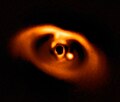
 EncycloReader
is supported by the
EncycloReader
is supported by the  KSF
KSF