Madelung equations
 From Wikipedia - Reading time: 11 min
| Part of a series of articles about |
| Quantum mechanics |
|---|
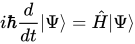
In theoretical physics, the Madelung equations, or the equations of quantum hydrodynamics, are Erwin Madelung's alternative formulation of the Schrödinger equation for a spinless non relativistic particle, written in terms of hydrodynamical variables, similar to the Navier–Stokes equations of fluid dynamics.[1] The derivation of the Madelung equations is similar to the de Broglie–Bohm formulation, which represents the Schrödinger equation as a quantum Hamilton–Jacobi equation. In both cases the hydrodynamic interpretations are not equivalent to Schrodinger's equation without the addition of a quantization condition.
Recently, the extension to the relativistic case with spin was done by having the Dirac equation written with hydrodynamic variables. In the relativistic case, the Hamilton–Jacobi equation is also the guidance equation,[2] which therefore does not have to be postulated.
History
[edit]In the fall of 1926, Erwin Madelung reformulated[3][4] Schrödinger's quantum equation in a more classical and visualizable form resembling hydrodynamics. His paper was one of numerous early attempts at different approaches to quantum mechanics, including those of Louis de Broglie and Earle Hesse Kennard.[5] The most influential of these theories was ultimately de Broglie's through the 1952 work of David Bohm[6] now called Bohmian mechanics.
In 1994 Timothy C. Wallstrom showed[7] that an additional ad hoc quantization condition must be added to the Madelung equations to reproduce Schrodinger's work. His analysis paralleled earlier work[8] by Takehiko Takabayashi on the hydrodynamic interpretation of Bohmian mechanics. The mathematical foundations of the Madelung equations continue to be a topic of research.[9]
Equations
[edit]The Madelung equations are quantum Euler equations:[citation needed]
![{\displaystyle {\begin{aligned}&\partial _{t}\rho _{m}+\nabla \cdot (\rho _{m}\mathbf {v} )=0,\\[4pt]&{\frac {d\mathbf {v} }{dt}}=\partial _{t}\mathbf {v} +\mathbf {v} \cdot \nabla \mathbf {v} =-{\frac {1}{m}}\mathbf {\nabla } (Q+V),\end{aligned}}}](https://wikimedia.org/api/rest_v1/media/math/render/svg/ff4f2f314a126ad8140896a2232bab8dbd4a805c)
where
- is the flow velocity, defined in terms of the phase of wavefunction below,
- is the mass density,
- is the Bohm quantum potential,
- V is the potential from the Schrödinger equation.



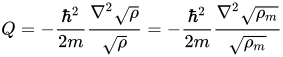
The Madelung equations answer the question whether obeys the continuity equations of hydrodynamics and, subsequently, what plays the role of the stress tensor.[10]

The circulation of the flow velocity field along any closed path obeys the auxiliary quantization condition for all integers n.[11][12]

Derivation
[edit]The Madelung equations are derived by first writing the wavefunction in polar form[13][14]

with and both real and


the associated probability density. Substituting this form into the probability current gives:

where the flow velocity is expressed as

However, the interpretation of as a "velocity" should not be taken too literally, because a simultaneous exact measurement of position and velocity would necessarily violate the uncertainty principle.[15]
Next, substituting the polar form into the Schrödinger equation
![{\displaystyle i\hbar {\frac {\partial }{\partial t}}\psi (\mathbf {x} ,t)=\left[{\frac {-\hbar ^{2}}{2m}}\nabla ^{2}+V(\mathbf {x} )\right]\psi (\mathbf {x} ,t),}](https://wikimedia.org/api/rest_v1/media/math/render/svg/13410555c5a652663b21955fd36bba323d8513be)
and performing the appropriate differentiations, dividing the equation by and separating the real and imaginary parts, one obtains a system of two coupled partial differential equations:

![{\displaystyle {\begin{aligned}&\partial _{t}R(\mathbf {x} ,t)+{\frac {1}{m}}\nabla R(\mathbf {x} ,t)\cdot \nabla S(\mathbf {x} ,t)+{\frac {1}{2m}}R(\mathbf {x} ,t)\Delta S(\mathbf {x} ,t)=0,\\&\partial _{t}S(\mathbf {x} ,t)+{\frac {1}{2m}}\left[\nabla S(\mathbf {x} ,t)\right]^{2}+V(\mathbf {x} )={\frac {\hbar ^{2}}{2m}}{\frac {\Delta R(\mathbf {x} ,t)}{R(\mathbf {x} ,t)}}.\end{aligned}}}](https://wikimedia.org/api/rest_v1/media/math/render/svg/5cbbc51679924188121e3ca4f54fd12c009452b7)
The first equation corresponds to the imaginary part of Schrödinger equation and can be interpreted as the continuity equation. The second equation corresponds to the real part and is also referred to as the quantum Hamilton-Jacobi equation.[16] Multiplying the first equation by and calculating the gradient of the second equation results in the Madelung equations:

![{\displaystyle {\begin{aligned}&\partial _{t}\rho (\mathbf {x} ,t)+\nabla \cdot \left[\rho (\mathbf {x} ,t)v(\mathbf {x} ,t)\right]=0,\\&{\frac {d}{dt}}\mathbf {v} (\mathbf {x} ,t)=\partial _{t}v(\mathbf {x} ,t)+\left[v(\mathbf {x} ,t)\cdot \nabla \right]v(\mathbf {x} ,t)=-{\frac {1}{m}}\nabla \left[V(\mathbf {x} )-{\frac {\hbar ^{2}}{2m}}{\frac {\Delta {\sqrt {\rho (\mathbf {x} ,t)}}}{\sqrt {\rho (\mathbf {x} ,t)}}}\right]=-{\frac {1}{m}}\nabla \left[V(\mathbf {x} )+Q(\mathbf {x} ,t)\right].\end{aligned}}}](https://wikimedia.org/api/rest_v1/media/math/render/svg/c93ecee55a0ef88e3ee3292e1e06103d881bec0b)
with quantum potential

Alternatively, the quantum Hamilton-Jacobi equation can be written in a form similar to the Cauchy momentum equation:

with an external force defined as

and a quantum pressure tensor[17]

The integral energy stored in the quantum pressure tensor is proportional to the Fisher information, which accounts for the quality of measurements. Thus, according to the Cramér–Rao bound, the Heisenberg uncertainty principle is equivalent to a standard inequality for the efficiency of measurements.[18][19]
Quantum energies
[edit]The thermodynamic definition of the quantum chemical potential
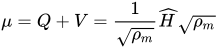
follows from the hydrostatic force balance above:
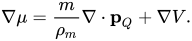
According to thermodynamics, at equilibrium the chemical potential is constant everywhere, which corresponds straightforwardly to the stationary Schrödinger equation. Therefore, the eigenvalues of the Schrödinger equation are free energies, which differ from the internal energies of the system. The particle internal energy is calculated as

and is related to the von Weizsäcker correction of density functional theory.[20][21]
See also
[edit]- Classical limit
- De Broglie–Bohm theory
- Magnetohydrodynamics
- Pilot wave theory
- Quantum potential
- Quantum hydrodynamics
- WKB approximation
Notes
[edit]- ^ Schönberg 1954, p. 103.
- ^ Fabbri, Luca (2025). "Madelung structure of the Dirac equation". J. Phys. A: Math. Theor. 58: 195301. arXiv:2505.05861. doi:10.1088/1751-8121/add2b0.
- ^ Madelung 1926.
- ^ Madelung 1927.
- ^ Kragh & Carazza 2000, p. 52.
- ^ Kragh & Carazza 2000, p. 53.
- ^ Wallstrom, Timothy C. (1994-03-01). "Inequivalence between the Schrödinger equation and the Madelung hydrodynamic equations". Physical Review A. 49 (3): 1613–1617. doi:10.1103/PhysRevA.49.1613.
- ^ Takabayasi, Takehiko (1952-08-01). "On the Formulation of Quantum Mechanics associated with Classical Pictures*". Progress of Theoretical Physics. 8 (2): 143–182. doi:10.1143/ptp/8.2.143. ISSN 0033-068X.
- ^ Reddiger, Maik; Poirier, Bill (2023-04-19). "Towards a mathematical theory of the Madelung equations: Takabayasi's quantization condition, quantum quasi-irrotationality, weak formulations, and the Wallstrom phenomenon". Journal of Physics A: Mathematical and Theoretical. 56 (19): 193001. arXiv:2207.11367. doi:10.1088/1751-8121/acc7db. ISSN 1751-8113.
- ^ Białynicki-Birula, Cieplak & Kaminski 1992, p. 88.
- ^ Białynicki-Birula, Cieplak & Kaminski 1992, pp. 90–91.
- ^ Wyatt 2005, §13.5.
- ^ Białynicki-Birula, Cieplak & Kaminski 1992, pp. 88–89.
- ^ Wyatt 2005, §2.2.
- ^ Sakurai & Napolitano 2020, p. 95.
- ^ Wyatt 2005, p. 48.
- ^ Tsekov 2011.
- ^ Reginatto 1998.
- ^ Heifetz & Cohen 2015.
- ^ von Weizsäcker 1935.
- ^ Tsekov 2009.
References
[edit]- Białynicki-Birula, Iwo; Cieplak, Marek; Kaminski, Jerzy (1992). Theory of Quanta. New York: Oxford University Press, USA. ISBN 0-19-507157-3.
- Heifetz, Eyal; Cohen, Eliahu (2015). "Toward a Thermo-hydrodynamic Like Description of Schrödinger Equation via the Madelung Formulation and Fisher Information". Foundations of Physics. 45 (11): 1514–1525. arXiv:1501.00944. doi:10.1007/s10701-015-9926-1. ISSN 0015-9018.
- Kragh, Helge; Carazza, Bruno (2000). "Classical Behavior of Macroscopic Bodies from Quantum Principles: Early Discussions". Archive for History of Exact Sciences. 55 (1): 43–56. doi:10.1007/s004070000018. ISSN 0003-9519.
- Madelung, E. (1926). "Eine anschauliche Deutung der Gleichung von Schrödinger". Die Naturwissenschaften (in German). 14 (45): 1004–1004. doi:10.1007/BF01504657. ISSN 0028-1042.
- Madelung, E. (1927). "Quantentheorie in hydrodynamischer Form". Zeitschrift für Physik (in German). 40 (3–4): 322–326. doi:10.1007/BF01400372. ISSN 1434-6001.
- Reginatto, Marcel (1998-09-01). "Derivation of the equations of nonrelativistic quantum mechanics using the principle of minimum Fisher information". Physical Review A. 58 (3): 1775–1778. doi:10.1103/PhysRevA.58.1775. ISSN 1050-2947.
- Sakurai, J. J.; Napolitano, Jim (2020). Modern Quantum Mechanics. Cambridge: Cambridge University Press. ISBN 978-1-108-47322-4.
- Schönberg, M. (1954). "On the hydrodynamical model of the quantum mechanics". Il Nuovo Cimento. 12 (1): 103–133. doi:10.1007/BF02820368. ISSN 0029-6341.
- Tsekov, Roumen (2011). "Quantum diffusion". Physica Scripta. 83 (3). arXiv:1001.1071. doi:10.1088/0031-8949/83/03/035004. ISSN 0031-8949.
- Tsekov, Roumen (2009). "Dissipative Time Dependent Density Functional Theory". International Journal of Theoretical Physics. 48 (9): 2660–2664. arXiv:0903.3644. doi:10.1007/s10773-009-0054-6. ISSN 0020-7748.
- von Weizsäcker, Carl F. (1935). "Zur Theorie der Kernmassen". Zeitschrift für Physik (in German). 96 (7–8): 431–58. doi:10.1007/bf01337700. ISSN 0044-3328.
- Wyatt, Robert E. (2005). Quantum Dynamics with Trajectories. New York: Springer Science & Business Media. ISBN 0-387-22964-7.
 EncycloReader
is supported by the
EncycloReader
is supported by the  KSF
KSF