Medicago littoralis
 From Wikipedia - Reading time: 6 min
| Medicago littoralis | |
|---|---|

| |
Scientific classification 
| |
| Kingdom: | Plantae |
| Clade: | Tracheophytes |
| Clade: | Angiosperms |
| Clade: | Eudicots |
| Clade: | Rosids |
| Order: | Fabales |
| Family: | Fabaceae |
| Subfamily: | Faboideae |
| Genus: | Medicago |
| Species: | M. littoralis
|
| Binomial name | |
| Medicago littoralis Lois
| |
| Synonyms | |
| |
Medicago littoralis is an annual plant species of the genus Medicago. Its native range encompasses the Mediterranean Basin, from Macaronesia to the Caucasus; it has been introduced elsewhere. It is useful as a forage for livestock. As a leguminous plant, it is capable of adding nitrogen to soils, through its symbiotic relationship with the bacterium Sinorhizobium meliloti, which enables nitrogen fixation. Common names include shore medick,[1] water medick,[2] coastal medick, and strand medick.[3]
Description
[edit]![[icon]](https://en.wikipedia.org/wiki/File:Wiki_letter_w_cropped.svg) | This section needs expansion. You can help by adding to it. (January 2024) |
Medicago littoralis is a prostrate or procumbent herb, occasionally with an ascending habit.[3][4]
Distribution and habitat
[edit]The species has been introduced to Belgium, the US states of Florida and New Jersey, Great Britain, the Netherlands, and to parts of Australia.[3] It is naturalised in South Australia and considered "alien" but non-invasive in Western Australia.[5][6]
Agricultural uses
[edit] | This section needs expansion. You can help by adding to it. (January 2024) |
'Seraph', is a specially bred variety of M. littoralis, selected for its resistance to powdery mildew and tolerance of sulfonylurea herbicide residues.[7]
Gallery
[edit]-

-

-
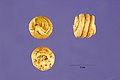 seed pods


References
[edit]- ^ BSBI List 2007 (xls). Botanical Society of Britain and Ireland. Archived from the original (xls) on 26 June 2015. Retrieved 17 October 2014.
- ^ USDA, NRCS (n.d.). "Medicago littoralis". The PLANTS Database (plants.usda.gov). Greensboro, North Carolina: National Plant Data Team. Retrieved 28 January 2016.
- ^ a b c "Medicago littoralis Rohde ex Loisel". Plants of the World Online. Kew Science. Retrieved 2 January 2024.
- ^ Howie, Jake; Lloyd, David (2009), Factsheet – Strand medic, Pastures Australia, Australian Wool Innovation (AWI), Grains Research and Development Corporation (GRDC), Meat and Livestock Australia (MLA), Rural Industries Research and Development Corporation (RIRDC), Dairy Australia – via Lucid Keys Central Archived 16 August 2022 at the Wayback Machine
- ^ "Medicago littoralis – Species Details". Atlas of Florida Plants.
- ^
- "Fact sheet for Medicago littoralis". The Electronic Flora of South Australia. The State Herbarium of South Australia: Government of South Australia.
- "Medicago littoralis Loisel. Strand Medic". Florabase—the Western Australian Flora. Western Australian Herbarium, Biodiversity and Conservation Science; Government of Western Australia.
- ^ Peck, David; South Australian Research and Development Institute (28 June 2021). "Strand Medic (Medicago littoralis) Variety: 'Seraph'". Plant Varieties Journal. 34 (1): 297–299. ISSN 1030-9748. (PDF direct download – 5 MB)
External links
[edit]- International Legume Database & Information Services
- "Environmental weed risk assessment" Department of Primary Industries, Government of Western Australia
- "Strand medic" Pasture species and varieties. Department of Primary Industries, Government of New South Wales
 | This Trifolieae-related article is a stub. You can help Wikipedia by expanding it. |
 EncycloReader
is supported by the
EncycloReader
is supported by the  KSF
KSF