Categories
Meketre
 From Wikipedia - Reading time: 3 min
| Meketre | |
|---|---|
| chancellor and high steward | |
 Model of a paddling boat with a canopy and chair on it from the Tomb of Meketre | |
| Dynasty | 11th Dynasty |
| Pharaoh | Mentuhotep II, Mentuhotep III, and Amenemhat I (possibly) |
| Burial | TT280 |
The ancient Egyptian official Meketre was chancellor and high steward during the reign of Mentuhotep II, Mentuhotep III and perhaps Amenemhat I, during the Middle Kingdom.
| |||||
| Meketre in hieroglyphs | |||||
|---|---|---|---|---|---|
| Era: Middle Kingdom (2055–1650 BC) | |||||


Meketre is first attested in a rock inscription in the Wadi Shatt el-Rigala, bearing the simple title sealer. The inscription is dated to year 41 of king Mentuhotep II. On reliefs from the mortuary temple of the same king in Deir el-Bahari Meketre bears the title of chancellor and was evidently promoted in the meantime, succeeding Kheti.[1] The same title was found on a statue in Meketre's tomb while on relief fragments in the tomb he held the main title of high steward. The tomb (TT280) is located in Sheikh Abd el-Qurna, part of the Theban Necropolis, and lies next to a large, unfinished royal tomb which was originally attributed to king Mentuhotep III and, after new research, to Amenemhat I. Therefore, Meketre most likely died under the latter king.[2]
Meketre's tomb TT280 contained several wooden replicas, representing the daily activities and life in Ancient Egypt, together with figurines of ships and cattle were, miniature buildings and gardens.[3] Selections of the replicas and other items from the tomb are on display at the Metropolitan Museum of Art in New York City.[4]
Gallery
[edit]-
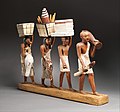 Procession of offerings
 -
 Fishing models from the Nile River


References
[edit]- ^ Wolfram Grajetzki: Die höchsten Beamten der ägyptischen Zentralverwaltung zur Zeit des Mittleren Reiches. Berlin 2000, 45
- ^ James P. Allen: The high officials of the early Middle Kingdom, in: Nigel Strudwick, John H. Taylor (editors): The Theban Necropolis, Past, Present and Future, London 2003, ISBN 0714122475, p. 19
- ^ [1] Archived 2018-02-16 at the Wayback Machine Amenemhat I
- ^ https://maps.metmuseum.org/galleries/fifth-ave/1/105 [dead link]
Bibliography
[edit]
- Dorothea Arnold: Amenemhet I and the Early Twelfth Dynasty at Thebes. In: Metropolitan Museum Journal. Vol. 26, 1991, ISSN 0077-8958, S. 5–48, online (PDF; 7,2 MB).
- H. E. Winlock: Models of Daily Life in Ancient Egypt. From the Tomb of Meket-Re at Thebes (= Publications of the Metropolitan Museum of Art. Egyptian Expedition. Vol. 18, ZDB-ID 86343-9). Published for the Metropolitan Museum of Art by Harvard University Press, Cambridge MA 1955.
 EncycloReader
is supported by the
EncycloReader
is supported by the  KSF
KSF