Mushroom-feeding Drosophila
 From Wikipedia - Reading time: 4 min
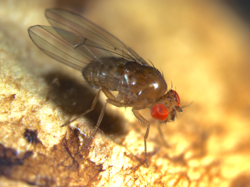
Mushroom-feeding Drosophila (mycophagous Drosophila) are a subset of Drosophila flies that have highly specific mushroom-breeding ecologies. Often these flies can tolerate toxic compounds from Amanita mushrooms.[1][2]
Species groups
[edit]- Drosophila testacea species group
- Drosophila quinaria species group
- Drosophila bizonata species group
- Some members of the Drosophila obscura species group
Sequenced genomes or transcriptomes
[edit]- Drosophila guttifera[3]
- Drosophila neotestacea[4]
- Drosophila innubila[5]
- Drosophila falleni[5]
- Drosophila phalerata[5]
Gallery
[edit]-
-
-

-
-
-
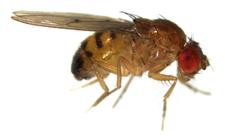
A dissected Drosophila falleni (Quinaria species group) infected with Howardula aoronymphium nematodes
References
[edit]- ^ Jaenike, John (1978). "Host Selection by Mycophagous Drosophila". Ecology. 50 (6): 1286–1288. doi:10.2307/1938245. JSTOR 1938245.
- ^ Tuno, Nobuko; Takahashi, Kazuo H.; Yamashita, Hiroshi; Osawa, Naoya; Tanaka, Chihiro (1 February 2007). "Tolerance of Drosophila Flies to Ibotenic Acid Poisons in Mushrooms". Journal of Chemical Ecology. 33 (2): 311–317. doi:10.1007/s10886-006-9228-3. PMID 17195114. S2CID 5625446.
- ^ Koshikawa, Shigeyuki; Giorgianni, Matt W.; Vaccaro, Kathy; Kassner, Victoria A.; Yoder, John H.; Werner, Thomas; Carroll, Sean B. (2015). "Gain of cis-regulatory activities underlies novel domains of wingless gene expression in Drosophila". Proceedings of the National Academy of Sciences. 112 (24): 7524–9. Bibcode:2015PNAS..112.7524K. doi:10.1073/pnas.1509022112. PMC 4475944. PMID 26034272.
- ^ Hamilton, P. T.; Leong, J. S.; Koop, B. F.; Perlman, S. J. (2014). "Transcriptional responses in a Drosophila defensive symbiosis". Molecular Ecology. 23 (6): 1558–70. doi:10.1111/mec.12603. PMID 24274471. S2CID 2964885.
- ^ a b c Hill, T.; Koseva, B. S.; Unckless, R. L. (2019). "genome of Drosophila innubila reveals lineage-specific patterns of selection in immune genes | Molecular Biology and Evolution | Oxford Academic". Molecular Biology and Evolution. 36 (7): 1405–1417. doi:10.1093/molbev/msz059. PMC 6573480. PMID 30865231.
External links
[edit]
 | This article related to members of the fly family Drosophilidae is a stub. You can help Wikipedia by expanding it. |
Licensed under CC BY-SA 3.0 | Source: https://en.wikipedia.org/wiki/Mushroom-feeding_Drosophila17 views | Status: cached on July 04 2025 07:32:58↧ Download as ZWI file
 EncycloReader
is supported by the
EncycloReader
is supported by the  KSF
KSF