Negativity (quantum mechanics)
 From Wikipedia - Reading time: 3 min
In quantum mechanics, negativity is a measure of quantum entanglement which is easy to compute. It is a measure deriving from the PPT criterion for separability.[1] It has been shown to be an entanglement monotone[2][3] and hence a proper measure of entanglement.
Definition
[edit]The negativity of a subsystem can be defined in terms of a density matrix as:


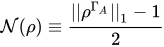
where:
- is the partial transpose of with respect to subsystem
- is the trace norm or the sum of the singular values of the operator .



An alternative and equivalent definition is the absolute sum of the negative eigenvalues of :
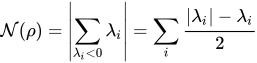
where are all of the eigenvalues.

Properties
[edit]- Is a convex function of :
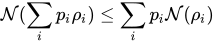
- Is an entanglement monotone:

where is an arbitrary LOCC operation over

Logarithmic negativity
[edit]The logarithmic negativity is an entanglement measure which is easily computable and an upper bound to the distillable entanglement.[4] It is defined as

where is the partial transpose operation and denotes the trace norm.


It relates to the negativity as follows:[1]

Properties
[edit]The logarithmic negativity
- can be zero even if the state is entangled (if the state is PPT entangled).
- does not reduce to the entropy of entanglement on pure states like most other entanglement measures.
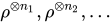
- is additive on tensor products:
- is not asymptotically continuous. That means that for a sequence of bipartite Hilbert spaces (typically with increasing dimension) we can have a sequence of quantum states which converges to (typically with increasing ) in the trace distance, but the sequence does not converge to .
- is an upper bound to the distillable entanglement






References
[edit]- This page uses material from Quantiki licensed under GNU Free Documentation License 1.2
- ^ a b K. Zyczkowski; P. Horodecki; A. Sanpera; M. Lewenstein (1998). "Volume of the set of separable states". Phys. Rev. A. 58 (2): 883–92. arXiv:quant-ph/9804024. Bibcode:1998PhRvA..58..883Z. doi:10.1103/PhysRevA.58.883. S2CID 119391103.
- ^ J. Eisert (2001). Entanglement in quantum information theory (Thesis). University of Potsdam. arXiv:quant-ph/0610253. Bibcode:2006PhDT........59E.
- ^ G. Vidal; R. F. Werner (2002). "A computable measure of entanglement". Phys. Rev. A. 65 (3): 032314. arXiv:quant-ph/0102117. Bibcode:2002PhRvA..65c2314V. doi:10.1103/PhysRevA.65.032314. S2CID 32356668.
- ^ M. B. Plenio (2005). "The logarithmic negativity: A full entanglement monotone that is not convex". Phys. Rev. Lett. 95 (9): 090503. arXiv:quant-ph/0505071. Bibcode:2005PhRvL..95i0503P. doi:10.1103/PhysRevLett.95.090503. PMID 16197196. S2CID 20691213.
 EncycloReader
is supported by the
EncycloReader
is supported by the  KSF
KSF