Categories
Northern royal flycatcher
 From Wikipedia - Reading time: 6 min
| Northern royal flycatcher | |
|---|---|
.jpg)
| |
Scientific classification 
| |
| Domain: | Eukaryota |
| Kingdom: | Animalia |
| Phylum: | Chordata |
| Clade: | Dinosauria |
| Class: | Aves |
| Order: | Passeriformes |
| Family: | Tityridae |
| Genus: | Onychorhynchus |
| Species: | O. mexicanus
|
| Binomial name | |
| Onychorhynchus mexicanus (Sclater, PL, 1857)
| |

| |
The northern royal flycatcher (Onychorhynchus mexicanus) is a passerine bird in the family Tityridae according to the International Ornithological Committee (IOC). It is found in Mexico, south through most of Central America, to northwestern Colombia and far western Venezuela.[2]
Taxonomy and systematics[edit]
The IOC considers the northern royal flycatcher and three other royal flycatcher taxa to be separate species and places them in the family Tityridae. The North and South American Classification Committees of the American Ornithological Society (AOS) consider the four to be subspecies of the widespread royal flycatcher (Onychorhynchus coronatus sensu lato). The AOS places O. coronatus in family Onychorhynchidae and includes four other flycatcher species in that family.[3][4]
The Clements taxonomy treats the northern royal flycatcher as part of the "tropical royal flycatcher" with the IOC's Amazonian royal flycatcher (O. coronatus) and Pacific royal flycatcher (O. occidentalis). Clements places the tropical royal flycatcher, the Atlantic royal flycatcher (O. swainsoni), and the sharpbill (O. cristatus) in family Oxyruncidae. IOC considers all of them to be in Tityridae.[5][2]
The northern royal flycatcher as defined by the IOC has two subspecies, the nominate Onychorhynchus mexicanus mexicanus and O. m. fraterculus.[2]
Description[edit]
The northern royal flycatcher is 16.5 to 18 cm (6.5 to 7.1 in) long and weighs 16.5 to 21 g (0.58 to 0.74 oz). It is brown above with small buffy spots on its wing-coverts and buffy yellow below. The rump and tail are buffy cinnamon. The bill is long and broad. It has an erectile fan-shaped crest that is orange-red in the male and yellow-orange in the female. The two subspecies are almost alike though fraterculus is somewhat paler than mexicanus.[6]
Distribution and habitat[edit]
The northern royal flycatcher occurs from southern Mexico into South America. However, it appears to have been extirpated from El Salvador. The nominate subspecies is found from Mexico to Panama and O. m. fraterculus in northern Colombia and northwestern Venezuela. In Mexico and northern Central America it ranges in elevation from sea level to 1,200 m (3,900 ft). On the Pacific side of Costa Rica it ranges up to 750 m (2,460 ft) but on the Caribbean side only to 400 m (1,300 ft).[6]
The northern royal flycatcher inhabits humid lowlands, both primary evergreen and second growth forests. It is a bird of the midstory, often along streams and in seasonally flooded várzea forest.[6]
Behavior[edit]
Feeding[edit]
All of the royal flycatchers are insectivorous.[6]
Breeding[edit]
The northern royal flycatcher breeds between April and July in Guatemala and between March and May or June in Costa Rica. The nest is long and narrow and is suspended from a branch or vine, usually above water. The clutch is two eggs; only the female incubates them and broods and feeds the nestlings.[6]
Vocalization[edit]
The northern royal flycatcher is usually inconspicuous and quiet. Its song is "a descending, slowing series of plaintive whistles" and its call a repeated "keeeyup or keee-yew". In this example [1] the song is faintly heard among the calls.[6]
Status[edit]
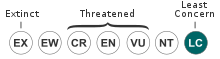
The IUCN has assessed the northern royal flycatcher as being of Least Concern.[1]
References[edit]
- ^ a b BirdLife International (2019). "Onychorhynchus mexicanus". IUCN Red List of Threatened Species. 2019: e.T22729313A140051796. doi:10.2305/IUCN.UK.2019-3.RLTS.T22729313A140051796.en. Retrieved 14 November 2021.
- ^ a b c Gill, Frank; Donsker, David; Rasmussen, Pamela, eds. (2023). "Cotingas, manakins, tityras, becards". IOC World Bird List (v 13.2). International Ornithologists' Union. Retrieved 31 July 2023.
- ^ Chesser, R. T., S. M. Billerman, K. J. Burns, C. Cicero, J. L. Dunn, B. E. Hern ndez-Ba os, R. A. Jim nez, A. W. Kratter, N. A. Mason, P. C. Rasmussen, J. V. Remsen, Jr., and K. Winker. 2023. Check-list of North American Birds (online). American Ornithological Society. https://checklist.americanornithology.org/taxa/
- ^ Remsen, J. V., Jr., J. I. Areta, E. Bonaccorso, S. Claramunt, G. Del-Rio, A. Jaramillo, D. F. Lane, M. B. Robbins, F. G. Stiles, and K. J. Zimmer. Version 28 September 2023. A classification of the bird species of South America. American Ornithological Society. https://www.museum.lsu.edu/~Remsen/SACCBaseline.htm retrieved October 20, 2023
- ^ Clements, J. F., P.C. Rasmussen, T. S. Schulenberg, M. J. Iliff, T. A. Fredericks, J. A. Gerbracht, D. Lepage, A. Spencer, S. M. Billerman, B. L. Sullivan, and C. L. Wood. 2023. The eBird/Clements checklist of birds of the world: v2023. Downloaded from https://www.birds.cornell.edu/clementschecklist/download/ retrieved October 28, 2023
- ^ a b c d e f Kirwan, G. M., R. Sample, B. Shackelford, R. Kannan, and P. F. D. Boesman (2023). Tropical Royal Flycatcher (Onychorhynchus coronatus), version 2.0. In Birds of the World (T. S. Schulenberg and B. K. Keeney, Editors). Cornell Lab of Ornithology, Ithaca, NY, USA. https://doi.org/10.2173/bow.royfly1.02 retrieved November 5, 2023
Further reading[edit]
- Skutch, Alexander F. (1960). "Royal flycatcher" (PDF). Life Histories of Central American Birds II. Pacific Coast Avifauna, Number 34. Berkeley, California: Cooper Ornithological Society. pp. 516–533.
 EncycloReader
is supported by the
EncycloReader
is supported by the  KSF
KSF