Pentagonal bipyramid
 From Wikipedia - Reading time: 7 min
 | This article or section is in a state of significant expansion or restructuring. You are welcome to assist in its construction by editing it as well. If this article or section has not been edited in several days, please remove this template. If you are the editor who added this template and you are actively editing, please be sure to replace this template with {{in use}} during the active editing session. Click on the link for template parameters to use.
This article was last edited by Dedhert.Jr (talk | contribs) 0 seconds ago. (Update timer) |
| Pentagonal bipyramid | |
|---|---|
 | |
| Type | Bipyramid, Johnson J12 – J13 – J14 |
| Faces | 10 triangles |
| Edges | 15 |
| Vertices | 7 |
| Vertex configuration | |
| Symmetry group | |
| Dual polyhedron | pentagonal prism |
| Properties | convex, face-transitive |
| Net | |
 | |



In geometry, the pentagonal bipyramid (or dipyramid) is third of the infinite set of face-transitive bipyramids, and the 13th Johnson solid (J13). Each bipyramid is the dual of a uniform prism.
Although it is face-transitive, it is not a Platonic solid because some vertices have four faces meeting and others have five faces.
Construction[edit]
Like other bipyramids, the pentagonal bipyramid can be constructed by attaching the base of two pentagonal pyramids.[1] These pyramids cover their pentagonal base, such that the resulting polyhedron has 10 triangles as its faces.[2] The pentagonal bipyramid is said to be right if the pyramids are symmetrically regular and both of their apices are on the line passing through the base's center; otherwise, it is oblique. If the pyramids are regular, then all edges of the triangular bipyramid are equal in length, making up the faces equilateral triangles. A polyhedron with only equilateral triangles as faces is called a deltahedron.[3] There are only eight different convex deltahedra, one of which is the pentagonal bipyramid with regular faces. More generally, the convex polyhedron in which all faces are regular is the Johnson solid, and every convex deltahedra is a Johnson solid. The pentagonal bipyramid with the regular faces is among numbered the Johnson solids as , the thirteenth Johnson solid.[4]

Properties[edit]
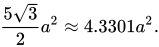
A pentagonal bipyramid's surface area is 10 times that of all triangles. In the case of edge length , its surface area is:[2]


The pentagonal bipyramid has three-dimensional symmetry group of dihedral group of order 20: the appearance is symmetrical by rotating around the axis of symmetry that passing through apices and base's center vertically, and it has mirror symmetry relative to any bisector of the base; it is also symmetrical by reflecting it across a horizontal plane. The dihedral angle of a pentagonal bipyramid with regular faces can be calculated by adding the angle of pentagonal pyramids. The dihedral angle of a pentagonal pyramid between two adjacent triangles is approximately , and that between the triangular face and the base is . Therefore, the dihedral angle of a pentagonal pyramid with regular faces between two adjacent triangular faces, on the edge where two pyramids are attached, is .[5]


The pentagonal dipyramid is 4-connected, meaning that it takes the removal of four vertices to disconnect the remaining vertices. It is one of only four 4-connected simplicial well-covered polyhedra, meaning that all of the maximal independent sets of its vertices have the same size. The other three polyhedra with this property are the regular octahedron, the snub disphenoid, and an irregular polyhedron with 12 vertices and 20 triangular faces.[6]
The dual polyhedron of a pentagonal bipyramid is the pentagonal prism. This prism has 7 faces: 2 pentagonal faces are the base, and the rest are 5 rectangular faces. More generally, the dual polyhedron of every bipyramid is the prism.
See also[edit]
References[edit]
- ^ Rajwade, A. R. (2001), Convex Polyhedra with Regularity Conditions and Hilbert's Third Problem, Texts and Readings in Mathematics, Hindustan Book Agency, p. 84, doi:10.1007/978-93-86279-06-4, ISBN 978-93-86279-06-4.
- ^ a b c Berman, Martin (1971), "Regular-faced convex polyhedra", Journal of the Franklin Institute, 291 (5): 329–352, doi:10.1016/0016-0032(71)90071-8, MR 0290245.
- ^ Trigg, Charles W. (1978), "An infinite class of deltahedra", Mathematics Magazine, 51 (1): 55–57, doi:10.1080/0025570X.1978.11976675, JSTOR 2689647, MR 1572246.
- ^ Uehara, Ryuhei (2020), Introduction to Computational Origami: The World of New Computational Geometry, Springer, doi:10.1007/978-981-15-4470-5, ISBN 978-981-15-4470-5, S2CID 220150682.
- ^ Johnson, Norman W. (1966), "Convex polyhedra with regular faces", Canadian Journal of Mathematics, 18: 169–200, doi:10.4153/cjm-1966-021-8, MR 0185507, S2CID 122006114, Zbl 0132.14603.
- ^ Finbow, Arthur S.; Hartnell, Bert L.; Nowakowski, Richard J.; Plummer, Michael D. (2010), "On well-covered triangulations. III", Discrete Applied Mathematics, 158 (8): 894–912, doi:10.1016/j.dam.2009.08.002, MR 2602814.
External links[edit]
- Weisstein, Eric W., "Pentagonal dipyramid" ("Dipyramid") at MathWorld.
- Conway Notation for Polyhedra Try: dP5
 EncycloReader
is supported by the
EncycloReader
is supported by the  KSF
KSF