Presheaf (category theory)
 From Wikipedia - Reading time: 6 min
In category theory, a branch of mathematics, a presheaf on a category is a functor . If is the poset of open sets in a topological space, interpreted as a category, then one recovers the usual notion of presheaf on a topological space.


A morphism of presheaves is defined to be a natural transformation of functors. This makes the collection of all presheaves on into a category, and is an example of a functor category. It is often written as and it is called the category of presheaves on . A functor into is sometimes called a profunctor.


A presheaf that is naturally isomorphic to the contravariant hom-functor Hom(–, A) for some object A of C is called a representable presheaf.
Some authors refer to a functor as a -valued presheaf.[1]


Examples
[edit]- A simplicial set is a Set-valued presheaf on the simplex category .
- A directed multigraph is a presheaf on the category with two elements and two parallel morphisms between them i.e. .
- An arrow category is a presheaf on the category with two elements and one morphism between them. i.e. .
- A right group action is a presheaf on the category created from a group , i.e. a category with one element and invertible morphisms.


Properties
[edit]- When is a small category, the functor category is cartesian closed.
- The poset of subobjects of form a Heyting algebra, whenever is an object of for small .
- For any morphism of , the pullback functor of subobjects has a right adjoint, denoted , and a left adjoint, . These are the universal and existential quantifiers.
- A locally small category embeds fully and faithfully into the category of set-valued presheaves via the Yoneda embedding which to every object of associates the hom functor .
- The category admits small limits and small colimits.[2] See limit and colimit of presheaves for further discussion.
- The density theorem states that every presheaf is a colimit of representable presheaves; in fact, is the colimit completion of (see #Universal property below.)





Universal property
[edit]The construction is called the colimit completion of C because of the following universal property:

Proposition[3]—Let C, D be categories and assume D admits small colimits. Then each functor factorizes as

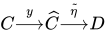
where y is the Yoneda embedding and is a, unique up to isomorphism, colimit-preserving functor called the Yoneda extension of .


Proof: Given a presheaf F, by the density theorem, we can write where are objects in C. Then let which exists by assumption. Since is functorial, this determines the functor . Succinctly, is the left Kan extension of along y; hence, the name "Yoneda extension". To see commutes with small colimits, we show is a left-adjoint (to some functor). Define to be the functor given by: for each object M in D and each object U in C,


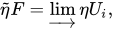




Then, for each object M in D, since by the Yoneda lemma, we have:


which is to say is a left-adjoint to .


The proposition yields several corollaries. For example, the proposition implies that the construction is functorial: i.e., each functor determines the functor .


Variants
[edit]A presheaf of spaces on an ∞-category C is a contravariant functor from C to the ∞-category of spaces (for example, the nerve of the category of CW-complexes.)[4] It is an ∞-category version of a presheaf of sets, as a "set" is replaced by a "space". The notion is used, among other things, in the ∞-category formulation of Yoneda's lemma that says: is fully faithful (here C can be just a simplicial set.)[5]

A copresheaf of a category C is a presheaf of Cop. In other words, it is a covariant functor from C to Set.[6]
See also
[edit]- Topos
- Category of elements
- Simplicial presheaf (this notion is obtained by replacing "set" with "simplicial set")
- Presheaf with transfers
Notes
[edit]- ^ co-Yoneda lemma at the nLab
- ^ Kashiwara & Schapira 2005, Corollary 2.4.3.
- ^ Kashiwara & Schapira 2005, Proposition 2.7.1.
- ^ Lurie, Definition 1.2.16.1.
- ^ Lurie, Proposition 5.1.3.1.
- ^ "copresheaf". nLab. Retrieved 4 September 2024.
References
[edit]- Kashiwara, Masaki; Schapira, Pierre (2005). Categories and sheaves. Grundlehren der mathematischen Wissenschaften. Vol. 332. Springer. ISBN 978-3-540-27950-1.
- Lurie, J. Higher Topos Theory.
- Mac Lane, Saunders; Moerdijk, Ieke (1992). Sheaves in Geometry and Logic. Springer. ISBN 0-387-97710-4.
- Awodey, Steve (2006). Category Theory. doi:10.1093/acprof:oso/9780198568612.001.0001. ISBN 978-0-19-856861-2.
Further reading
[edit]- Presheaf at the nLab
- category of presheaves at the nLab
- Free cocompletion at the nLab
- Daniel Dugger, Sheaves and Homotopy Theory, the pdf file provided by nlab.
 EncycloReader
is supported by the
EncycloReader
is supported by the  KSF
KSF