Categories
Prunus gracilis
 From Wikipedia - Reading time: 5 min
| Prunus gracilis | |
|---|---|

| |
| 1913 illustration[1] | |
Scientific classification 
| |
| Kingdom: | Plantae |
| Clade: | Tracheophytes |
| Clade: | Angiosperms |
| Clade: | Eudicots |
| Clade: | Rosids |
| Order: | Rosales |
| Family: | Rosaceae |
| Genus: | Prunus |
| Subgenus: | Prunus subg. Prunus |
| Section: | Prunus sect. Prunocerasus |
| Species: | P. gracilis
|
| Binomial name | |
| Prunus gracilis | |
| Synonyms | |
|
Prunus normalis Small | |

Prunus gracilis, called the Oklahoma plum,[3][2] sour plum, and sand plum, is a species of Prunus native to the south-central United States.
Description
[edit]Prunus gracilis grows up to 1.8 metres (6 feet) tall, has five-petaled leaves, and fruits ripen June–August.[4] It grows in clusters and thickets.[5] It is hermaphroditic and pollinated by insects.[2]
Taxonomy
[edit]The specific epithet Gracilis refers to 'slender branches'.[6]
Distribution and habitat
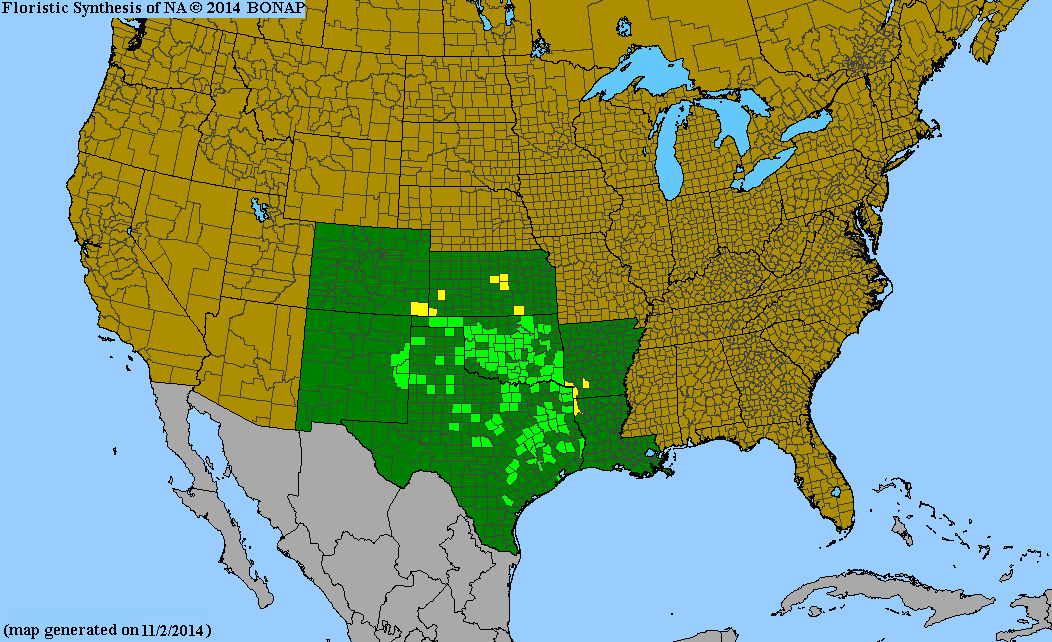
[edit]It is natively found in various states of the United States, including Alabama, southwestern Arkansas, southeastern Colorado, Kansas, northwestern Louisiana, eastern New Mexico, Oklahoma, and Texas.[2][7][8][9]
It is found growing in fence rows, open woodlands, woodlands edge, forest openings, hillsides, slopes, sandy roadsides, upland thickets and waste places. It is normally found at 100–1,300 m (330–4,270 ft) above sea level.[2]
Uses
[edit]Its red fruits are considered poor for eating, but Native Americans dried them for consumption during winter.[10]
References
[edit]- ^ illustration published in Britton, N.L., and A. Brown. 1913. An illustrated flora of the northern United States, Canada and the British Possessions. Vol. 2: 323.
- ^ a b c d e Pollard, R.P.; Rhodes, L.; Maxted, N. (2016). "Prunus gracilis". IUCN Red List of Threatened Species. 2016: e.T50403541A50673957. doi:10.2305/IUCN.UK.2016-2.RLTS.T50403541A50673957.en. Retrieved 12 November 2021.
- ^ NRCS. "Prunus gracilis". PLANTS Database. United States Department of Agriculture (USDA). Retrieved 14 October 2015.
- ^ "Prunus gracilis". Lady Bird Johnson Wildflower Center. Retrieved December 30, 2014.
- ^ Wright, William Franklin (1915). Native American species of Prunus. Washington, DC: United States Department of Agriculture. p. 58.
- ^ "Prunus gracilis Engelm. & Gray". Oklahoma Biological Survey, University of Oklahoma. Retrieved December 30, 2014.
- ^ "Prunus gracilis". Germplasm Resources Information Network. Agricultural Research Service, United States Department of Agriculture. Retrieved December 30, 2014.
- ^ Biota of North America Program 2014 county distribution map
- ^ "USDA Plants Database".
- ^ "Oklahoma Plum, Sour Plum, Sand Plum". Texas A&M University. Retrieved December 30, 2014.
External links
[edit]- "Prunus gracilis". Plants for a Future.
- photo of herbarium specimen at Missouri Botanical Garden, collected in Republic of Texas in 1844
 Media related to Prunus gracilis at Wikimedia Commons
 Data related to Prunus gracilis at Wikispecies


 | This Prunus article is a stub. You can help Wikipedia by expanding it. |
 EncycloReader
is supported by the
EncycloReader
is supported by the  KSF
KSF