-
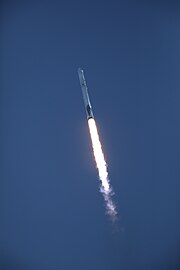 Launch of CRS-13
 -
 Falcon 9 landing at LZ-1
 -
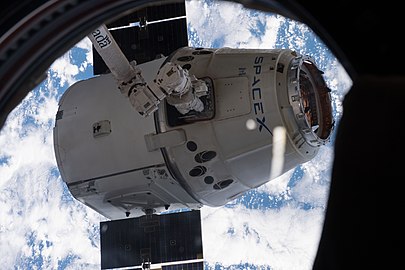 Dragon grappled by the ISS
Categories
SpaceX CRS-13
 From Wikipedia - Reading time: 12 min
 CRS-13 Dragon attached to the ISS | |
| Names | SpX-13 |
|---|---|
| Mission type | ISS resupply |
| Operator | SpaceX |
| COSPAR ID | 2017-080A |
| SATCAT no. | 43060 |
| Mission duration | 29 days |
| Spacecraft properties | |
| Spacecraft | Dragon 1 C108 |
| Spacecraft type | Dragon 1 |
| Manufacturer | SpaceX |
| Dry mass | 4,200 kg (9,300 lb) |
| Dimensions | Height: 6.1 m (20 ft) Diameter: 3.7 m (12 ft) |
| Start of mission | |
| Launch date | 15 December 2017, 15:36:09 UTC[1] |
| Rocket | Falcon 9 Full Thrust (B1035)[2] |
| Launch site | Cape Canaveral, SLC-40[2] |
| Contractor | SpaceX |
| End of mission | |
| Disposal | Recovered |
| Landing date | 13 January 2018, 15:37 UTC[3] |
| Landing site | Pacific Ocean off Baja California |
| Orbital parameters | |
| Reference system | Geocentric |
| Regime | Low Earth |
| Inclination | 51.6° |
| Berthing at ISS | |
| Berthing port | Harmony nadir |
| RMS capture | 17 December 2017, 10:57 UTC[4] |
| Berthing date | 17 December 2017, 13:26 UTC[5] |
| Unberthing date | 12 January 2018, 10:47 UTC[6] |
| RMS release | 13 January 2018, 09:58 UTC[7] |
| Time berthed | 25 days, 21 hours, 21 minutes |
| Cargo | |
| Mass | 2,205 kg (4,861 lb)[8] |
| Pressurised | 1,560 kg (3,439 lb)[8] |
| Unpressurised | 645 kg (1,422 lb)[8] |
 NASA SpX-13 mission patch | |
SpaceX CRS-13, also known as SpX-13, was a Commercial Resupply Service mission to the International Space Station launched on 15 December 2017.[1] The mission was contracted by NASA and is flown by SpaceX. It was the second mission to successfully reuse a Dragon capsule, previously flown on CRS-6.[8][9] The first stage of the Falcon 9 Full Thrust rocket was the previously flown, "flight-proven" core from CRS-11.[8][10] The first stage returned to land at Cape Canaveral's Landing Zone 1 after separation of the first and second stage.[11]
Mission overview
[edit].jpg)
In early 2015, NASA awarded a contract extension to SpaceX for three CRS additional missions (CRS-13 to CRS-15).[12] In June 2016, a NASA Inspector General report had this mission manifested for September 2017.[13] The flight was then delayed from 13 September, 1 November, 4 December, 12 December, and 13 December 2017.[14] SpaceX pushed off the launch to 15 December due to the detection of particulates in the second stage fuel system, taking the time to completely flush out the fuel and liquid oxygen tanks on the first and second stages as a precautionary measure.[15][16]
The CRS-13 mission launched aboard a Falcon 9 Full Thrust rocket on 15 December 2017 at 15:36:09 UTC[1] from the Cape Canaveral Air Force Station Space Launch Complex 40.[2] The Dragon spacecraft rendezvoused with the International Space Station on 17 December 2017; the vehicle was captured by the Canadarm2 at 10:57 UTC[4] and was berthed to the Harmony module's nadir docking port at 13:26 UTC.[5] Dragon spent just under a month at the ISS: it was unberthed on 12 January 2018 at 10:47 UTC and was released from Canadarm2 on 13 January 2018 at 09:58 UTC.[6][7] The spacecraft deorbited a few hours later, splashing down in the Pacific Ocean at 15:37 UTC carrying 1,850 kg (4,078 lb) of equipment and science experiments.[3]
Payload
[edit]NASA has contracted for the CRS-13 mission from SpaceX and therefore determines the primary payload, date/time of launch, and orbital parameters for the Dragon space capsule. CRS-13 carried a total of 2,205 kg (4,861 lb) of material into orbit. This includes 1,560 kg (3,439 lb) of pressurised cargo with packaging bound for the International Space Station, and 645 kg (1,422 lb) of unpressurised cargo composed of two external station experiments: the Total and Spectral Solar Irradiance Sensor (TSIS) and the Space Debris Sensor (SDS).[8]
The following is a breakdown of cargo bound for the ISS:[8]
- Science investigations: 711 kg (1,567 lb)
- Crew supplies: 490 kg (1,080 lb)
- Vehicle hardware: 189 kg (417 lb)
- Spacewalk equipment: 165 kg (364 lb)
- Computer resources: 5 kg (11 lb)
- External payloads: 645 kg (1,422 lb)
- Total and Spectral Solar Irradiance Sensor (TSIS)
- Space Debris Sensor (SDS)
Gallery
[edit]SpaceX CRS-13
.jpg)
.jpg)
.jpg)
See also
[edit]- Uncrewed spaceflights to the International Space Station
- List of Falcon 9 and Falcon Heavy launches
- 2017 in spaceflight
References
[edit]- ^ a b c Clark, Stephen (15 December 2017). "SpaceX's 50th Falcon rocket launch kicks off station resupply mission". Spaceflight Now. Retrieved 17 December 2017.
- ^ a b c Graham, William (15 December 2017). "Flight proven Falcon 9 launches previously flown Dragon to ISS". NASASpaceFlight.com. Retrieved 17 December 2017.
- ^ a b Clark, Stephen (13 January 2018). "Commercial cargo craft splashes down in Pacific Ocean after station resupply run". Spaceflight Now. Retrieved 14 January 2018.
- ^ a b Garcia, Mark (17 December 2017). "Astronauts Capture Dragon Loaded With New Science". NASA. Retrieved 17 December 2017.
- ^ a b Garcia, Mark (17 December 2017). "Dragon Attached to Station for Month of Cargo Transfers". NASA. Retrieved 17 December 2017.
- ^ a b Garcia, Mark (12 January 2018). "Dragon Cargo Craft Prepped for Saturday Morning Release". NASA. Retrieved 14 January 2018.
- ^ a b Garcia, Mark (13 January 2018). "Dragon Departs Station and Heads Back to Earth for Splashdown". NASA. Retrieved 14 January 2018.
- ^ a b c d e f g "SpaceX CRS-13 Mission Overview" (PDF). NASA. Retrieved 3 June 2017.
- ^ Clark, Stephen (6 December 2017). "Test-firing at repaired launch pad clears way for SpaceX cargo flight next week". Spaceflight Now. Retrieved 7 December 2017.
- ^ Fernholz, Tim (29 November 2017). "NASA will use one of Elon Musk's lightly-used rockets for the first time". Quartz. Retrieved 7 December 2017.
- ^ Grush, Loren (15 December 2017). "SpaceX launches and lands its first used rocket for NASA". The Verge. Retrieved 15 December 2017.
- ^ de Selding, Peter B. (24 February 2016). "SpaceX wins 5 new space station cargo missions in NASA contract estimated at $700 million". Space News. Retrieved 24 February 2016.
- ^ NASA Office of Inspector General (28 June 2016). NASA's Response to SpaceX's June 2015 Launch Failure: Impacts on Commercial Resupply of the International Space Station (PDF) (Report). NASA Office of Inspector General. p. 13. Retrieved 18 July 2016.
- ^ Clark, Stephen (12 December 2017). "Launch Schedule". Spaceflight Now. Archived from the original on 13 December 2017.
- ^ Clark, Stephen (13 December 2017). "SpaceX cargo launch slips to Friday, allowing for additional rocket inspections". Spaceflight Now. Retrieved 17 December 2017.
- ^ SpaceX/Dragon CRS-13 Post Launch Briefing. YouTube.com. NASA. 15 December 2017. Event occurs at 6:19. Retrieved 17 December 2016.
External links
[edit] Media related to SpaceX CRS-13 at Wikimedia Commons
- Dragon website at SpaceX.com
- Commercial Resupply Services at NASA.gov

| Spacecraft |   | ||||||
|---|---|---|---|---|---|---|---|
| Hardware | |||||||
| Missions |
| ||||||
| |||||||
| ||
| 2000–2004 |  | |
| 2005–2009 | ||
| 2010–2014 | ||
| 2015–2019 | ||
| 2020–2024 | ||
| Future | ||
| Spacecraft | ||
| ||

Licensed under CC BY-SA 3.0 | Source: https://en.wikipedia.org/wiki/SpaceX_CRS-1314 views | Status: cached on January 27 2025 21:00:06↧ Download as ZWI file
 EncycloReader
is supported by the
EncycloReader
is supported by the  KSF
KSF