Categories
Tokyu 2020 series
 From Wikipedia - Reading time: 14 min
 | This article needs additional citations for verification. (April 2022) |
| Tokyu 2020/6020/3020 series | |
|---|---|
 A Den-en-toshi Line 2020 series set in October 2021 | |
| Manufacturer | J-TREC |
| Designer | Tanseisha |
| Built at |
|
| Family name | Sustina S24 series |
| Operators |  Tōkyū Railways Tōkyū Railways |
| Specifications | |
| Car body construction | Stainless steel |
| Car length |
|
| Width | 2,788 mm (9 ft 2 in) |
| Height | 4,046 mm (13 ft 3 in) (not including pantograph) |
| Floor height | 1,130 mm (3 ft 8 in) |
| Doors | 4 pairs per side |
| Maximum speed | 120 km/h (75 mph) (design) |
| Traction system | Variable frequency (SiC-MOSFET) |
| Acceleration | 3.3 km/(h⋅s) (2.1 mph/s) |
| Deceleration |
|
| Electric system(s) | 1,500 V DC (overhead catenary) |
| Current collector(s) | Pantograph |
| Bogies |
|
| Track gauge | 1,067 mm (3 ft 6 in) |
| Notes/references | |
| Details in this infobox apply to the 2020 series and its derivatives. Type-specific details can be found in their respective sections.[1][2] | |
The Tokyu 2020 series (東急2020系, Tōkyū 2020-kei) is an electric multiple unit (EMU) commuter train type built by J-TREC and used by the Japanese private railway operator Tokyu Corporation in the Tokyo area since March 2018.[3] The 2020 series is used primarily on the Tokyu Den-en-toshi Line while its derivatives, the 3020 series (3020系, 3020-kei) and the 6020 series (6020系, 6020-kei), are used mainly on the Tokyu Meguro Line[4] and Tokyu Oimachi Line[5] respectively.
Design
[edit]The 2020 series trains were built by Japan Transport Engineering Company (J-TREC) as part of its "Sustina S24 Series" family of 20-metre long four-door stainless steel cars.[6] The styling of the trains was overseen by Tanseisha, a company involved in designing commercial buildings along the Tokyu route.[3]
The classification "2020 series" for the trains was chosen to mark the year 2020 in which the Tokyo Olympics were scheduled to be held and in which Tokyu celebrated its 100th anniversary.[3]
Variants
[edit]- 2020 series: 10-car sets used on the Tokyu Den-en-toshi Line since March 2018
- 3020 series: 8-car (originally 6-car) sets used on the Tokyu Meguro Line since November 2019
- 6020 series: 5- and 7-car sets used on the Tokyu Oimachi Line since March 2018
2020 series
[edit]| Tokyu 2020 series | |
|---|---|
 The first set, 2121, in October 2018 | |
| In service | March 2018 – present |
| Built at |
|
| Replaced |
|
| Constructed | 2017–2022 |
| Entered service | 28 March 2018 |
| Number built | 300 vehicles (30 sets) |
| Number in service | 300 vehicles (30 sets) |
| Formation | 10 cars per trainset |
| Fleet numbers | 2121–2150 |
| Depots | Nagatsuta |
| Lines served | |
Details of the 2020 series were officially announced on 17 March 2017.[3] Three ten-car sets (30 vehicles) are scheduled to be delivered during fiscal 2017, entering service in spring 2018,[1] with further sets introduced over the following years.[3] The first trainset, 2121, was delivered from the J-TREC factory in Yokohama in late November 2017, and shown off to the media on 30 November 2017.[7] The second trainset, 2122, was delivered from the J-TREC factory in Niitsu, Niigata, in February 2018.[8]
The first sets entered service on 28 March 2018.[9]
Interior
[edit]Passenger accommodation consists of high-back longitudinal seats.[3] In addition to passenger information screens placed above the doorways and car ends, LCD screens are also located above the seats.[3] Security cameras are installed in the cars.[3]
-
 2020 series interior view

Formation
[edit]The trains are formed as follows, with five motored ("M") cars and five non-powered trailer ("T") cars, and car 1 at the Shibuya end.[1]
← Shibuya
| ||||||||||
| Car No. | 1 | 2 | 3 | 4 | 5 | 6 | 7 | 8 | 9 | 10 |
| Designation | KuHa 2120 (Tc2) |
DeHa 2220 (M2) |
DeHa 2320 (M1) |
SaHa 2420 (T3) |
SaHa 2520 (T2) |
DeHa 2620 (M3) |
SaHa 2720 (T1) |
DeHa 2820 (M2) |
DeHa 2920 (M1) |
KuHa 2020 (Tc1) |
| Weight (t) | 31.5 | 33.5 | 33.5 | 27.8 | 27.5 | 32.0 | 27.5 | 33.5 | 33.5 | 31.4 |
| Capacity (total/seated) | 143/45 | 155/48 | 155/51 | 155/51 | 155/51 | 155/51 | 155/51 | 155/51 | 155/51 | 143/45 |
Cars 3 and 9 each have two single-arm pantographs, and car 6 has one.[1]
Build histories
[edit]The manufacturers and delivery dates for the fleet are as shown below.
| Set No. | Manufacturer | Date delivered | Notes |
|---|---|---|---|
| 2121 | J-TREC, Yokohama | November 2017[7] | |
| 2122 | J-TREC, Niitsu | February 2018[8] | |
| 2123 | February 2018[10] | ||
| 2124 | 6 June 2018 | ||
| 2125 | 27 June 2018 | ||
| 2126 | 30 October 2018 | Car 3 is a former 6020 series car.[11] | |
| 2127 | 5 December 2018 | ||
| 2128 | 6 March 2019[12] | ||
| 2129 | 27 March 2019 | ||
| 2130 | 21 August 2019 | ||
| 2131 | J-TREC, Yokohama | 31 October 2019 | |
| 2132 | J-TREC, Niitsu | 17 January 2020 | |
| 2133 | 14 February 2020 | ||
| 2134 | 4 March 2020 | ||
| 2135 | 25 March 2020 | ||
| 2136 | 15 April 2020 | ||
| 2137 | 13 May 2020 | ||
| 2138 | J-TREC, Yokohama | 17 September 2020 | |
| 2139 | J-TREC, Niitsu | 6 August 2020 | |
| 2140 | 2 September 2020 | ||
| 2141 | 9 December 2020 | ||
| 2142 | 7 January 2021 | ||
| 2143 | 18 March 2021 | ||
| 2144 | 15 April 2021 | ||
| 2145 | 23 May 2021 | ||
| 2146 | 11 June 2021 | ||
| 2147 | 15 July 2021 | ||
| 2148 | 26 August 2021 | ||
| 2149 | 22 December 2021 | ||
| 2150 | May 2022 | Final set[13] |
3020 series
[edit]| Tokyu 3020 series | |
|---|---|
 A 3020 series train on the Toei Mita Line approaching Hasune in November 2022 | |
| Built at | Yokohama |
| Constructed | 2019 |
| Entered service | 22 November 2019 |
| Number built | 24 vehicles |
| Number in service | 24 vehicles (3 sets) |
| Formation | 8 (originally 6) cars per trainset |
| Fleet numbers | 3121–3123 |
| Lines served | |

On 26 March 2019, Tokyu Corporation announced the introduction of new 3020 series trains on their Meguro Line.[4] The first set of eight cars was delivered in April 2019.[14] A second set of eight cars was transferred from J-TREC in Yokohama to Nagatsuta in May 2019.[15] Trial runs on the Den-en-toshi Line began in June 2019.[16]
The first 3020 series set entered revenue service on 22 November 2019.[17][better source needed] Originally operating as 6-car sets, the fleet began operating as 8-car sets in April 2022.[18]
Service commenced on the Tōkyū Shin-Yokohama Line in March 2023. As of June 2023, the 3020 series lacks equipment needed in order to through run on the Sōtetsu Shin-Yokohama Line and associated through services. Tokyu plans to install the required equipment to enable Sotetsu through service in the near future.[19] Set 3121 had officially entered service along the Sotetsu network on 26 September 2023, over a half year later of the opening of the Sōtetsu-Tokyu Link Line.
Interior
[edit]Passenger accommodation consists of high-back seating.[4] The trains are also fitted with security cameras and air purifiers.[20]
-
 Interior view
 -
 Wheelchair space (right)
 -
 Passenger information displays


Formation
[edit]The trains are operated as eight-car sets. They were originally built as such, but were initially operated as six-car sets, with two cars per set stored until 2022, when platform doors were extended to fit 8-car trains as part of Tokyu Corporation's strategy to cope with high demand on the Meguro Line and for the opening of the Sōtetsu Tōkyū Link Line.[4][21] All three trainsets are distinguished with an "8-Cars" sticker located on the front window of the first and last cars, and are formed as follows:[2]
← Meguro Hiyoshi →
| ||||||||
| Car No. | 1 | 2 | 3 | 4 | 5 | 6 | 7 | 8 |
| Designation | KuHa 3120 (Tc2) |
DeHa 3220 (M2B) |
DeHa 3320 (M1B) |
SaHa 3420 (T2) |
SaHa 3520 (T1) |
DeHa 3620 (M2A) |
DeHa 3720 (M1A) |
KuHa 3820 (Tc1) |
| Weight (t) | 31.5 | 33.3 | 33.3 | 27.3 | 27.3 | 33.3 | 33.3 | 31.9 |
| Capacity (total/seated) | 143/45 | 155/48 | 155/51 | 155/51 | 155/51 | 155/51 | 155/51 | 143/45 |
| Numbering | 3121 : 3123 |
3221 : 3223 |
3321 : 3323 |
3421 : 3423 |
3521 : 3523 |
3621 : 3623 |
3721 : 3723 |
3821 : 3823 |
The "M1B" and "M1A" cars are each fitted with two single-arm pantographs.[2]
Initial 6-car set formation
[edit]The original six-car formation was as follows:[2]
← Meguro Hiyoshi →
| ||||||
| Car No. | 1 | 2 | 3 | 4 | 5 | 6 |
| Designation | KuHa 3120 (Tc2) |
DeHa 3220 (M2B) |
DeHa 3320 (M1B) |
DeHa 3620 (M2A) |
DeHa 3720 (M1A) |
KuHa 3820 (Tc1) |
| Weight (t) | 31.5 | 33.3 | 33.3 | 33.3 | 33.3 | 31.9 |
| Capacity (total/seated) | 143/45 | 155/48 | 155/51 | 155/51 | 155/51 | 143/45 |
| Numbering | 3121 : 3123 |
3221 : 3223 |
3321 : 3323 |
3621 : 3623 |
3721 : 3723 |
3821 : 3823 |
The "M1B" and "M1A" cars were each fitted with two single-arm pantographs.[2]
-
 6-car set on the Toei Mita Line in June 2021

Build histories
[edit]The manufacturers and delivery dates for the fleet are as shown below.
| Set No. | Manufacturer | Date delivered |
|---|---|---|
| 3121 | J-TREC, Yokohama | April 2019[14] |
| 3122 | May 2019[15] | |
| 3123 | July 2019[22] |
6020 series
[edit]| Tokyu 6020 series | |
|---|---|
 Set 6121 in service in December 2018 | |
| In service | March 2018 – present |
| Built at | Yokohama |
| Constructed | 2017–2018, 2025– |
| Entered service | 28 March 2018 |
| Number under construction | 85 vehicles (17 sets) on order |
| Number built |
|
| Number in service | 19 vehicles (3 sets) |
| Formation | 5/7 cars per trainset |
| Fleet numbers |
|
| Lines served | |
Details of the 6020 series were officially announced on 12 October 2017.[5] The first set was delivered from the J-TREC factory in Yokohama in December 2017,[24] followed by a second in January 2018.[25] They entered revenue service from 28 March 2018.[9]
In both sets, car 3 was replaced by a new-build "Q Seat" car built in October 2018. The outgoing cars were subsequently used in 2020 series sets 2126 and 2127.[11] The Q Seat cars are usually arranged in longitudinal mode, but on specific evening express trains from Ōimachi to Nagatsuta, they are arranged in transverse mode and can be used only with a reservation by paying a small surcharge.[23]
-
 Q Seat car

5-car trains
[edit]On 28 February 2025, Tokyu announced its plans to procure eighteen 5-car 6020 series sets to replace all 9000 and 9020 series sets on local Ōimachi Line services.[26] Tokyu states that the new trains offer approximately 40% energy savings over the 9000 series sets and allow for quieter operation.[27] These sets feature "5 Cars" stickers on the front ends and blue stickers next to the train doors to distinguish them from the 7-car sets.[28] The first such set, 6151, was delivered to the Nagatsuta depot in March of that year.[29] The 5-car fleet entered revenue service on 2 July 2025.[30]
Interior
[edit]Passenger accommodation consists of high-back longitudinal seating throughout,[5] except car 3 in 7-car sets, which is a "Q Seat" car that features rotating pairs of seats that can be arranged in longitudinal mode or transverse mode.[23] Security cameras are installed in the cars.[5]
-
 Interior view
 -
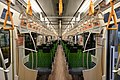 Interior view of a Q Seat car
 -
 Rotating seat


Formations
[edit]7-car sets
[edit]The 7-car sets are formed as follows:[31]
← Ōimachi
| |||||||
| Car No. | 1 | 2 | 3 | 4 | 5 | 6 | 7 |
| Designation | KuHa 6120 (Tc2) |
DeHa 6220 (M2B) |
DeHa 6320 (M1L) |
SaHa 6420 (T1) |
DeHa 6520 (M2A) |
DeHa 6620 (M1A) |
KuHa 6720 (Tc1) |
Cars 3 and 6 are each fitted with two single-arm pantographs.[31]
5-car sets
[edit]The 5-car sets are formed as follows:[27]
← Ōimachi
| |||||
| Car No. | 1 | 2 | 3 | 4 | 5 |
| Designation | KuHa 6120 (Tc2) |
DeHa 6220 (M3) |
DeHa 6320 (M2) |
DeHa 6420 (M1) |
KuHa 6520 (Tc1) |
| Capacity (total/seated) | 143/45 | 155/48 | 155/51 | 155/51 | 143/45 |
Former formations
[edit]The 7-car sets were originally formed as follows:[32]
← Ōimachi
| |||||||
| Car No. | 1 | 2 | 3 | 4 | 5 | 6 | 7 |
| Designation | KuHa 6120 (Tc2) |
DeHa 6220 (M2B) |
DeHa 6320 (M1B) |
SaHa 6420 (T1) |
DeHa 6520 (M2A) |
DeHa 6620 (M1A) |
KuHa 6720 (Tc1) |
| Weight (t) | 31.2 | 33.3 | 33.3 | 27.3 | 33.3 | 33.3 | 31.4 |
| Capacity (total/seated) | 143/45 | 155/48 | 155/51 | 155/51 | 155/51 | 155/51 | 143/45 |
Cars 3 and 6 were each fitted with two single-arm pantographs.[32]
Build histories
[edit]The manufacturers and delivery dates for the fleet are as shown below.
| Set No. | Manufacturer | Date delivered |
|---|---|---|
| 6121 | J-TREC, Yokohama | December 2017[24] |
| 6122 | January 2018[25] | |
| 6151 | March 2025 |
Special liveries
[edit]On 10 April 2022, 3020 series set 3121 received a special livery to commemorate the 100th anniversary of Tokyu Corporation's founding.[33][34] A 2020 series set is also due to receive the commemorative livery from 17 April.[34]
On 17 April 2023, 3020 series set 3122 received a colorful rainbow Sustainable Development Goals (SDGs) livery.[19]
References
[edit]This article incorporates material from the corresponding article in the Japanese Wikipedia.
- ^ a b c d 東急2020系 [Tokyu 2020 series]. Japan Railfan Magazine (in Japanese). Vol. 58, no. 683. Japan: Koyusha Co., Ltd. March 2018. pp. 72–73.
- ^ a b c d e "新車ガイド 東急電鉄3020系" [New car guide: Tokyu Corporation 3020 series]. 鉄道ファン (in Japanese). 704: 52–56. December 2019.
- ^ 総合車両製作所、東急2020系製造を担当 『sustina S24シリーズ』 [J-TREC to be in charge of Tokyu 2020 series manufacture - "Sustina S24 Series"]. Tetsudo Shimbun (in Japanese). Japan. 22 March 2017. Archived from the original on 22 March 2017. Retrieved 22 March 2017.
- ^ a b 東急,2020系を公開 [Tokyu 2020 series shown off]. Japan Railfan Magazine Online (in Japanese). Japan: Koyusha Co., Ltd. 30 November 2017. Archived from the original on 30 November 2017. Retrieved 30 November 2017.
- ^ a b 新津製の東急2020系が甲種輸送される [Niitsu-built Tokyu 2020 series delivered]. Japan Railfan Magazine Online (in Japanese). Japan: Koyusha Co., Ltd. 7 February 2018. Archived from the original on 9 February 2018. Retrieved 9 February 2018.
- ^ a b 東急2020系・6020系、新型車両3/28デビューへ - 特別列車も登場 [Tokyu 2020 and 6020 series to enter service on 28 March with a special service]. Mynavi News (in Japanese). Japan: Mynavi Corporation. 24 March 2018. Archived from the original on 27 March 2018. Retrieved 27 March 2018.
- ^ 東急2020系第3編成が甲種輸送される [Third Tokyu 2020 series delivered]. Japan Railfan Magazine Online (in Japanese). Japan: Koyusha Co., Ltd. 21 February 2018. Archived from the original on 21 February 2018. Retrieved 21 February 2018.
- ^ a b 車両 データバンク [Rolling Stock Databank]. Japan Railfan Magazine (in Japanese). Vol. 59, no. 702. Koyusha Co., Ltd. August 2019.
- ^ 東急2020系2128編成が甲種輸送される [Tokyu 2020 series set 2128 transported]. Japan Railfan Magazine Online (in Japanese). Japan: Koyusha Co., Ltd. 7 March 2019. Retrieved 3 June 2022.
- ^ 東急2020系製造完了! 2150編成を新津から甲種輸送 [Tokyu 2020 series production completed! Set 2150 transported from Niitsu]. Tetsudo Hobidas. Japan: Neko Publishing. 24 May 2022. Retrieved 3 June 2022.
- ^ a b "目黒線用3020系が甲種輸送される" [Meguro Line 3020 series will be transported]. Japan Railfan Magazine Online (in Japanese). Japan: Koyusha Co., Ltd. 10 April 2019. Archived from the original on 4 March 2021. Retrieved 24 July 2019.
- ^ a b "東急3020系第2編成が甲種輸送される" [The Tokyu 3020 series second formation will be transported]. Japan Railfan Magazine Online (in Japanese). Japan: Koyusha Co., Ltd. 31 May 2019. Archived from the original on 22 January 2021. Retrieved 24 July 2019.
- ^ "東急3020系が6両編成で試運転を実施" [The Tokyu 3020 series carries out trial operation with a six-car train]. Japan Railfan Magazine Online (in Japanese). Japan: Koyusha Co., Ltd. 29 June 2019. Archived from the original on 12 August 2020. Retrieved 24 July 2019.
- ^ 【東急】目黒線・新横浜線向け新形式 3020系が営業運転開始! [[Tokyu] New 3020 series for Meguro Line and Shin-Yokohama Line starts commercial operation!]. Train Fan Waiting Room (in Japanese). 23 November 2019. Archived from the original on 2 February 2023. Retrieved 24 June 2023.
- ^ 東急目黒線・東京メトロ南北線など、8両編成の列車が営業運転開始 [Eight-car trains begin operation on the Tokyu Meguro Line, Tokyo Metro Namboku Line, and other lines]. Mynavi News (in Japanese). 5 April 2022. Retrieved 5 April 2022.
- ^ a b "「近いうちに相鉄線へ」東急3020系 車体の上半分だけ虹色カラフルに 新SDGsトレイン登場" ['Soon to the Sotetsu Line" Upper half of the 3020 series gains colorful rainbow SDGs livery]. Traffic News (in Japanese). 18 April 2023. Archived from the original on 22 April 2023. Retrieved 24 June 2023.
- ^ "東急目黒線に3020系を導入へ東急新横浜線開業までに8両編成化も実施" [To introduce 3020 series to the Tokyu Meguro Line Also 8-car organization by the opening of the Tokyu Shin-Yokohama Line]. Japan Railfan Magazine Online (in Japanese). Japan: Koyusha Co., Ltd. 26 March 2019. Archived from the original on 3 October 2020. Retrieved 24 July 2019.
- ^ 東急3020系3123編成が甲種輸送される [Tokyu 3020 series train 3123 is transported]. Japan Railfan Magazine Online (in Japanese). 10 July 2019. Archived from the original on 8 December 2022. Retrieved 24 June 2023.
- ^ a b c "2018年12月14日(金)より、大井町線の有料座席指定サービス「Q SEAT」を開始します!" ["Q Seat" reserved seat service on the Ōimachi Line begins 14 December 2018!] (PDF). 23 October 2018. Archived (PDF) from the original on 2 September 2021. Retrieved 16 October 2021.
- ^ a b 東急6020系が甲種輸送される [Tokyu 6020 series delivered]. Japan Railfan Magazine Online (in Japanese). Japan: Koyusha Co., Ltd. 28 December 2017. Archived from the original on 28 December 2017. Retrieved 28 December 2017.
- ^ a b 東急6020系第2編成が甲種輸送される [Second Tokyu 6020 series delivered]. Japan Railfan Magazine Online (in Japanese). Japan: Koyusha Co., Ltd. 25 January 2018. Archived from the original on 25 February 2018. Retrieved 25 February 2018.
- ^ 東急電鉄、大井町線に6020系5両編成 - 各駅停車用9000系など置換え [Tokyu Corporation to introduce 5-car 6020 series trains on Oimachi Line - replacing 9000 series local trains]. Mynavi News (in Japanese). 28 February 2025. Retrieved 6 March 2025.
- ^ a b 東急大井町線6020系「6050番代」各駅停車用の車両を公開、写真70枚 [Tokyu Oimachi Line 6020 series "6050 subseries" local trains shown off – 70 photos]. Mynavi News (in Japanese). 20 June 2025. Retrieved 27 June 2025.
- ^ 東急6020系6151編成が甲種輸送される [Tokyu 6020 series set 6151 delivered]. Japan Railfan Magazine Online (in Japanese). Japan: Koyusha Co., Ltd. 6 March 2025. Retrieved 6 March 2025.
- ^ 東急6020系6151編成が営業運転を開始 [Tokyu 6020 series set 6151 enters revenue service]. Japan Railfan Magazine Online (in Japanese). Japan: Koyusha Co., Ltd. 4 July 2025. Retrieved 4 July 2025.
- ^ a b 東京急行電鉄 6020系 「Q SEAT」 [Tokyu Corporation 6020 series "Q SEAT"]. Japan Railfan Magazine (in Japanese). Vol. 59, no. 693. Japan: Koyusha Co., Ltd. January 2019. p. 63.
- ^ a b 東京急行電鉄 2020系・6020系 [Tokyu Corporation 2020 and 6020 series]. Japan Railfan Magazine (in Japanese). Vol. 58, no. 685. Japan: Koyusha Co., Ltd. May 2018. pp. 83–93.
- ^ "特別企画列車「東急グループ100周年トレイン」を運転" [Tokyu to operate special 100th anniversary trains]. Japan Railfan Magazine Online (in Japanese). Japan: Koyusha Co., Ltd. 29 March 2022. Archived from the original on 2 April 2022. Retrieved 29 March 2022.
- ^ a b "「東急グループ100周年トレイン」目黒線3020系ラッピング車両公開" ["Tokyu Group 100th Anniversary Train"-wrapped Meguro Line 3020 series released]. Mynavi News (in Japanese). Mynavi Corporation. 10 April 2022. Retrieved 10 April 2022.
External links
[edit]
- Official 2020 series news release (in Japanese)
- Official 3020 series news release (in Japanese)
- Official 6020 series news release (in Japanese)
Tokyu Corporation trainsets | ||
|---|---|---|
| In service |  | |
| Withdrawn | ||
 EncycloReader
is supported by the
EncycloReader
is supported by the  KSF
KSF