Topological K-theory
 From Wikipedia - Reading time: 6 min
In mathematics, topological K-theory is a branch of algebraic topology. It was founded to study vector bundles on topological spaces, by means of ideas now recognised as (general) K-theory that were introduced by Alexander Grothendieck. The early work on topological K-theory is due to Michael Atiyah and Friedrich Hirzebruch.
Definitions
[edit]Let X be a compact Hausdorff space and or . Then is defined to be the Grothendieck group of the commutative monoid of isomorphism classes of finite-dimensional k-vector bundles over X under Whitney sum. Tensor product of bundles gives K-theory a commutative ring structure. Without subscripts, usually denotes complex K-theory whereas real K-theory is sometimes written as . The remaining discussion is focused on complex K-theory.


As a first example, note that the K-theory of a point is the integers. This is because vector bundles over a point are trivial and thus classified by their rank and the Grothendieck group of the natural numbers is the integers.
There is also a reduced version of K-theory, , defined for X a compact pointed space (cf. reduced homology). This reduced theory is intuitively K(X) modulo trivial bundles. It is defined as the group of stable equivalence classes of bundles. Two bundles E and F are said to be stably isomorphic if there are trivial bundles and , so that . This equivalence relation results in a group since every vector bundle can be completed to a trivial bundle by summing with its orthogonal complement. Alternatively, can be defined as the kernel of the map induced by the inclusion of the base point x0 into X.




K-theory forms a multiplicative (generalized) cohomology theory as follows. The short exact sequence of a pair of pointed spaces (X, A)

extends to a long exact sequence

Let Sn be the n-th reduced suspension of a space and then define

Negative indices are chosen so that the coboundary maps increase dimension.
It is often useful to have an unreduced version of these groups, simply by defining:

Here is with a disjoint basepoint labeled '+' adjoined.[1]


Finally, the Bott periodicity theorem as formulated below extends the theories to positive integers.
Properties
[edit]- (respectively, ) is a contravariant functor from the homotopy category of (pointed) spaces to the category of commutative rings. Thus, for instance, the K-theory over contractible spaces is always
- The spectrum of K-theory is (with the discrete topology on ), i.e. where [ , ] denotes pointed homotopy classes and BU is the colimit of the classifying spaces of the unitary groups: Similarly, For real K-theory use BO.
- There is a natural ring homomorphism the Chern character, such that is an isomorphism.
- The equivalent of the Steenrod operations in K-theory are the Adams operations. They can be used to define characteristic classes in topological K-theory.
- The Splitting principle of topological K-theory allows one to reduce statements about arbitrary vector bundles to statements about sums of line bundles.
- The Thom isomorphism theorem in topological K-theory is where T(E) is the Thom space of the vector bundle E over X. This holds whenever E is a spin-bundle.
- The Atiyah-Hirzebruch spectral sequence allows computation of K-groups from ordinary cohomology groups.
- Topological K-theory can be generalized vastly to a functor on C*-algebras, see operator K-theory and KK-theory.


![{\displaystyle K(X)\cong \left[X_{+},\mathbb {Z} \times BU\right],}](https://wikimedia.org/api/rest_v1/media/math/render/svg/8a01d73e01d7df1b23606d7d21566814b3c1325e)

![{\displaystyle {\widetilde {K}}(X)\cong [X,\mathbb {Z} \times BU].}](https://wikimedia.org/api/rest_v1/media/math/render/svg/035a00294eb3c68d1132027458e751be51038d31)



Bott periodicity
[edit]The phenomenon of periodicity named after Raoul Bott (see Bott periodicity theorem) can be formulated this way:
- and where H is the class of the tautological bundle on i.e. the Riemann sphere.

![{\displaystyle K(\mathbb {S} ^{2})=\mathbb {Z} [H]/(H-1)^{2}}](https://wikimedia.org/api/rest_v1/media/math/render/svg/f5fc775befb28b2d1933747551e892e0c0e2c7f8)



In real K-theory there is a similar periodicity, but modulo 8.
Applications
[edit]Topological K-theory has been applied in John Frank Adams’ proof of the “Hopf invariant one” problem via Adams operations.[2] Adams also proved an upper bound for the number of linearly-independent vector fields on spheres.[3]
Chern character
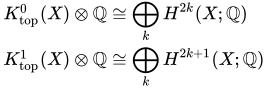
[edit]Michael Atiyah and Friedrich Hirzebruch proved a theorem relating the topological K-theory of a finite CW complex with its rational cohomology. In particular, they showed that there exists a homomorphism

such that
There is an algebraic analogue relating the Grothendieck group of coherent sheaves and the Chow ring of a smooth projective variety .
See also
[edit]- Atiyah–Hirzebruch spectral sequence (computational tool for finding K-theory groups)
- KR-theory
- Atiyah–Singer index theorem
- Snaith's theorem
- Algebraic K-theory
References
[edit]- ^ Hatcher. Vector Bundles and K-theory (PDF). p. 57. Retrieved 27 July 2017.
- ^ Adams, John (1960). On the non-existence of elements of Hopf invariant one. Ann. Math. 72 1.
- ^ Adams, John (1962). "Vector Fields on Spheres". Annals of Mathematics. 75 (3): 603–632.
- Atiyah, Michael Francis (1989). K-theory. Advanced Book Classics (2nd ed.). Addison-Wesley. ISBN 978-0-201-09394-0. MR 1043170.
- Friedlander, Eric; Grayson, Daniel, eds. (2005). Handbook of K-Theory. Berlin, New York: Springer-Verlag. doi:10.1007/978-3-540-27855-9. ISBN 978-3-540-30436-4. MR 2182598.
- Karoubi, Max (1978). K-theory: an introduction. Classics in Mathematics. Springer-Verlag. doi:10.1007/978-3-540-79890-3. ISBN 0-387-08090-2.
- Karoubi, Max (2006). "K-theory. An elementary introduction". arXiv:math/0602082.
- Hatcher, Allen (2003). "Vector Bundles & K-Theory".
- Stykow, Maxim (2013). "Connections of K-Theory to Geometry and Topology".
 EncycloReader
is supported by the
EncycloReader
is supported by the  KSF
KSF