Topological algebra
 From Wikipedia - Reading time: 4 min
In mathematics, a topological algebra is an algebra and at the same time a topological space, where the algebraic and the topological structures are coherent in a specified sense.

Definition[edit]
A topological algebra over a topological field is a topological vector space together with a bilinear multiplication

- ,

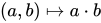
that turns into an algebra over and is continuous in some definite sense. Usually the continuity of the multiplication is expressed by one of the following (non-equivalent) requirements:
- joint continuity:[1] for each neighbourhood of zero there are neighbourhoods of zero and such that (in other words, this condition means that the multiplication is continuous as a map between topological spaces ), or
- stereotype continuity:[2] for each totally bounded set and for each neighbourhood of zero there is a neighbourhood of zero such that and , or
- separate continuity:[3] for each element and for each neighbourhood of zero there is a neighbourhood of zero such that and .


(Certainly, joint continuity implies stereotype continuity, and stereotype continuity implies separate continuity.) In the first case is called a "topological algebra with jointly continuous multiplication", and in the last, "with separately continuous multiplication".
A unital associative topological algebra is (sometimes) called a topological ring.
History[edit]
The term was coined by David van Dantzig; it appears in the title of his doctoral dissertation (1931).
Examples[edit]
- 1. Fréchet algebras are examples of associative topological algebras with jointly continuous multiplication.
- 2. Banach algebras are special cases of Fréchet algebras.
- 3. Stereotype algebras are examples of associative topological algebras with stereotype continuous multiplication.
Notes[edit]
External links[edit]
- Topological algebra at the nLab
References[edit]
- Beckenstein, E.; Narici, L.; Suffel, C. (1977). Topological Algebras. Amsterdam: North Holland. ISBN 9780080871356.
- Akbarov, S.S. (2003). "Pontryagin duality in the theory of topological vector spaces and in topological algebra". Journal of Mathematical Sciences. 113 (2): 179–349. doi:10.1023/A:1020929201133. S2CID 115297067.
- Mallios, A. (1986). Topological Algebras. Amsterdam: North Holland. ISBN 9780080872353.
- Balachandran, V.K. (2000). Topological Algebras. Amsterdam: North Holland. ISBN 9780080543086.
- Fragoulopoulou, M. (2005). Topological Algebras with Involution. Amsterdam: North Holland. ISBN 9780444520258.
 | This topology-related article is a stub. You can help Wikipedia by expanding it. |
 EncycloReader
is supported by the
EncycloReader
is supported by the  KSF
KSF