Categories
William Augustus Edwards
 From Wikipedia - Reading time: 9 min
William Augustus Edwards | |
|---|---|
| Born | December 8, 1866 |
| Died | March 30, 1939 (aged 72) |
| Nationality | American |
| Occupation | Architect |
| Buildings | Sumter County Courthouse (South Carolina) Odd Fellows Building and Auditorium, Atlanta |
| Projects | University of Florida Campus Historic District |
William Augustus Edwards, also known as William A. Edwards (December 8, 1866 – March 30, 1939) was an Atlanta-based American architect renowned for the educational buildings, courthouses and other public and private buildings that he designed in Florida, Georgia and his native South Carolina. More than 25 of his works have been listed on the National Register of Historic Places.
Early life and education[edit]
William Augustus Edwards was born in Darlington, South Carolina, the son of Augustus Fulton Edwards and his wife, Elizabeth Sarah Hart. After graduating from St. David's School in Society Hill, Edwards attended Richmond College, now the University of Richmond for one year and then entered the University of South Carolina where he received a degree in mechanical engineering in 1889.[1]
Career history[edit]
He and another Darlington County native, Charles Coker Wilson, set up an office together in Columbia, having previously worked in Roanoke, Virginia. The two men prospered for a time, but in 1901 Edwards found a new partner, Frank C. Walter. Between then and 1908 the two designed many public school buildings across the state. In 1908 the men moved their firm to Atlanta, Georgia, where they were briefly associated with an architect named Parnham. The firm lasted until 1911, at which point Walter left to work on his own.
In 1915 Edwards established another partnership, this one with William J. Sayward, and in 1919 Joseph Leitner joined the practice. Edwards continued working successfully from this office until his death in 1939.
Marriage and family[edit]
William Augustus Edwards married India Pearl Brown on December 21, 1898. They had two sons and two daughters. He was a member of the Unitarian Church.
Educational buildings[edit]
Among the academic institutions for which Edwards designed buildings were:
In Alabama[edit]
Camp Hill[edit]
In 1930 William A. Edwards and firm designed the educational classroom and administrative building for The Southern Industrial Institute, now known as Lyman Ward Military Academy, in Camp Hill, AL. The structure known as Tallapoosa Hall was designed at the request of well known educator Dr. Lyman Ward who like Edwards was also a Unitarian. Dr. Ward had transplanted to Alabama in 1898 to establish a school for impoverished boys and girls. Completed in 1933, Tallapoosa Hall is also a Gothic Revival design and the building was added to the Alabama Register of Landmarks and Heritage in 2008.
In Florida[edit]
From 1905-1925, William A. Edwards was architect for the Florida Board of Control and designed many buildings in the Collegiate Gothic style for the three existing state institutions of higher learning as well as other public schools.
Gainesville[edit]
University of Florida[edit]
As the main architect for Florida's newly reorganized system of higher education, Edwards designed numerous buildings for the University of Florida's new Gainesville campus, which first welcomed students in 1906. Most of his surviving works at the school had already been individually recognized by the National Register of Historic Places when the University of Florida Campus Historic District was established in the heart of the original campus in 1989.[2]
Works by Edwards at the University of Florida:
|
|
St. Augustine[edit]
Tallahassee[edit]
FAMU[edit]
Florida Agricultural & Mechanical University. Buildings designed by William Augustus Edwards include:[4]
|
|
The Carnegie Library and perhaps other buildings designed by Edwards are among 14 contributing buildings in Florida Agricultural and Mechanical College Historic District, NRHP-listed[2]
FSU[edit]
Florida State College for Women (Florida State University). Buildings designed by William Augustus Edwards include:[4]
|
|
Other[edit]
- Caroline Brevard Grammar School, 727 S. Calhoun St., Tallahassee, Florida (Edwards, William A.), NRHP-listed[2]
- Lincoln High School, 438 W Brevard St, Tallahassee, Florida (Edwards, William A. and Sayward, William)[5]
- Sealey Memorial Elementary School (demolished), 7th Avenue near Monroe Street, Tallahassee, Florida (Edwards, William A. and Sayward, William)[5]
- W. H. Covington Residence, 328 Cortez Street, Tallahassee, Florida (Edwards, William A. and Sayward, William)[6]
- Exchange Bank, Southeast corner of Monroe Street and College Avenue, Tallahassee, Florida (Edwards, William A. and Sayward, William)[7]
In Georgia[edit]
- Agnes Scott College, Decatur, Georgia: Buttrick Hall, 1930; McCain Library, 1936[8]
- Columbia Theological Seminary, Decatur, Georgia
- Georgia State Teachers College
- Georgia State Women's College (Valdosta State University)
In South Carolina[edit]
- Clemson College (Clemson University)
- Furman University, Greenville: Judson Alumni Hall, 1900–1961.[9]
- Limestone College, Gaffney: Winnie Davis Hall, 1904,
- McMaster School, now USC's McMaster College, Columbia
- South Carolina School for the Deaf and Blind, Spartanburg
- University of South Carolina, Columbia: Currell College (originally the law school named Petigru College, but changed in 1950 to Currell when a new Petigru was built for the law school) 1919,.
- Walhalla Graded School, Walhalla, 1901
- Winthrop College, Winthrop University, Rock Hill: Withers Building, Main Classroom - Office Building, 1912–1913.
County courthouses[edit]
William Augustus Edwards designed many county courthouses, as follows:
In Florida[edit]
In Georgia[edit]

- Fannin County Courthouse, Georgia, 1937, replaced 2004 by new courthouse next door. Old one is leased as Georgia Mountain Center for the Arts.[12][13]
- Tift County Courthouse (1912), Courthouse Sq., Tifton, Georgia, 1912–13, NRHP-listed[2][14] Beaux Arts in style, listed on the National Register of Historic Places individually and as part of Tifton Commercial Historic District[15]
In South Carolina[edit]
Between 1908 and 1915 Edwards designed nine county courthouses for the state of South Carolina, all of which are still standing except the ones in Kershaw and Darlingon which were destroyed. The courthouses are as follows:
- Abbeville County Courthouse, Court Sq. Abbeville, South Carolina, NRHP-listed[2]
- Calhoun County Courthouse, S. Railroad Ave., St. Matthews, South Carolina, NRHP-listed[2]
- Darlington County Courthouse, 1904–1964, replaced by highrise courthouse on same site[16]
- Dillon County Courthouse, 1303 W. Main St., Dillon, South Carolina. (Edwards, William Augustus), NRHP-listed[2]
- Kershaw County Courthouse, destroyed
- Jasper County Courthouse, Russell St., Ridgeland, South Carolina, NRHP-listed[2]
- Lee County Courthouse, 123 Main St., Bishopville, South Carolina, NRHP-listed[2]
- Sumter County Courthouse, 141 N. Main St., Sumter, South Carolina, NRHP-listed[2]
- York County Courthouse, corner of W. Liberty and S. Congress Sts., York, South Carolina, NRHP-listed[2]
Other buildings[edit]
In Florida[edit]
- Covington House, 328 Cortez St., Tallahassee, Florida, 1926, NRHP-listed[2]
- Exchange Bank Building, Tallahassee, Florida
- Hotel Thomas, 1919, bounded by N.E. 2nd and 5th Sts. and N.E. 6th and 7th Aves., Gainesville, Florida, NRHP-listed[2]
In Georgia[edit]
- City Hall and Firehouse, Bainbridge, Georgia
- Odd Fellows Building and Auditorium, 1912–1913, 228-250 Auburn Ave., NE, Atlanta, Georgia (Edwards, William A.), NRHP-listed[2]
- University Homes in the Atlanta University Center area
- Unitarian Church of Atlanta, 669 West Peachtree Street, 1915[17]
- United States Post Office and Courthouse (Columbus, Georgia), 1933
- former Bank of Tifton (1917), Tifton, Georgia, a C&S Bank in 1985, "a fine example of the Neoclassical style", a contributing building in NRHP-listed Tifton Commercial Historic District[15]
- One or more works in Lakewood Heights Historic District, jct. of Jonesboro Rd. and Lakewood Ave., Atlanta, Georgia (Edwards, William), NRHP-listed[2]
- One or more works in Southern Railway North Avenue Yards Historic District, 539 John St. NW, Atlanta, Georgia (Edwards, William), NRHP-listed[2]
In South Carolina[edit]
- Abbeville Opera House, Abbeville, South Carolina
- Cain House at 1619 Pendleton Street, Columbia, South Carolina. 1912. now The Inn at USC'.
- South Carolina State Armory, 1219 Assembly Street, Columbia, South Carolina, 1905, NRHP-listed[2]
NRHP-listed works[edit]
More than 25 of his works have been listed on the National Register of Historic Places, either as individual buildings or as contributing buildings within historic districts.
Gallery[edit]
-
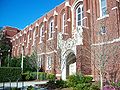
Library East, UF
-
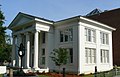
FAMU's Carnegie Library in 2008
-

Caroline Brevard School, Tallahassee
-

Buttrick Hall, Agnes Scott College
-

McCain Library, Agnes Scott College
-

Walhalla Graded School, SC
-

Withers Building at Winthrop University, SC
-

Historic Sumter County Courthouse, Florida, 2008
-

Tift County Courthouse, Georgia, in 1971
-

Sumter County Courthouse, South Carolina
-

Covington House, Florida
-

Thomas Hotel, Florida
-

Odd Fellows Building and Auditorium, Atlanta, 1979
-

-

Abbeville Opera House, South Carolina
-


.JPG)
.jpg)


References[edit]
- ^ Multiple Resource Area for 4 of the 9 South Carolina courthouses designed by William Augustus Edwards - 12 pages
- ^ a b c d e f g h i j k l m n o p q r s t u v w x y z aa ab ac "National Register Information System". National Register of Historic Places. National Park Service. March 13, 2009.
- ^ Tate, Susan, Preservation and Compatible Growth of a Twentieth Century Campus: The University of Florida, p. 61
- ^ a b Tate, Susan, Preservation and Compatible Growth of a Twentieth Century Campus: The University of Florida, p. 63
- ^ a b Tallahassee Democrat, April 16, 1929
- ^ Tallahassee Democrat, April 5, 1931
- ^ Tallahassee Democrat, May 23, 1971
- ^ Historic Campus Project
- ^ Historic Stained Glass from Judson Alumni Hall
- ^ St Petersburg Times: Brooksville 150 years
- ^ Sumter County Florida history
- ^ Vinson Institute: courthouses in Georgia: Fannin
- ^ Vinson Institute: courthouses in Georgia: Old Fannin
- ^ Vinson Institute: courthouses in Georgia: Tift
- ^ a b Carolyn Brooks (November 26, 1985). "National Register of Historic Places Inventory/Nomination: Tifton Commercial Historic District". National Park Service. Retrieved August 31, 2016. with 21 photos from 1984
- ^ Darlington County Administrator's page: has picture
- ^ Historical notes on Unitarian Universalist Congregation of Atlanta
External links[edit]
- Biography at the University of Florida library website
- Tate, Susan, Preservation and Compatible Growth of a Twentieth Century Campus: The University of Florida
| International | |
|---|---|
| Artists | |

 EncycloReader
is supported by the
EncycloReader
is supported by the  KSF
KSF