Categories
Yasuharu Ōyama
 From Wikipedia - Reading time: 6 min
 | You can help expand this article with text translated from the corresponding article in Japanese. (September 2024) Click [show] for important translation instructions.
|
| Yasuharu Ōyama | |
|---|---|
 Oyama after winning the Meijin title for the first time in 1952. | |
| Native name | 大山康晴 |
| Born | March 13, 1923 |
| Hometown | Kurashiki, Okayama |
| Nationality | Japanese |
| Died | July 26, 1992 (aged 69) |
| Career | |
| Achieved professional status | January 1, 1940 (aged 16) |
| Badge Number | 26 |
| Rank | 9 dan |
| Teacher | Kinjiro Kimi (9 dan) |
| Lifetime titles | |
| Major titles won | 80 |
| Tournaments won | 44 |
| Career record | 1433–781 (.647) |
| Notable students | |
| Websites | |
| JSA profile page | |
Yasuharu Ōyama (大山 康晴 Ōyama Yasuharu, March 13, 1923 - July 26, 1992[1]) was a professional shogi player, 15th Lifetime Meijin[1] and president of Japan Shogi Association (1976 - 1989).[2] He studied shogi under Kinjiro Kimi [ja] (木見金治郎, Kinjirō Kimi).[1] He won 80 titles (2nd on record), 44 other type tournaments (2nd on record) and 1433 games (2nd on record) in life, and was awarded five lifetime titles: Lifetime Meijin, Lifetime Jūdan, Lifetime Ōi, Lifetime Kisei and Lifetime Ōshō.[1] Among his 80 titles, 18 were the Meijin title (most prestigious title in shogi, along with Ryūō). He has appeared in the Meijin title match 25 times winning 18; he also holds the record for the most consecutive Meijin titles (13 in a row from 1959 to 1971), the most overall Meijin titles, and being the oldest player to challenge for the Meijin title, at age 63 in 1986.[citation needed]
Ōyama played as professional from 1940 until his death in 1992.[1] His students include Michio Ariyoshi, Isao Nakata and Hisashi Namekata. He was awarded as honorary citizen of Kurashiki, Okayama, his birthplace[1] and then Hyakkoku, Aomori (now merged to Oirase, Aomori).[3]
Ōyama had a strong interest in other kinds of boardgames, including go, mahjong, chess, chu shogi[4] and xiangqi. He founded the Japan Xiangqi Association in 1973 and served as its president.[5]
Honours
[edit]- Medal with Purple Ribbon (1979)
- Kikuchi Kan Prize (1987)
- Person of Cultural Merit (1990)
- Order of the Sacred Treasure, 2nd class, Gold and Silver Star (1992)
- Senior Fourth Rank (1992)
Gallery
[edit]-
 Ōyama Meijin Memorial Hall in Kurashiki
 -
 Ōyama in 1935
 -
 Ōyama in 1939
 -
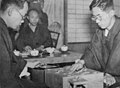 Ōyama vs Tsukada 1948
 -
 Ōyama 1948
 -
 Ōyama in 1952
 -
 Ōyama (left) playing against Yoshio Kimura in 1952 with Prince Chichibu present
 -
 shogi position when Ōyama defeated Kimura in 1952 for the Meijin title
 -
 Ōyama & Takashima Kazukiyo in 1955


References
[edit]- ^ a b c d e f "棋士紹介-物故棋士 (1955年以降)". 日本将棋連盟. 日本将棋連盟 (Japan Shogi Association). Archived from the original on 2014-09-23. Retrieved 2014-09-29.
- ^ "組織概要[創立・沿革]". 日本将棋連盟. Archived from the original on 2014-10-06. Retrieved 2014-09-29.
- ^ "大山将棋記念館". Tooなび・青森情報サイト. Too Nippo Sha. Archived from the original on 2014-10-06. Retrieved 2014-09-29.
- ^ "故・大山康晴名人による中将棋のススメ". 中将棋連盟. Retrieved 2018-02-28.
- ^ "シャンチーとは". シャンチー協会. 日本シャンチー協会. Archived from the original on 2014-10-06. Retrieved 2014-09-29.
| International | |
|---|---|
| National | |
| Academics | |

 EncycloReader
is supported by the
EncycloReader
is supported by the  KSF
KSF