Austerity (Package Deal game)
 From Wikiversity - Reading time: 5 min
| Austerity (Package Deal game) | |
|---|---|
| Designer | Simon Usherwood |
| Topic | Austerity |
| Organisation | University of Surrey |
| Preparation | Print and play |
| Time | 1 hour 30 minutes (plus) |
| No. of roles/players | minimum 11 players |
| Archive of Simulations and Games for the Enhancement of the Learning Experience The individual resources in this archive come from diverse sources. They have been brought together into this archive in a project supported by | |
 .jpg) | |
 | |
Introduction
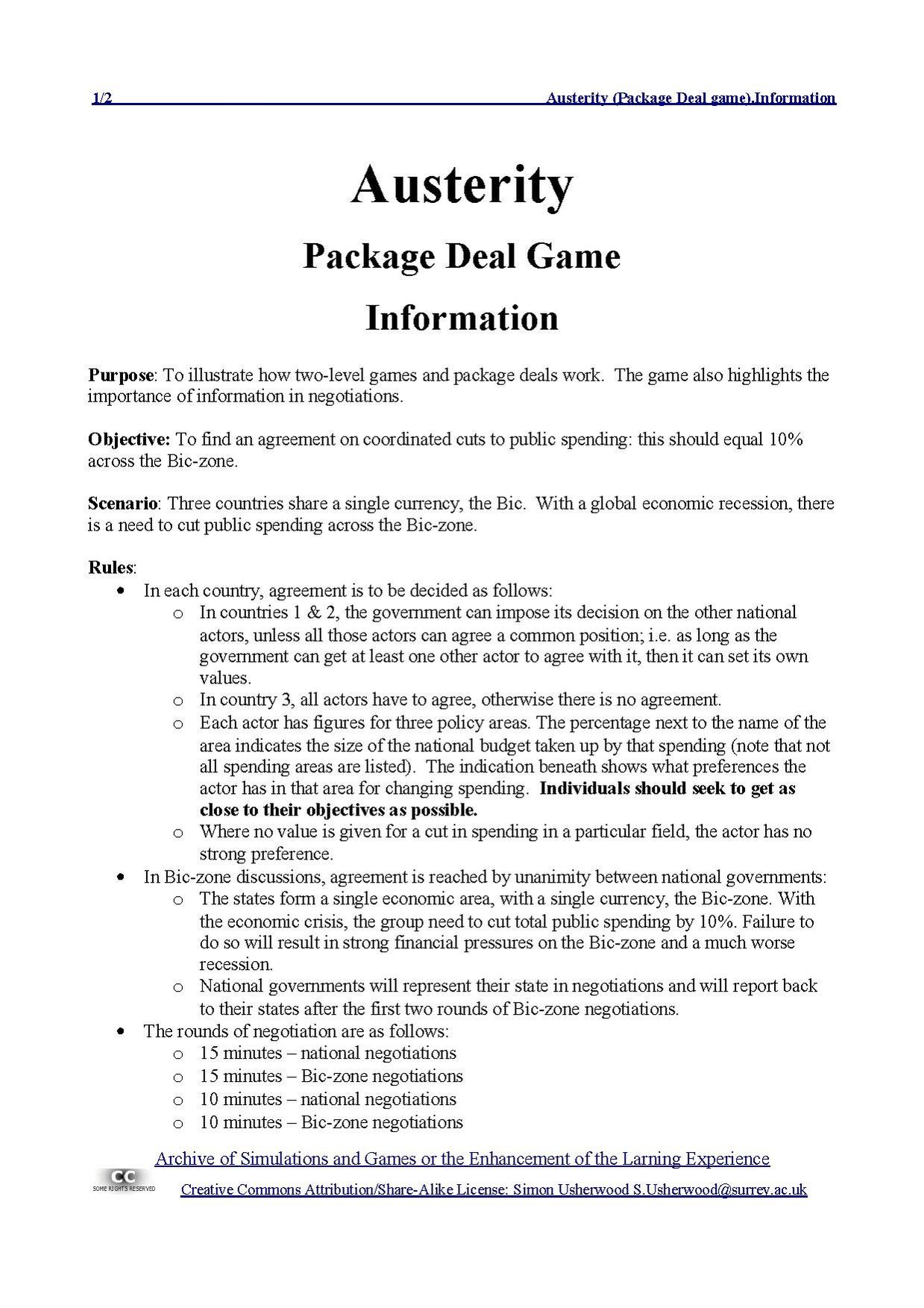
[edit | edit source]In this exercise, you will be exploring the dynamics of a two-level game. You each represent different government officials, trying to cut budgets, both within your own country and across a single currency area. The task is to find an agreement between you. This requires you to balance your national and international commitments. It highlights the importance of information in negotiations.
Purpose
[edit | edit source]To illustrate how two-level games and package deals work. The game also highlights the importance of information in negotiations.
Objective
[edit | edit source]To find an agreement on coordinated cuts to public spending.
Scenario
[edit | edit source]Three countries share a single currency, the Bic. With a global economic recession, there is a need to cut public spending across the Bic-zone.
Players
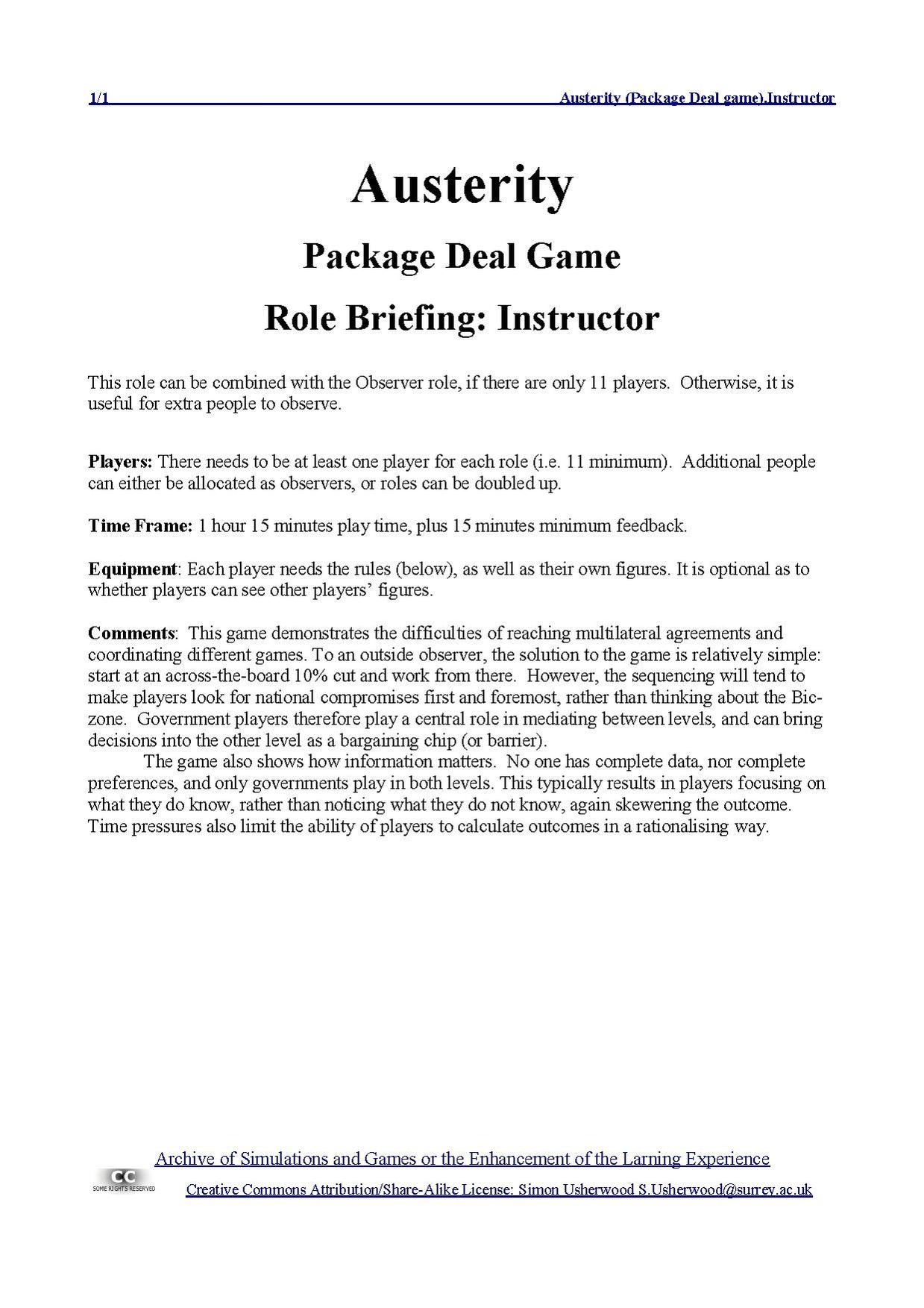
[edit | edit source]There needs to be at least one player for each role (i.e. 11 minimum). Additional people can either be allocated as observers, or roles can be doubled up.
Time Frame
[edit | edit source]1 hour 15 minutes play time, plus 15 minutes minimum feedback.
What you will do
[edit | edit source]| Activity | Time |
|---|---|
|
All read though the Context |
Up to 5 minutes |
|
Each group of national officials to debate changes to spending |
15 minutes |
|
Governments to meet as Bic-zone, to debate changes to spending: other national officials to leave the room |
15 minutes |
|
Each group of national officials to debate changes to spending |
10 minutes |
|
Governments to meet as Bic-zone, to debate changes to spending: other national officials to leave the room |
10 minutes |
|
Each group of national officials to debate changes to spending |
10 minutes |
|
Governments to meet as Bic-zone, to debate changes to spending: other national officials can remain present. |
10 minutes |
|
Feedback from outside observer |
15 minutes |
|
Total |
1 Hour 30 minutes |
Resources
[edit | edit source]To print, click on resource and then click on Full resolution . Provide printouts in each row to the people playing the relevant role:
| Role | Introduction | Role Briefing |
|---|---|---|
|
Country 1 (4 players) |
|
|
|
Country 2 (4 players) |
|
|
|
Country 3 (3 players) |
|
|
|
Observer |
|
|
|
Instructor |
|
|


Comments
[edit | edit source]This game demonstrates the difficulties of reaching multilateral agreements and coordinating different games. To an outside observer, the solution to the game is relatively simple: start at an across-the-board 10% cut and work from there. However, the sequencing will tend to make players look for national compromises first and foremost, rather than thinking about the Bic-zone. Government players therefore play a central role in mediating between levels, and can bring decisions into the other level as a bargaining chip (or barrier). The game also shows how information matters. No one has complete data, nor complete preferences, and only governments play in both levels. This typically results in players focusing on what they do know, rather than noticing what they do not know, again skewering the outcome. Time pressures also limit the ability of players to calculate outcomes in a rationalising way.
Rules
[edit | edit source]In each country, agreement is to be decided as follows:
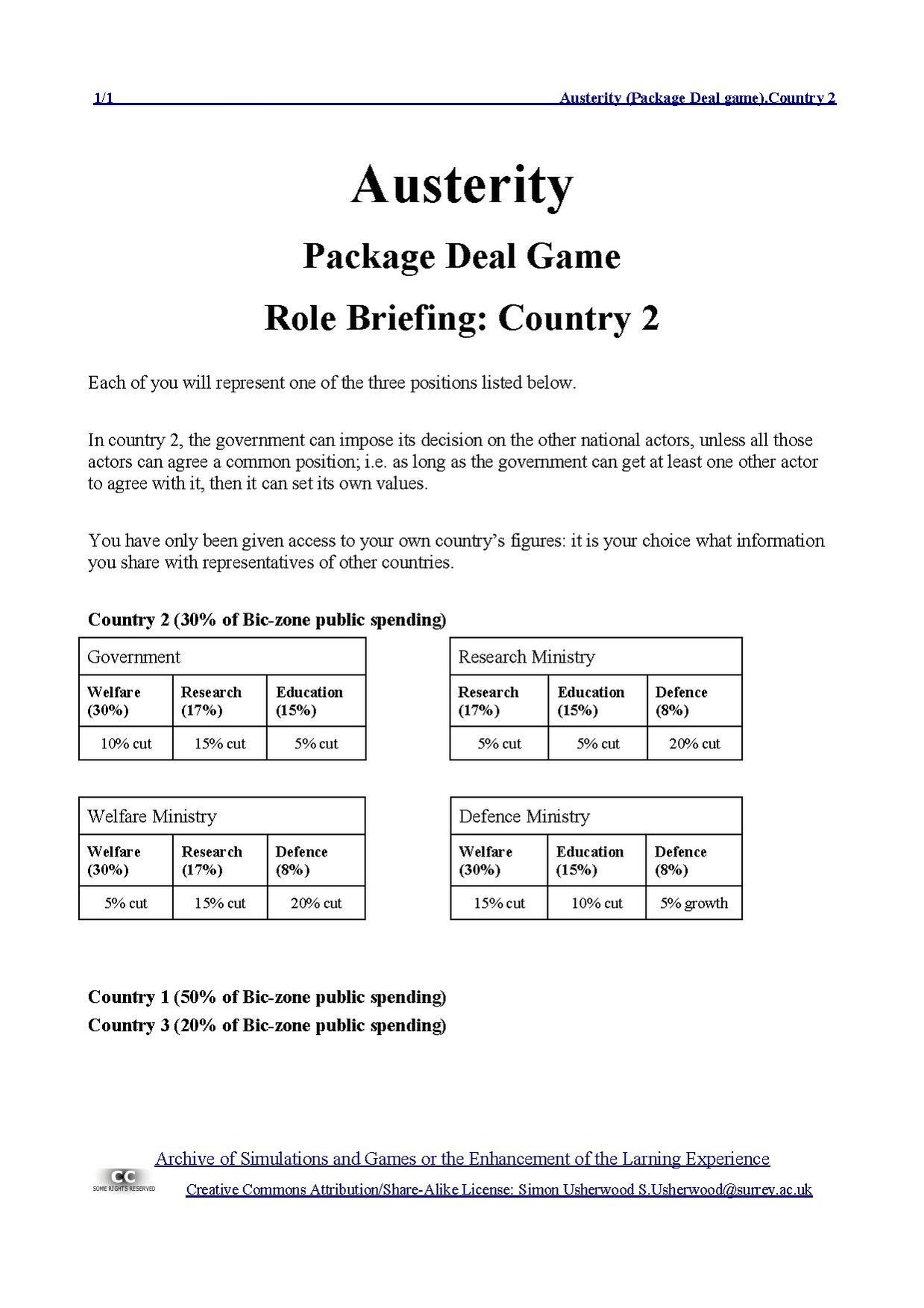
- In countries 1 & 2, the government can impose its decision on the other national actors, unless all those actors can agree a common position; i.e. as long as the government can get at least one other actor to agree with it, then it can set its own values.
- In country 3, all actors have to agree, otherwise there is no position.
- Each actor has figures for three policy areas. The % next to the name of the area indicates the size of the national budget taken up by that spending (note that not all spending areas are listed). The indication below shows what preferences the actor has in that area for changing spending. Actors should seek to get as close to their objectives as possible. Where no value is given for a cut in spending in a particular field, the actor has no strong preference.
- In Bic-zone discussions, agreement is reached by unanimity between national governments:
- The states form a single economic area, with a single currency, the Bic-zone. With the economic crisis, the group need to cut total public spending by 10%. Failure to do so will result in strong financial pressures on the Bic-zone and a much worse recession.
National governments will represent their state in negotiations and will report back to their states after the first two rounds of Bic-zone negotiations.
- The rounds of negotiation are as follows:
- 15 minutes – national negotiations
- 15 minutes – Bic-zone negotiations
- 10 minutes – national negotiations
- 10 minutes – Bic-zone negotiations
- 10 minutes – national negotiations
- 10 minutes – Bic-zone negotiations
- National groups will sit separately around the room.
- During the first two rounds of Bic-zone negotiations, the national ministries will leave the room.
For Observers
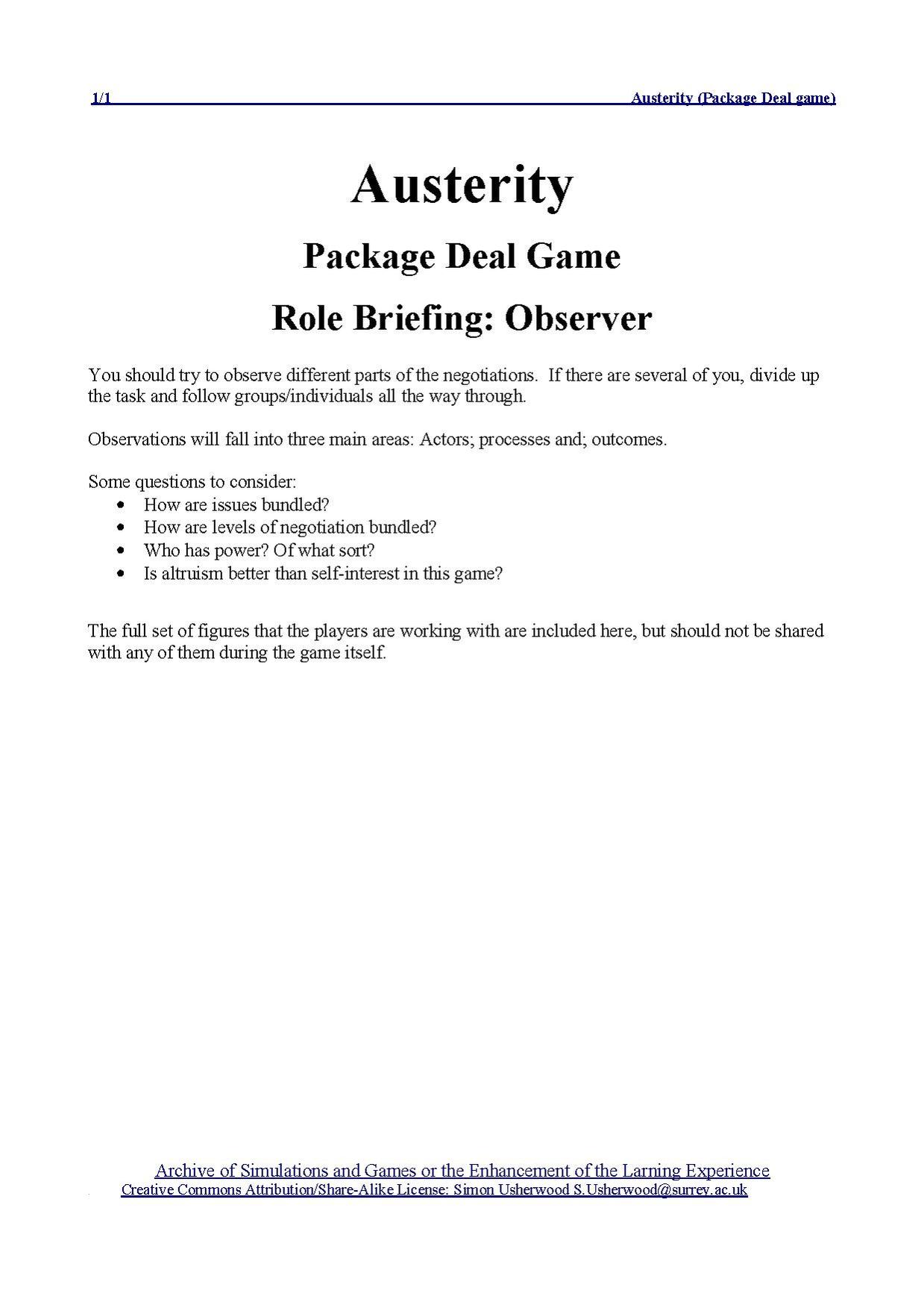
[edit | edit source]- How are issues bundled?
- How are levels of negotiation bundled?
- Who has power? Of what sort?
- Is altruism better than self-interest in this game?
 EncycloReader
is supported by the
EncycloReader
is supported by the  KSF
KSF