Table of Contents Categories
Axiomatic introduction to the Real Numbers
 From Wikiversity - Reading time: 3 min
I am sure that you probably know, intuitively, about the Real Numbers. However, this resource will disregard intuition of the Real Numbers, and will give a formal, Axiomatic approach to the Real Numbers.
The Rationals[edit | edit source]
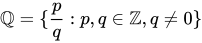
We start off from the rationals, as later we use them to define the Real Numbers. We can define the rationals as
. We can add, subtract, multiply and divide (except by 0) in the usual way. We call a field.

On Order[edit | edit source]
I add to this in which the rational numbers are also an ordered field. That is, a field with an order such that , and also and implies .


However, why do we need the real numbers at all, if we can use them just fine? The next section will elaborate on the limitations of the rational numbers.
Limitations of the rational numbers[edit | edit source]
On the Least-upper-bound property[edit | edit source]
Definitions[edit | edit source]
We go over the property of Least-upper-bound first. We start by defining the "prerequisite definitions": Say if we have a subset of an ordered field. It is bounded above if there exists a number in said ordered field s.t. . is known as an upper bound of .



A supremum of satisfies 2 properties: It is an upper bound of , and all other upper bounds of S are greater than or equal to . In other words, a supremum of a set is the least upper bound of a set. As an example, take the set , in which we denote by . It is bounded above, as there exists a number (say ) for which it is greater for all elements in , and is an upper bound. The supremum of is 1.




Also, we look back at . It is bounded below if there exists a number in said ordered field s.t. , and is a lower bound. The infimum, or greatest lower bound of is a lower bound of that is greater that all other lower bounds of .


The property of least-upper-bound then states that any subset (whatever set may be) that is bounded above also has a supremum. The rational numbers, though all subsets of the rational numbers are indeed bounded above, it is not always the case every subset in has a supremum.


Theorem. does NOT have the property of Least-upper-bound.
Proof. We give the example of the subset . This subset has an upper bound, with the example of . However, it does NOT have a supremum, as , even being bounded above. Therefore, does NOT have the property of Least-upper-bound.



 EncycloReader
is supported by the
EncycloReader
is supported by the  KSF
KSF