Cauchy Integral Theorem
 From Wikiversity - Reading time: 5 min
Introduction
[edit | edit source]The Cauchy integral theorem is one of the central results of Complex Analysis. It exists in various versions, and in this article, we aim to present a basic one for convex regions and a relatively general one for nullhomologous cycles.
For Convex Regions
[edit | edit source]Statement
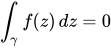
[edit | edit source]Let be a convex region, and let be a closed rectifiable curve Trace of Curve in . Then, for every holomorphic function , the following holds:


Proof 1: Antiderivatives of f
[edit | edit source]First, we observe that has a antiderivative in . Fix a point . For any point , let denote the straight-line segment connecting and as path.


![{\displaystyle [z_{0},z]}](https://wikimedia.org/api/rest_v1/media/math/render/svg/708c2843c4b0a4e214ec36e8dc3200fa284356da)


Proof 2: Definition of the Antiderivative
[edit | edit source]Define by:

- .
![{\displaystyle F(z):=\int _{[z_{0},z]}f(\zeta ),d\zeta }](https://wikimedia.org/api/rest_v1/media/math/render/svg/95b1b2e45a5ad1b34800d9823281ea6bb5ac47aa)
Due to the convexity of , the triangle with vertices lies entirely within for .


Proof 3: Application of Goursat’s Lemma
[edit | edit source]By Goursat's Lemma for the boundary of a triangle with vertices , we have:


![{\displaystyle {\begin{array}{rl}0&=\int _{\partial \Delta }f(z)\,dz\\&=\int _{[z_{0},z]}f(\zeta )\,d\zeta -\int _{[z_{0},w]}f(\zeta )\,d\zeta +\int _{[z,w]}f(\zeta )\,d\zeta \\&=F(z)-F(w)+\int _{[z,w]}f(\zeta )\,d\zeta \end{array}}}](https://wikimedia.org/api/rest_v1/media/math/render/svg/731f234fc9fc27bfc602b41ecb9844b503544b41)
Proof 4: Conclusion Using Goursat's Lemma
[edit | edit source]This leads to:
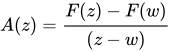
![{\displaystyle {\begin{array}{rl}F(z)-F(w)&=\int _{[w,z]}f(\zeta )\,d\zeta \\&=\int _{0}^{1}f{\bigl (}w+t(z-w){\bigr )}\cdot (z-w)\,dt\\&=\underbrace {\int _{0}^{1}f{\bigl (}w+t(z-w){\bigr )}\,dt} _{A(z):=}\cdot (z-w)\end{array}}}](https://wikimedia.org/api/rest_v1/media/math/render/svg/6b4b7ffc3b49845241a239960a805ce0303c35f1)
Thus, we have:
Proof 5: Limit Process
[edit | edit source]Since is continuous in , taking the limit as gives:


Proof 5: Differentiability of
[edit | edit source]
Therefore, is continuous, and is differentiable in , with:


Since was arbitrary, we conclude , proving that has a antiderivative.

Proof 6: Path Integration
[edit | edit source]Now, let be a piecewise continuously differentiable, closed curve. Then:
![{\displaystyle \gamma \colon [a,b]\to G}](https://wikimedia.org/api/rest_v1/media/math/render/svg/601c8522053a766d00a46f49a8541fb058509f02)

Proof 7:
[edit | edit source]Let be an arbitrary integration path in , and let . As shown here, we choose a polygonal path such that , , and

![{\displaystyle {\hat {\gamma }}\colon [a,b]\to \mathbb {C} }](https://wikimedia.org/api/rest_v1/media/math/render/svg/477f60a2cdbed9ad66b384d0f9053a15a1f39860)


Since polygonal paths are piecewise continuously differentiable, the above result implies . Consequently,


As was arbitrary, the claim follows.
For Cycles in Arbitrary Open Sets
[edit | edit source]In arbitrary open sets, one must ensure that cycles do not enclose singularities or poles in the complement of the domain. Enclosing such singularities may contribute a non-zero value to the integral (e.g., the function and in a domain . Even though is holomorphic in , the integral is not zero but (see null-homologous Chain).


Statement
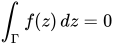
[edit | edit source]Let be open, and let be a null-homologous cycle in . Then, for every holomorphic function , the following holds:

Proof
[edit | edit source]Let , and define by


Then, is holomorphic, and by the global integral formula, we have:


See Also
[edit | edit source]Page Information
[edit | edit source]You can display this page as Wiki2Reveal slides
Wiki2Reveal
[edit | edit source]The Wiki2Reveal slides were created for the Complex Analysis' and the Link for the Wiki2Reveal Slides was created with the link generator.
- This page is designed as a PanDocElectron-SLIDE document type.
- Source: Wikiversity https://en.wikiversity.org/wiki/Cauchy%20Integral%20Theorem
- see Wiki2Reveal for the functionality of Wiki2Reveal.
Translation and Version Control
[edit | edit source]This page was translated based on the following Wikiversity source page and uses the concept of Translation and Version Control for a transparent language fork in a Wikiversity:
- Source: Integralsatz von Cauchy - URL: https://de.wikiversity.org/wiki/Integralsatz_von_Cauchy
- Date: 12/18/2024
 EncycloReader
is supported by the
EncycloReader
is supported by the  KSF
KSF