Harmonic analysis and conformal field theory
 From Wikiversity - Reading time: 3 min
The operator product expansion of conformal field theory is analogous to the product of functions over a manifold in harmonic analysis. In particular, crossing symmetry is analogous to the associativity of the product of functions over the manifold. The bootstrap method from CFT can be used for studying a manifold's geometry, or conversely the calculation of integrals over some manifolds can help determine correlation functions in certain CFTs.
Bootstrap approach to spectral geometry
[edit | edit source]Assuming unitarity of a CFT and discreteness of the spectrum, numerical bootstrap methods can derive bounds on quantities such as conformal dimensions, using semidefinite programming.[1] The same method can be applied to problems of spectral geometry that obey analogous assumptions.
Closed Einstein manifolds
[edit | edit source]Bounds on geometric data of closed Einstein manifolds can be derived.[2]
Closed hyperbolic surfaces
[edit | edit source]Bounds on the eigenvalues of the Laplace-Beltrami operator can similarly be derived.[3][4] In particular, a bound on the spectral gap of surfaces of genus 2 is nearly saturated by the Bolza surface.
Harmonic analysis in limits of two-dimensional CFTs
[edit | edit source]In certain limits of two-dimensional CFTs, correlation functions reduce to integrals over finite-dimensional manifolds.
Liouville theory
[edit | edit source]In the light asymptotic limit where the central charge is large and the conformal dimensions are constant, correlation functions of Liouville theory reduce to integrals of products of Laplacian eigenvectors over ,[5] or equivalently over .[6]


WZW models
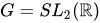
[edit | edit source]In the large level limit, correlation functions of the -WZW model reduce to integrals of products of Laplacian eigenvectors over the group . In the case , this can be used for determining the three-point structure constant in that limit.[7]

References
[edit | edit source]- ↑ Poland, David; Rychkov, Slava; Vichi, Alessandro (2018-05-11). "The Conformal Bootstrap: Theory, Numerical Techniques, and Applications". arXiv.org. doi:10.1103/RevModPhys.91.015002. Retrieved 2021-12-04.
- ↑ Bonifacio, James; Hinterbichler, Kurt (2020-07-20). "Bootstrap Bounds on Closed Einstein Manifolds". arXiv.org. doi:10.1007/JHEP10(2020)069. Retrieved 2021-12-04.
- ↑ Kravchuk, Petr; Mazac, Dalimil; Pal, Sridip (2021-11-24). "Automorphic Spectra and the Conformal Bootstrap". arXiv.org. Retrieved 2021-12-04.
- ↑ Bonifacio, James (2021-11-25). "Bootstrapping Closed Hyperbolic Surfaces". arXiv.org. Retrieved 2021-12-04.
- ↑ Zamolodchikov, A. B.; Zamolodchikov, Al. B. (1995-06-20). "Structure Constants and Conformal Bootstrap in Liouville Field Theory". arXiv.org. doi:10.1016/0550-3213(96)00351-3. Retrieved 2021-11-30.
- ↑ Ribault, Sylvain (2014-06-17). "Conformal field theory on the plane". arXiv.org. Retrieved 2021-11-30.
- ↑ Ribault, Sylvain (2009-12-22). "Minisuperspace limit of the AdS3 WZNW model". arXiv.org. doi:10.1007/JHEP04(2010)096. Retrieved 2021-11-30.
 EncycloReader
is supported by the
EncycloReader
is supported by the  KSF
KSF