Jump models in financial modelling
 From Wikiversity - Reading time: 9 min
 |
Introduction
[edit | edit source]This is an outline of a seminar's contents.
The main reference for the seminar is Rama Cont and Tankov[1]. Purely mathematical texts on the same subject are Protter[2] and Jacod and Shiryaev[3]. Texts being more devoted to finance are Shreve[4] and Shiryaev[5].
Home reading
[edit | edit source]Rama Cont and Tankov[1]: Chapter 1 and the introduction of each Chapter 2--15.
Protter[2]: Chapter I, in particular section 4.
Prior knowledge
[edit | edit source]- measures, measurable functions - Radon Nikodym theorem - random variables - characteristic functions (Fourier transforms), how to find moments from characteristic functions - moment generating functions (how to find moments from characteristic functions)
- special distributions (exponential - gamma - Gaussian)
- convergence of random variables (almost sure, in probability, in distribution)
- stochastic process - cadlag and caglad - filtrations and histories - non-anticipating (adapted) - stopping time - martingale - optional sampling (stopping) theorem
- Levy process - characterization of continuous Levy processes -Poisson process - compensated Poisson process - counting process - compound Poisson process - characteristic function of a compound Poisson process
Examples of Levy processes
[edit | edit source]Concepts and facts
[edit | edit source]- point processes - marked point processes - characterization of Poisson and compound Poisson processes (without proof)
- jump diffusion - Levy measure of jump diffusion - Fourier transform of jump diffusion
- infinitely divisible distribution - convolution semigroups - Levy processes have infinitely divisible distributions - examples (Gaussian, Poisson, compound Poisson, Gamma, Cauchy)
- for every infinitely divisible distribution there is a Levy process (without proof)
- Fourier transform of Levy processes ) - zeros of - dependence of - examples (Gaussian, Poisson, compound Poisson, Gamma, Cauchy)
- Gamma process as limit of compound Poisson processes (via Fourier transforms) - limit behaviour of the Levy measures - Gamma process is FV-process - Levy measure of Gamma process - order of singularity at zero
- Cauchy process as limit of compound Poisson processes (via Fourier transforms) - limit behaviour of the Levy measures - Levy measure of Cauchy process - order of singularity at zero


Review questions
[edit | edit source]- Explain the notions of a point process and a marked point process.
- Which Levy processes can be characterized by path properties ?
- Which path properties characterize special Levy processes ?
- What are jump diffusions ? Give the Fourier transform of jump diffusions.
- Explain the notion of infinitely divisible distributions. What is the relation between infinitely divisble distributions and Levy processes ?
- Explain the Gamma process and its Fourier transform.
- Describe, how a Gamma process can be approximated by jump diffusions. What does it tell us about small and large jumps ?
- Explain the Cauchy process and its Fourier transform.
- Describe, how a Cauchy process can be approximated by jump diffusions. What does it tell us about small and large jumps ?
- Which compound Poisson processes can be written as a linear combination of independent Poisson processes ?
\end{enumerate}
Problems
[edit | edit source]- Analyze the Levy processes with the following Fourier transforms (expectation, variance, path properties, decomposition as a jump diffusion, Levy measure, jump intensity, jump height distribution, martingale property (yes/no), compensator).
- Find the Fourier transform of a jump diffusion with variance 2, jumping with intensity 3, having jump heights +1 and -1 with equal probability.
- Find the Fourier transform of a jump diffusion with variance 1, jumping with intensity 1, having jump heights uniformly distributed on .
- Find the Levy measure of a sum of five independent Poisson processes with intensities .
- Find the Levy measure of a linear combination of five independent Poisson processes with intensity 1 and weights .




![{\displaystyle [-2,0]}](https://wikimedia.org/api/rest_v1/media/math/render/svg/71a51abb57b43d885053eed14d7fda7aff8e45b2)

Proofs
[edit | edit source]- Is every driftless (i.e. centered) process a martingale ? (Give a counter example for the general case. Prove it for processes with independent increments.)
- Any finite sum of independent Poisson processes is a Poisson process. Find the Levy measure.
- Any linear combination of independent Poisson processes is a compound Poisson process. Find the Levy measure.
- For every finite measure there is a compound Poisson process with Levy measure .
- Show that the characteristic function of a Levy process satisfies .
- Let be a Levy process. Show that is a martingale.





Jump measures and decomposition of Levy processes
[edit | edit source]Concepts and facts
[edit | edit source]- Levy processes with uniformly bounded jumps have moments of all orders (without proof)
- counting measure of a finite set - representation of sums as integrals
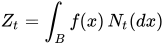
- jump measure of a cadlag process - jump heights in sets bounded away from zero - finiteness of the jump measure of a cadlag process
- properties of - properties of
- Poissonian jump measure (two properties) - Levy processes have Poissonian jump measures
- Levy measure of a Levy process - Levy measures are bounded on , \epsilon>0
- is a compound Poisson process for - expectation and variance of - Fourier transform of
- elimination of big jumps from Levy processes - Levy processes are semimartingales
- moments of Levy processes and Levy measures
- relation between quadratic variation and the singularity of Levy measures
- decomposition of Levy processes (big jumps - continuous part - compensated small jumps) - relation to the Fourier transform - Levy-Khintchine formula - uniquenesss (without proof) - predictable characteristics (w.r.t. a particular centering function )
- characterization of FV-Levy processes (without proof)




Review questions
[edit | edit source]- How many jumps can occur on a single path of a stochastic process ?
- Explain, why the jump measure of a Levy process leads to Poisson processes.
- What is the Levy measure of a Levy process ?
- Explain the integral representation of sums of jump expressions.
- What is a Poissonian jump measure ? Why are the jump measures of Levy processes of Poissonian type ?
- How to extract big jumps from a stochastic process ?
- Refer the moment properties of integrals w.r.t. Poissonian jump measures.
- Discuss the properties of the singularity of a Levy measure.
- Describe the basic steps of the decomposition of a Levy process. What are the predictable characteristics ? What about uniqueness ?
Problems
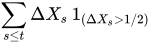
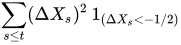
[edit | edit source]- Let be a Levy process with Levy measure
- ,
- .
- Find expectation and variance of
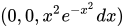
- Find the moments and the Fourier transform of a Levy process with characteristics (let ):

![{\displaystyle \nu (dx)=1_{[-1,1]}(x)\,dx}](https://wikimedia.org/api/rest_v1/media/math/render/svg/251241ca0ee60589029a367c715eef57f11d822e)




Proofs
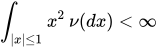
[edit | edit source]- Every Levy measure satisfies .
- The jump measure of any Levy process is a Poisson jump measure.
- Every Levy process is a semimartingale.
- Let be a Poisson jump measure and let be its Levy measure. Prove the formulas:
- Every Levy measure satisfies .






Stochastic analysis for processes with jumps
[edit | edit source]Concepts and facts
[edit | edit source]- general Ito-formula - proof by induction
- Ito-formula for processes with isolated jumps - direct proof
- solving when is a semimartingale with isolated jumps
- Poisson process : - solving - solving - martingale solutions




Review questions
[edit | edit source]- Explain the solution of when has isolated jumps.
- What is the stochastic exponential of a compound Poisson process ?
Problems
[edit | edit source]- Find the solution of where is a Poisson process with intensity .
- In the preceding problem choose such that is a martingale.
- Find the solution of where is a Poisson process with intensity .
- In the preceding problem choose such that is a martingale.
- Find the solution of where is a Wiener process and is an independent Poisson process with intensity .
- In the preceding problem choose such that is a martingale.
- Let where is a Wiener process and is an independent Poisson process with intensity . Expand by Ito's formula.
- Let be the solution of where is a Poisson process with intensity . Expand by Ito's formula.









Financial models with jumps, pricing and hedging
[edit | edit source]Concepts and facts
[edit | edit source]- equivalent change of measure for Poisson processes (Escher transform) - existence of transforms for arbitrary intensities
- Poissonian stock models - risk neutral models - criterion for NA property - completeness - hedging
- Poisson-diffusion stock models - risk neutral models - criterion for NA property - incompleteness - hedging
Review questions
[edit | edit source]- Describe Poissonian stock models. Which of them are risk neutral mdoels ?
- Discuss the NA property for Poissonian stock models.
- Discuss completeness of Poissonian stock models.
- Describe Poisson-diffusion stock models. Which of them are risk neutral mdoels ?
- Discuss the NA property for Poisson-diffusion stock models.
- Discuss completeness of Poisson-diffusion stock models.
Proofs
[edit | edit source]- Let be a Poisson process under . Show that for every one may find an equivalent probability measure such that has intensity .


References
[edit | edit source]- ↑ 1.0 1.1 Rama Cont; Peter Tankov (26 October 2012). Financial Modelling with Jump Processes, Second Edition. CRC PressINC. ISBN 978-1-4200-8219-7. http://books.google.com/books?id=-fZtKgAACAAJ. Retrieved 24 January 2013.
- ↑ 2.0 2.1 Philip Protter (24 May 2005). Stochastic Integration and Differential Equations: Version 2.1. Springer. ISBN 978-3-540-00313-7. http://books.google.com/books?id=mJkFuqwr5xgC. Retrieved 24 January 2013.
- ↑ Jean Jacod; Albert N. Shiryaev (31 December 1987). Limit theorems for stochastic processes. Springer-Verlag. ISBN 978-3-540-17882-8. http://books.google.com/books?id=sUgXKpUIdHwC. Retrieved 24 January 2013.
- ↑ Steven E. Shreve (3 June 2004). Stochastic Calculus for Finance II: Continuous-Time Models. Springer. ISBN 978-0-387-40101-0. http://books.google.com/books?id=O8kD1NwQBsQC. Retrieved 24 January 2013.
- ↑ Albert N. Shiryaev (1 February 1999). Essentials of Stochastic Finance: Facts, Models, Theory. World Scientific. ISBN 978-981-02-3605-2. http://books.google.com/books?id=oiIG5FmJxWgC. Retrieved 24 January 2013.
Licensed under CC BY-SA 3.0 | Source: https://en.wikiversity.org/wiki/Jump_models_in_financial_modelling23 views | Status: cached on May 15 2025 05:35:04↧ Download this article as ZWI file
 EncycloReader
is supported by the
EncycloReader
is supported by the  KSF
KSF