Zud (Mongolia)
 From Handwiki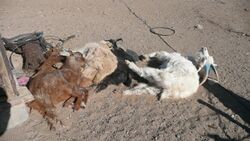
A zud or dzud (Mongolian: зуд) is a Mongolian term for a severe winter in which large number of livestock die, primarily due to starvation due to being unable to graze, in other cases directly from the cold. There are various kinds of zud, including white zud, which is an extremely snowy winter in which livestock are unable to find nourishing foodstuff through the snow cover and starve.
One-third of Mongolia's population depends entirely on pastoral farming for its livelihood, and harsh zuds can cause economic crises and food security issues in the country.[1] This natural disaster is unique to Mongolia.[2][3]
Description and mitigation
There are different types of zud:
- Tsagaan (white) zud results from high snowfall that prevents livestock from reaching the grass.[4] It is a frequent and serious disaster that has caused a great number of deaths.[5]
- Khar (black) zud results from a lack of snow in grazing areas, leading to both livestock and humans lacking water. This type of zud does not occur every year, nor does it affect large areas. It mostly happens in the Gobi Desert region.[4]
- Tumer (iron) zud results from a short wintertime warming, followed by a return to sub-freezing temperatures. The snow melts and then freezes again, producing an impenetrable ice-cover that prevents livestock from grazing.[4]
- Khuiten (cold) zud occurs when the temperature drops to very low levels for several days. The cold temperature and the strong winds prevent livestock from grazing; the animals have to use most of their energy to keep warm.[4]
- Khavsarsan (combined) zud is a combination of at least two of the above types of zud.[4]
Some traditional methods to protect the livestock from such inclement weather conditions include drying and storing cut grass during the summer months, and collecting sheep and goat dung to build dried flammable blocks called "Khurjun" or kizyak. Dried grass can be fed to animals to prevent death from starvation when zud occurs.[citation needed] The "Khurjun", or blocks of sheep and goat dung, are stacked to make a wall that protects the animals from the wind chills, and keep them warm enough to withstand the harsh conditions. These blocks can also be burnt as fuel during the winter. These methods are still practiced today[when?] in the westernmost parts of Mongolia, and areas formerly part of the Zuun Gar nation.[citation needed]
Also, because of the semi-permanent structure of the winter shelter for their livestock and the cold, most – if not all – nomads engage in transhumance (seasonal migration). They have winter locations to spend the winter, which are in a valley protected by mountains on most sides from the wind, while in the summer they move to more open space.[citation needed]
Man-made factors
Human factors worsen the situation caused by the harsh winters. Under the communist regime, the state regulated the size of the herds to prevent overgrazing. The 1990s saw a deregulation of Mongolia's economy and a simultaneous growth in worldwide demand for cashmere wool, which is made from goat hair. As a result, the number of goats in Mongolia has increased significantly. Unlike sheep, goats tend to damage the grass by nibbling at its roots; their sharp hooves also damage the upper layer of the pasture, which is subsequently swept away by the wind. This leads to desertification.[1]
Extent and history
It is not uncommon for zuds to kill over one million head of livestock in a given winter. The 1944 record of almost seven million head of livestock lost[6] was surpassed in the 21st century.
The arctic oscillation in both 1944–45 and in 2010 was pushed much deeper into Central Asia, bringing prolonged extreme cold weather. In 1999–2000, 2000–2001, and 2001–2002, Mongolia was hit by three zuds in a row, in which a combined number of 11 million animals were lost.[7]
During the winter of 2009–2010, 80% of the country's territory was covered with a snow blanket of 200–600mm (7-24 inches).[8] In the Uvs aimag, extreme cold (night temperature of −48 °C / −54 °F) remained for almost 50 days.[9] 9,000 families lost their entire herds while a further 33,000 suffered 50% loss.[10] The Ministry of Food, Agriculture and Light Industry reported 2,127,393 head of livestock were lost as of 9 February 2010 (188,270 horse, cattle, camel and 1,939,123 goat and sheep).[8] The agriculture ministry predicted that livestock losses might reach four million before the end of winter;[11] however, by May 2010, the United Nations reported that eight million, or about 17% of the country's entire livestock, had died.[1]
In the winter of 2015–2016, extreme temperatures were again recorded and the previous summer's drought led to insufficient hay fodder reserves for many herders, which caused another ongoing loss of livestock.[12]
Social consequences
Some herders who lose all of their animals to zud have to seek a new life in the cities. Mongolia's capital, Ulaanbaatar, is surrounded by clusters of wooden houses without roads, water or sewage systems. Lacking in education and skills to survive in an urban environment, many displaced herders cannot find work and become extremely poor, may become addicted to alcohol, and may commit crime. Others risk their lives in dangerous illegal mining jobs.[13]
Regional equivalents
In Kazakh, dzhut (джут) is a term for a famine due to natural disaster.[14][better source needed][15]
Notes
- ↑ 1.0 1.1 1.2 Jacobs, Andrew (May 19, 2010). "Winter Leaves Mongolians a Harvest of Carcasses". The New York Times. https://www.nytimes.com/2010/05/20/world/asia/20mongolia.html.
- ↑ Mongolia: Harsh Winter Wiping Out Livestock, Stoking Economic Crisis for Nomads, Eurasianet, 1 April 2016
- ↑ The slow and deadly dzud in Mongolia, BBC, 14 May 2010
- ↑ 4.0 4.1 4.2 4.3 4.4 Neil Leary (2008). Climate Change and Vulnerability. The International STAT Secretariat. p. 76. ISBN 9781849770804. https://books.google.com/books?id=bqXln2IgClMC&pg=PA76.
- ↑ J.M. Suttie; Stephen G. Reynolds; Caterina Batello (2005). Grasslands of the World. Food and Agriculture Organization of the United Nations. p. 293. https://archive.org/details/bub_gb_BBA_HxFizNgC.
- ↑ "Mongolia faces calamity". BBC news. 2000-03-29. http://news.bbc.co.uk/2/hi/asia-pacific/694716.stm.
- ↑ ADB Approves $2 Million for Herders Hit By Mongolian Climate Disaster, Asian Development Bank, 11 April 2016
- ↑ 8.0 8.1 "Severe winter kills two million livestock". Montsame News Agency, Ulaanbaatar. 2010-02-11. http://www.montsame.mn/index.php?option=com_news&mt=normal_news&tab=201002&task=news_detail&ne=799.
- ↑ "Ch. Khurelbaatar works in Uvs.". Montsame News Agency, Ulaanbaatar. 2010-02-12. http://www.montsame.mn/index.php?option=com_news&mt=normal_news&tab=201002&task=news_detail&ne=827.
- ↑ Branigan, Tania The Guardian 21 July 2010 Mongolia: Winter of white death
- ↑ "Livestock Loss Could Reach Up to 4 Million By Spring". UBPost. 2010-02-05. http://ubpost.mongolnews.mn/index.php?option=com_content&task=view&id=4376&Itemid=36.
- ↑ Madoka Ikegami (2016-05-10). "Mongolia's dzud disaster". New Internationalist. http://newint.org/features/web-exclusive/2016/05/10/mongolias-dzud-disaster/.
- ↑ Mongolia’s dzud disaster, The New Internationalist, May 10, 2016
- ↑ "Amina's Grandfather Played Opossum". 2009-08-24. https://kazakhnomad.wordpress.com/2009/08/24/aminas-grandfather-played-opossum/.
- ↑ Bustanov, Alfrid (2015). Soviet Orientalism and the Creation of Central Asian Nations. New York: Routledge. p. 45. ISBN 9781138019225.
References
- "In the Mongolian Zud—A Witness to Winter's Wrath". Mercy Corps. http://www.mercycorps.org/articles/mongolia/mongolian-zud—-witness-winters-wrath.
- Zud Natural Disaster, Prevention and Recovery by Tsakhiagiin Elbegdorj, President of Mongolia
 |
Categories: [Weather hazards]
↧ Download as ZWI file | Last modified: 08/12/2025 00:52:36 | 8 views
☰ Source: https://handwiki.org/wiki/Earth:Zud_(Mongolia) | License: CC BY-SA 3.0
 KSF
KSF