Tau Ceti E
 From Handwiki
 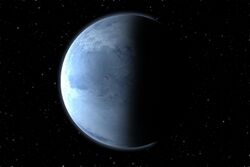 Artistic depiction of Tau Ceti e as a terrestrial planet. | |
| Discovery | |
|---|---|
| Discovery date | December 19, 2012 |
Detection method | Radial velocity |
| Designations | |
Alternative names | 52 Ceti e, Tau cet e |
| Orbital characteristics | |
Semi-major axis | 0.552 AU |
| Orbital period | 168 d |
| Physical characteristics | |
| Mass | ≥3.93 M🜨 |
Tau Ceti e, also called 52 Ceti e, is an exoplanet orbiting Tau Ceti that was detected by statistical analyses of the data of the star's variations in radial velocity that were obtained using HIRES, AAPS and HARPS.[1][2] Its possible properties were refined in 2017: it orbits at a distance of 0.552 astronomical unit|AU (between the orbits of Venus and Mercury in the Solar System) with an orbital period of 168 days and has a minimum mass of 3.93 Earth masses.[3] If Tau Ceti e possesses an Earth-like atmosphere, the surface temperature would be around 68 °C (154 °F).[4] Based upon the incident flux upon the planet, a study by Güdel et al. (2014) speculated that the planet may lie inside the inner-boundary of the habitable zone and closer to a Venus-like world.[5]
References
- ↑ Tuomi, Mikko; Jones, Hugh R. A.; Jenkins, James S.; Tinney, Chris G.; Butler, R. Paul; Vogt, Steve S.; Barnes, John R.; Wittenmyer, Robert A. et al. (2013). "Signals embedded in the radial velocity noise. Periodic variations in the tau Ceti velocities". Astronomy & Astrophysics 551: A79. doi:10.1051/0004-6361/201220509. ISSN 0004-6361. Bibcode: 2013A&A...551A..79T.
- ↑ "Four Exoplanets Detected around Nearby Star Tau Ceti | Astronomy | Sci-News.com" (in en-US). http://www.sci-news.com/astronomy/tau-ceti-exoplanets-05117.html.
- ↑ Feng, Fabo; Tuomi, Mikko; Jones, Hugh R. A.; Barnes, John; Anglada-Escude, Guillem; Vogt, Steven S.; Butler, R. Paul (2017-09-05). "Color difference makes a difference: four planet candidates around tau Ceti". The Astronomical Journal 154 (4): 135. doi:10.3847/1538-3881/aa83b4. ISSN 1538-3881. Bibcode: 2017AJ....154..135F.
- ↑ Bignami, Giovanni F. (2015-06-13) (in en). The Mystery of the Seven Spheres: How Homo sapiens will Conquer Space. Springer. ISBN 978-3-319-17004-6. https://books.google.com/books?id=crvpCQAAQBAJ&pg=PA110.
- ↑ Guedel, M.; Dvorak, R.; Erkaev, N.; Kasting, J.; Khodachenko, M.; Lammer, H.; Pilat-Lohinger, E.; Rauer, H. et al. (2014). "Astrophysical Conditions for Planetary Habitability". Protostars and Planets VI. doi:10.2458/azu_uapress_9780816531240-ch038. ISBN 9780816531240.
 |  |
Categories: [Tau Ceti] [Exoplanets in the habitable zone]
↧ Download as ZWI file | Last modified: 02/04/2024 23:59:31 | 2 views
☰ Source: https://handwiki.org/wiki/Astronomy:Tau_Ceti_e | License: CC BY-SA 3.0
 KSF
KSF