
Bright red inesite with orange prehnite from N'Chwanning II Mine, Kuruman, Kalahari Manganese Field, North Cape, South Africa
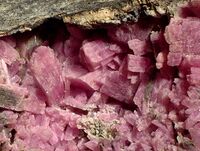
Inesite from Hale Creek Mine,Trinity County, California, USA
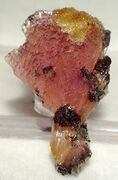
Inesite with yellow hubeite from Fengjishan Mine (Daye Copper Mine), Edong Mining District, Daye County, Huangshi Prefecture, Hubei Province, China
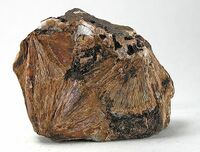
Brown Inesite from Broken Hill, New South Wales, Australia

Inesite on top of orlymanite from Wessels Mine, Hotazel, Kalahari Manganese field, Northern Cape, South Africa
Inesite
 From Handwiki
 | Inesite | |
|---|---|
 Inesite Crystals from Fengjishan Mine (Daye Copper Mine), Edong Mining District, Daye County, Huangshi Prefecture, Hubei Province, China. | |
| General | |
| Category | Inosilicates |
| Formula (repeating unit) | Ca2Mn7Si10O28(OH)2•5(H2O) |
| Strunz classification | 09.DL.05 |
| Dana classification | 66.3.3.1 |
| Crystal system | Triclinic |
| Space group | P1 (no.2) |
| Identification | |
| Color | Rose red, pink, orange-pink, orange-red-brown |
| Crystal habit | Massive, fibrous, radial, spherical |
| Cleavage | Perfect |
| Fracture | Irregular/Uneven |
| Tenacity | Brittle |
| Mohs scale hardness | 5.5 - 6 |
| |re|er}} | Vitreous, Silky |
| Streak | White |
| Diaphaneity | Translucent |
| Specific gravity | 3.0 |
| Ultraviolet fluorescence | Non-fluorescent |
| Common impurities | Fe, Al, Mg, K |
| References | [1][2][3] |
Inesite is a hydrous calcium manganese silicate mineral.[5] Its chemical formula is Ca2Mn7Si10O28(OH)2•5(H2O). Inesite is an inosilicate with a triclinic crystal system. It has a Mohs hardness of 5.5 to 6, and a specific gravity of 3.0. Its name originates from the Greek Ίνες (ines), "fibers" in allusion to its color and habit. [2]
Occurrence and distribution
Inesite occurs in hydrothermal replacement deposits of manganese-rich metamorphic rocks and serpentines.[6] It was first described in 1887 at Hilfe Gottes Mine, Oberscheld, Dillenburg, Dillenburg District, Hesse, Germany. Outside of the type locality, there are several notable localities of inesite, such as:[7][8]
- Wessels and N'Chwanning Mines, Kalahari Manganese Field, Northern Cape, South Africa where Inesite is associated with datolite, pectolite, apophyllite, ruizite, orientite and quartz.
- Broken Hill, New South Wales, Australia.
- Långban, Persberg, Värmland, Sweden.
- Kawazu Mine, Shizuoka Prefecture, Chubu Region, Honshu Island, Japan
- Hale Creek Mine, Trinity County, California, USA, where Inesite is associated with Rhodochrosite, bementite, and hausmannite.
- Fengjishan Mine (Daye Copper Mine), Edong Mining District, Daye County, Huangshi Prefecture, Hubei Province, China.
Inesite Gallery
References
- ↑ Dave Barthelmy. "Inesite Mineral Data". http://www.webmineral.com/data/Inesite.shtml#.XEvCI89Kjq1.
- ↑ 2.0 2.1 "Inesite: Mineral information, data and localities". https://www.mindat.org/min-2031.html.
- ↑ Wan, C.; Ghose, S. (1978). "Inesite, a hydrated calcium manganese silicate with five-tetrahedral-repeat double chains". American Mineralogist 63: 563–571.
- ↑ Warr, L.N. (2021). "IMA–CNMNC approved mineral symbols". Mineralogical Magazine 85 (3): 291–320. doi:10.1180/mgm.2021.43. Bibcode: 2021MinM...85..291W.
- ↑ Chesterman, Charles (1978). The Audubon Society Field Guide to North American Rocks And Minerals. Knopf. pp. 592.
- ↑ The Mineral Inesite
- ↑ "Inesite". 18 August 2001. http://rruff.info/doclib/hom/inesite.pdf.
- ↑ http://www.minsocam.org/ammin/AM53/AM53_1614.pdf Inesite From the Broken Hill Lode, New South Wales, Australia
 |  |
Categories: [Manganese(II) minerals] [Inosilicates] [Triclinic minerals] [Calcium minerals] [Minerals in space group 2]
↧ Download as ZWI file | Last modified: 09/03/2024 14:51:22 | 3 views
☰ Source: https://handwiki.org/wiki/Chemistry:Inesite | License: CC BY-SA 3.0
✘
ZWI is not signed. [what is this?]
ZWI viewer
by the  KSF
KSF
KSF