Upsilon Lupi
 From Handwiki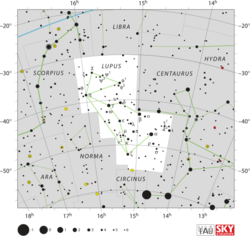
 | |
| Observation data Equinox J2000.0]] (ICRS) | |
|---|---|
| Constellation | Lupus |
| Right ascension | 15h 24m 45.00855s[1] |
| Declination | −39° 42′ 36.9524″[1] |
| Apparent magnitude (V) | 5.37[2] (5.37 + 10.90)[3] |
| Characteristics | |
| Spectral type | A0p Si[4] |
| B−V color index | −0.11[2] |
| Astrometry | |
| Radial velocity (Rv) | −7.6±2.8[5] km/s |
| Proper motion (μ) | RA: −26.10[1] mas/yr Dec.: −54.77[1] mas/yr |
| Parallax (π) | 8.02 ± 0.62[1] mas |
| Distance | 410 ± 30 ly (125 ± 10 pc) |
| Absolute magnitude (MV) | −0.10[6] |
| Details | |
| υ Lup A | |
| Luminosity | 113[7] L☉ |
| Temperature | 10,049[7] K |
| Rotational velocity (v sin i) | 0[8] km/s |
| Other designations | |
υ Lup, CD−39° 9827, HD 136933, HIP 75439, HR 5719, SAO 206597.[9] | |
| Database references | |
| SIMBAD | data |
Upsilon Lupi, Latinized from υ Lupi, is a star system in the southern constellation of Lupus. It is faintly visible to the naked eye with an apparent visual magnitude of 5.37.[2] Based upon an annual parallax shift of 8.02[1] mas as seen from Earth, it is located around 410 light years from the Sun. The two components of Upsilon Lupi share a common proper motion through space and most likely form a wide binary star system.[10] As of 1945, the pair had an angular separation of 1.50 arc seconds along a position angle of 40°.[3]
The brighter member, component A, is a chemically peculiar Ap star with a stellar classification of A0p Si,[4] where the 'Si' suffix indicates an abnormal abundance of silicon in the star's photosphere. A magnetic field has been detected with a quadratic field strength of (764.7±311.3)×10−4 T.[11] The star is radiating 113 times the solar luminosity from its outer atmosphere at an effective temperature of 10,049 K.[7]
The magnitude 10.9 companion star, component B, has a visual magnitude of 10.90.[3] It may be the source of the X-ray emission detected coming from these coordinates.[12]
References
- ↑ 1.0 1.1 1.2 1.3 1.4 1.5 van Leeuwen, F. (2007), "Validation of the new Hipparcos reduction", Astronomy and Astrophysics 474 (2): 653–664, doi:10.1051/0004-6361:20078357, Bibcode: 2007A&A...474..653V.
- ↑ 2.0 2.1 2.2 Corben, P. M.; Stoy, R. H. (1968), "Photoelectric Magnitudes and Colours for Bright Southern Stars", Monthly Notes of the Astronomical Society of Southern Africa 27: 11, Bibcode: 1968MNSSA..27...11C.
- ↑ 3.0 3.1 3.2 Mason, B. D. et al. (2014), "The Washington Visual Double Star Catalog", The Astronomical Journal 122 (6): 3466–3471, doi:10.1086/323920, Bibcode: 2001AJ....122.3466M.
- ↑ 4.0 4.1 Houk, Nancy (1979), Michigan catalogue of two-dimensional spectral types for the HD stars, 3, Ann Arbor, Michigan: Dept. of Astronomy, University of Michigan, Bibcode: 1982mcts.book.....H.
- ↑ de Bruijne, J. H. J.; Eilers, A.-C. (October 2012), "Radial velocities for the HIPPARCOS-Gaia Hundred-Thousand-Proper-Motion project", Astronomy & Astrophysics 546: 14, doi:10.1051/0004-6361/201219219, A61, Bibcode: 2012A&A...546A..61D.
- ↑ Anderson, E.; Francis, Ch. (2012), "XHIP: An extended hipparcos compilation", Astronomy Letters 38 (5): 331, doi:10.1134/S1063773712050015, Bibcode: 2012AstL...38..331A.
- ↑ 7.0 7.1 7.2 McDonald, I. et al. (2012), "Fundamental Parameters and Infrared Excesses of Hipparcos Stars", Monthly Notices of the Royal Astronomical Society 427 (1): 343–57, doi:10.1111/j.1365-2966.2012.21873.x, Bibcode: 2012MNRAS.427..343M.
- ↑ Uesugi, Akira; Fukuda, Ichiro (1970), "Catalogue of rotational velocities of the stars", Contributions from the Institute of Astrophysics and Kwasan Observatory (University of Kyoto), Bibcode: 1970crvs.book.....U.
- ↑ "ups Lup". SIMBAD. Centre de données astronomiques de Strasbourg. http://simbad.u-strasbg.fr/simbad/sim-basic?Ident=ups+Lup.
- ↑ Eggleton, P. P.; Tokovinin, A. A. (September 2008), "A catalogue of multiplicity among bright stellar systems", Monthly Notices of the Royal Astronomical Society 389 (2): 869–879, doi:10.1111/j.1365-2966.2008.13596.x, Bibcode: 2008MNRAS.389..869E.
- ↑ Bychkov, V. D. et al. (April 2009), "Catalogue of averaged stellar effective magnetic fields - II. Re-discussion of chemically peculiar A and B stars", Monthly Notices of the Royal Astronomical Society 394 (3): 1338–1350, doi:10.1111/j.1365-2966.2008.14227.x, Bibcode: 2009MNRAS.394.1338B.
- ↑ Schröder, C.; Schmitt, J. H. M. M. (November 2007), "X-ray emission from A-type stars", Astronomy and Astrophysics 475 (2): 677–684, doi:10.1051/0004-6361:20077429, Bibcode: 2007A&A...475..677S.
 |  |
Categories: [Lupus (constellation)] [Bayer objects] [Henry Draper Catalogue objects] [Hipparcos objects] [Durchmusterung objects] [Binary stars]
↧ Download as ZWI file | Last modified: 10/30/2023 00:51:34 | 7 views
☰ Source: https://handwiki.org/wiki/Astronomy:Upsilon_Lupi | License: CC BY-SA 3.0
 ZWI signed:
 KSF
KSF