Fact Check#How Rare Are Open Seats In The U.S. House Of Representatives
 From Ballotpedia
March 25, 2016
By Karen Shanton
On February 25, U.S. Rep. Matt Salmon (R) unexpectedly announced that he would not seek re-election to his seat in Arizona's 5th Congressional District.[1] Within half an hour of Salmon’s announcement, state Senate President Andy Biggs (R-Gilbert) declared his candidacy for the newly open seat and Salmon's support for his campaign.[2]
Political analysts are split on the likely implications of these announcements. Summit Consulting Group’s Brian Murray projected that Biggs’ Salmon-backed bid would discourage other contenders from entering the race.[3] Consultant Rodd McLeod took a different view. Predicting that the race could attract significant interest, McLeod noted that congressional seats “don’t come open that often.”[4]
We wondered just how rare open House seats are. When we looked into it, we found that Arizona has seen slightly more open races over the past few years than the U.S. as a whole. However, McLeod is correct. In Arizona and nationwide, incumbents run in the vast majority of House races.
Background[edit]
Salmon is currently serving his second turn in Congress. He was first elected to the House in 1994 to fill the seat U.S. Rep. Sam Coppersmith (D-Ariz.) vacated to run for the U.S. Senate.[5] Term limits were a priority for the GOP in the mid-1990s, featured prominently in the party’s “Contract with America,” and Salmon pledged to serve no more than three terms in the House.[6] He stood by that pledge in 2000, stepping down from his 1st District seat and endorsing then-Goldwater Institute director Jeff Flake to succeed him.[7][8]
Salmon returned to the House a little over a decade later, in 2012. He was elected to replace Flake, who left the recently renumbered 5th District for the Senate.[9][10] Salmon won re-election in 2014 with close to 70 percent of the vote and, before his announcement in February, had not attracted any challengers this cycle.[11][12]
Trends in open seats[edit]
Open seats have not always been rare. As the below graphic from the Congressional Research Service shows, it was fairly common in early congresses for one-third or more of House incumbents not to run for re-election.[13] Some cycles in the 18th and early 19th century saw 50 or even 60 percent of incumbents not seeking re-election.[14]
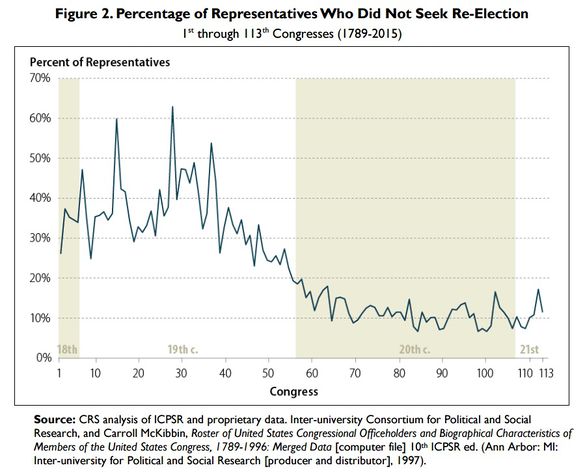
However, that changed after the Civil War. Institutional changes in congressional elections and operations—as well as increasing federal government influence—made longer House tenures more appealing, and incumbents started running for re-election at higher rates.[15] The share of House incumbents not seeking re-election dropped steadily through the end of the 19th century and the beginning of the 20th century before roughly stabilizing at around 11 percent.[16]
To get a more granular look at recent trends in open races, Ballotpedia reviewed elections for all voting members of the House from 2004 to 2014. We found 270 open races out of a total of 2664 elections during that period, for a nationwide rate of just over 10 percent.[17] The average share of open seats was 12 percent, with states like Hawaii and Montana bumping up the numbers. Five of Hawaii’s 14 elections, including special elections for the 1st District in 2010 and the 2nd in 2004, were open races. Montana’s at-large House seat was open twice in the past six cycles.
| Open U.S. House Races, 2004 to 2014[18] | ||||
|---|---|---|---|---|
| State | Open seats | Total seats | Rate of open seats | |
| Alabama | 5 | 43 | 12% | |
| Alaska | 0 | 6 | 0% | |
| Arizona | 8 | 51 | 16% | |
| Arkansas | 6 | 24 | 25% | |
| California | 30 | 326 | 9% | |
| Colorado | 6 | 42 | 14% | |
| Connecticut | 1 | 30 | 3% | |
| Delaware | 1 | 6 | 17% | |
| Florida | 17 | 157 | 11% | |
| Georgia | 10 | 82 | 12% | |
| Hawaii | 5 | 14 | 36% | |
| Idaho | 1 | 12 | 8% | |
| Illinois | 8 | 115 | 7% | |
| Indiana | 7 | 56 | 13% | |
| Iowa | 3 | 28 | 11% | |
| Kansas | 3 | 24 | 13% | |
| Kentucky | 4 | 38 | 11% | |
| Louisiana | 9 | 43 | 21% | |
| Maine | 2 | 12 | 17% | |
| Maryland | 2 | 49 | 4% | |
| Massachusetts | 3 | 59 | 5% | |
| Michigan | 11 | 89 | 12% | |
| Minnesota | 4 | 48 | 8% | |
| Mississippi | 2 | 25 | 8% | |
| Missouri | 5 | 52 | 10% | |
| Montana | 2 | 6 | 33% | |
| Nebraska | 2 | 18 | 11% | |
| Nevada | 4 | 21 | 19% | |
| New Hampshire | 1 | 12 | 8% | |
| New Jersey | 7 | 79 | 9% | |
| New Mexico | 4 | 18 | 22% | |
| New York | 17 | 175 | 10% | |
| North Carolina | 9 | 80 | 11% | |
| North Dakota | 1 | 6 | 17% | |
| Ohio | 9 | 107 | 8% | |
| Oklahoma | 5 | 30 | 17% | |
| Oregon | 2 | 31 | 6% | |
| Pennsylvania | 8 | 113 | 7% | |
| Rhode Island | 1 | 12 | 8% | |
| South Carolina | 5 | 39 | 13% | |
| South Dakota | 1 | 7 | 14% | |
| Tennessee | 5 | 54 | 9% | |
| Texas | 12 | 202 | 6% | |
| Utah | 2 | 20 | 10% | |
| Vermont | 1 | 6 | 17% | |
| Virginia | 5 | 68 | 7% | |
| Washington | 7 | 57 | 12% | |
| West Virginia | 1 | 18 | 6% | |
| Wisconsin | 5 | 48 | 10% | |
| Wyoming | 1 | 6 | 17% | |
| Total | 270 | 2664 | 10% | |
Arizona’s rate of open races was slightly higher than the national average. Eight of the state’s 51 elections between 2004 and 2014 were for open seats, including the 5th District seat that went to Salmon in 2012. Nonetheless, open races were still not common. With the exception of 2012, when the newly created 9th District and a special election helped push the number of open races to four, no more than one of Arizona’s House seats was open in any single cycle from 2004 to 2014.
Current state of the 5th District race[edit]
Though House seats do not come open often, there was not an immediate rush to file for Salmon’s seat. State political observers have identified a number of potential contenders in the 5th District, including Scott Smith, former mayor of Mesa; Steve Chucri, Maricopa County supervisor; Justin Olson, current member of the Arizona House of Representatives (R-Mesa); and Kirk Adams, gubernatorial chief of staff and former congressional candidate.[19] But, as of this writing, just one—Olson—has officially joined Biggs in the contest.[20]
That being said, there is still time for other candidates to enter the race. The filing deadline isn’t until June 1.[21] The primary is slated for August 30.[22]
Conclusion[edit]
Predicting significant interest in the seat left open by Salmon’s retirement, McLeod noted that open House seats are uncommon. It’s too early to tell whether McLeod’s prediction about the 5th District is accurate (just one other candidate has joined the race so far, but the filing deadline is still a couple of months away) but he is right about the general trend. Since 2004, just 10 percent of House races have been open nationwide. Open races were slightly more common in Arizona during the same time period, but, even there, few races failed to feature an incumbent.
See also[edit]

Launched in October 2015 and active through October 2018, Fact Check by Ballotpedia examined claims made by elected officials, political appointees, and political candidates at the federal, state, and local levels. We evaluated claims made by politicians of all backgrounds and affiliations, subjecting them to the same objective and neutral examination process. As of 2025, Ballotpedia staff periodically review these articles to revaluate and reaffirm our conclusions. Please email us with questions, comments, or concerns about these articles. To learn more about fact-checking, click here.
Sources and Notes
- ↑ Prescott eNews, "Salmon's Surprise Retirement Throws Open the Race for His House Seat," February 27, 2016
- ↑ Prescott eNews, "Salmon's Surprise Retirement Throws Open the Race for His House Seat," February 27, 2016
- ↑ Prescott eNews, "Salmon's Surprise Retirement Throws Open the Race for His House Seat," February 27, 2016
- ↑ Prescott eNews, "Salmon's Surprise Retirement Throws Open the Race for His House Seat," February 27, 2016
- ↑ Arizona Secretary of State, "State of Arizona Official Canvass - General Election - November 8, 1994," November 28, 1994
- ↑ USA Today, "Congressmen Differ Over Term-limit Pledges," June 16, 2000
- ↑ Arizona Secretary of State, "State of Arizona Official Canvass - 2000 Primary Election - September 12, 2000," September 25, 2000
- ↑ USA Today, "Congressmen Differ Over Term-limit Pledges," June 16, 2000
- ↑ The Arizona Republic, "Matt Salmon Seeks to Replace Jeff Flake in U.S. House," April 19, 2011
- ↑ Arizona Secretary of State, "State of Arizona Official Canvass - 2012 General Election - November 6, 2012," December 3, 2012
- ↑ Arizona Secretary of State, "State of Arizona Official Canvass - 2014 General Election - November 4, 2014," December 1, 2014
- ↑ Prescott eNews, "Salmon's Surprise Retirement Throws Open the Race for His House Seat," February 27, 2016
- ↑ The share of incumbents not seeking re-election is not identical to the share of open seats because multiple incumbents may run for the same seat—e.g., when drawn into the same district following redistricting. However, these numbers capture the general trend.
- ↑ Congressional Research Service, "Congressional Careers: Service Tenure and Patterns of Member Service, 1789-2015," January 3, 2015
- ↑ Congressional Research Service, "Congressional Careers: Service Tenure and Patterns of Member Service, 1789-2015," January 3, 2015
- ↑ Congressional Research Service, "Congressional Careers: Service Tenure and Patterns of Member Service, 1789-2015," January 3, 2015
- ↑ Verbatim counted a race as open if the incumbent did not appear on the primary or general election ballot so that races in which the incumbent lost in the primary (or won the primary but withdrew or passed away before the general) are not counted as open. Both special and regular elections are included in the calculations unless special and regular elections for the same seat were held concurrently. Sitting House members are counted as incumbents in elections following redistricting, even if their district was renumbered or they opted to run in a different district.
- ↑ This table was compiled by Karen Shanton using data from the Center for Responsive Politics, the Federal Election Commission and the U.S. House of Representatives.
- ↑ Prescott eNews, "Salmon's Surprise Retirement Throws Open the Race for His House Seat," February 27, 2016
- ↑ Federal Election Commission, "FEC Form 2 - Statement of Candidacy," March 10, 2016
- ↑ Ron Gunzburger's Politics1, "Arizona," accessed March 24, 2016
- ↑ Ron Gunzburger's Politics1, "Arizona," accessed March 24, 2016
Contact
More from Fact Check by Ballotpedia
 March 24, 2016 |
 March 22, 2016 |
 March 16, 2016 |
Follow us on Facebook and Twitter



Categories: [Fact Check federal] [Fact Check influencers] [Fact Check House of Representatives] [Fact Check Republican] [Fact Check Arizona] [Fact Check elections] [Fact Check March 2016] [Fact Check 2016]
↧ Download as ZWI file | Last modified: 06/10/2025 09:44:43 | 5 views
☰ Source: https://ballotpedia.org/Fact_check/How_rare_are_open_seats_in_the_U.S._House_of_Representatives | License: CC BY-SA 3.0
 KSF
KSF