29 Amphitrite
 From Handwiki
 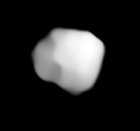 VLT image of Amphitrite | |
| Discovery [1] | |
|---|---|
| Discovered by | A. Marth |
| Discovery site | London |
| Discovery date | 1 March 1854 |
| Designations | |
MPC designation | (29) Amphitrite |
| Pronunciation | /æmfɪˈtraɪtiː/[6] |
| Named after | Amphitrite [2] (Greek mythology) |
Alternative designations | A899 NG |
| Minor planet category | main-belt [1][3] · (middle) background [4][5] |
| Adjectives | Amphitritean /ˌæmfɪtrɪˈtiːən/, /ˌæmfɪˈtraɪtiən/ |
| Orbital characteristics [3] | |
| Epoch 23 March 2018 (JD 2458200.5) | |
| Uncertainty parameter 0 | |
| Observation arc | 162.83 yr (59,472 d) |
| |{{{apsis}}}|helion}} | 2.7400 AU |
| |{{{apsis}}}|helion}} | 2.3712 AU |
Semi-major axis | 2.5556 AU |
| Eccentricity | 0.0722 |
| Orbital period | 4.09 yr (1,492 d) |
| Mean anomaly | 187.97° |
| Mean motion | 0° 14m 28.68s / day |
| Inclination | 6.0823° |
| Longitude of ascending node | 356.37° |
|{{{apsis}}}|helion}} | 63.036° |
| Physical characteristics | |
| Dimensions | c/a = 0.82±0.03[7] 233 km × 212 km × 193 km[8] |
| Mean diameter | 204±2 km[7] 189.6±1.1 km[9] 196±22 km[10] 206.86 km[11] 212.22±6.8 km[12] 227.1±4.0 km[13] |
| Mass | (12.7±2.0)×1018 kg[7] (11.8±?)×1018 kg[8] |
| Mean density | 2.86±0.45 g/cm3[7] 2.36±0.26 g/cm3[8] |
| Rotation period | 5.3921 h[14][5] |
| Geometric albedo | 0.194[7] 0.157±0.035[13] 0.1793±0.012[12] 0.195[11] 0.216±0.043[9] |
Spectral type | S [5] |
| Absolute magnitude (H) | 5.85[1][3] 6.0[4] |
.svg.png) (historical)
(historical)
Amphitrite (minor planet designation: 29 Amphitrite) is one of the largest S-type asteroids, approximately 200 kilometers (120 miles) in diameter, and probably fifth largest after Eunomia, Juno, Iris and Herculina.
Discovery
Amphitrite was discovered by Albert Marth on 1 March 1854, at the private South Villa Observatory, in Regent's Park, London. It was Marth's only asteroid discovery. Its name was chosen by George Bishop, the owner of the observatory, who named it after Amphitrite, a sea goddess in Greek mythology.[2] Its historical symbol was a shell and star; it is in the pipeline for Unicode 17.0 as U+1CECF (.svg.png) ).[15][16]
).[15][16]
Characteristics
.png)
Amphitrite's orbit is less eccentric and inclined than those of its larger cousins; indeed, it is the most circular of any asteroid discovered up to that point. As a consequence, it never becomes as bright as Iris or Hebe, especially as it is much further from the Sun than those asteroids. It can reach magnitudes of around +8.6 at a favorable opposition, but usually is around the binocular limit of +9.5.
In 2007, James Baer and Steven R. Chesley estimated Amphitrite to have a mass of 1.9×10¹⁹ kg.[17] A more recent estimate by Baer suggests it has a mass of 1.18×10¹⁹ kg.[8]
A satellite of the asteroid is suspected to exist, based on lightcurve data collected by Edward F. Tedesco.[18][19] In 1988 a search for satellites or dust orbiting this asteroid was performed using the UH88 telescope at the Mauna Kea Observatories, but neither were found.[20]
References
- ↑ 1.0 1.1 1.2 "29 Amphitrite". Minor Planet Center. https://www.minorplanetcenter.net/db_search/show_object?object_id=29.
- ↑ 2.0 2.1 Schmadel, Lutz D. (2007). "(29) Amphitrite". Dictionary of Minor Planet Names – (29) Amphitrite. Springer Berlin Heidelberg. p. 18. doi:10.1007/978-3-540-29925-7_30. ISBN 978-3-540-00238-3.
- ↑ 3.0 3.1 3.2 "JPL Small-Body Database Browser: 29 Amphitrite". Jet Propulsion Laboratory. https://ssd.jpl.nasa.gov/sbdb.cgi?sstr=2000029.
- ↑ 4.0 4.1 "Asteroid (29) Amphitrite". AstDyS-2, Asteroids – Dynamic Site. https://newton.spacedys.com/astdys/index.php?n=29&pc=1.1.6.
- ↑ 5.0 5.1 5.2 "Asteroid 29 Amphitrite". Small Bodies Data Ferret. https://sbntools.psi.edu/ferret/SimpleSearch/results.action?targetName=29+Amphitrite.
- ↑ Noah Webster (1884) A Practical Dictionary of the English Language
- ↑ 7.0 7.1 7.2 7.3 7.4 P. Vernazza et al. (2021) VLT/SPHERE imaging survey of the largest main-belt asteroids: Final results and synthesis. Astronomy & Astrophysics 54, A56
- ↑ 8.0 8.1 8.2 8.3 Jim Baer (2008). "Recent Asteroid Mass Determinations". Personal Website. http://home.earthlink.net/~jimbaer1/astmass.txt.
- ↑ 9.0 9.1 Masiero, Joseph R.; Grav, T.; Mainzer, A. K.; Nugent, C. R.; Bauer, J. M.; Stevenson, R. et al. (August 2014). "Main-belt Asteroids with WISE/NEOWISE: Near-infrared Albedos". The Astrophysical Journal 791 (2): 11. doi:10.1088/0004-637X/791/2/121. Bibcode: 2014ApJ...791..121M.
- ↑ Hanus, J.; Marchis, F.; Durech, J. (September 2013). "Sizes of main-belt asteroids by combining shape models and Keck adaptive optics observations". Icarus 226 (1): 1045–1057. doi:10.1016/j.icarus.2013.07.023. Bibcode: 2013Icar..226.1045H.
- ↑ 11.0 11.1 Usui, Fumihiko; Kuroda, Daisuke; Müller, Thomas G.; Hasegawa, Sunao; Ishiguro, Masateru; Ootsubo, Takafumi et al. (October 2011). "Asteroid Catalog Using Akari: AKARI/IRC Mid-Infrared Asteroid Survey". Publications of the Astronomical Society of Japan 63 (5): 1117–1138. doi:10.1093/pasj/63.5.1117. Bibcode: 2011PASJ...63.1117U. (online, AcuA catalog p. 153)
- ↑ 12.0 12.1 Tedesco, E. F.; Noah, P. V.; Noah, M.; Price, S. D. (October 2004). "IRAS Minor Planet Survey V6.0". NASA Planetary Data System 12: IRAS-A-FPA-3-RDR-IMPS-V6.0. Bibcode: 2004PDSS...12.....T. https://sbnarchive.psi.edu/pds3/iras/IRAS_A_FPA_3_RDR_IMPS_V6_0/data/diamalb.tab. Retrieved 22 October 2019.
- ↑ 13.0 13.1 Mainzer, A.; Grav, T.; Masiero, J.; Hand, E.; Bauer, J.; Tholen, D. et al. (November 2011). "NEOWISE Studies of Spectrophotometrically Classified Asteroids: Preliminary Results". The Astrophysical Journal 741 (2): 25. doi:10.1088/0004-637X/741/2/90. Bibcode: 2011ApJ...741...90M. (catalog)
- ↑ "LCDB Data for (29) Amphitrite". Asteroid Lightcurve Database (LCDB). http://www.minorplanet.info/PHP/generateOneAsteroidInfo.php?AstInfo=29|Amphitrite.
- ↑ Bala, Gavin Jared; Miller, Kirk (18 September 2023). "Unicode request for historical asteroid symbols". Unicode. https://www.unicode.org/L2/L2023/23207-historical-asteroids.pdf.
- ↑ Unicode. "Proposed New Characters: The Pipeline". The Unicode Consortium. https://unicode.org/alloc/Pipeline.html.
- ↑ Baer, James; Steven R. Chesley (2008). "Astrometric masses of 21 asteroids, and an integrated asteroid ephemeris". Celestial Mechanics and Dynamical Astronomy 100 (2008): 27–42. doi:10.1007/s10569-007-9103-8. Bibcode: 2008CeMDA.100...27B.
- ↑ Tedesco, E. F. (March 1979). "Binary Asteroids: Evidence for Their Existence from Lightcurves". Science. New Series 203 (4383): 905–907. doi:10.1126/science.203.4383.905. PMID 17771729. Bibcode: 1979Sci...203..905T.
- ↑ van Flandern, T. C.; Tedesco, E. F.; Binzel, R. P. (1979). "Satellites of asteroids". Tucson, AZ: University of Arizona Press. pp. 443–465. Bibcode: 1979aste.book..443V.
- ↑ Gradie, J.; Flynn, L. (March 1988), "A Search for Satellites and Dust Belts Around Asteroids: Negative Results", Abstracts of the Lunar and Planetary Science Conference 19: pp. 405–406, Bibcode: 1988LPI....19..405G
External links
- Discovery Circumstances: Numbered Minor Planets (1)-(5000) – Minor Planet Center
- 29 Amphitrite at AstDyS-2, Asteroids—Dynamic Site
- Ephemeris · Observation prediction · Orbital info · Proper elements · Observational info
- 29 Amphitrite at the JPL Small-Body Database
- Close approach · Discovery · Ephemeris · Orbit diagram · Orbital elements · Physical parameters
 |  |
Categories: [Background asteroids] [Named minor planets] [S-type asteroids (Tholen)] [S-type asteroids (SMASS)]
↧ Download as ZWI file | Last modified: 04/02/2024 15:36:45 | 6 views
☰ Source: https://handwiki.org/wiki/Astronomy:29_Amphitrite | License: CC BY-SA 3.0
 KSF
KSF