Pan (Moon)
 From Handwiki
  Color photo of Pan by Cassini in March 2017[lower-alpha 1] | |
| Discovery | |
|---|---|
| Discovered by | M. R. Showalter |
| Discovery date | July 16, 1990 |
| Designations | |
Designation | Saturn XVIII |
| Pronunciation | /ˈpæn/ |
| Named after | Πάν Pān |
| S/1981 S 13 | |
| Adjectives | Pandean /pænˈdiːən/[1] |
| Orbital characteristics[2] | |
| 133584.0±0.1 km | |
| Eccentricity | 0.0000144±0.0000054 |
| Orbital period | 0.575050718 d (13.801217 h) |
| Inclination | 0.0001°±0.0004° |
| Satellite of | Saturn |
| Group | Shepherd moon of the Encke Gap |
| Physical characteristics | |
| Dimensions | 34.6 × 28.2 × 21.0 km (± 0.4 × 0.4 × 1.0 km)[3]: 2 |
| Mean diameter | 27.4±0.6 km[3]: 2 |
| Volume | 10748 km3[3]: 8 |
| Mass | (4.30±0.22)×1015 kg[3]: 3 |
| Mean density | 0.400±0.031 g/cm3[3]: 3 |
| 0.0111–0.0169 m/s2[3]: 3 | |
| 0.006 km/s at longest axis to 0.007 km/s at poles | |
| Rotation period | synchronous |
| Axial tilt | zero |
| Albedo | 0.5 |
| Physics | ≈ 78 K |
Pan is the innermost named moon of Saturn.[4] It is a small, walnut-shaped moon approximately 35 kilometres across and 23 km wide that orbits within the Encke Gap in Saturn's A Ring. Pan is a ring shepherd and is responsible for keeping the Encke Gap free of ring particles. It is sometimes described as having the appearance of a ravioli.[5]
It was discovered by Mark R. Showalter in 1990 from analysis of old Voyager 2 probe photos and received the provisional designation S/1981 S 13 because the discovery images dated back to 1981.[6]
Prediction and discovery
The existence of a moon in the Encke Gap was first predicted by Jeffrey N. Cuzzi and Jeffrey D. Scargle in 1985, based on wavy edges of the gap which indicated a gravitational disturbance.[7] In 1986 Showalter et al. inferred its orbit and mass by modeling its gravitational wake. They arrived at a very precise prediction of 133,603 ± 10 km for the semi-major axis and a mass of 5–10×10−12 Saturn masses, and inferred that there was only a single moon within the Encke gap.[8] The actual semi-major axis differs by 19 km and the actual mass is 8.6×10⁻¹² of Saturn's.
The moon was later found within 1° of the predicted position. The search was undertaken by considering all Voyager 2 images and using a computer calculation to predict whether the moon would be visible under sufficiently favorable conditions in each one. Every qualifying Voyager 2 image with resolution better than ~50 km/pixel shows Pan clearly. In all, it appears in eleven Voyager 2 images.[9][10]
Name
The moon was named on 16 September 1991,[11] after the mythological Pan, who was (among other things) the god of shepherds. This is a reference to Pan's role as a shepherd moon. It is also designated Saturn XVIII.[12]
Orbit
The eccentricity of Pan's orbit causes its distance from Saturn to vary by ~4 km. Its inclination, which would cause it to move up and down, is not distinguishable from zero with present data. The Encke Gap, within which Pan orbits, is about 325 km wide.
Geography
_edge-on.jpg)
Cassini scientists have described Pan as "walnut-shaped"[13] owing to the equatorial ridge, similar to that on Atlas, that is visible in images. The ridge is due to ring material that Pan has swept up from the Encke gap. It has been referred to by journalists as a space empanada, a form of stuffed bread or pastry, as well as a ravioli.[14][15] A new study suggests that the bizarre shape of Pan could also be due to collisions between tiny moonlets, thus causing them to merge and form Pan (known as the pyramidal regime formation scenario).[16]
Pandean ringlet
The Encke Gap contains a ringlet that is coincident with Pan's orbit, indicating that Pan maintains the particles in horseshoe orbits.[17] A second ringlet is periodically disrupted by Pan, similarly to how the F Ring is disturbed by Prometheus.[18]
Gallery
-
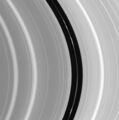 Closeup of the Encke Gap, showing the central ringlet that is coincident with Pan's orbit.
 -
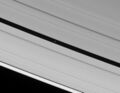 Cassini image showing Pan orbiting in the Encke Gap.
 -
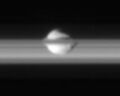 Equatorial view of Pan from Cassini, with the rings of Saturn surrounding the moon.
 -
 Pan in the center of the image, occupying the Encke Gap in Saturn's rings. Its walnut-like shape is clearly visible.
 -
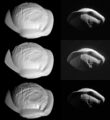 Stretched (4x) images, processed in various ways.


See also
Notes
- ↑ This color photo of Pan was created by combining separate photos taken in infrared, green, and ultraviolet spectral filters of the Cassini spacecraft's narrow-angle Imaging Science Subsystem (ISS) camera on 7 March 2017. This view of the moon's northern hemisphere shows its walnut-like appearance, with a highly inclined equatorial ridge almost eclipsing the moon's southern hemisphere from view.
References
- ↑ Pandean (3rd ed.), Oxford University Press, September 2005, http://oed.com/search?searchType=dictionary&q=Pandean (Subscription or UK public library membership required.)
- ↑ Jacobson, R. A. (2008). "Revised orbits of Saturn's small inner satellites". Astronomical Journal 135 (1): 261–263. doi:10.1088/0004-6256/135/1/261. Bibcode: 2008AJ....135..261J.
- ↑ 3.0 3.1 3.2 3.3 3.4 3.5 Thomas, P. C.; Helfenstein, P. (July 2020). "The small inner satellites of Saturn: Shapes, structures and some implications". Icarus 344: 20. doi:10.1016/j.icarus.2019.06.016. 113355. Bibcode: 2020Icar..34413355T.
- ↑ "Saturn - Moons". NASA. https://solarsystem.nasa.gov/planets/saturn/moons.
- ↑ "Saturn's Tiny Moon Pan Looks Like a Ravioli". CNET. https://www.cnet.com/news/nasa-saturn-pan-cassini-ravioli-moon/.
- ↑ IAUC 5052: Saturn July 16, 1990 (discovery)
- ↑ Cuzzi, J. N.; and Scargle, J. D.; Wavy Edges Suggest Moonlet in Encke's Gap, Astrophysical Journal, Vol. 292 (May 1, 1985), pp. 276–290
- ↑ Showalter, M. R. (1986). "Satellite "wakes" and the orbit of the Encke Gap moonlet". Icarus 66 (2): 297–323. doi:10.1016/0019-1035(86)90160-0. Bibcode: 1986Icar...66..297S. https://zenodo.org/record/1253894.
- ↑ Showalter, M. R. (1990). "Visual Detection of 1981 S 13, the Encke Gap Moonlet". Bulletin of the American Astronomical Society 22: 1031. http://adsabs.harvard.edu//full/seri/BAAS./0022//0001040.000.html.
- ↑ Showalter, M. R. (1991). "Visual detection of 1981 S 13, Saturn's eighteenth satellite, and its role in the Encke gap". Nature 351 (6329): 709–713. doi:10.1038/351709a0. Bibcode: 1991Natur.351..709S.
- ↑ IAUC 5347: Satellites of Saturn and Neptune 1991 September 16 (naming the moon)
- ↑ "Planet and Satellite Names and Discoverers". Gazetteer of Planetary Nomenclature. USGS Astrogeology. July 21, 2006. http://planetarynames.wr.usgs.gov/append7.html.
- ↑ "PIA08320: Cruising with Pan", Planetary Photojournal.
- ↑ Chang, Kenneth (10 March 2017). "Pan, Moon of Saturn, Looks Like a Cosmic Ravioli (or Maybe a Walnut)". The New York Times. https://www.nytimes.com/2017/03/10/science/nasa-cassini-saturn-moon-pan.html?_r=0.
- ↑ Perkins, Sid (2017-03-09). "Stunning close-up of Saturn's moon, Pan, reveals a space empanada". http://www.sciencemag.org/news/2017/03/space-empanada-frozen-ridge-around-saturn-s-moon-pan-collected-planet-s-rings.
- ↑ "Here's Why Saturn's Inner Moons Are Shaped Like Ravioli and Potatoes". 22 May 2018. https://www.space.com/amp/40653-saturns-weird-moon-shapes-explained.html.
- ↑ Hedman, M.M.; Burns, J.A.; Hamilton, D.P.; Showalter, M.R. (2013). "Of horseshoes and heliotropes: Dynamics of dust in the Encke Gap". Icarus 223 (1): 252–276. doi:10.1016/j.icarus.2012.11.036. Bibcode: 2013Icar..223..252H.
- ↑ Porco, C.C.; Baker, E.; Barbara, John; Beurle, K.; Brahic, A.; Burns, J.A.; Charnoz, S.; Cooper, N. et al. (2005). "Cassini Imaging Science: Initial Results on Saturn's Rings and Small Satellites". Science 307 (5713): 1226–1236. doi:10.1126/science.1108056. PMID 15731439. Bibcode: 2005Sci...307.1226P.
External links
.jpg)
 |  |
Categories: [Moons of Saturn]
↧ Download as ZWI file | Last modified: 06/11/2026 07:40:41 | 37 views
☰ Source: https://handwiki.org/wiki/Astronomy:Pan_(moon) | License: CC BY-SA 3.0
 KSF
KSF