Geforce 10 Series
 From Handwiki
   GeForce GTX 1080 Ti released in 2017, the series' flagship unit | |
| Release date | May 27, 2016 |
|---|---|
| Codename | GP10x |
| Architecture | Pascal |
| Models | GeForce GTX series |
| Transistors |
|
| Fabrication process |
|
| Cards | |
| Entry-level |
|
| Mid-range |
|
| High-end |
|
| Enthusiast |
|
| API support | |
| Direct3D | Direct3D 12.0 (feature level 12 1) Shader Model 6.7 |
| OpenCL | OpenCL 3.0[1][lower-alpha 1] |
| OpenGL | OpenGL 4.6[2] |
| Vulkan | |
| History | |
| Predecessor | GeForce 900 series |
| Successor | |
The GeForce 10 series is a series of graphics processing units developed by Nvidia, initially based on the Pascal microarchitecture announced in March 2014. This design series succeeded the GeForce 900 series, and is succeeded by the GeForce 16 series and GeForce 20 series using the Turing microarchitecture.[citation needed]
Architecture
The Pascal microarchitecture, named after Blaise Pascal, was announced in March 2014 as a successor to the Maxwell microarchitecture.[4] The first graphics cards from the series, the GeForce GTX 1080 and 1070, were announced on May 6, 2016, and were released several weeks later on May 27 and June 10, respectively. The architecture incorporates either 16 nm FinFET (TSMC) or 14 nm FinFET (Samsung) technologies. Initially, chips were only produced in TSMC's 16 nm process, but later chips were made with Samsung's newer 14 nm process (GP107, GP108).[5]
New Features in GP10x:
- CUDA Compute Capability 6.0 (GP100 only), 6.1 (GP102, GP104, GP106, GP107, GP108)
- DisplayPort 1.4 (No DSC)
- HDMI 2.0b
- Fourth generation Delta Color Compression
- PureVideo Feature Set H hardware video decoding HEVC Main10 (10 bit), Main12 (12 bit) & VP9 hardware decoding (GM200 & GM204 did not support HEVC Main10/Main12 & VP9 hardware decoding)[6]
- HDCP 2.2 support for 4K DRM protected content playback & streaming (Maxwell GM200 & GM204 lack HDCP 2.2 support, GM206 supports HDCP 2.2)[7]
- NVENC HEVC Main10 10 bit hardware encoding (except GP108 which doesn't support NVENC[8])
- GPU Boost 3.0
- Simultaneous Multi-Projection
- HB SLI Bridge Technology
- New memory controller with GDDR5X & GDDR5 support (GP102, GP104, GP106)[9]
- Dynamic load balancing scheduling system. This allows the scheduler to dynamically adjust the amount of the GPU assigned to multiple tasks, ensuring that the GPU remains saturated with work except when there is no more work that can safely be distributed. Nvidia therefore has safely enabled asynchronous compute in Pascal's driver.[10]
- Instruction-level preemption. In graphics tasks, the driver restricts this to pixel-level preemption because pixel tasks typically finish quickly and the overhead costs of doing pixel-level preemption are much lower than performing instruction-level preemption. Compute tasks get either thread-level or instruction-level preemption. Instruction-level preemption is useful because compute tasks can take long times to finish and there are no guarantees on when a compute task finishes, so the driver enables the very expensive instruction-level preemption for these tasks.[11]
- Triple buffering implemented in the driver level. Nvidia calls this "Fast Sync". This has the GPU maintain three frame buffers per monitor. This results in the GPU continuously rendering frames, and the most recently completely rendered frame is sent to a monitor each time it needs one. This removes the initial delay that double buffering with vsync causes and disallows tearing. The costs are that more memory is consumed for the buffers and that the GPU will consume power drawing frames that might be wasted because two or more frames could possibly be drawn between the time a monitor is sent a frame and the time the same monitor needs to be sent another frame. In this case, the latest frame is picked, causing frames drawn after the previously displayed frame but before the frame that is picked to be completely wasted.[12] This feature has been backported to Maxwell-based GPUs in driver version 372.70.[13]
Nvidia has announced that the Pascal GP100 GPU will feature four High Bandwidth Memory stacks, allowing a total of 16 GB HBM2 on the highest-end models,[14] 16 nm technology,[5] Unified Memory and NVLink.[15]
Starting with Windows 10 version 2004, support has been added for using a hardware graphics scheduler to reduce latency and improve performance, which requires a driver level of WDDM 2.7.
Products
Founders Edition

Announcing the GeForce 10 series products, Nvidia introduced Founders Edition graphics card versions of the GTX 1060, 1070, 1070 Ti, 1080 and 1080 Ti. These are what were previously known as reference cards, i.e. which were designed and built by Nvidia and not by its authorized board partners. These cards have started being used as reference to measure performance of partner cards. The Founders Edition cards have a die cast machine-finished aluminum body with a single radial fan and a vapor chamber cooling (1070 Ti, 1080, 1080 Ti only[16]), an upgraded power supply and a new low profile backplate (1070, 1070 Ti, 1080, 1080 Ti only).[17] Nvidia also released a limited supply of Founders Edition cards for the GTX 1060 that were only available directly from Nvidia's website.[18] Founders Edition cards prices (with the exception of the GTX 1070 Ti and 1080 Ti) are greater than MSRP of partners cards; however, some partners' cards, incorporating a complex design, with liquid or hybrid cooling may cost more than Founders Edition.
-
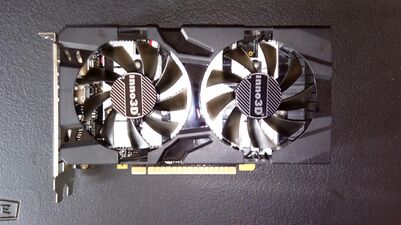 An Inno3D GeForce GTX 1050 Twin X2
 -
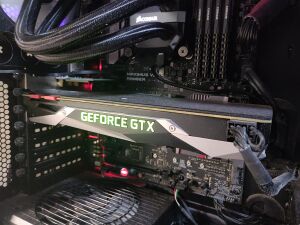 A GeForce GTX 1080 Founders Edition in a computer


Reintroduction of older cards

Due to production problems surrounding the RTX 30-series cards and a general shortage of graphics cards due to production issues caused by the ongoing COVID-19 pandemic, which led to a global shortage of semiconductor chips, and general demand for graphics cards increasing due to an increase in cryptocurrency mining, the GTX 1050 Ti, alongside the RTX 2060 and its Super counterpart,[19] was brought back into production in 2021.[20][21]
The reintroduction of the GTX 1050 Ti in 2021 caused a minor controversy regarding pricing; in Poland, during the 1050 Ti's launch period, the card cost around 600-850 Polish złotych, compared to the 2021 price of 1000 Polish złotych.[22]
In addition, Nvidia quietly released the GeForce GT 1010 in January 2021.[23]
GeForce 10 (10xx) series for desktops
- Supported display standards are: DP 1.3/1.4, HDMI 2.0b, dual link DVI[lower-alpha 2][24]
- Supported APIs are: Direct3D 12 (feature level 12_1), OpenGL 4.6, OpenCL 3.0 and Vulkan 1.2
| Model | Launch | Code name(s) | Fab (nm) | Transistors (billion) | Die size (mm2) | Bus interface |
Core config[lower-alpha 3] |
SM count[lower-alpha 4] |
L2 cache (KB) |
Clock speeds[lower-alpha 5] | Fillrate[lower-alpha 6][lower-alpha 7] | Memory[lower-alpha 5] | Processing power (GFLOPS)[lower-alpha 8] | TDP (watts) |
SLI HB support[lower-alpha 9] |
Launch MSRP (United States dollar ) | |||||||||
|---|---|---|---|---|---|---|---|---|---|---|---|---|---|---|---|---|---|---|---|---|---|---|---|---|---|
| Base core clock (MHz) |
Boost core clock (MHz) |
Memory (MT/s) |
Pixel (GP/s) |
Texture (GT/s) |
Size (GB) |
Bandwidth (GB/s) |
Type | Bus width (bit) |
Single precision (boost) |
Double precision (boost) |
Half precision (boost)[25] |
Standard | Founders Edition | ||||||||||||
| GeForce GT 1010 (DDR4)[lower-alpha 10][26][27][28] |
2022 | GP108-200-A1 | 14 | 1.8 | 74 | PCIe 3.0 ×4 |
256:16:16 | 2 | 256 | 1151 | 1379 | 2100 | 18.42 | 18.42 | 2 | 16.8 | DDR4 | 64 | 589.3 (706.1) |
24.56 (29.42) |
N/A | 20 | No | ? | N/A |
| GeForce GT 1010[lower-alpha 10][23][29] |
2021 | GP108-200-A1 | 1228 | 1468 | 5000 | 23.49 | 23.49 | 40.1 | GDDR5 | 629 (752) |
26.2 (31.3) |
30 | $70[30] | ||||||||||||
| GeForce GT 1030 (DDR4)[lower-alpha 10][31][32] |
2018 | GP108-310-A1 | 384:24:16 | 3 | 512 | 1151 | 1379 | 2100 | 18.41 | 27.6 | 16.8 | DDR4 | 883 (1059) |
27 (33) |
13 (16) |
20 | $80[33] | ||||||||
| GeForce GT 1030[lower-alpha 10][31][34] |
2017 | GP108-300-A1 | 1227 | 1468 | 6000 | 19.6 | 29.4 | 48 | GDDR5 | 942 (1127) |
29 (35) |
15 (18) |
30 | ||||||||||||
| GeForce GTX 1050 (2GB)[35][36] |
2016 | GP107-300-A1 | 3.3 | 132 | PCIe 3.0 ×16 |
640:40:32 | 5 | 1024 | 1354 | 1455 | 7000 | 43.3 | 54.2 | 112 | 128 | 1733 (1862) |
54 (58) |
27 (29) |
75 | $109 | |||||
| GeForce GTX 1050 (3GB)[37] |
2018 | GP107-301-A1 | 768:48:24 | 6 | 768 | 1392 | 1518 | 33.4 | 66.8 | 3 | 84 | 96 | 2138 (2332) |
66 (72) |
33 (36) |
? | |||||||||
| GeForce GTX 1050 Ti[35][38][39] |
2016 | GP107-400-A1 | 768:48:32 | 1024 | 1290 | 1392 | 41.3 | 61.9 | 4 | 112 | 128 | 1981 (2138) |
62 (67) |
31 (33) |
$139 | ||||||||||
| GeForce GTX 1060 (3GB)[40][41] |
2016 | GP106-300-A1 | 16 | 4.4 | 200 | 1152:72:48 | 9 | 1536 | 1506 | 1708 | 8000 | 72.3 | 108.4 | 3 | 192 | 192 | 3470 (3935) |
108 (123) |
54 (61) |
120 | $199 | ||||
| GeForce GTX 1060 (5GB)[42][43] |
2017 (Only available in China) |
GP106-350-K3-A1 | 1280:80:40 | 10 | 1280 | 8000 | 60.2 | 120.5 | 5 | 160 | 160 | 3855 (4372) |
120 (137) |
60 (68) |
OEM | ||||||||||
| GeForce GTX 1060[40][44][45] |
2016 | GP106-400-A1 GP106-410-A1 |
1280:80:48 | 1536 | 8000 9000 |
72.3 | 6 | 192 216 |
192 | $249 | $299 | ||||||||||||||
| GeForce GTX 1060 (GDDR5X)[46] |
2018 | GP104-150-KA-A1 | 7.2 | 314 | 8000 | 192 | GDDR5X | N/A | N/A | ||||||||||||||||
| GeForce GTX 1070[47][48] |
2016 | GP104-200-A1 | 1920:120:64 | 15 | 2048 | 1683 | 96.4[lower-alpha 11][49] | 180.7 | 8 | 256 | GDDR5 | 256 | 5783 (6463) |
181 (202) |
90 (101) |
150 | 2-way SLI HB[50] or 2/3/4-way SLI[51] |
$379 | $449 | ||||||
| GeForce GTX 1070 Ti[52] |
2017 | GP104-300-A1 | 2432:152:64 | 19 | 1607 | 102.8 | 244.3 | 7816 (8186) |
244 (256) |
122 (128) |
180 | $449 | |||||||||||||
| GeForce GTX 1080[24][53][54] |
2016 | GP104-400-A1 GP104-410-A1 |
2560:160:64 | 20 | 1733 | 10000 11000 |
257.1 | 320 352 |
GDDR5X | 8228 (8873) |
257 (277) |
128 (139) |
$599 | $699 | |||||||||||
| GeForce GTX 1080 Ti[55] |
2017 | GP102-350-K1-A1 | 12 | 471 | 3584:224:88 | 28 | 2816 | 1480 | 1582 | 11000 | 130.2 | 331.5 | 11 | 484 | 352 | 10609 (11340) |
332 (354) |
166 (177) |
250 | $699 | |||||
| Nvidia Titan X[56][57] |
2016 | GP102-400-A1 | 3584:224:96 | 3072 | 1417 | 1531 | 10000 | 136 | 317.4 | 12 | 480 | 384 | 10157 (10974) |
317 (343) |
159 (171) |
N/A | $1200 | ||||||||
| Nvidia Titan Xp[58][59] |
2017 | GP102-450-A1 | 3840:240:96 | 30 | 1405 | 1582 | 11410 | 135 | 337.2 | 547.7 | 10790 (12150) |
337 (380) |
169 (190) | ||||||||||||
| Model | Launch | Code name(s) | Fab (nm) | Transistors (billion) | Die size (mm2) | Bus interface |
Core config[lower-alpha 3] |
SM count[lower-alpha 4] |
L2 cache (KB) |
Clock speeds[lower-alpha 5] | Fillrate[lower-alpha 6][lower-alpha 7] | Memory | Processing power (GFLOPS)[lower-alpha 8] | TDP (watts) |
SLI HB support[lower-alpha 9] |
Launch MSRP (United States dollar ) | |||||||||
| Base core clock (MHz) |
Boost core clock (MHz) |
Memory (MT/s) |
Pixel (GP/s) |
Texture (GT/s) |
Size (GB) |
Bandwidth (GB/s) |
Type | Bus width (bit) |
Single precision (boost) |
Double precision (boost) |
Half precision (boost)[60] |
Standard | Founders Edition | ||||||||||||
- ↑ In OpenCL 3.0, OpenCL 1.2 functionality has become a mandatory baseline, while all OpenCL 2.x and OpenCL 3.0 features were made optional.
- ↑ The Nvidia Titan Xp & the Founders Edition GTX 1080 Ti does not have a dual link DVI port, but a DisplayPort to single link DVI adapter is included in the box.
- ↑ 3.0 3.1 Shader Processors: Texture mapping units: Render output units
- ↑ 4.0 4.1 The number of streaming multiprocessors on the GPU.
- ↑ 5.0 5.1 5.2 GTX 1060 and GTX 1080 cards shipped after April 2017 feature increased memory speeds, thus increasing memory bandwidth.
- ↑ 6.0 6.1 Pixel fillrate is calculated as the lowest of three numbers: number of ROPs multiplied by the base core clock speed, number of rasterizers multiplied by the number of fragments they can generate per rasterizer multiplied by the base core clock speed, and the number of streaming multiprocessors multiplied by the number of fragments per clock that they can output multiplied by the base clock rate.
- ↑ 7.0 7.1 Texture fillrate is calculated as the number of TMUs multiplied by the base core clock speed.
- ↑ 8.0 8.1 For calculating the processing power, see the Performance subsection of the Pascal architecture article.
- ↑ 9.0 9.1 SLI HB only supports a maximum of 2-way SLI using SLI HB bridges, however if using traditional SLI bridges it can support a maximum of 4-way SLI but the performance is mostly improved in synthetic benchmarks only.
- ↑ 10.0 10.1 10.2 10.3 Lacks hardware video encoder
- ↑ The GTX 1070 has one of the four GPCs disabled in the die. Losing one of the Raster Engines only allows for the use of 48 ROPs per cycle.
GeForce 10 (10xx) series for notebooks
The biggest highlight to this line of notebook GPUs is the implementation of configured specifications close to (for the GTX 1060–1080) and exceeding (for the GTX 1050/1050 Ti) that of their desktop counterparts, as opposed to having "cut-down" specifications in previous generations. As a result, the "M" suffix is completely removed from the model's naming schemes, denoting these notebook GPUs to possess similar performance to those made for desktop PCs, including the ability to overclock their core frequencies by the user, something not possible with previous generations of notebook GPUs. This was made possible by having lower Thermal Design Power (TDP) ratings as compared to their desktop equivalents, making these desktop-level GPUs thermally feasible to be implemented into OEM notebook chassis with improved thermal dissipation designs, and, as such, are only available through the OEMs. In addition, the entire line of GTX Notebook GPUs also are available in lower-TDP and quieter variations called the "Max-Q Design", specifically made for ultra-thin gaming systems in conjunction with OEM Partners that incorporate enhanced heat dissipation mechanisms with lower operating noise volumes, which are also made available as an additional more powerful option to existing gaming notebooks as well, which was launched on 27 June 2017.
In addition, the GT series line of Notebook GPUs is no longer introduced starting from this generation, replaced by the MX series of Notebook GPUs. Only the MX150 is based on Pascal's GP108 die used on the GT1030 for Desktops, with higher clock frequencies compared to its Desktop counterpart, while the other chips in the MX series were re-branded versions of the previous generation GPUs (MX130 is a re-branded GT940MX GPU while MX110 is a re-branded GT920MX GPU).[citation needed]
- Supported APIs are: Direct3D 12 (feature level 12_1 or 11_0 on MX110 and MX130), OpenGL 4.6, OpenCL 3.0 and Vulkan 1.2
- Only GTX 1070 and GTX 1080 have SLI support.
| Model | Launch | Code name(s) |
Fab (nm) | Transistors (billion) | Die size (mm2) | Bus interface |
Core config[lower-alpha 1] |
SM Count[lower-alpha 2] |
L2 cache (MB) |
Clock speeds | Fillrate[lower-alpha 3][lower-alpha 4] | Memory | Processing power (GFLOPS)[lower-alpha 5] | TDP (watts) | ||||||||
|---|---|---|---|---|---|---|---|---|---|---|---|---|---|---|---|---|---|---|---|---|---|---|
| Base core clock (MHz) |
Boost core clock (MHz) |
Memory (MT/s) |
Pixel (GP/s) |
Texture (GT/s) |
Size (GB) |
Bandwidth (GB/s) |
Type | Bus width (bit) |
Single precision (Boost) |
Double precision (Boost) |
Half precision (Boost) | |||||||||||
| GeForce MX110[lower-alpha 6][61][62] |
2017 | GM108 (N16V-GMR1) |
28 | ? | ? | PCIe 3.0 ×4 |
384:24:8 | 3 | 1.0 | 965 | 993 | 1800 (DDR3) 5000 (GDDR5) |
7.944 | 23.83 | 2 | 14.4 (DDR3) 40.1 (GDDR5) |
DDR3 GDDR5 |
64 | 741.1 (762.6) |
23.16 (23.83) |
N/A | 30 |
| GeForce MX130[lower-alpha 6][63][64] |
GM108 (N16S-GTR) |
1122 | 1242 | 9.936 | 29.81 | 861.7 (953.9) |
26.93 (29.81) | |||||||||||||||
| GeForce MX150[lower-alpha 6][65][66][67] |
2017 | GP108 (N17S-LG) |
14 | 1.8 | 74 | 384:24:16 | 0.5 | 937 | 1038 | 5000 | 14.99 | 22.49 | 2 4 |
40.1 | GDDR5 | 719.6 (797.2) |
22.49 (24.91) |
11.24 (12.45) |
10 | |||
| GP108 (N17S-G1) |
1468 | 1532 | 6000 | 23.49 | 35.23 | 48 | 1127 (1177) |
35.23 (36.77) |
17.62 (18.38) |
25 | ||||||||||||
| GeForce GTX 1050 Max-Q (Notebook)[68][69] |
2018 | GP107 (N17P-G0) |
3.3 | 132 | PCIe 3.0 ×16 |
640:40:16 | 5 | 1.0 | 999–1189 | 1139–1328 | 7000 | 19.02 | 47.56 | 112 | 128 | 1278–1521 (1457–1699) |
39.96–47.56 (45.56–53.12) |
19.98–23.78 (22.78–26.56) |
34-40 | |||
| GeForce GTX 1050 (Notebook)[68][69] |
2017 | 1354 | 1493 | 21.66 | 54.16 | 1733 (1911) |
54.16 (59.72) |
27.08 (29.86) |
53 | |||||||||||||
| GeForce GTX 1050 Ti Max-Q (Notebook)[68][70] |
2018 | GP107 (N17P-G1) |
768:48:32 | 6 | 1151–1290 | 1290–1417 | 41.28 | 61.92 | 4 | 1767–1981 (1981–2176) |
55.24–61.92 (61.92–68.02) |
27.62–30.96 (30.96–34.01) |
40-46 | |||||||||
| GeForce GTX 1050 Ti (Notebook)[68][70] |
2017 | 1493 | 1620 | 47.78 | 71.66 | 2293 (2488) |
71.66 (77.76) |
35.83 (38.88) |
64 | |||||||||||||
| GeForce GTX 1060 Max-Q (Notebook)[68][71] |
2017 | GP106 (N17E-G1) |
16 | 4.4 | 200 | 1280:80:48 | 10 | 1.5 | 1063–1265 | 1341–1480 | 8000 | 60.72 | 101.2 | 3 6 |
192 | 192 | 2721–3238 (3432–3788) |
85.04–101.2 (107.3–118.4) |
42.52–50.60 (53.64–59.20) |
60-70 | ||
| GeForce GTX 1060 (Notebook)[68][71] |
2016 | 1404 | 1670 | 67.39 | 112.3 | 3594 (4275) |
112.3 (133.6) |
56.16 (66.80) |
80 | |||||||||||||
| GeForce GTX 1070 Max-Q (Notebook)[68][72] |
2017 | GP104 (N17E-G2) |
7.2 | 314 | 2048:128:64 | 16 | 2.0 | 1101–1215 | 1265–1379 | 77.76 | 155.5 | 8 | 256 | 256 | 4509–4977 (5181–5648) |
140.9–155.5 (161.9–176.5) |
70.46–77.76 (80.96–88.26) |
80-90 | ||||
| GeForce GTX 1070 (Notebook)[68][72] |
2016 | 1442 | 1645 | 92.29 | 184.6 | 5906 (6738) |
184.6 (210.6) |
92.29 (105.3) |
115 | |||||||||||||
| GeForce GTX 1080 Max-Q (Notebook)[68][73] |
2017 | GP104 (N17E-G3) |
2560:160:64 | 20 | 1101–1290 | 1278–1458 | 10000 | 82.56 | 206.4 | 320 | GDDR5X | 5637–6605 (6543–7465) |
176.2–206.4 (204.5–233.3) |
88.08–103.2 (102.2–116.6) |
90-110 | |||||||
| GeForce GTX 1080 (Notebook)[68][73] |
2016 | 1556 | 1733 | 99.58 | 249.0 | 7967 (8873) |
249.0 (277.3) |
124.5 (138.6) |
150 | |||||||||||||
- ↑ Shader Processors: Texture mapping units: Render output units
- ↑ The number of streaming multiprocessors on the GPU.
- ↑ Pixel fillrate is calculated as the lowest of three numbers: number of ROPs multiplied by the base core clock speed, number of rasterizers multiplied by the number of fragments they can generate per rasterizer multiplied by the base core clock speed, and the number of streaming multiprocessors multiplied by the number of fragments per clock that they can output multiplied by the base clock rate.
- ↑ Texture fillrate is calculated as the number of TMUs multiplied by the base core clock speed.
- ↑ For calculating the processing power, see the Performance subsection of the Pascal architecture article.
- ↑ 6.0 6.1 6.2 Lacks hardware video encoder and decoder
Discontinued support
Nvidia stopped releasing 32-bit drivers for 32-bit operating systems after driver 391.35 in March 2018.[74]
Nvidia announced that after release of the 470 drivers, it would transition driver support for the Windows 7 and Windows 8.1 operating systems to legacy status and continue to provide critical security updates for these operating systems through September 2024.[75] The GeForce 10 series is the last Nvidia GPU generation to support Windows 7/8.x or any 32-bit operating system; beginning with the Turing architecture, newer Nvidia GPUs now require a 64-bit operating system.
See also
- GeForce 900 series
- GeForce 16 series
- GeForce 20 series
- GeForce 30 series
- GeForce 40 series
- Nvidia Quadro
- Nvidia Tesla
- Pascal (microarchitecture)
- List of Nvidia graphics processing units
References
- ↑ "OpenCL Driver Support | NVIDIA Developer" (in en-US). 24 April 2013. https://developer.nvidia.com/opencl.
- ↑ "OpenGL Driver Support | NVIDIA Developer". NVIDIA. 19 August 2013. https://developer.nvidia.com/opengl-driver.
- ↑ "Vulkan Driver Support | NVIDIA Developer". February 10, 2016. https://developer.nvidia.com/vulkan-driver.
- ↑ "NVIDIA Updates GPU Roadmap; Announces Pascal" (in en-US). http://blogs.nvidia.com/blog/2014/03/25/gpu-roadmap-pascal/.
- ↑ 5.0 5.1 btarunr (September 17, 2015). "NVIDIA "Pascal" GPUs to be Built on 16 nm TSMC FinFET Node". http://www.techpowerup.com/216080/nvidia-pascal-gpus-to-be-built-on-16-nm-tsmc-finfet-node.html.
- ↑ "How The New Pascal Architecture Supports Next-Generation Video Playback". May 17, 2016. http://www.geforce.com/whats-new/articles/pascal-video-playback.
- ↑ "Nvidia Pascal HDCP 2.2". http://www.geforce.com/hardware/10series/geforce-gtx-1080/.
- ↑ "Whether GT1030 is support nvenc encoder?". December 6, 2017. https://devtalk.nvidia.com/default/topic/1027260/video-codec-sdk/whether-gt1030-is-support-nvenc-encoder-/.
- ↑ Shrout, Ryan (July 14, 2016). "3DMark Time Spy: Looking at DX12 Asynchronous Compute Performance". http://www.pcper.com/reviews/Graphics-Cards/3DMark-Time-Spy-Looking-DX12-Asynchronous-Compute-Performance.
- ↑ Smith, Ryan (July 20, 2016). "The NVIDIA GeForce GTX 1080 & GTX 1070 Founders Editions Review: Kicking Off the FinFET Generation". p. 9. http://www.anandtech.com/show/10325/the-nvidia-geforce-gtx-1080-and-1070-founders-edition-review/9.
- ↑ Smith, Ryan (July 20, 2016). "The NVIDIA GeForce GTX 1080 & GTX 1070 Founders Editions Review: Kicking Off the FinFET Generation". p. 10. http://www.anandtech.com/show/10325/the-nvidia-geforce-gtx-1080-and-1070-founders-edition-review/10.
- ↑ Smith, Ryan; Wilson, Derek (July 20, 2016). "The NVIDIA GeForce GTX 1080 & GTX 1070 Founders Editions Review: Kicking Off the FinFET Generation". p. 13. http://www.anandtech.com/show/10325/the-nvidia-geforce-gtx-1080-and-1070-founders-edition-review/13.
- ↑ "Release 370 Graphics Drivers for Windows, Version 372.70" (in en-US). August 30, 2016. http://us.download.nvidia.com/Windows/372.70/372.70-win10-win8-win7-desktop-release-notes.pdf.
- ↑ Harris, Mark (April 5, 2016). "Inside Pascal: NVIDIA's Newest Computing Platform". Parallel Forall. Nvidia. https://devblogs.nvidia.com/parallelforall/inside-pascal/.
- ↑ "NVIDIA Pascal GPU Architecture to Provide 10X Speedup for Deep Learning Apps | NVIDIA Blog". http://blogs.nvidia.com/blog/2015/03/17/pascal/.
- ↑ Oh, Nate (November 2, 2017). "The NVIDIA GeForce GTX 1070 Ti Founders Edition Review: GP104 Comes in Threes". AnandTech. http://www.anandtech.com/show/11987/the-nvidia-geforce-gtx-1070-ti-founders-edition-review.
- ↑ Burnes, Andrew (May 18, 2016). "GeForce GTX 1080 Founders Edition: Premium Construction & Advanced Features". http://www.geforce.com/whats-new/articles/geforce-gtx-1080-founders-edition.
- ↑ "A Quantum Leap for Every Gamer: NVIDIA Unveils the GeForce GTX 1060". July 7, 2016. http://nvidianews.nvidia.com/news/a-quantum-leap-for-every-gamer:-nvidia-unveils-the-geforce-gtx-1060.
- ↑ WhyCry (January 20, 2021). "NVIDIA to reintroduce GeForce RTX 2060 and RTX 2060 SUPER to the market". https://videocardz.com/newz/nvidia-to-reintroduce-geforce-rtx-2060-and-rtx-2060-super-to-the-market.
- ↑ Dent, Steve (February 12, 2021). "NVIDIA revives the GTX 1050 Ti in the face of GPU shortages". https://www.engadget.com/nvidia-revives-the-gtx-1050-ti-in-the-face-of-gpu-shortages-113533736.html.
- ↑ Chacos, Brad (February 11, 2021). "Confirmed: Nvidia taps the GTX 1050 Ti to battle graphics card shortages". https://www.pcworld.com/article/3607190/nvidia-rtx-30-graphics-card-shortages-gaming-gpu-gtx-1050-ti-geforce-rtx-2060.html.
- ↑ "NVIDIA wznawia produkcję układów GTX 1050 Ti" (in PL). February 16, 2021. https://nt.interia.pl/komputery/news-nvidia-wznawia-produkcje-ukladow-gtx-1050-ti,nId,5051247.
- ↑ 23.0 23.1 "NVIDIA quietly introduces the GeForce GT 1010". January 16, 2021. https://www.notebookcheck.net/NVIDIA-quietly-introduces-the-GeForce-GT-1010-A-Pascal-GP108-GPU-with-256-CUDA-cores-2-GB-GDDR5-VRAM-and-55-W-TDP.515158.0.html.
- ↑ 24.0 24.1 "GTX 1080 Graphics Card". http://www.geforce.com/hardware/10series/geforce-gtx-1080.
- ↑ Smith, Ryan (July 20, 2016). "FP16 Throughput on GP104: Good for Compatibility (and Not Much Else) - The NVIDIA GeForce GTX 1080 & GTX 1070 Founders Editions Review: Kicking Off the FinFET Generation". http://www.anandtech.com/show/10325/the-nvidia-geforce-gtx-1080-and-1070-founders-edition-review/5.
- ↑ "NVIDIA GeForce GT 1010 DDR4 Specs". https://www.techpowerup.com/gpu-specs/geforce-gt-1010-ddr4.c3874.
- ↑ Liu, Zhiye (June 8, 2022). "Colorful Unchains GeForce GT 1010 With DDR4 to Rival iGPUs". https://www.tomshardware.com/uk/news/colorful-unchains-geforce-gt-1010-with-ddr4-to-rival-igpus.
- ↑ WhyCry (June 7, 2022). "Colorful launches entry-level GeForce GT 1010 with DDR4 memory and 20W TDP". https://videocardz.com/newz/colorful-launches-entry-level-geforce-gt-1010-with-ddr4-memory-and-20w-tdp.
- ↑ "NVIDIA GeForce GT 1010 Specs". https://www.techpowerup.com/gpu-specs/geforce-gt-1010.c3762.
- ↑ Subramaniam, Vaidyanathan (February 2, 2022). "Nvidia GT 1010 now available for US$70, GP108 Pascal card 40% slower than GT 1030; entry-level Radeon RX 6500 XT is a cool 1,378% faster". https://www.notebookcheck.net/Nvidia-GT-1010-now-available-for-US-70-GP108-Pascal-card-40-slower-than-GT-1030-and-93-slower-than-Radeon-RX-6500-XT.596746.0.html.
- ↑ 31.0 31.1 "GeForce GT 1030 | GeForce". http://www.geforce.com/hardware/desktop-gpus/geforce-gt-1030.
- ↑ "NVIDIA GeForce GT 1030 DDR4 Specs". https://www.techpowerup.com/gpu-specs/geforce-gt-1030-ddr4.c3187.
- ↑ Paul, Ian (May 17, 2017). "Nvidia quietly launches the GeForce GT 1030, a Radeon RX 550 rival with a modest price". http://www.pcworld.com/article/3196801/components-graphics/nvidia-quietly-launches-the-geforce-gt-1030-a-radeon-rx-550-rival-with-a-modest-price.html.
- ↑ Angelini, Chris (July 13, 2017). "Nvidia GeForce GT 1030 2GB Review". Tom's Hardware. http://www.tomshardware.com/reviews/nvidia-geforce-gt-1030-2gb,5110.html.
- ↑ 35.0 35.1 "GTX 1050 Graphics Card". https://www.nvidia.com/en-us/geforce/products/10series/geforce-gtx-1050/.
- ↑ "NVIDIA GeForce GTX 1050". https://www.techpowerup.com/gpudb/2875/geforce-gtx-1050.
- ↑ "Nvidia GTX 1050". https://www.nvidia.com/en-us/geforce/products/10series/geforce-gtx-1050/.
- ↑ "NVIDIA GeForce GTX 1050 Ti". https://www.techpowerup.com/gpudb/2885/geforce-gtx-1050-ti.
- ↑ "Palit GeForce GTX 1050 Ti KalmX Review - Introduction". http://www.guru3d.com/articles-pages/palit-geforce-gtx-1050-ti-kalmx-review,1.html.
- ↑ 40.0 40.1 "GTX 1060 Graphics Card". https://www.nvidia.com/en-us/geforce/products/10series/geforce-gtx-1060/.
- ↑ "NVIDIA GeForce GTX 1060 3 GB". https://www.techpowerup.com/gpudb/2867/geforce-gtx-1060-3-gb.
- ↑ "ASUS GTX1060-5G-SI" (in ZH). https://www.asus.com.cn/Graphics-Cards/GTX1060-5G-SI/.
- ↑ "NVIDIA GeForce GTX 1060 5GB" (in en-US). https://videocardz.net/nvidia-geforce-gtx-1060-5gb.
- ↑ "NVIDIA GeForce GTX 1060 6 GB". https://www.techpowerup.com/gpudb/2862/geforce-gtx-1060-6-gb.
- ↑ "Nvidia GeForce GTX 1060 6GB Review". Tom's Hardware. July 19, 2016. http://www.tomshardware.com/reviews/nvidia-geforce-gtx-1060-pascal,4679.html.
- ↑ "NVIDIA GeForce 10 Series Graphics Cards". https://www.nvidia.com/en-us/geforce/products/10series/geforce-gtx-1060/.
- ↑ "GTX 1070 Graphics Card". https://www.nvidia.com/en-us/geforce/products/10series/geforce-gtx-1070-ti/.
- ↑ "NVIDIA GeForce GTX 1070". https://www.techpowerup.com/gpudb/2840/geforce-gtx-1070.
- ↑ Smith, Ryan (July 20, 2016). "Synthetics - The NVIDIA GeForce GTX 1080 & GTX 1070 Founders Editions Review: Kicking Off the FinFET Generation". http://www.anandtech.com/show/10325/the-nvidia-geforce-gtx-1080-and-1070-founders-edition-review/29.
- ↑ W1zzard (May 17, 2016). "Nvidia GeForce GTX 1080 8 GB". TechPowerUp. http://www.techpowerup.com/reviews/NVIDIA/GeForce_GTX_1080/3.html.
- ↑ W1zzard (June 21, 2016). "Nvidia GeForce GTX 1080 SLI". TechPowerUp. https://www.techpowerup.com/reviews/NVIDIA/GeForce_GTX_1080_SLI/23.html.
- ↑ "GTX 1070 Ti Graphics Card". https://www.nvidia.com/en-us/geforce/products/10series/geforce-gtx-1070-ti/.
- ↑ "NVIDIA GeForce GTX 1080". https://www.techpowerup.com/gpudb/2839/geforce-gtx-1080.
- ↑ "The GeForce GTX 1080 8GB Founders Edition Review – GP104 Brings Pascal to Gamers". https://www.pcper.com/reviews/Graphics-Cards/GeForce-GTX-1080-8GB-Founders-Edition-Review-GP104-Brings-Pascal-Gamers.
- ↑ "NVIDIA GeForce 10 Series Graphics Cards". https://www.nvidia.com/en-us/geforce/products/10series/geforce-gtx-1080-ti/.
- ↑ "NVIDIA TITAN X Graphics Card with Pascal". https://www.nvidia.com/en-us/geforce/products/10series/titan-x-pascal/.
- ↑ "NVIDIA TITAN X Pascal". https://www.techpowerup.com/gpudb/2863/titan-x-pascal.
- ↑ "TITAN Xp Graphics Card with Pascal Architecture". https://www.nvidia.com/en-us/geforce/products/10series/titan-xp/.
- ↑ "NVIDIA TITAN Xp". https://www.techpowerup.com/gpudb/2948/titan-xp.
- ↑ Smith, Ryan (July 20, 2016). "FP16 Throughput on GP104: Good for Compatibility (and Not Much Else) - The NVIDIA GeForce GTX 1080 & GTX 1070 Founders Editions Review: Kicking Off the FinFET Generation". http://www.anandtech.com/show/10325/the-nvidia-geforce-gtx-1080-and-1070-founders-edition-review/5.
- ↑ "GeForce MX110 Specifications GeForce" (in en). https://www.geforce.com/hardware/notebook-gpus/nvidia-geforce-mx110/specifications.
- ↑ "NVIDIA GeForce MX110 Specs". https://www.techpowerup.com/gpu-specs/geforce-mx110.c3044.
- ↑ "GeForce MX130 Specifications GeForce" (in en). https://www.geforce.com/hardware/notebook-gpus/nvidia-geforce-mx130/specifications.
- ↑ "NVIDIA GeForce MX130 Specs". https://www.techpowerup.com/gpu-specs/geforce-mx130.c3043.
- ↑ Burnes, Andrew (May 25, 2017). "Introducing GeForce MX150 Laptops: Supercharged For Work and Play | Geforce News | NVIDIA". Nvidia. https://www.geforce.com/whats-new/articles/nvidia-geforce-mx150-laptops.
- ↑ "NVIDIA GeForce MX150 Specs (N17S-LG-A1)". https://www.techpowerup.com/gpu-specs/geforce-mx150.c2984.
- ↑ "NVIDIA GeForce MX150 Specs (N17S-G1-A1)". https://www.techpowerup.com/gpu-specs/geforce-mx150.c2959.
- ↑ 68.00 68.01 68.02 68.03 68.04 68.05 68.06 68.07 68.08 68.09 "GeForce GTX 10-Series Laptops". https://www.nvidia.com/en-us/geforce/products/10series/laptops.
- ↑ 69.0 69.1 "NVIDIA GeForce GTX 1050 Max-Q vs NVIDIA GeForce GTX 1050 Mobile". https://www.notebookcheck.net/GeForce-GTX-1050-Max-Q-vs-GeForce-GTX-1050-Mobile_8482_7503.247598.0.html.
- ↑ 70.0 70.1 "NVIDIA GeForce GTX 1050 Ti Max-Q vs NVIDIA GeForce GTX 1050 Ti Mobile". https://www.notebookcheck.net/GeForce-GTX-1050-Ti-Max-Q-vs-GeForce-GTX-1050-Ti-Mobile_8480_7346.247598.0.html.
- ↑ 71.0 71.1 "NVIDIA GeForce GTX 1060 Max-Q vs NVIDIA GeForce GTX 1060 Mobile". https://www.notebookcheck.net/GeForce-GTX-1060-Max-Q-vs-GeForce-GTX-1060-Mobile_8010_7362.247598.0.html.
- ↑ 72.0 72.1 "NVIDIA GeForce GTX 1070 Max-Q vs NVIDIA GeForce GTX 1070 Mobile". https://www.notebookcheck.net/GeForce-GTX-1070-Max-Q-vs-GeForce-GTX-1070-Mobile_8008_7364.247598.0.html.
- ↑ 73.0 73.1 "NVIDIA GeForce GTX 1080 Max-Q vs NVIDIA GeForce GTX 1080 Mobile". https://www.notebookcheck.net/GeForce-GTX-1080-Max-Q-vs-GeForce-GTX-1080-Mobile_8006_7376.247598.0.html.
- ↑ "Support Plan for 32-bit and 64-bit Operating Systems | NVIDIA". http://nvidia.custhelp.com/app/answers/detail/a_id/4604/.
- ↑ "Support Plan for Windows 7 and Windows 8/8.1 | NVIDIA". https://nvidia.custhelp.com/app/answers/detail/a_id/5201.
External links
 |  |
Categories: [Graphics processing units]
↧ Download as ZWI file | Last modified: 05/07/2026 01:39:03 | 4 views
☰ Source: https://handwiki.org/wiki/GeForce_10_series | License: CC BY-SA 3.0
 KSF
KSF