Explorers Program
 From Handwiki

The Explorers Program[1] is a NASA exploration program that provides flight opportunities for physics, geophysics, heliophysics, and astrophysics investigations from space. Launched in 1958, Explorer 1 was the first spacecraft of the United States to achieve orbit. Over 90 space missions have been launched since. Starting with Explorer 6, it has been operated by NASA, with regular collaboration with a variety of other institutions, including many international partners.
Launchers for the Explorers Program have included Juno I, Juno II, various Thor, Scout, Delta and Pegasus launch vehicles, and Falcon 9.[2][3]
The program has three classes: Medium-Class Explorers (MIDEX), Small Explorers (SMEX), and University-Class Explorers (UNEX), with select Missions of Opportunity operated with other agencies.[citation needed]
History
Early Explorer satellites


The Explorers Program began as a U.S. Army proposal (Project Orbiter) to place a "civilian" artificial satellite into orbit during the International Geophysical Year (IGY). Although that proposal was rejected in favor of the U.S. Navy's Project Vanguard, which made the first sub-orbital flight Vanguard TV0 in December 1956, the Soviet Union's launch of Sputnik 1 on 4 October 1957 (and the resulting "Sputnik crisis") and the failure of the Vanguard 1 launch attempt resulted in the Army program being funded to match the Soviet space achievements. Explorer 1 was launched on the Juno I on 1 February 1958, becoming the first U.S. satellite, as well as discovering the Van Allen radiation belt.
Four follow-up satellites of the Explorer series were launched by the Juno I launch vehicle in 1958, of which Explorer 3 and Explorer 4 were successful, while Explorer 2 and Explorer 5 failed to reach orbit.[4] The Juno I vehicle was replaced by the Juno II in 1959.
Continuation of the Explorers Program
With the establishment of NASA in 1958, the Explorers Program was transferred to NASA from the U.S. Army. NASA continued to use the name for an ongoing series of relatively small space missions, typically an artificial satellite with a specific science focus. Explorer 6 in 1959 was the first scientific satellite under the project direction of NASA's Goddard Space Flight Center (GSFC) in Greenbelt, Maryland.[5][6]
The Interplanetary Monitoring Platform (IMP) was launched in 1963 and involved a network of eleven Explorer satellites designed to collect data on space radiation in support of the Apollo program. The IMP program was a major step forward in spacecraft electronics design, as it was the first space program to use integrated circuit (IC) chips and MOSFETs (MOS transistors).[7][8] The IMP-A (Explorer 18) in 1963 was the first spacecraft to use IC chips, and the IMP-D (Explorer 33) in 1966 was the first to use MOSFETs.[7]
| Mission | Photo | Satellite | Launch date | Decay date | Notes | |
|---|---|---|---|---|---|---|
| Explorer | IMP | |||||
| IMP-1 | 
|
Explorer 18 | IMP-A | 27 November 1963, 02:30 UTC[9] | 30 December 1965 | First use of integrated circuits in a spacecraft. First satellite in IMP-A/-B/-C design series. |
| IMP-2 | 
|
Explorer 21 | IMP-B | 4 October 1964, 03:45 UTC[9] | 1 January 1966 | Second satellite in IMP-A/-B/-C design series. |
| IMP-3 | 
|
Explorer 28 | IMP-C | 29 May 1965, 12:00 UTC[9] | 4 July 1968 | Third satellite in IMP-A/-B/-C design series. |
| AIMP-1 | 
|
Explorer 33 | IMP-D | 1 July 1966, 16:02 UTC[9] | In orbit | First use of MOSFET integrated circuits in a spacecraft, similar design to IMP-E. Originally intended to orbit the Moon, but placed in an elliptical high orbit instead. |
| IMP-4 | 
|
Explorer 34 | IMP-F | 24 May 1967, 14:05 UTC[9] | 3 May 1969 | Similar design to IMP-G. |
| AIMP-2 | 
|
Explorer 35 | IMP-E | 19 July 1967, 14:19 UTC[9] | After 24 June 1973 | Similar design to IMP-D. Positioned in Selenocentric orbit. |
| IMP-5 | 
|
Explorer 41 | IMP-G | 21 June 1969, 08:47 UTC[9] | 23 December 1972 | Similar design to IMP-F. |
| IMP-6 | 
|
Explorer 43 | IMP-I | 13 March 1971, 16:15 UTC[9] | 2 October 1974 | First spacecraft in IMP-I/-H/-J series. |
| IMP-7 | 
|
Explorer 47 | IMP-H | 23 September 1972, 01:20 UTC[9] | In orbit | Second spacecraft in IMP-I/-H/-J series. |
| IMP-8 | 
|
Explorer 50 | IMP-J | 26 October 1973, 02:26 UTC[9] | In orbit | Third spacecraft in IMP-I/-H/-J series, remained in service until 2006 |
SMEX, MIDEX, and Student Explorers Programs
In 1988, the Small Explorer (SMEX) class was established with a focus on frequent flight opportunities for highly focused and relatively inexpensive space science missions in the disciplines of astrophysics and space physics.[10][11] The first three SMEX missions were chosen in April 1989 out of 51 candidates, and launched in 1992, 1996 and 1998[12] The second set of two missions were announced in September 1994 and launched in 1998 and 1999.[10]

In the mid-1990s, NASA initiated the Medium-class Explorers (MIDEX) to enable more frequent flights. These are larger than SMEX missions and were to be launched aboard a new kind of medium-light class launch vehicle.[10] This new launch vehicle was not developed and instead, these missions were flown on a modified Delta II rocket.[13][14] The first announcement opportunity for MIDEX was issued in March 1995, and the first launch under this new class was FUSE in 1999.[10]
In May 1994, NASA started the Student Explorer Demonstration Initiative (STEDI) pilot program, to demonstrate that high-quality space science can be carried out with small, low-cost missions. Of the three selected missions, SNOE was launched in 1998 and TERRIERS in 1999, but the latter failed after launch. The STEDI program was terminated in 2001.[10] Later, NASA established the University-Class Explorer (UNEX) program for much cheaper missions, which is regarded as a successor to STEDI.[15]
The Explorer missions were at first managed by the Small Explorers Project Office at NASA's Goddard Space Flight Center (GSFC). In early 1999, that office was closed and with the announcement of opportunity for the third set of SMEX missions NASA converted the SMEX class so that each mission was managed by its principal investigator, with oversight by the GSFC Explorer Project.[16] The Explorers Program Office at Goddard Space Flight Center, provides management of the many operational scientific exploration missions that are characterized by relatively moderate costs and small to medium-sized missions that are capable of being built, tested, and launched in a short time interval compared to larger observatories like NASA's Great Observatories.[17]
Excluding the launches, the MIDEX class has a current mission cap cost of US$250 million in 2018,[18] with future MIDEX missions being capped at US$350 million.[19] The cost cap for SMEX missions in 2017 was US$165 million.[20] UNEX missions are capped at US$15 million.[21] A sub-project called Missions of Opportunity (MO) has funded science instruments or hardware components of onboard non-NASA space missions, and have a total NASA cost cap of US$70 million.[18][21]
Classes
Medium-Class (MIDEX)
| Name | MIDEX number |
Explorer number |
Launch (UTC) | Status |
|---|---|---|---|---|
| RXTE | Explorer-69 | 30 December 1995 | Ended in 2012 / Reentered on 30 April 2018 | |
| ACE | Explorer-71 | 25 August 1997 | Operational | |
| FUSE | MIDEX-0 | Explorer-77 | 23 June 1999 | Ended in 2007 |
| IMAGE | MIDEX-1 | Explorer-78 | 25 March 2000 | Lost contact in 2005. Partial contact reestablished in January 2018 |
| WMAP | MIDEX-2 | Explorer-80 | 30 June 2001 | Ended in 2010 |
| Swift | MIDEX-3 | Explorer-84 | 20 November 2004 | Operational |
| FAME | MIDEX-4 | —
|
Scheduled for 2004 | Cancelled in 2002 (cost) |
| THEMIS A | MIDEX-5A | Explorer-85 | 17 February 2007 | Operational |
| THEMIS B | MIDEX-5B | Explorer-86 | 17 February 2007 | Operational |
| THEMIS C | MIDEX-5C | Explorer-87 | 17 February 2007 | Operational |
| THEMIS D | MIDEX-5D | Explorer-88 | 17 February 2007 | Operational |
| THEMIS E | MIDEX-5E | Explorer-89 | 17 February 2007 | Operational |
| WISE / NEOWISE | MIDEX-6 | Explorer-92 | 14 December 2009 | Mission operations completed on 31 July 2024.[25] Reentered on 2 November 2024. |
| TESS | MIDEX-7 | Explorer-95 | 18 April 2018 | Operational |
| ICON | MIDEX-8 | Explorer-96 | 11 October 2019 | Operational |
| SPHEREx | MIDEX-9 | Explorer-102 | 12 March 2025 | Operational |
| MUSE | MIDEX-10 | 2027 | In development | |
| HelioSwarm | MIDEX-11 | 2029 | In development | |
| UVEX | MIDEX-12 | 2030 | In development |
Small Explorers (SMEX)
The Small Explorers class was implemented in 1989 specifically to fund space exploration missions that cost no more than US$120 million.[21][12] The missions are managed by the Explorers Project at the Goddard Space Flight Center (GSFC).[16]
The first set of three SMEX missions were launched between 1992 and 1998. The second set of two missions were launched in 1998 and 1999. These early missions were managed by the Small Explorers Project Office at Goddard Space Flight Center. In early 1999, that office was closed and with the announcement of opportunity for the third set of SMEX missions NASA converted the program so that each mission was managed by its Principal Investigator, with oversight by the GSFC Explorers Project.[16]
NASA funded a competitive study of five candidate heliophysics Small Explorers missions for flight in 2022. The proposals were Mechanisms of Energetic Mass Ejection – eXplorer (MEME-X), Focusing Optics X-ray Solar Imager (FOXSI), Multi-Slit Solar Explorer (MUSE), Tandem Reconnection and Cusp Electrodynamics Reconnaissance Satellites (TRACERS), and Polarimeter to Unify the Corona and Heliosphere (PUNCH).[26][27][28] In June 2019 NASA selected TRACERS and PUNCH for flight.[29]
| Name | SMEX number |
Explorer number |
Launch (UTC) | End of mission |
Status |
|---|---|---|---|---|---|
| SAMPEX | SMEX-1 | Explorer-68 | 3 July 1992 | 30 June 2004 | Reentered on 13 November 2012 |
| FAST | SMEX-2 | Explorer-70 | 21 August 1996 | 4 May 2009 | |
| SWAS | SMEX-3 | Explorer-74 | 6 December 1998 | 21 July 2004 | |
| TRACE | SMEX-4 | Explorer-73 | 2 April 1998 | 21 June 2010 | Reentered on 18 July 2025[31] |
| WIRE | SMEX-5 | Explorer-75 | 5 March 1999 | N/A | Spacecraft equipment failure; reentered on 10 May 2011 |
| RHESSI | SMEX-6 | Explorer-81 | 5 February 2002 | April 2018 | Deorbited on 20 April 2023 |
| GALEX | SMEX-7 | Explorer-83 | 28 April 2003 | May 2012 | Decommissioned on 28 June 2013 |
| SPIDR | SMEX-8 | —
|
Scheduled for 2005 | N/A | Cancelled in 2003 due to poor instrument sensitivity [32] |
| Aeronomy of Ice in the Mesosphere (AIM) | SMEX-9 | Explorer-90 | 25 April 2007 | 19 August 2024 | Reentered on 19 August 2024 |
| IBEX | SMEX-10 | Explorer-91 | 19 October 2008 | Operational | |
| NuSTAR | SMEX-11 | Explorer-93 | 13 June 2012 | Operational | |
| IRIS | SMEX-12 | Explorer-94 | 28 June 2013 | Operational | |
| GEMS | SMEX-13 | —
|
Scheduled for 2014 | N/A | Cancelled in 2012 due to expected cost overruns[33] |
| Imaging X-ray Polarimetry Explorer (IXPE) | SMEX-14 | Explorer-97 | 9 December 2021 | Operational | |
| PUNCH-NFI | SMEX-15A | Explorer-98 | 12 March 2025[34] | Operational | |
| PUNCH-WFI 1 | SMEX-15B | Explorer-99 | 12 March 2025[34] | Operational | |
| PUNCH-WFI 3 | SMEX-15D | Explorer-100 | 12 March 2025[34] | Operational | |
| PUNCH-WFI 2 | SMEX-15C | Explorer-101 | 12 March 2025[34] | Operational | |
| TRACERS A | SMEX-16A | Explorer-106 | 23 July 2025 | Operational | |
| TRACERS B | SMEX-16B | Explorer-107 | 23 July 2025 | Operational | |
| COSI | SMEX-17 | August 2027[35] | In development |
-
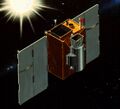 SAMPEX
 -
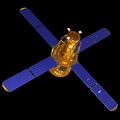 RHESSI
 -
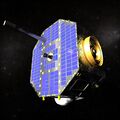 IBEX
IBEX -
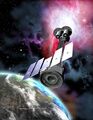 IXPE
IXPE


University-Class Explorers (UNEX)
| Name | UNEX number | Explorer number |
Launch (UTC) | Status |
|---|---|---|---|---|
| SNOE | UNEX-1 | Explorer-72 | 26 February 1998 | Ended in 2000; decayed from orbit in December 2003 |
| IMEX | UNEX-2 | —
|
Scheduled for 2003 | Cancelled before 2005 (cost)[37] |
| CHIPS | UNEX-3 | Explorer-82 | 12 January 2003 | Ended in 2008 |
Missions of Opportunity (MO)
Missions of Opportunity (MO) are investigations characterized by being part of a non-NASA space mission of any size and having a total NASA cost of under $55 million. These missions are conducted on a no-exchange-of-funds basis with the organization sponsoring the mission. NASA solicits proposals for Missions of Opportunity on SMEX, MIDEX and UNEX investigations.[38]
| Name | Launcher (mission) | Launch (UTC) | Status |
|---|---|---|---|
| HETE-2 | NASA (Explorer-79) | 9 October 2000 | Ended in March 2008[39] |
| INTEGRAL | ESA[40] | 17 October 2002 | Ended on 28 February 2025[41] |
| Suzaku (Astro-E2) | JAXA[42] | 10 July 2005 | Ended on 2 September 2015 |
| TWINS | NRO (USA-184;[43] USA-200[44]) |
TWINS-1: 28 June 2006 TWINS-2: 13 March 2008 |
Operational |
| CINDI | DoD (C/NOFS)[45] | 16 April 2008 | Ended in November 2015 |
| Hitomi (Astro-H) | JAXA[46] | 17 February 2016 | Failed |
| NICER | ISS (CRS-11) | 3 June 2017 | Operational |
| GOLD | SES (SES-14) | 25 January 2018 | Operational |
| XRISM | JAXA | 6 September 2023 | Operational |
| AWE | ISS (CRS-29) | December 2023 | Ended on 21 May 2026[47] |
| GUSTO | NASA (high-altitude balloon) | 31 December 2023 | Ended on 26 February 2024[48] |
| EZIE | NASA, JHUAPL | 15 March 2025 | Operational |
| SunRISE | NASA (Maxar satellite) | 2026 | In development[49][50] |
| Solar-C EUVST | JAXA | July 2028 | In development[51][52] |
| CASE | ESA (Cosmic Vision M4) | 2029 | In development[53][54] |
Beacon Explorers
Three satellites were planned in this series: Beacon Explorer-A, Beacon Explorer-B, Beacon Explorer-C.
GEOS series
A series of three Geodetic Earth Orbiting Satellite (GEOS) were put in orbit: GEOS 1, GEOS 2, GEOS 3.
Launched spacecraft
Explorers Program name numbers can be found in the NSSDC master catalog, typically assigned to each spacecraft in a mission. These numbers were not officially assigned until after 1975.[55]
| No. | Name(s) | Launch date (UTC) | Rocket | Mass (kg) | Orbit regime | End of data | Re-entry [60] |
Mission/Notes |
|---|---|---|---|---|---|---|---|---|
| 1 | Explorer 1 | 1 February 1958 | Juno I | 14 | MEO | 23 May 1958 | 31 March 1970 | First American satellite, third satellite to achieve orbit; discovered the Van Allen radiation belt; launched by the U.S. Army[61] |
| 2 | Explorer 2 | 5 March 1958 | Juno I | 15 | Failed | — | — | Failed to achieve orbit.[62] |
| 3 | Explorer 3 | 26 March 1958 | Juno I | 14 | MEO | 27 June 1958 | 27 June 1958 | Energetic particle studies helped confirm the presence of Van Allen radiation belt[63] |
| 4 | Explorer 4 | 26 July 1958 | Juno I | 26 | MEO | 5 October 1958 | 23 October 1959 | Monitor charged particles inside Van Allen belts from nuclear detonations (during Operation Argus)[64] |
| 5 | Explorer 5 | 24 August 1958 | Juno I | 17 | failed | — | — | Planned in conjunction with Explorer 4, but launch failed[65] |
| — | Explorer S-1 (7X) | 16 July 1959 | Juno II | 42 | failed | — | — | Planned to measure Earth's radiation balance, but destroyed within seconds by range safety[66] |
| 6 | Explorer 6 (S-2, Able 3) | 7 August 1959 | Thor-Able | 64 | HEO | 6 October 1959 | 12 July 1961 | Magnetosphere research and digital telemetry; first NASA launch, first Earth photo from orbit[67][68] |
| 7 | Explorer 7 (S-1A) | 13 October 1959 | Juno II | 42 | LEO | 24 August 1961 | In orbit | Micrometeoroids and energetic particle studies, first satellite to measure Earth's climate[69][70][71] |
| – | S-46A (IE-B) | 23 March 1960 | Juno II | 16 | failed | — | — | Analyze electron and proton radiation energies, failed to achieve orbit[72] |
| 8 | Explorer 8 (S-30) | 3 November 1960 | Juno II | 41 | LEO | 27 December 1960 | 27 March 2012 | Measured atmospheric composition of the ionosphere[73] |
| – | S-56 | 4 December 1960 | Scout X-1 | 6 | failed | — | — | Atmosphere density measurement, but failed to achieve orbit[74] |
| 9 | Explorer 9 (S-56A) | 16 February 1961 | Scout X-1 | 36 | LEO | 9 April 1964 | 9 April 1964 | Atmospheric density measurements, first spacecraft placed in orbit by a solid-fuel rocket[75] |
| – | S-45 | 24 February 1961 | Juno II | 34 | failed | — | — | Ionosphere research, but failed to achieve orbit[76] |
| 10 | Explorer 10 (P 14) | 25 March 1961 | Thor-Delta | 79 | HEO | 25 March 1961 | 1 June 1968 | Investigated the magnetic field between the Earth and Moon[77] |
| 11 | Explorer 11 (S 15) | 27 April 1961 | Juno II | 37 | LEO | 17 November 1961 | In orbit | Gamma ray astronomy[78] |
| – | S-45A | 25 May 1961 | Juno II | 34 | failed | — | — | Ionosphere research, failed to achieve orbit. Last Juno II launch.[79] |
| – | S-55 (satellite) (Meteoroid Satellite-A, Micrometeorite Explorer) | 30 June 1961 | Scout X-1 | 85 | failed | — | — | Micrometeoroid research, failed to achieve orbit[80] |
| 12 | EPE-A (S 3, Energetic Particle Explorer-A) | 16 August 1961 | Thor-Delta | 38 | HEO | 6 December 1961 | 1 September 1963 | Energetic particle research[81] |
| 13 | Explorer 13 (S-55A) | 25 August 1961 | Scout X-1 | 86 | LEO | 28 August 1961 | 28 August 1961 | Micrometeoroid research; partial failure[82] |
| 14 | EPE-B (Energetic Particle Explorer-B) | 2 October 1962 | Delta A | 40 | HEO | 11 August 1963 | 1 July 1966 | Energetic particle research[83] |
| 15 | EPE-C (S-3B, Energetic Particle Explorer-C) | 27 October 1962 | Delta A | 44 | HEO | 30 January 1963 | 15 January 1978 | Energetic particle research[84] |
| 16 | S-55B | 16 December 1962 | Scout X-3 | 101 | LEO | 22 July 1963 | In orbit | Micrometeoroid research[85] |
| 17 | AE-A (S-6, Atmosphere Explorer-A) | 3 April 1963 | Delta B | 184 | LEO | 10 July 1963 | 24 November 1966 | Atmospheric research[86] |
| 18 | IMP-A (IMP 1, Interplanetary Monitoring Platform-A) | 27 November 1963 | Delta C | 138 | HEO | 10 May 1965 | 30 December 1965 | Magnetospheric research[87] |
| 19 | AD-A (Atmospheric Density-A) | 19 December 1963 | Scout X-4 | 8 | LEO | 10 May 1981 | 10 May 1981 | Atmospheric density measurements[88] |
| – | BE-A (Beacon Explorer-A, S-66A) | 19 March 1964 | Delta B | 114 | failed | — | — | Launch failure[89] |
| 20 | IE-A (S 48, TOPSI, Ionosphere Explorer-A) | 25 August 1964 | Scout X-4 | 45 | LEO | 29 December 1965 | In orbit | Ionosphere research[90] |
| 21 | IMP-B (IMP 2, Interplanetary Monitoring Platform-B) | 4 October 1964 | Delta C | 135 | HEO | 13 October 1965 | 30 January 1966 | Magnetospheric research[91] |
| 22 | BE-B (Beacon Explorer-B, S-66B) | 10 October 1964 | Scout X-4 | 53 | LEO | February 1970 | In orbit | Ionospheric and geodetic research[92] |
| 23 | S 55C | 6 November 1964 | Scout X-4 | 134 | LEO | 7 November 1965 | 29 June 1983 | Micrometeoric research[93] |
| 24 | AD-B (Atmospheric Density-B) | 21 November 1964 | Scout X-4 | 9 | MEO | 18 October 1968 | 18 October 1968 | Atmospheric density measurements[94] |
| 25 | Injun 4 (IE-B, Ionosphere Explorer-B) | 21 November 1964 | Scout X-4 | 40 | LEO | December 1966 | In orbit | Ionospheric research[95] |
| 26 | EPE-D (Energetic Particle Explorer-D) | 21 December 1964 | Delta C | 46 | MEO | 27 December 1967 | 23 August 2021 | High energy particle observations[96] |
| 27 | BE-C (Beacon Explorer-C, S-66C) | 29 April 1965 | Scout X-4 | 61 | LEO | 20 July 1973 | In orbit | Magnetospheric research[97] |
| 28 | IMP-C (IMP 3, Interplanetary Monitoring Platform-C) | 29 May 1965 | Delta C | 128 | HEO | 12 May 1967 | 4 July 1968 | Magnetospheric research[98] |
| 29 | GEOS 1 (GEOS-A, Geodetic Earth Orbiting Satellite-1) | 6 November 1965 | Delta E | 387 | LEO | 23 June 1978 | In orbit | Geodetic Earth monitoring[99] |
| 30 | SOLRAD 8 (SE-A) | 19 November 1965 | Scout X-4 | 57 | LEO | 5 November 1967 | In orbit | Solar radiation monitoring (Cover for covert ELINT mission)[100] |
| 31 | DME-A (Direct Measurements Explorer) | 29 November 1965 | Thor-Agena B | 99 | LEO | 1 October 1969 | In orbit | Ionospheric research[101] |
| 32 | AE-B (Atmosphere Explorer-B) | 25 May 1966 | Delta C1 | 225 | LEO | March 1967 | 22 February 1985 | Atmospheric research[102] |
| 33 | IMP-D (AIMP 1, Interplanetary Monitoring Platform-D) | 1 July 1966 | Delta E1 | 212 | HEO | 21 September 1971[103] | In orbit | Magnetospheric research |
| 34 | IMP-F (IMP 4, Interplanetary Monitoring Platform-F) | 24 May 1967 | Delta E1 | 163 | MEO | 3 May 1969 | 3 May 1969 | Magnetospheric research[104] |
| 35 | IMP-E (AIMP 2, Interplanetary Monitoring Platform-E) | 19 July 1967 | Delta E1 | 230 | Lunar | 24 June 1973 | Lunar orbit | Magnetospheric research[105] |
| 36 | GEOS 2 (GEOS-B, Geodetic Earth Orbiting Satellite-2) | 11 January 1968 | Delta E1 | 469 | LEO | 1 July 1982 | In orbit | Geodetic Earth monitoring[106] |
| 37 | SOLRAD 9 (SE B) | 5 March 1968 | Scout B | 198 | LEO | 30 April 1974 | 16 November 1990 | Solar radiation monitoring (Cover for covert ELINT mission)[107] |
| 38 | RAE-A (RAE 1, Radio Astronomy Explorer-A) | 4 July 1968 | Delta J | 602 | MEO | (~1969) | In orbit | Radio astronomy[108] |
| 39 | AD-C (Atmospheric Density-C) | 8 August 1968 | Scout B | 9 | LEO | 23 June 1971 | 22 June 1981 | Atmospheric density measurements[109] |
| 40 | Injun 5 (Injun C, IE-C, Ionosphere Explorer-C) | 8 August 1968 | Scout B | 71 | LEO | June 1971 | In orbit | Magnetospheric Research[110] |
| 41 | IMP-G (IMP 5, Interplanetary Monitoring Platform-G) | 21 June 1969 | Delta E1 | 145 | HEO | 23 December 1972 | 23 December 1972 | Magnetospheric research[111] |
| 42 | Uhuru (SAS-A, SAS 1) | 12 December 1970 | Scout B | 142 | LEO | 4 January 1975 | 5 April 1979 | X-ray astronomy[112] |
| 43 | IMP-H (IMP 7, Interplanetary Monitoring Platform-H) | 13 March 1971 | Delta M6 | 635 | MEO | 2 October 1974 | 2 October 1974 | Magnetospheric research[113] |
| 44 | SOLRAD 10 (SE-C, SOLRAD-C) | 8 July 1971 | Scout B | 260 | LEO | 30 June 1973 | 15 December 1979 | Solar radiation monitoring (Cover for covert ELINT mission)[114] |
| 45 | SSS-A (S-Cubed A) | 15 November 1971 | Scout B | 52 | MEO | 30 September 1974 | 10 January 1992 | Magnetospheric research[115] |
| 46 | MTS (Meteoroid Technology Satellite, METEC)[116] | 13 August 1972 | Scout D-1 | 90 | LEO | 4 November 1974 | 2 November 1979 | Micrometeoroids research[117] |
| 47 | IMP-I (IMP 6, Interplanetary Monitoring Platform-I) | 23 September 1972 | Delta 1604 | 635 | HEO | 31 October 1978 | In orbit | Magnetospheric research[118] |
| 48 | SAS-B (Small Astronomy Satellite-B, SAS 2) | 15 November 1972 | Scout D-1 | 166 | LEO | 8 June 1973 | 20 August 1980 | X-ray astronomy[119] |
| 49 | RAE-B (RAE 2, Radio Astronomy Explorer-B) | 10 June 1973 | Delta 1913 | 328 | Lunar | 26 April 1977 | Presumed crashed into Moon sometime after August 1977[120] | Radio astronomy[120] |
| 50 | IMP-J (IMP 8, Interplanetary Monitoring Platform-J) | 26 October 1973 | Delta 1604 | 371 | HEO | 7 October 2006 | In orbit | Magnetospheric research[121] |
| 51 | AE-C (Atmosphere Explorer-C) | 16 December 1973 | Delta 1900 | 658 | LEO | (12 December 1978) | 12 December 1978 | Atmospheric research[122] |
| 52 | Hawkeye 1 (Injun-F, Injun 6, IE-D, Ionosphere Explorer-D) | 3 June 1974 | Scout E-1 | 23 | HEO | 28 April 1978 | 28 April 1978 | Magnetospheric research[123] |
| 53 | SAS-C (Small Astronomy Satellite-C, SAS 3) | 7 May 1975 | Scout F-1 | 197 | LEO | 7 April 1979 | 9 April 1979 | X-ray astronomy[124] |
| 54 | AE-D (Atmosphere Explorer-D) | 6 October 1975 | Delta 2910 | 681 | LEO | 29 January 1976 | 12 March 1976 | Atmospheric research[125] |
| 55 | AE-E (Atmosphere Explorer-E) | 20 November 1975 | Delta 2910 | 735 | LEO | 25 September 1980 | 10 June 1981 | Atmospheric research[126] |
| — | DADE-A (Dual Air Density Explorer-A) | 5 December 1975 | Scout F-1 | 40 | failed | — | — | Atmospheric research; failed during launch[127] |
| — | DADE-B (Dual Air Density Explorer-B) | 5 December 1975 | Scout F-1 | 43 | failed | — | — | Atmospheric research; failed during launch[128] |
| 56 | ISEE-1 (ISEE-A) | 22 October 1977 | Delta 2914 | 340 | HEO | 26 September 1987 | 26 September 1987 | Magnetospheric research; launched with ESA's ISEE-2; co-mission with ISEE 3[129] |
| 57 | IUE | 26 January 1978 | Delta 2914 | 669 | MEO | 30 September 1996 | In orbit | Ultraviolet astronomy[130] |
| 58 | HCMM (AEM-A) | 26 April 1978 | Scout F | 117 | LEO | 30 September 1980 | December 22, 1981 | Thermal mapping of the Earth[131] |
| 59 | ICE (ISEE 3, ISEE-C) | 12 August 1978 | Delta 2914 | 390 | Sun–Earth L1 | 16 September 2014 | Heliocentric orbit | Magnetospheric research; heliocentric mission, re-purposed in 1982 as a cometary probe (renamed International Cometary Explorer). First spacecraft to be placed at a libration point, and first one to perform a flyby of a comet.[132][68] |
| 60 | SAGE (AEM-B) | 18 February 1979 | Scout D-1 | 149 | LEO | 7 January 1982 | 11 April 1989 | Stratospheric aerosol and ozone data[133] |
| 61 | MAGSAT (AEM-C) | 30 October 1979 | Scout G-1 | 158 | LEO | 6 May 1980 | 11 June 1980 | Mapped the near surface magnetic field of the Earth[134] |
| 62 | Dynamics Explorer 1 (DE-1) | 3 August 1981 | Delta 3913 | 424 | MEO | 28 February 1991 | In orbit | Magnetospheric research[135] |
| 63 | Dynamics Explorer 2 (DE-2) | 3 August 1981 | Delta 3913 | 420 | LEO | 19 February 1983 | 19 February 1983 | Magnetospheric research[136] |
| 64 | SME | 6 October 1981 | Delta 2310 | 145 | LEO | 4 April 1989 | 5 March 1991 | Atmospheric research[137] |
| 65 | AMPTE-CCE | 16 August 1984 | Delta 3924 | 242 | MEO | 12 July 1989 | In orbit | Magnetosphere research[138] |
| 66 | COBE | 18 November 1989 | Delta 5920 | 2,206 | LEO | 23 December 1993 | In orbit | Microwave astronomy[139] |
| 67 | EUVE (BERKSAT) | 7 June 1992 | Delta II 6920-X | 3,275 | LEO | 31 January 2001 | 30 January 2002 | Ultraviolet astronomy[140] |
| 68 | SAMPEX | 3 July 1992 | Scout G-1 | 158 | LEO | 30 June 2004[141] | 13 November 2012.[142] | SMEX: magnetospheric research[143] |
| 69 | RXTE | 30 December 1995 | Delta II 7920 | 3,200 | LEO | 3 January 2012 | 30 April 2018[144] | MIDEX: X-ray astronomy[145] |
| 70 | FAST | 21 August 1996 | Pegasus XL | 187 | LEO | 4 May 2009 | In orbit | SMEX: auroral phenomena[146] |
| — | HETE 1 | 4 November 1996 | Pegasus XL | 128 | LEO | — | 7 April 2002 | Separation failure, mission relaunched as HETE 2[147] |
| 71 | ACE | 25 August 1997 | Delta II 7920 | 596 | Sun–Earth L1 | Operational | In L1 orbit | MIDEX: solar/interplanetary/interstellar particle research[148] |
| 72 | SNOE | 26 February 1998 | Pegasus XL | 120 | LEO | 13 December 2003 | 13 December 2003 | STEDI, UNEX: atmospheric research[149] |
| 73 | TRACE | 2 April 1998 | Pegasus XL | 250 | LEO | In orbit | SMEX: solar observatory[150] | |
| 74 | SWAS | 6 December 1998 | Pegasus XL | 288 | LEO | 1 September 2005 | In orbit | SMEX: submillimeter astronomy[151] |
| 75 | WIRE | 5 March 1999 | Pegasus XL | 250 | SSO | 30 September 2000[152] | 10 May 2011[153] | SMEX, Infrared astronomy, primary mission failed due to loss of coolant[154] |
| 76 | TERRIERS | 18 May 1999 | Pegasus XL | 120 | Polar LEO | 18 May 1999 | In orbit | STEDI: atmospheric research, satellite failed shortly after achieving orbit[155] |
| 77 | FUSE | 23 June 1999 | Delta II 7320 | 1,400 | LEO | 18 October 2007 | In orbit | MIDEX: ultraviolet astronomy[156] |
| 78 | IMAGE | 25 March 2000 | Delta II 7326 | 536 | Polar MEO | 18 December 2005[157] | In orbit | MIDEX: magnetospheric research[158] |
| 79 | HETE-2 | 9 October 2000 | Pegasus-H | 124 | LEO | 28 March 2007[159] | In orbit | MO: UV, X-ray, and gamma ray astronomy[160] |
| 80 | WMAP | 30 June 2001 | Delta II 7425-10 | 840 | Sun–Earth L2 | October 2010[161] | Heliocentric orbit | MIDEX: microwave astronomy[162] |
| 81 | RHESSI | 5 February 2002 | Pegasus XL | 230 | LEO | 16 August 2018 | Deorbited | SMEX: X-ray and gamma ray solar flare imaging[163] |
| — | INTEGRAL | 17 October 2002 | Proton-K Blok DM-2 | 4,000 | HEO | 28 February 2025 | In orbit | International: space telescope for observing gamma rays[164] |
| 82 | CHIPSat | 13 January 2003 | Delta II 7320-10 | 60 | LEO | 11 April 2008[165] | In orbit | UNEX: ultraviolet spectroscopy and astronomy[166] |
| 83 | GALEX | 28 April 2003 | Pegasus XL | 280 | LEO | 28 June 2013[167] | In orbit | SMEX: ultraviolet astronomy[168] |
| 84 | Swift | 20 November 2004 | Delta II 7320-10C | 1,470 | LEO | Operational | In orbit | MIDEX: gamma ray astronomy[169] |
| — | Suzaku (Astro E2) | 10 July 2005 | M-V | 1,706 | LEO | 2 September 2015 | In orbit | MO: instrument on JAXA's Suzaku mission[170] |
| — | TWINS A | 28 June 2006 | Delta IV M+(4,2) | classified | Molniya | Operational | In orbit | MO: payload on Trumpet-F/O-1 1 (USA-184) |
| 85 | THEMIS A | 17 February 2007 | Delta II 7925 | 77 | HEO | Operational | In orbit | MIDEX: magnetospheric research[171] |
| 86 | THEMIS B (ARTEMIS P1) | 17 February 2007 | Delta II 7925 | 77 | Lunar | Operational | Lunar orbit | MIDEX; Magnetospheric research[172] |
| 87 | THEMIS C (ARTEMIS P2) | 17 February 2007 | Delta II 7925 | 77 | Lunar | Operational | Lunar orbit | MIDEX: magnetospheric research[173] |
| 88 | THEMIS D | 17 February 2007 | Delta II 7925 | 77 | HEO | Operational | In orbit | MIDEX: magnetospheric research[174] |
| 89 | THEMIS E | 17 February 2007 | Delta II 7925 | 77 | HEO | Operational | In orbit | MIDEX: magnetospheric research[175] |
| 90 | AIM | 25 April 2007 | Pegasus XL | 197 | SSO | March 2023 | 19 August 2024 | SMEX: noctilucent cloud observation[176] |
| — | TWINS B | 13 March 2008 | Atlas V 411 | classified | Molniya | Operational | In orbit | MO: payload on Trumpet-F/O-1 2 (USA-200) |
| — | CINDI | 16 April 2008 | Pegasus XL | 395 | LEO | 28 November 2015 | 28 November 2015 | MO: instruments on C/NOFS |
| 91 | IBEX | 19 October 2008 | Pegasus XL | 107 | MEO | Operational | In orbit | SMEX: mapping the boundary between the Solar System and interstellar space.[177] |
| 92 | WISE | 14 December 2009 | Delta II 7320 | 661 | LEO | August 2024 | 2 November 2024 | MIDEX: infrared astronomy, NEOWISE extension. Discovered first Earth trojan.[178] |
| 93 | NuSTAR | 13 June 2012 | Pegasus XL | 350 | LEO | Operational | In orbit | SMEX: high-energy X-ray astronomy[179] |
| 94 | IRIS | 27 June 2013 | Pegasus XL | 183 | SSO | Operational | In orbit | SMEX: solar UV astronomy[180] |
| — | Hitomi (NeXT, ASTRO-H) | 7 February 2016 | H-2A-202 | 2,700 | LEO | 26 March 2016 | In orbit | MO: X-ray instrument on JAXA's Hitomi, but spacecraft failed after initial checkouts[181] |
| — | NICER | 3 May 2017 | Falcon 9 FT | 372 | ISS | Operational | ISS | MO: instrument on ISS for neutron star observations |
| — | GOLD | 25 January 2018 | Ariane 5 ECA | 37 | GEO | Operational | In orbit | MO: instrument on SES-14 comsat for studying Earth–space boundary |
| 95 | TESS | 18 April 2018 | Falcon 9 FT | 362 | HEO | Operational | In orbit | MIDEX: survey for transiting exoplanets |
| 96 | ICON | 11 October 2019 | Pegasus XL | 287 | LEO | Operational | In orbit | MIDEX: ionospheric studies |
| 97 | IXPE | 9 December 2021 | Falcon 9 Block 5 | 330 | LEO | Operational | In orbit | SMEX: X-ray studies |
| — | XRISM | 6 September 2023 | H-IIA 202 | 2,300 | LEO | Operational | In orbit | MO: instruments on JAXA's XRISM x-ray space telescope |
| 98 | PUNCH-NFI | 12 March 2025 | Falcon 9 Block 5 | 40 | LEO | Operational | In orbit | SMEX: Heliosphere studies |
| 99 | PUNCH-WFI 1 | 12 March 2025 | Falcon 9 Block 5 | 40 | LEO | Operational | In orbit | SMEX: Heliosphere studies |
| 100 | PUNCH-WFI 3 | 12 March 2025 | Falcon 9 Block 5 | 40 | LEO | Operational | In orbit | SMEX: Heliosphere studies |
| 101 | PUNCH-WFI 2 | 12 March 2025 | Falcon 9 Block 5 | 40 | LEO | Operational | In orbit | SMEX: Heliosphere studies |
| 102 | SPHEREx | 12 March 2025 | Falcon 9 Block 5 | 178 | LEO | Operational | In orbit | MIDEX: Infrared studies |
| 103 | EZIE A | 15 March 2025 | Falcon 9 Block 5 | 10 | LEO | Operational | In orbit | MO: Space weather studies |
| 104 | EZIE C | 15 March 2025 | Falcon 9 Block 5 | 10 | LEO | Operational | In orbit | MO: Space weather studies |
| 105 | EZIE B | 15 March 2025 | Falcon 9 Block 5 | 10 | LEO | Operational | In orbit | MO: Space weather studies |
| 106 | TRACERS A | 23 July 2025 | Falcon 9 Block 5 | 200 | LEO | Operational | In orbit | MO: Solar wind studies |
| 107 | TRACERS B | 23 July 2025 | Falcon 9 Block 5 | 200 | LEO | Operational | In orbit | MO: Solar wind studies |
Cancelled missions
.jpg)

_in_dynamic_test_chamber.jpg)
Many missions are proposed, but not selected. For example, in 2011, the Explorers Program received 22 full missions solicitations, 20 Missions of Opportunity, and 8 USPI.[182] Sometimes mission are only partially developed but must be stopped for financial, technological, or bureaucratic reasons. Some missions failed upon reaching orbit including WIRE and TERRIERS. Examples of missions that were not developed or cancelled were:[59]
- Owl 1 and 2 (cost, 1965)[183]
- MSS A (Magnetic Storm Satellite, Explorer-A, 1970)[184][185]
- CATSAT (STEDI 3) (cost)[37]
- IMEX (UNEX 2) (cost)[37]
- FAME (MIDEX 4)
- SPIDR (SMEX 8) (technical, 2003)[37]
- GEMS (SMEX 13)
Recent examples of conclusions of launched missions, cancelled due to budgetary constraints:
- FAST - 2009
- TRACE - 2010 (Solar observatory, see Solar Dynamics Observatory)
- Wilkinson MAP - 2010
- WISE - 2011 (extended in 2013 as NEOWISE mission)
- RXTE - 2012
- Galaxy Evolution Explorer - 2013
Launch statistics
Number of launches per decade:[186]
| Decade |
|
|---|---|
| 1950s | 8
|
| 1960s | 34
|
| 1970s | 20
|
| 1980s | 5
|
| 1990s | 11
|
| 2000s | 15
|
| 2010s | 7
|
| 2020s | 5
|
See also
- Cosmic Vision, a European Space Agency (ESA) programme
- Cosmic Vision S-class missions, the European Space Agency equivalent to the Small Explorers Program
- Astronomy:New Frontiers program – Series of space exploration missions being conducted by NASA
References
- ↑ "Explorers Program". NASA. https://explorers.gsfc.nasa.gov/.
 This article incorporates text from this source, which is in the public domain.
- ↑ "Explorer 1 - NASA Science" (in en-US). 2026-02-10. https://science.nasa.gov/mission/explorer-1/.
- ↑ "Explorer 1, 2, 3, 4, 5" (in en). https://space.skyrocket.de/doc_sdat/explorer-1.htm.
- ↑ One or more of the preceding sentences incorporates text from a work now in the public domain: J. Boehm, H.J. Fichtner and Otto A. Hoberg, EXPLORER SATELLITES LAUNCHED BY JUNO 1 AND JUNO 2 VEHICLES NASA Report
- ↑ Portree, David S. F. (22 May 2013). "Cometary Explorer (1973)". Wired. https://www.wired.com/2013/05/cometary-explorer-1973/. Retrieved 24 June 2019.
- ↑ "Goddard Missions". Goddard Space Flight Center. NASA. 5 June 2018. https://www.nasa.gov/content/goddard-missions-past. This article incorporates text from this source, which is in the public domain.
- ↑ 7.0 7.1 Butrica, Andrew J. (2015). "Chapter 3: NASA's Role in the Manufacture of Integrated Circuits". Historical Studies in the Societal Impact of Spaceflight. NASA. pp. 149-250 (237-242). ISBN 978-1-62683-027-1. https://www.nasa.gov/sites/default/files/atoms/files/historical-studies-societal-impact-spaceflight-ebook_tagged.pdf#page=237. This article incorporates text from this source, which is in the public domain.
- ↑ Butler, P. M. (29 August 1989). Interplanetary Monitoring Platform. NASA. pp. 1, 11, 134. https://ntrs.nasa.gov/archive/nasa/casi.ntrs.nasa.gov/19800012928.pdf. Retrieved 12 August 2019. This article incorporates text from this source, which is in the public domain.
- ↑ 9.00 9.01 9.02 9.03 9.04 9.05 9.06 9.07 9.08 9.09 McDowell, Jonathan. "Launch Log". Jonathan's Space Page. http://www.planet4589.org/space/log/launchlog.txt.
- ↑ 10.0 10.1 10.2 10.3 10.4 Rumerman, Judy A. (2009). NASA Historical Data Book, Vol. VII: NASA Launch Systems, Space Transportation, Human Spaceflight, and Space Science, 1989-1998. NASA. https://history.nasa.gov/SP-4012v7ch4.pdf. Retrieved 24 June 2019. This article incorporates text from this source, which is in the public domain.
- ↑ "NASA's Small Explorers Program: Faster, Better, Cheaper". Goddard Space Flight Center. NASA. January 1998. https://www.nasa.gov/centers/goddard/pdf/106477main_smex.pdf. This article incorporates text from this source, which is in the public domain.
- ↑ 12.0 12.1 Mason, G. M.; Baker, D. N.; Blake, J. B.; Boughner, R. E.; Callis, L. B. (1998). "SAMPEX: NASA's First Small Explorer Satellite". IEEE Aerospace Conference 21–28 March 1998 Aspen, Colorado. 5. pp. 389–412. doi:10.1109/AERO.1998.685848.
- ↑ Ed Kyle. "Delta II Data Sheet". Spacelaunchreport.com. http://www.spacelaunchreport.com/delta2.html.
- ↑ "NASA Taps Mcdonnell For Med-Lite Launches". Aviation Week. 4 March 1996. http://aviationweek.com/awin/nasa-taps-mcdonnell-med-lite-launches. Retrieved 28 April 2018.
- ↑ "The Large Benefits of Small Satellite Missions". https://web.stanford.edu/~sbuchman/publications-PDF/The Large Benefits of Small Satellite Missions.pdf.
- ↑ 16.0 16.1 16.2 "Welcome to the Small Explorer's Web Site". NASA. 18 February 2000. http://sunland.gsfc.nasa.gov/smex/. This article incorporates text from this source, which is in the public domain.
- ↑ "Explorers Program". 1958-01-31. http://explorers.gsfc.nasa.gov/history.html. This article incorporates text from this source, which is in the public domain.
- ↑ 18.0 18.1 "NASA Selects Proposals to Study Galaxies, Stars, Planets". NASA. 9 August 2017. https://www.nasa.gov/press-release/nasa-selects-proposals-to-study-galaxies-stars-planets. This article incorporates text from this source, which is in the public domain.
- ↑ Jeff Foust (5 January 2018). "Earth science decadal report recommends mix of large and small missions". SpaceNews. http://spacenews.com/earth-science-decadal-report-recommends-mix-of-large-and-small-missions/.
- ↑ Wu, Chauncey; Manuel, Greg; Salas, Andrea (15 August 2016). "2016 Heliophysics Small Explorers (SMEX) & Mission of Opportunity (MO) Solicitations Pre-Proposal Conference". NASA. https://explorers.larc.nasa.gov/HPSMEX/pdf_files/05-2016_Helio_PPC_TMC_Wu_v2.pdf. This article incorporates text from this source, which is in the public domain.
- ↑ 21.0 21.1 21.2 "Explorers Missions". NASA. http://explorers.gsfc.nasa.gov/missions.html. This article incorporates text from this source, which is in the public domain.
- ↑ "Explorers Program". http://explorers.gsfc.nasa.gov/midex.html. This article incorporates text from this source, which is in the public domain.
- ↑ 23.0 23.1 "Explorers Program". http://space.skyrocket.de/doc_sat/explorer.htm.
- ↑ "Medium-class Explorers (MIDEX)". Explorers.larc.nasa.gov. https://explorers.larc.nasa.gov/MIDEX/MIDEX.html. This article incorporates text from this source, which is in the public domain.
- ↑ "NASA’s NEOWISE Infrared Heritage Will Live On - NASA". 1 July 2024. https://www.nasa.gov/missions/neowise/nasas-neowise-infrared-heritage-will-live-on/.
- ↑ Brown, Dwayne (28 July 2017). "NASA Selects Proposals to Study Sun, Space Environment". NASA. https://www.nasa.gov/press-release/nasa-selects-proposals-to-study-sun-space-environment. This article incorporates text from this source, which is in the public domain.
- ↑ "Announcement of Opportunity: Heliophysics Explorers Program, 2016 Small Explorers (SMEX)". NASA. 13 July 2016. https://nspires.nasaprs.com/external/viewrepositorydocument/cmdocumentid=524225/solicitationId={A0C496AC-9B9D-8F7D-A506-B1695BF9BDE8}/viewSolicitationDocument=1/2016 Helio SMEX AO_amend1_clarify.pdf. This article incorporates text from this source, which is in the public domain.
- ↑ Mendoza-Hill, Alicia (25 August 2017). "Heliophysics Small Explorers 2016 Announcement of Opportunity: Concept Study Report Kickoff". NASA / Launch Services Program. https://explorers.larc.nasa.gov/HPSMEX/pdf_files/8_SMEX-AO-2016Helio-CSR-Kickoff-LSP-MENDOZA-HILL.pdf. This article incorporates text from this source, which is in the public domain.
- ↑ "NASA Selects Missions to Study Our Sun, Its Effects on Space Weather". NASA. 20 June 2019. https://www.nasa.gov/press-release/nasa-selects-missions-to-study-our-sun-its-effects-on-space-weather. This article incorporates text from this source, which is in the public domain.
- ↑ "Operational Small Explorers (SMEX) Missions". http://explorers.gsfc.nasa.gov/smex.html. This article incorporates text from this source, which is in the public domain.
- ↑ McDowell, Jonathan (18 July 2025). "NASA's TRACE solar observatory, which operated from 1998 to 2010, reentered over the ocean 600 km south of Perth, W Australia at 1137 UTC Jul 18.". https://x.com/planet4589/status/1946352736775135363.
- ↑ "NASA cancels space science mission". 4 June 2003. http://www.spacetoday.net/Summary/1695.
- ↑ Berger, Brian; Leone, Dan (7 June 2012). "GEMS Spacecraft Team Appeals NASA Cancellation Decision". Space.com. https://www.space.com/16041-gems-spacecraft-nasa-cancellation.html.
- ↑ 34.0 34.1 34.2 34.3 "Upcoming Missions". NASA Launch Services Program. 1 July 2024. https://public.ksc.nasa.gov/lspeducation/upcoming-missions/.
- ↑ "NASA Awards Launch Services Contract for Space Telescope Mission". NASA (Press release). 2 July 2024. Retrieved 3 July 2024. This article incorporates text from this source, which is in the public domain.
- ↑ 36.0 36.1 "Explorers Program". http://explorers.gsfc.nasa.gov/unex_mo_intern.html. This article incorporates text from this source, which is in the public domain.
- ↑ 37.0 37.1 37.2 37.3 6 Lessons Learned from PI-Led Mission Experiences | Principal-Investigator-Led Missions in the Space Sciences | The National Academies Press. Nap.edu. 2006. doi:10.17226/11530. ISBN 978-0-309-10070-0. https://www.nap.edu/read/11530/chapter/8#54. Retrieved 28 April 2018.
- ↑ Explorers Missions: Missions of Opportunity (MO) NASA Goddard Space Flight Center (GSFC). Accessed on 18 August 2019. This article incorporates text from this source, which is in the public domain.
- ↑ "The HETE-2 Satellite". NASA. https://heasarc.gsfc.nasa.gov/docs/hete2/hete2.html. This article incorporates text from this source, which is in the public domain.
- ↑ "NASA - NSSDCA - Spacecraft". NASA. https://nssdc.gsfc.nasa.gov/nmc/spacecraft/display.action?id=2002-048A. This article incorporates text from this source, which is in the public domain.
- ↑ Mission accomplished for Integral, ESA's gamma-ray telescope
- ↑ "NASA - NSSDCA - Spacecraft". NASA. 21 March 2017. https://nssdc.gsfc.nasa.gov/nmc/spacecraft/display.action?id=2005-025A. This article incorporates text from this source, which is in the public domain.
- ↑ "NASA - NSSDCA - Spacecraft". NASA. https://nssdc.gsfc.nasa.gov/nmc/spacecraft/display.action?id=2006-027A. This article incorporates text from this source, which is in the public domain.
- ↑ "NASA - NSSDCA - Spacecraft". NASA. https://nssdc.gsfc.nasa.gov/nmc/spacecraft/display.action?id=2008-010A. This article incorporates text from this source, which is in the public domain.
- ↑ "NASA - NSSDCA - Spacecraft". NASA. 2017-03-21. https://nssdc.gsfc.nasa.gov/nmc/spacecraft/display.action?id=2008-017A. This article incorporates text from this source, which is in the public domain.
- ↑ "NASA - NSSDCA - Spacecraft". NASA. 2017-03-21. https://nssdc.gsfc.nasa.gov/nmc/spacecraft/display.action?id=2016-012A. This article incorporates text from this source, which is in the public domain.
- ↑ Thomas, Vanessa (May 21, 2026). "NASA's AWE Completes Mission to Study Earth's Effect on Space Weather". NASA. https://science.nasa.gov/science-research/heliophysics/nasas-awe-completes-mission-to-study-earths-effect-on-space-weather/.
- ↑ Littleton, Olivia F. (27 February 2024). "NASA Scientific Balloons Ready for Flights Over Antarctica". NASA. https://www.nasa.gov/missions/scientific-balloons/nasa-scientific-balloons-ready-for-flights-over-antarctica/.
- ↑ Ng, Joy (9 September 2021). "NASA's SunRISE Mission Studying Solar Particle Storms Moves Toward Launch". NASA. https://blogs.nasa.gov/sunspot/2021/09/09/nasas-sunrise-mission-studying-solar-particle-storms-moves-toward-launch/. This article incorporates text from this source, which is in the public domain.
- ↑ Hautaluoma, Grey; Fox, Karen (30 March 2020). "NASA Selects Mission to Study Causes of Giant Solar Particle Storms" (Press release). NASA. Retrieved 31 March 2020. This article incorporates text from this source, which is in the public domain.
- ↑ Hautaluoma, Grey; Frazier, Sarah (29 December 2020). "NASA Approves Heliophysics Missions to Explore Sun, Earth's Aurora" (Press release). NASA. Retrieved 30 December 2020. This article incorporates text from this source, which is in the public domain.
- ↑ Shimizu, Toshifumi (15 December 2023). "SH54A-03 The SOLAR-C EUVST mission: Coronal physics advanced by novel EUV spectroscopy". American Geophysical Union (AGU23). https://agu.confex.com/agu/fm23/meetingapp.cgi/Paper/1295860. Retrieved 26 December 2023.
- ↑ Landau, Elizabeth (8 November 2019). "NASA Instrument to Probe Planet Clouds on European Mission". NASA. https://www.nasa.gov/feature/jpl/nasa-instrument-to-probe-planet-clouds-on-european-mission. This article incorporates text from this source, which is in the public domain.
- ↑ Zellem, Robert T. (2019). "Constraining Exoplanet Metallicities and Aerosols with the Contribution to ARIEL Spectroscopy of Exoplanets (CASE)". Publications of the Astronomical Society of the Pacific 131 (1003): 094401. doi:10.1088/1538-3873/ab2d54. Bibcode: 2019PASP..131i4401Z. This article incorporates text from this source, which is in the public domain.
- ↑ "Explorers Program". http://www.planet4589.org/space/misc/explorer.html.
- ↑ "NASA's Explorers Program Satellites". National Space Science Data Center. https://nssdc.gsfc.nasa.gov/multi/explorer.html. This article incorporates text from this source, which is in the public domain.
- ↑ "Explorers Program". Planet4589.org. http://www.planet4589.org/space/misc/explorer.html.
- ↑ "Explorers Spacecraft Series". History.nasa.gov. https://history.nasa.gov/explorer.html. This article incorporates text from this source, which is in the public domain.
- ↑ 59.0 59.1 "Explorers Program". http://space.skyrocket.de/doc_sat/explorer.htm.
- ↑ "Search OSOidx". Unoosa.org. 2018-04-23. http://www.unoosa.org/oosa/osoindex/search-ng.jspx?match=explorer.
- ↑ "Explorer 1 (1958-001A)". NASA. 7 January 2022. https://nssdc.gsfc.nasa.gov/nmc/spacecraft/display.action?id=1958-001A. This article incorporates text from this source, which is in the public domain.
- ↑ "Explorer 1 (EXPLR2)". NASA. 7 January 2022. https://nssdc.gsfc.nasa.gov/nmc/spacecraft/display.action?id=EXPLR2. This article incorporates text from this source, which is in the public domain.
- ↑ "Explorer 3 (1958-003A)". NASA. 7 January 2022. https://nssdc.gsfc.nasa.gov/nmc/spacecraft/display.action?id=1958-003A. This article incorporates text from this source, which is in the public domain.
- ↑ "NASA - NSSDCA - Spacecraft". National Space Science Data Center. https://nssdc.gsfc.nasa.gov/nmc/spacecraft/display.action?id=1958-005A. This article incorporates text from this source, which is in the public domain.
- ↑ "NASA - NSSDCA - Spacecraft". National Space Science Data Center. https://nssdc.gsfc.nasa.gov/nmc/spacecraft/display.action?id=EXPLR5. This article incorporates text from this source, which is in the public domain.
- ↑ "NASA - NSSDCA - Spacecraft". National Space Science Data Center. https://nssdc.gsfc.nasa.gov/nmc/spacecraft/display.action?id=EXP-7X. This article incorporates text from this source, which is in the public domain.
- ↑ "NASA - NSSDCA - Spacecraft". National Space Science Data Center. https://nssdc.gsfc.nasa.gov/nmc/spacecraft/display.action?id=1959-004A. This article incorporates text from this source, which is in the public domain.
- ↑ 68.0 68.1 "Timeline: 50 Years of Spaceflight". 28 September 2012. https://www.space.com/4422-timeline-50-years-spaceflight.html.
- ↑ "50 Year Anniversary of Explorer 7 Launch". ssec.wisc.edu. https://www.ssec.wisc.edu/media/spotlight/explorer7.html.
- ↑ Evans, Gareth (2010-04-05). "Nasa's High-Tech Climate Monitoring". Aerospace Technology. https://www.aerospace-technology.com/features/feature78185/.
- ↑ "NASA - NSSDCA - Spacecraft". National Space Science Data Center. https://nssdc.gsfc.nasa.gov/nmc/spacecraft/display.action?id=1959-009A. This article incorporates text from this source, which is in the public domain.
- ↑ "NASA - NSSDCA - Spacecraft". National Space Science Data Center. 2017-03-21. https://nssdc.gsfc.nasa.gov/nmc/spacecraft/display.action?id=EXS-46. This article incorporates text from this source, which is in the public domain.
- ↑ "NASA - NSSDCA - Spacecraft". National Space Science Data Center. https://nssdc.gsfc.nasa.gov/nmc/spacecraft/display.action?id=1960-014A. This article incorporates text from this source, which is in the public domain.
- ↑ "NASA - NSSDCA - Spacecraft". National Space Science Data Center. 2017-03-21. https://nssdc.gsfc.nasa.gov/nmc/spacecraft/display.action?id=EXS-56. This article incorporates text from this source, which is in the public domain.
- ↑ "NASA - NSSDCA - Spacecraft". National Space Science Data Center. https://nssdc.gsfc.nasa.gov/nmc/spacecraft/display.action?id=1961-004A. This article incorporates text from this source, which is in the public domain.
- ↑ "NASA - NSSDCA - Spacecraft". National Space Science Data Center. 2017-03-21. https://nssdc.gsfc.nasa.gov/nmc/spacecraft/display.action?id=EXS-451. This article incorporates text from this source, which is in the public domain.
- ↑ "NASA - NSSDCA - Spacecraft". National Space Science Data Center. 2017-03-21. https://nssdc.gsfc.nasa.gov/nmc/spacecraft/display.action?id=1961-010A. This article incorporates text from this source, which is in the public domain.
- ↑ "NASA - NSSDCA - Spacecraft". National Space Science Data Center. 2017-03-21. https://nssdc.gsfc.nasa.gov/nmc/spacecraft/display.action?id=1961-013A. This article incorporates text from this source, which is in the public domain.
- ↑ "NASA - NSSDCA - Spacecraft". National Space Science Data Center. 2017-03-21. https://nssdc.gsfc.nasa.gov/nmc/spacecraft/display.action?id=EXS-452. This article incorporates text from this source, which is in the public domain.
- ↑ "NASA - NSSDCA - Spacecraft". National Space Science Data Center. 2017-03-21. https://nssdc.gsfc.nasa.gov/nmc/spacecraft/display.action?id=EXS-55. This article incorporates text from this source, which is in the public domain.
- ↑ "NASA - NSSDCA - Spacecraft". National Space Science Data Center. https://nssdc.gsfc.nasa.gov/nmc/spacecraft/display.action?id=1961-020A. This article incorporates text from this source, which is in the public domain.
- ↑ "NASA - NSSDCA - Spacecraft". National Space Science Data Center. https://nssdc.gsfc.nasa.gov/nmc/spacecraft/display.action?id=1961-022A. This article incorporates text from this source, which is in the public domain.
- ↑ "NASA - NSSDCA - Spacecraft". National Space Science Data Center. https://nssdc.gsfc.nasa.gov/nmc/spacecraft/display.action?id=1962-051A. This article incorporates text from this source, which is in the public domain.
- ↑ "NASA - NSSDCA - Spacecraft". National Space Science Data Center. 2017-03-21. https://nssdc.gsfc.nasa.gov/nmc/spacecraft/display.action?id=1962-059A. This article incorporates text from this source, which is in the public domain.
- ↑ "NASA - NSSDCA - Spacecraft". National Space Science Data Center. https://nssdc.gsfc.nasa.gov/nmc/spacecraft/display.action?id=1962-070A. This article incorporates text from this source, which is in the public domain.
- ↑ "NASA - NSSDCA - Spacecraft". National Space Science Data Center. https://nssdc.gsfc.nasa.gov/nmc/spacecraft/display.action?id=1963-009A. This article incorporates text from this source, which is in the public domain.
- ↑ "NASA - NSSDCA - Spacecraft". National Space Science Data Center. https://nssdc.gsfc.nasa.gov/nmc/spacecraft/display.action?id=1963-046A. This article incorporates text from this source, which is in the public domain.
- ↑ "NASA - NSSDCA - Spacecraft". National Space Science Data Center. 2017-03-21. https://nssdc.gsfc.nasa.gov/nmc/spacecraft/display.action?id=1963-053A. This article incorporates text from this source, which is in the public domain.
- ↑ "NASA - NSSDCA - Spacecraft". National Space Science Data Center. 2017-03-21. https://nssdc.gsfc.nasa.gov/nmc/spacecraft/display.action?id=EXS-66A. This article incorporates text from this source, which is in the public domain.
- ↑ "NASA - NSSDCA - Spacecraft". National Space Science Data Center. https://nssdc.gsfc.nasa.gov/nmc/spacecraft/display.action?id=1964-051A. This article incorporates text from this source, which is in the public domain.
- ↑ "NASA - NSSDCA - Spacecraft". National Space Science Data Center. https://nssdc.gsfc.nasa.gov/nmc/spacecraft/display.action?id=1964-060A. This article incorporates text from this source, which is in the public domain.
- ↑ "NASA - NSSDCA - Spacecraft". National Space Science Data Center. 2017-03-21. https://nssdc.gsfc.nasa.gov/nmc/spacecraft/display.action?id=1964-064A. This article incorporates text from this source, which is in the public domain.
- ↑ "NASA - NSSDCA - Spacecraft". National Space Science Data Center. https://nssdc.gsfc.nasa.gov/nmc/spacecraft/display.action?id=1964-074A. This article incorporates text from this source, which is in the public domain.
- ↑ "NASA - NSSDCA - Spacecraft". National Space Science Data Center. https://nssdc.gsfc.nasa.gov/nmc/spacecraft/display.action?id=1964-076A. This article incorporates text from this source, which is in the public domain.
- ↑ "NASA - NSSDCA - Spacecraft". National Space Science Data Center. 2017-03-21. https://nssdc.gsfc.nasa.gov/nmc/spacecraft/display.action?id=1964-076B. This article incorporates text from this source, which is in the public domain.
- ↑ "NASA - NSSDCA - Spacecraft". National Space Science Data Center. https://nssdc.gsfc.nasa.gov/nmc/spacecraft/display.action?id=1964-086A. This article incorporates text from this source, which is in the public domain.
- ↑ "NASA - NSSDCA - Spacecraft". National Space Science Data Center. https://nssdc.gsfc.nasa.gov/nmc/spacecraft/display.action?id=1965-032A. This article incorporates text from this source, which is in the public domain.
- ↑ "NASA - NSSDCA - Spacecraft". National Space Science Data Center. https://nssdc.gsfc.nasa.gov/nmc/spacecraft/display.action?id=1965-042A. This article incorporates text from this source, which is in the public domain.
- ↑ "NASA - NSSDCA - Spacecraft". National Space Science Data Center. 2017-03-21. https://nssdc.gsfc.nasa.gov/nmc/spacecraft/display.action?id=1965-089A. This article incorporates text from this source, which is in the public domain.
- ↑ "NASA - NSSDCA - Spacecraft". National Space Science Data Center. https://nssdc.gsfc.nasa.gov/nmc/spacecraft/display.action?id=1965-093A. This article incorporates text from this source, which is in the public domain.
- ↑ "NASA - NSSDCA - Spacecraft - Details". National Space Science Data Center. https://nssdc.gsfc.nasa.gov/nmc/spacecraft/display.action?id=1965-098B.
- ↑ "NASA - NSSDCA - Spacecraft - Details". National Space Science Data Center. 2017-03-21. https://nssdc.gsfc.nasa.gov/nmc/spacecraft/display.action?id=1966-044A.
- ↑ "Explorer 33 (NSSDC ID: 1966-058A)". NASA / National Space Science Data Center. 2008-04-02. https://nssdc.gsfc.nasa.gov/nmc/spacecraft/display.action?id=1966-058A.
- ↑ "NASA - NSSDCA - Spacecraft - Details". National Space Science Data Center. https://nssdc.gsfc.nasa.gov/nmc/spacecraft/display.action?id=1967-051A.
- ↑ "NASA - NSSDCA - Spacecraft - Details". National Space Science Data Center. https://nssdc.gsfc.nasa.gov/nmc/spacecraft/display.action?id=1967-070A.
- ↑ "NASA - NSSDCA - Spacecraft - Details". National Space Science Data Center. 2017-03-21. https://nssdc.gsfc.nasa.gov/nmc/spacecraft/display.action?id=1968-002A.
- ↑ "NASA - NSSDCA - Spacecraft - Details". National Space Science Data Center. https://nssdc.gsfc.nasa.gov/nmc/spacecraft/display.action?id=1968-017A.
- ↑ "NASA - NSSDCA - Spacecraft - Details". National Space Science Data Center. 2017-03-21. https://nssdc.gsfc.nasa.gov/nmc/spacecraft/display.action?id=1968-055A.
- ↑ "NASA - NSSDCA - Spacecraft - Details". National Space Science Data Center. 2017-03-21. https://nssdc.gsfc.nasa.gov/nmc/spacecraft/display.action?id=1968-066A.
- ↑ "NASA - NSSDCA - Spacecraft - Details". National Space Science Data Center. https://nssdc.gsfc.nasa.gov/nmc/spacecraft/display.action?id=1968-066B.
- ↑ "NASA - NSSDCA - Spacecraft - Details". National Space Science Data Center. https://nssdc.gsfc.nasa.gov/nmc/spacecraft/display.action?id=1969-053A.
- ↑ "NASA - NSSDCA - Spacecraft - Details". National Space Science Data Center. https://nssdc.gsfc.nasa.gov/nmc/spacecraft/display.action?id=1970-107A.
- ↑ "NASA - NSSDCA - Spacecraft - Details". National Space Science Data Center. https://nssdc.gsfc.nasa.gov/nmc/spacecraft/display.action?id=1971-019A.
- ↑ "NASA - NSSDCA - Spacecraft - Details". National Space Science Data Center. 2017-03-21. https://nssdc.gsfc.nasa.gov/nmc/spacecraft/display.action?id=1971-058A.
- ↑ "NASA - NSSDCA - Spacecraft - Details". National Space Science Data Center. https://nssdc.gsfc.nasa.gov/nmc/spacecraft/display.action?id=1971-096A.
- ↑ "NASA - NSSDCA - Spacecraft - Details". 2016-02-12. https://nssdc.gsfc.nasa.gov/nmc/spacecraft/display.action?id=1972-061A.
- ↑ "NASA - NSSDCA - Spacecraft - Details". National Space Science Data Center. 2017-03-21. https://nssdc.gsfc.nasa.gov/nmc/spacecraft/display.action?id=1972-061A.
- ↑ "NASA - NSSDCA - Spacecraft - Details". National Space Science Data Center. https://nssdc.gsfc.nasa.gov/nmc/spacecraft/display.action?id=1972-073A.
- ↑ "NASA - NSSDCA - Spacecraft - Details". National Space Science Data Center. https://nssdc.gsfc.nasa.gov/nmc/spacecraft/display.action?id=1972-091A.
- ↑ 120.0 120.1 "NASA - NSSDCA - Spacecraft - Details". National Space Science Data Center. https://nssdc.gsfc.nasa.gov/nmc/spacecraft/display.action?id=1973-039A.
- ↑ "NASA - NSSDCA - Spacecraft - Details". National Space Science Data Center. https://nssdc.gsfc.nasa.gov/nmc/spacecraft/display.action?id=1973-078A.
- ↑ "NASA - NSSDCA - Spacecraft - Details". National Space Science Data Center. 2017-03-21. https://nssdc.gsfc.nasa.gov/nmc/spacecraft/display.action?id=1973-101A.
- ↑ "NASA - NSSDCA - Spacecraft - Details". National Space Science Data Center. https://nssdc.gsfc.nasa.gov/nmc/spacecraft/display.action?id=1974-040A.
- ↑ "NASA - NSSDCA - Spacecraft - Details". National Space Science Data Center. 2017-03-21. https://nssdc.gsfc.nasa.gov/nmc/spacecraft/display.action?id=1975-037A.
- ↑ "AE-D". National Space Science Data Center. https://nssdc.gsfc.nasa.gov/nmc/spacecraft/display.action?id=1975-096A.
- ↑ "AE-E". National Space Science Data Center. https://nssdc.gsfc.nasa.gov/nmc/spacecraft/display.action?id=1975-107A.
- ↑ "DADE-A". National Space Science Data Center. https://nssdc.gsfc.nasa.gov/nmc/spacecraft/display.action?id=DADE-A.
- ↑ "DADE-B". National Space Science Data Center. https://nssdc.gsfc.nasa.gov/nmc/spacecraft/display.action?id=DADE-B.
- ↑ "ISEE 1". NASA - NSSDCA. https://nssdc.gsfc.nasa.gov/nmc/spacecraft/display.action?id=1977-102A.
- ↑ "IUE". NASA - NSSDCA. https://nssdc.gsfc.nasa.gov/nmc/spacecraft/display.action?id=1978-012A.
- ↑ "HCMM". NASA - NSSDCA. https://nssdc.gsfc.nasa.gov/nmc/spacecraft/display.action?id=1978-041A.
- ↑ "ISEE 3". NASA - NSSDCA. https://nssdc.gsfc.nasa.gov/nmc/spacecraft/display.action?id=1978-079A.
- ↑ "SAGE". NASA - NSSDCA. https://nssdc.gsfc.nasa.gov/nmc/spacecraft/display.action?id=1979-013A.
- ↑ "Magsat". NASA - NSSDCA. https://nssdc.gsfc.nasa.gov/nmc/spacecraft/display.action?id=1979-094A.
- ↑ "Dynamics Explorer 1". NASA - NSSDCA. https://nssdc.gsfc.nasa.gov/nmc/spacecraft/display.action?id=1981-070A.
- ↑ "Dynamics Explorer 2". NASA - NSSDCA. https://nssdc.gsfc.nasa.gov/nmc/spacecraft/display.action?id=1981-070B.
- ↑ "SME". NASA - NSSDCA. https://nssdc.gsfc.nasa.gov/nmc/spacecraft/display.action?id=1981-100A.
- ↑ One or more of the preceding sentences incorporates text from a work now in the public domain: "AMPTE-CEE (1984-088A)". NSSDCA. https://nssdc.gsfc.nasa.gov/nmc/spacecraft/display.action?id=1984-088A.
- ↑ "NASA - NSSDCA - Spacecraft - Details". Nssdc.gsfc.nasa.gov. https://nssdc.gsfc.nasa.gov/nmc/spacecraft/display.action?id=1989-089A.
- ↑ "NASA - NSSDCA - Spacecraft - Details". Nssdc.gsfc.nasa.gov. https://nssdc.gsfc.nasa.gov/nmc/spacecraft/display.action?id=1992-031A.
- ↑ "The SAMPEX Data Center". http://www.srl.caltech.edu/sampex/DataCenter/.
- ↑ "SAMPEX | The Aerospace Corporation". http://www.aerospace.org/cords/reentry-predictions/upcoming-reentries/1992-038a/.
- ↑ "NASA - NSSDCA - Spacecraft - Details". Nssdc.gsfc.nasa.gov. https://nssdc.gsfc.nasa.gov/nmc/spacecraft/display.action?id=1992-038A.
- ↑ Reddy, Francis (2018-05-04). "Nasa's Rossi X-ray Timing Explorer leaves scientific legacy". https://phys.org/news/2018-05-nasa-rossi-x-ray-explorer-scientific.html.
- ↑ "NASA - NSSDCA - Spacecraft - Details". Nssdc.gsfc.nasa.gov. 2017-03-21. https://nssdc.gsfc.nasa.gov/nmc/spacecraft/display.action?id=1995-074A.
- ↑ "NASA - NSSDCA - Spacecraft - Details". Nssdc.gsfc.nasa.gov. https://nssdc.gsfc.nasa.gov/nmc/spacecraft/display.action?id=1996-049A.
- ↑ "NASA - NSSDCA - Spacecraft - Details". Nssdc.gsfc.nasa.gov. 2017-03-21. https://nssdc.gsfc.nasa.gov/nmc/spacecraft/display.action?id=1996-061A.
- ↑ "NASA - NSSDCA - Spacecraft - Details". Nssdc.gsfc.nasa.gov. 2017-03-21. https://nssdc.gsfc.nasa.gov/nmc/spacecraft/display.action?id=1997-045A.
- ↑ "NASA - NSSDCA - Spacecraft - Details". Nssdc.gsfc.nasa.gov. https://nssdc.gsfc.nasa.gov/nmc/spacecraft/display.action?id=1998-012A.
- ↑ "NASA - NSSDCA - Spacecraft - Details". Nssdc.gsfc.nasa.gov. 2017-03-21. https://nssdc.gsfc.nasa.gov/nmc/spacecraft/display.action?id=1998-020A.
- ↑ "NASA - NSSDCA - Spacecraft - Details". Nssdc.gsfc.nasa.gov. https://nssdc.gsfc.nasa.gov/nmc/spacecraft/display.action?id=1998-071A.
- ↑ "Complete WIRE Star-Camera Observation History". Spider.ipac.caltech.edu. http://spider.ipac.caltech.edu/staff/laher/asteroseismology/wireobs2.html.
- ↑ WIRE Web Team. "WIRE: The Wide Field Infrared Explorer". http://www.ipac.caltech.edu/wire/.
- ↑ "NASA - NSSDCA - Spacecraft - Details". Nssdc.gsfc.nasa.gov. 2017-03-21. https://nssdc.gsfc.nasa.gov/nmc/spacecraft/display.action?id=1999-011A.
- ↑ "NASA - NSSDCA - Spacecraft - Details". Nssdc.gsfc.nasa.gov. https://nssdc.gsfc.nasa.gov/nmc/spacecraft/display.action?id=1999-026A.
- ↑ "NASA - NSSDCA - Spacecraft - Details". Nssdc.gsfc.nasa.gov. https://nssdc.gsfc.nasa.gov/nmc/spacecraft/display.action?id=1999-035A.
- ↑ "NASA - IMAGE Science Center". http://image.gsfc.nasa.gov/.
- ↑ "NASA - NSSDCA - Spacecraft - Details". Nssdc.gsfc.nasa.gov. https://nssdc.gsfc.nasa.gov/nmc/spacecraft/display.action?id=2000-017A.
- ↑ "Missions - HETE-2 - NASA Science". https://science.nasa.gov/missions/hete-2/.
- ↑ "NASA - NSSDCA - Spacecraft - Details". Nssdc.gsfc.nasa.gov. 2017-03-21. https://nssdc.gsfc.nasa.gov/nmc/spacecraft/display.action?id=2000-061A.
- ↑ "Mission Complete! WMAP fires its thrusters for the last time". http://news.discovery.com/space/mission-complete-wmap-fires-its-thrusters-for-the-last-time.html.
- ↑ "NASA - NSSDCA - Spacecraft - Details". Nssdc.gsfc.nasa.gov. 2017-03-21. https://nssdc.gsfc.nasa.gov/nmc/spacecraft/display.action?id=2001-027A.
- ↑ "NASA - NSSDCA - Spacecraft - Details". Nssdc.gsfc.nasa.gov. https://nssdc.gsfc.nasa.gov/nmc/spacecraft/display.action?id=2002-004A.
- ↑ "The International Gamma-Ray Astrophysics Laboratory (INTEGRAL)". Heasarc.gsfc.nasa.gov. 2002-10-17. https://heasarc.gsfc.nasa.gov/docs/integral/integral.html.
- ↑ Savage, Sam (2008-06-04). "CHIPSat Quietly Shut Down". http://www.redorbit.com/news/space/1417075/chipsat_quietly_shut_down/.
- ↑ "NASA - NSSDCA - Spacecraft - Details". Nssdc.gsfc.nasa.gov. https://nssdc.gsfc.nasa.gov/nmc/spacecraft/display.action?id=2003-002B.
- ↑ "Press Release: NASA Decommissions Its Galaxy Hunter Spacecraft". 2013-06-28. http://www.galex.caltech.edu/newsroom/glx2013-03r.html.
- ↑ "NASA - NSSDCA - Spacecraft - Details". Nssdc.gsfc.nasa.gov. 2017-03-21. https://nssdc.gsfc.nasa.gov/nmc/spacecraft/display.action?id=2003-017A.
- ↑ "NASA - NSSDCA - Spacecraft - Details". Nssdc.gsfc.nasa.gov. 2017-03-21. https://nssdc.gsfc.nasa.gov/nmc/spacecraft/display.action?id=2004-047A.
- ↑ "HEASARC: Suzaku Guest Observer Facility". Heasarc.gsfc.nasa.gov. https://heasarc.gsfc.nasa.gov/docs/astroe/astroegof.html.
- ↑ "NASA - NSSDCA - Spacecraft - Details". Nssdc.gsfc.nasa.gov. 2017-03-21. https://nssdc.gsfc.nasa.gov/nmc/spacecraft/display.action?id=2007-004A.
- ↑ "NASA - NSSDCA - Spacecraft - Details". Nssdc.gsfc.nasa.gov. https://nssdc.gsfc.nasa.gov/nmc/spacecraft/display.action?id=2007-004B.
- ↑ "NASA - NSSDCA - Spacecraft - Details". Nssdc.gsfc.nasa.gov. https://nssdc.gsfc.nasa.gov/nmc/spacecraft/display.action?id=2007-004C.
- ↑ "NASA - NSSDCA - Spacecraft - Details". Nssdc.gsfc.nasa.gov. 2017-03-21. https://nssdc.gsfc.nasa.gov/nmc/spacecraft/display.action?id=2007-004D.
- ↑ "NASA - NSSDCA - Spacecraft - Details". Nssdc.gsfc.nasa.gov. 2017-03-21. https://nssdc.gsfc.nasa.gov/nmc/spacecraft/display.action?id=2007-004E.
- ↑ "NASA - NSSDCA - Spacecraft - Details". Nssdc.gsfc.nasa.gov. 2017-03-21. https://nssdc.gsfc.nasa.gov/nmc/spacecraft/display.action?id=2007-015A.
- ↑ "NASA - NSSDCA - Spacecraft - Details". Nssdc.gsfc.nasa.gov. https://nssdc.gsfc.nasa.gov/nmc/spacecraft/display.action?id=2008-051A.
- ↑ "NASA - NSSDCA - Spacecraft - Details". Nssdc.gsfc.nasa.gov. https://nssdc.gsfc.nasa.gov/nmc/spacecraft/display.action?id=2009-071A.
- ↑ "NASA - NSSDCA - Spacecraft - Details". Nssdc.gsfc.nasa.gov. 2017-03-21. https://nssdc.gsfc.nasa.gov/nmc/spacecraft/display.action?id=2012-031A.
- ↑ "NASA - NSSDCA - Spacecraft - Details". Nssdc.gsfc.nasa.gov. https://nssdc.gsfc.nasa.gov/nmc/spacecraft/display.action?id=2013-033A.
- ↑ "JAXA | Communication anomaly of X-ray Astronomy Satellite "Hitomi" (ASTRO-H)". Global.jaxa.jp. http://global.jaxa.jp/press/2016/03/20160327_hitomi.html.
- ↑ "Science Office for Mission Assessments: Explorer 2011". http://explorers.larc.nasa.gov/EX/.
- ↑ "Explorer: Owl 1, 2". Space.skyrocket.de. http://space.skyrocket.de/doc_sdat/explorer_owl.htm.
- ↑ "Explorer: MSS A". Space.skyrocket.de. http://space.skyrocket.de/doc_sdat/explorer_mss-a.htm.
- ↑ "NASA - NSSDCA - Spacecraft - Details". Nssdc.gsfc.nasa.gov. 2017-03-21. https://nssdc.gsfc.nasa.gov/nmc/spacecraft/display.action?id=MSS-A.
- ↑ "NASA's Explorers Program Satellites". http://nssdc.gsfc.nasa.gov/multi/explorer.html.

External links
- "Explorers Program". Goddard Space Flight Center. NASA. 2009. http://explorers.gsfc.nasa.gov/index.html.
- NASA Explorers Program missions page
- NSSDC updated list of Explorers missions
- Explorers Program Profile by NASA's Solar System Exploration
- Small Explorers Missions by Goddard Space Flight Center
- SMEX-series satellites by Colorado State University
.png)
| Policy and history |
|  | |||||
|---|---|---|---|---|---|---|---|
| Robotic programs |
| ||||||
| Human spaceflight programs |
| ||||||
| Individual featured missions (human and robotic) |
| ||||||
| Communications and navigation | |||||||
| NASA lists | |||||||
| NASA images and artwork | |||||||
| Related | |||||||

 |  |
Categories: [NASA programs] [Explorers Program]
↧ Download as ZWI file | Last modified: 08/14/2026 13:51:11 | 54 views
☰ Source: https://handwiki.org/wiki/Astronomy:Explorers_Program | License: CC BY-SA 3.0
 KSF
KSF