Scan Line
 From Handwiki
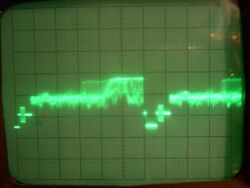
A scan line (also scanline) is one line, or row, in a raster scanning pattern, such as a line of video on a cathode ray tube (CRT) display of a television set or computer monitor.[1]
On CRT screens the horizontal scan lines are visually discernible, even when viewed from a distance, as alternating colored lines and black lines, especially when a progressive scan signal with below maximum vertical resolution is displayed.[2] This is sometimes used today as a visual effect in computer graphics.[3]
The term is used, by analogy, for a single row of pixels in a raster graphics image.[4] Scan lines are important in representations of image data, because many image file formats have special rules for data at the end of a scan line. For example, there may be a rule that each scan line starts on a particular boundary (such as a byte or word; see for example BMP file format). This means that even otherwise compatible raster data may need to be analyzed at the level of scan lines in order to convert between formats.
See also
- Interlaced video
- Scanline rendering
- Flicker (screen)
- Stroboscopic effect
References
- ↑ Keith Jack and Vladimir Tsatsulin (2002). Dictionary of Video and Television Technology. Newnes. p. 242. ISBN 978-1-878707-99-4. https://books.google.com/books?id=4Hsh7J0d1DwC&q=scan-line+video+display+computer+television&pg=PA242.
- ↑ Wesley Fenlon (15 January 2014). "In Search of Scanlines: The Best CRT Monitor for Retro Gaming". Tested. http://www.tested.com/tech/gaming/456719-best-crt-retro-games/.
- ↑ Gabriel B. (December 2012). "Freeware Friday: Maldita Castilla". Blistered Thumbs. http://www.blisteredthumbs.net/2012/12/ff-maldita-castilla/.
- ↑ Robin Stuart Ferguson (2001). Practical algorithms for 3D computer graphics. A K Peters, Ltd. p. 104. ISBN 978-1-56881-154-3. https://books.google.com/books?id=bBOxUmw83jUC&q=scanline+row-of-pixels&pg=PA104.
 |  |
Categories: [Computer graphics] [Image processing] [Display technology] [Video signal] [Television terminology]
↧ Download as ZWI file | Last modified: 01/26/2024 23:22:47 | 3 views
☰ Source: https://handwiki.org/wiki/Engineering:Scan_line | License: CC BY-SA 3.0
 KSF
KSF