Arvid
 From Handwiki
  | This article needs additional citations for verification. (February 2023) (Learn how and when to remove this template message) |
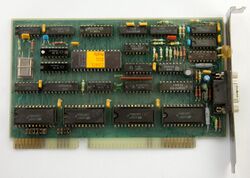

ArVid (Archiver on Video) (Russian: АрВид, Архиватор на Видео) is a data backup solution using a VHS tape as a storage medium. It was very popular in Russia and the rest of the former USSR in the mid-1990s.
It was produced in Zelenograd, Russia by PO KSI.[1]
Features
- Using low-cost VHS tapes and recording units for data backup.
- High reliability
- Hamming code error correction
- Easy data copying between two VHS units (eliminating need of a computer for data copying)
Disadvantages
- Inefficient tape capacity usage (only 2 grades of luminance signal spectrum were used)
- Poor software support
Operation
A VHS recorder unit should be connected to an ArVid ISA board by a composite video cable. Unit operation is controlled by a remote control emulator using an LED.
Device may operate in two modes: low data rate at 200 KB/s and high data rate at 325 KB/s (equivalent to roughly 1.33× and 2.17× CDR recording speed). The original, lower recording speed was retained as a user option because not all VHS recorders of the time offered sufficient recording quality to reliably support the higher speed.
An E-180 video tape is able to hold 2 GB of uncompressed data at the lower rate, more than sufficient for most PC hard drives of the time. This can be shown by calculating 200 KB/s × 60 s/min × 60 min/h × 3 h = 2.06 GB (2.06 × 230 bytes), which also leaves a few minutes spare for header and synchronisation space.
Note that it is unclear here whether "200 kbyte" means 200000 (200 × 103) or 204800 (200 × 210); the above calculation assumes the latter, but the former still produces a capacity of 2.01 GB (2.01 × 230 bytes), providing 2.00 GB of capacity in a little under 2 hours and 59 minutes. Similarly, this means that an E240 4-hour tape, using the higher data rate, would be capable of storing between 4.35 and 4.46 GB (230 bytes), approximately equivalent to a standard single-layer recordable DVD.
Models
- ArVid 1010, 100 kbyte/s, 4 kbyte RAM,[2] was first of ArVid devices. Its production started in 1992.
- ArVid 1020, 200 kbyte/s, no RAM, was a successor to ArVid 1010 using more advanced integrated circuitry.
- ArVid 1030/1031, 200 kbyte/s, 64 kbyte RAM, had better internal design, less power consumption, was smaller in size and was made using CPLD. It allowed automatic switching to a TV set when device was not in use.
- ArVid 1051/1052, 325 kbyte/s, 128/512 kbyte RAM
References
- ↑ http://pc2008.ru/ustroistva-arhivacii-dannih-i-strimeri/arvid.php Arvid (Арвид), стример на базе видеомагнитофона VHS (in Russian)
- ↑ http://andy.sumy.ua/old_computers/world_museum/detali_ussr.htm (in Russian)
External links
- "ArVid documentation" (in Russian). Archived from the original on 2005-02-07. https://web.archive.org/web/20050207182321/http://oldhard.hotmail.ru/pc/arvid/arvid.htm.
- ArVid description and images (in Russian)
- Drivers for linux and FreeBSD[|permanent dead link|dead link}}]
- "Drivers for Linux" (in Russian). Archived from the original on 2011-05-18. https://web.archive.org/web/20110518153645/http://www.pentahd.redline.ru/arvlinux/.
- "Arvid FAQ". Archived from the original on 2013-03-19. https://web.archive.org/web/20130319085844/http://faqs.org.ru/hardw/storage/arvidfaq.htm.
 |  |
Categories: [Computer storage devices]
↧ Download as ZWI file | Last modified: 12/30/2023 21:49:38 | 5 views
☰ Source: https://handwiki.org/wiki/ArVid | License: CC BY-SA 3.0
 ZWI signed:
 KSF
KSF