Library Of Congress Classification
 From Handwiki
 The Library of Congress Classification (LCC) is a system of library classification developed by the Library of Congress in the United States , which can be used for shelving books in a library. LCC is mainly used by large research and academic libraries, while most public libraries and small academic libraries used the Dewey Decimal Classification system.[1] The classification was developed by James Hanson (chief of the Catalog Department), with assistance from Charles Martel, in 1897, while they were working at the Library of Congress.[2] It was designed specifically for the purposes and collection of the Library of Congress to replace the fixed location system developed by Thomas Jefferson.
LCC has been criticized for lacking a sound theoretical basis; many of the classification decisions were driven by the practical needs of that library rather than epistemological considerations.[3] Although it divides subjects into broad categories, it is essentially enumerative in nature. That is, it provides a guide to the books actually in one library's collections, not a classification of the world.
History
The central core of the modern Library of Congress was formed from books sold to the government by Thomas Jefferson after the original collection was razed by the British in the War of 1812. As a result, the original classification system used by the library was of his own invention. However, by the end of the nineteenth century, the collection had grown to over a million volumes and his system was deemed too unwieldy.[4]
John Russell Young, the seventh Librarian of Congress, hired James Hanson and Charles Martel in 1897,[5] who began the development of a new classification system that would more accurately describe the collections the library held. Young's tenure as Librarian ended with his death in 1899, and his successor, Herbert Putnam, continued to implement the updates to the catalog through his long stay in the office.[6] By the time he departed from his post in 1939, all the classes except K (Law) were well developed.[4]
In creating their classification system, Hanson and Martel evaluated several systems already in existence, including the Dewey Decimal System, Charles Ammi Cutter's Cutter Expansive Classification, the Index Medicus,[7] and the Putnam Classification System (developed while Putnam was head librarian at the Minneapolis Public Library).[8] The one closest to their needs was Cutter's; however, he died before the completion of his system.[9] Hanson and Martel thus decided to develop their own unique system, strongly based on his ideas. They published their first outline of the classification scheme in 1904.[4] Development of the classes continued throughout the twentieth century. The last class to be developed was K (Law): the first K schedule was published in 1969 and not completed until the 2004 publication of KB.[4]
From 1996 onwards, the LCC schedules were available online, and since 2013, there have been no new print editions of the classification system. All updates are now distributed by the Library's Cataloging Distribution Service entirely online.[4]
Design and organization
LCC divides all knowledge into twenty-one basic classes, exchanges given a single letter of the alphabet as an identifier. The vast majority of these classes are divided further into two and three level sub-classes.[10] With these sub-classes, numerical ranges are assigned to topics, going from more general to more specific. Unlike in the Dewey Decimal Classification, where the numbers assigned to a topic iterate throughout the system (e.g., the ".05" tag indicated a periodical publication on the topic), the LCC numerical ranges are strictly hierarchal, only corresponding to their level on the outline. LCC is enumerative, meaning that it lists all the classes in officially published schedules, which are updated as needed by the Library of Congress.[10]
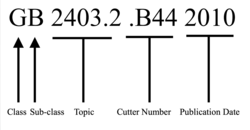
After the range of numbers making up the topical division, call numbers often also include one or more Cutter numbers, modeled after the unfinished Cutter Expansive Classification index. The full LCC schedules contain tables that describe Cutter numbers for certain types of media, collections of work, and geographical areas.[4] Cutter numbers also can take the form of an author-specific code, containing a letter and several numbers corresponding to the author's last name. This serves to further distinguish publications and nominally alphabetize volumes within a topic section. The final component of a typical LCC call-number is the publication year, in full.[11] Library collections can add modifiers to distinguish specific volumes, such as "Copy 1."[1]
LCC should not be confused with Library of Congress Control Numbers (LCCN), which are assigned to all books (and authors) and defines online catalog entries.[lower-alpha 1] Library of Congress Classification is also distinct from Library of Congress Subject Headings, the system of labels such as "Glaciers" and "Glaciers—Fiction" that describe contents systematically.[lower-alpha 2]
One variation from the original LCC system is the National Library of Medicine classification system (NLM), which uses the initial letters W and QS–QZ, which are not used by LCC. Some libraries use NLM in conjunction with LCC, eschewing LCC's R, QM, and QP, which overlap with NLM's schema.[12][13] Another is the Canadian Universities and the Canadian National Library using FC for Canadian History, a subclass that LCC has not officially adopted, but which it has agreed not to use for anything else.[14][15]
Classes
| Letter | Subject area[10] |
|---|---|
| A | General Works |
| B | Philosophy, Psychology, Religion |
| C | Auxiliary Sciences of History |
| D | World History and History of Europe, Asia, Africa, Australia, New Zealand, etc. |
| E | History of America |
| F | History of the Americas |
| G | Geography, Anthropology, and Recreation |
| H | Social Sciences |
| J | Political Science |
| K | Law |
| L | Education |
| M | Music |
| N | Fine Arts |
| P | Language and Literature |
| Q | Science |
| R | Medicine |
| S | Agriculture |
| T | Technology |
| U | Military Science |
| V | Naval Science |
| Z | Bibliography, Library Science, and General Information Resources |
Use and criticism
Together with the Dewey Decimal System (DDC), LCC make up the two main classification system used in U.S. libraries.[1] LCC is favored by large academic and research libraries.
Systems of classification can be evaluated on several metrics, including expressiveness (the ability of the numeration system to express the hierarchal and correlative relationships between topics), hospitality (the ability of the system to accommodate new subjects), and brevity (length of call numbers).[4] While LCC is significantly less expressive than DDC, it is extremely hospitable, mainly in the fact that five class (I, O, W, X, and Y) lack any assignment to topics.[9] LCC call numbers also tend to be shorter than those in DDC.
The main difference between DDC and LCC is their approach to classifying. Dewey's system is a comprehensive classification to all topics, with no regard to the actual collections a library might hold. While this has allowed it to be successfully adapted into more modern classification systems for use outside of libraries, such as the Universal Decimal Classification (UDC),[16] it does make it more unwieldy for large or specialized collections. On the other hand, Hanson and Martel designed LCC specifically for library use, which means while it does not completely enumerate the world, it does more reflect what books a library might hold.[3]
Because LCC was designed around the collections of the Library of Congress, it has an American, European, and Christian bias, as reflected mainly in the earlier developed schedules of D (World History), E and F (History of the Americas), and B (Philosophy, Psychology, Religion). On the other hand, the later-developed K (Law) gives fairly even weight to global law.[10] Today, the various schedules are maintained and revised by the Library's Policy and Standards Division, in conjunction with experts in each field. However, updating various schedules with classification biases is generally assumed to be impractical due to the massive workload that would result in,[4] especially as the "discipline" based classes of LCC have been entrenched in the average library user's mind.[17]
Like all classification systems, LCC struggles with catering to interdisciplinary scholars and topics, as ultimately, a book can only be shelved in a single location.[17] Additionally, LCC has a problem with "othering" marginalized groups, making works related to or authored by members of these groups particularly difficult to locate.[17] This is not a new issue, and libraries with more specialized collections about minority groups or issues sometimes eschew LCC,[17] with one example alternative classification being the Harvard–Yenching Classification, specifically developed for Chinese language materials.
Full classification outline
Class A – general works
- Subclass AC – Collections. Series. Collected works
- Subclass AE – Encyclopedias
- Subclass AG – Dictionaries and other general reference works
- Subclass AI – Indexes
- Subclass AM – Museums. Collectors and collecting
- Subclass AN – Newspapers
- Subclass AP – Periodicals
- Subclass AS – Academies and learned societies
- Subclass AY – Yearbooks. Almanacs. Directories
- Subclass AZ – History of scholarship and learning. The humanities
Class B – Philosophy, Psychology, Religion
- Subclass B – Philosophy (General)
- Subclass BC – Logic
- Subclass BD – Speculative philosophy
- Subclass BF – Psychology
- Subclass BH – Aesthetics
- Subclass BJ – Ethics
- Subclass BL – Religions. Mythology. Rationalism
- Subclass BM – Judaism
- Subclass BP – Islam. Baháʼísm. Theosophy, etc.
- Subclass BQ – Buddhism
- Subclass BR – Christianity
- Subclass BS – The Bible
- Subclass BT – Doctrinal theology
- Subclass BV – Practical theology
- Subclass BX – Christian Denominations
Class C – Auxiliary Sciences of History
- Subclass C – Auxiliary Sciences of History
- Subclass CB – History of Civilization
- Subclass CC – Archaeology
- Subclass CD – Diplomatics. Archives. Seals
- Subclass CE – Technical Chronology; Calendar
- Subclass CJ – Numismatics
- Subclass CN – Inscriptions; Epigraphy
- Subclass CR – Heraldry
- Subclass CS – Genealogy
- Subclass CT – Biography
Class D – World History and History of Europe, Asia, Africa, Australia, New Zealand, etc.
- Subclass D – History (General)
- Subclass DA – Great Britain
- Subclass DAW – Central Europe
- Subclass DB – Austria – Liechtenstein – Hungary – Czechoslovakia
- Subclass DC – France – Andorra – Monaco
- Subclass DD – Germany
- Subclass DE – Greco-Roman World
- Subclass DF – Greece
- Subclass DG – Italy – Malta
- Subclass DH – Low Countries – Benelux Countries
- Subclass DJ – Netherlands (Holland)
- Subclass DJK – Eastern Europe (General)
- Subclass DK – Russia. Soviet Union. Former Soviet Republics – Poland
- Subclass DL – Northern Europe. Scandinavia
- Subclass DP – Spain – Portugal
- Subclass DQ – Switzerland
- Subclass DR – Balkan Peninsula
- Subclass DS – Asia
- Subclass DT – Africa
- Subclass DU – Oceania (South Seas)
- Subclass DX – Romanies
Class E – History of America
- Class E does not have any subclasses.
Class F – Local History of the Americas
- Class F does not have any subclasses, though Canadian Universities and the Canadian National Library use FC for Canadian History, a subclass that LCC has not officially adopted, but which it has agreed not to use for anything else.[14][15]
Class G – Geography, Anthropology, Recreation
- Subclass G – Geography (General). Atlases. Maps
- Subclass GA – Mathematical geography. Cartography
- Subclass GB – Physical geography
- Subclass GC – Oceanography
- Subclass GE – Environmental Sciences
- Subclass GF – Human ecology. Anthropogeography
- Subclass GN – Anthropology
- Subclass GR – Folklore
- Subclass GT – Manners and customs (General)
- Subclass GV – Recreation. Leisure
Class H – Social Sciences
- Subclass H – Social sciences (General)
- Subclass HA – Statistics
- Subclass HB – Economic theory. Demography
- Subclass HC – Economic history and conditions
- Subclass HD – Industries. Land use. Labor
- Subclass HE – Transportation and communications
- Subclass HF – Commerce
- Subclass HG – Finance
- Subclass HJ – Public finance
- Subclass HM – Sociology (General)
- Subclass HN – Social history and conditions. Social problems. Social reform
- Subclass HQ – The family. Marriage, Women and Sexuality
- Subclass HS – Societies: secret, benevolent, etc.
- Subclass HT – Communities. Classes. Races
- Subclass HV – Social pathology. Social and public welfare. Criminology
- Subclass HX – Socialism. Communism. Anarchism
Class J – Political Science
- Subclass J – General legislative and executive papers
- Subclass JA – Political science (General)
- Subclass JC – Political theory
- Subclass JF – Political institutions and public administration
- Subclass JJ – Political institutions and public administration (North America)
- Subclass JK – Political institutions and public administration (United States)
- Subclass JL – Political institutions and public administration (Canada, Latin America, etc.)
- Subclass JN – Political institutions and public administration (Europe)
- Subclass JQ – Political institutions and public administration (Asia, Africa, Australia, Pacific Area, etc.)
- Subclass JS – Local government. Municipal government
- Subclass JV – Colonies and colonization. Emigration and immigration. International migration
- Subclass JX – International law, see JZ and KZ (obsolete)
- Subclass JZ – International relations
Class K – Law
- Subclass K – Law in general. Comparative and uniform law. Jurisprudence
- Subclass KB – Religious law in general. Comparative religious law. Jurisprudence
- Subclass KBM – Jewish law
- Subclass KBP – Islamic law
- Subclass KBR – History of canon law
- Subclass KBS – Canon law of Eastern churches
- Subclass KBT – Canon law of Eastern Rite Churches in Communion with the Holy See of Rome
- Subclass KBU – Law of the Roman Catholic Church. The Holy See
- Subclasses – KD/KDK - United Kingdom and Ireland
- Subclass KDZ – America. North America
- Subclass KE – Canada
- Subclass KF – United States
- Subclass KG – Latin America – Mexico and Central America – West Indies. Caribbean area
- Subclass KH – South America
- Subclasses KJ-KKZ – Europe
- Subclasses KL-KWX – Asia and Eurasia, Africa, Pacific Area, and Antarctica
- Subclass KU/KUQ – Law of Australia and New Zealand
- Subclass KZ – Law of nations
Class L – Education
- Subclass L – Education (General)
- Subclass LA – History of education
- Subclass LB – Theory and practice of education
- Subclass LC – Special aspects of education
- Subclass LD – Individual institutions – United States
- Subclass LE – Individual institutions – America (except United States)
- Subclass LF – Individual institutions – Europe
- Subclass LG – Individual institutions – Asia, Africa, Indian Ocean islands, Australia, New Zealand, Pacific islands
- Subclass LH – College and school magazines and papers
- Subclass LJ – Student fraternities and societies, United States
- Subclass LT – Textbooks
Class M – Music
- Subclass M – Music
- Subclass ML – Literature on music
- Subclass MT – Instruction and study
Class N – Fine Arts
- Subclass N – Visual Arts
- Subclass NA – Architecture
- Subclass NB – Sculpture
- Subclass NC – Drawing. Design. Illustration
- Subclass ND – Painting
- Subclass NE – Print media
- Subclass NK – Decorative arts
- Subclass NX – Arts in general
Class P – Language and Literature
- Subclass P – Philology. Linguistics
- Subclass PA – Greek language and literature. Latin language and literature
- Subclass PB – Modern languages. Celtic languages and literature
- Subclass PC – Romanic languages
- Subclass PD – Germanic languages. Scandinavian languages
- Subclass PE – English language
- Subclass PF – West Germanic languages
- Subclass PG – Slavic languages and literature. Baltic languages. Albanian language
- Subclass PH – Uralic languages. Basque language
- Subclass PJ – Oriental languages and literatures
- Subclass PK – Indo-Iranian languages and literature
- Subclass PL – Languages and literature of Eastern Asia, Africa, Oceania
- Subclass PM – Hyperborean, Native American, and artificial languages
- Subclass PN – Literature (General)
- Subclass PQ – French literature – Italian literature – Spanish literature – Portuguese literature
- Subclass PR – English literature
- Subclass PS – American literature
- Subclass PT – German literature – Dutch literature – Flemish literature since 1830 – Afrikaans literature -Scandinavian literature – Old Norse literature: Old Icelandic and Old Norwegian – Modern Icelandic literature – Faroese literature – Danish literature – Norwegian literature – Swedish literature
- Subclass PZ – Fiction and juvenile belles lettres
Class Q – Science
- Subclass Q – Science (General)
- Subclass QA – Mathematics
- Subclass QB – Astronomy
- Subclass QC – Physics
- Subclass QD – Chemistry
- Subclass QE – Geology
- Subclass QH – Natural history – Biology
- Subclass QK – Botany
- Subclass QL – Zoology
- Subclass QM – Human anatomy
- Subclass QP – Physiology
- Subclass QR – Microbiology
Class R – Medicine
- Subclass R – Medicine (General)
- Subclass RA – Public aspects of medicine
- Subclass RB – Pathology
- Subclass RC – Internal medicine
- Subclass RD – Surgery
- Subclass RE – Ophthalmology
- Subclass RF – Otorhinolaryngology
- Subclass RG – Gynecology and Obstetrics
- Subclass RJ – Pediatrics
- Subclass RK – Dentistry
- Subclass RL – Dermatology
- Subclass RM – Therapeutics. Pharmacology
- Subclass RS – Pharmacy and materia medica
- Subclass RT – Nursing
- Subclass RV – Botanic, Thomsonian, and Eclectic medicine
- Subclass RX – Homeopathy
- Subclass RZ – Other systems of medicine
Class S – Agriculture
- Subclass S – Agriculture (General)
- Subclass SB – Horticulture. Plant propagation. Plant breeding
- Subclass SD – Forestry. Arboriculture. Silviculture
- Subclass SF – Animal husbandry. Animal science
- Subclass SH – Aquaculture. Fisheries. Angling
- Subclass SK – Hunting
Class T – Technology
- Subclass T – Technology (General)
- Subclass TA – Engineering Civil engineering (General).
- Subclass TC – Hydraulic engineering. Ocean engineering
- Subclass TD – Environmental technology. Sanitary engineering
- Subclass TE – Highway engineering. Roads and pavements
- Subclass TF – Railroad engineering and operation
- Subclass TG – Bridges
- Subclass TH – Building construction
- Subclass TJ – Mechanical engineering and machinery
- Subclass TK – Electrical engineering. Electronics. Nuclear engineering
- Subclass TL – Motor vehicles. Aeronautics. Astronautics
- Subclass TN – Mining engineering. Metallurgy
- Subclass TP – Chemical technology
- Subclass TR – Photography
- Subclass TS – Manufacturing engineering. Mass production
- Subclass TT – Handicrafts. Arts and crafts
- Subclass TX – Home economics
Class U – Military Science
- Subclass U – Military science (General)
- Subclass UA – Armies: Organization, distribution, military situation
- Subclass UB – Military administration
- Subclass UC – Military maintenance and transportation
- Subclass UD – Infantry
- Subclass UE – Cavalry. Armor
- Subclass UF – Artillery
- Subclass UG – Military engineering. Air forces
- Subclass UH – Other military services
- Subclass V – Naval science (General)
- Subclass VA – Navies: Organization, distribution, naval situation
- Subclass VB – Naval administration
- Subclass VC – Naval maintenance
- Subclass VD – Naval seamen
- Subclass VE – Marines
- Subclass VF – Naval ordnance
- Subclass VG – Minor services of navies
- Subclass VK – Navigation. Merchant marine
- Subclass VM – Naval architecture. Shipbuilding. Marine engineering
Class Z – Bibliography, Library Science
- Subclass Z – Books (General). Writing. Paleography. Book industries and trade. Libraries. Bibliography
- Subclass ZA – Information resources/materials
See also
- ACM Computing Classification System
- Books in the United States
- Brinkler classification
- Chinese Library Classification
- Database of Recorded American Music
- Dewey Decimal Classification
- Comparison of Dewey and Library of Congress subject classification
- Harvard–Yenching Classification
- Moys Classification Scheme
- ISBN
- Minnie Earl Sears, formulated Sears Subject Headings, simplified for use by small libraries
Notes
- ↑ LCSH too is developed by the Library and assigns alphanumeric IDs. A closer look at this example shows refinements defined in 2004, 2007, and 2009. LCSH: Boarding schools.
References
- ↑ 1.0 1.1 1.2 Lavallee, Andrew (July 20, 2007). "Discord Over Dewey: A New Library in Arizona Fans a Heated Debate Over What Some Call the 'Googlization' of Libraries". Wall Street Journal. https://www.wsj.com/articles/SB118340075827155554. "Some 95% of U.S. public libraries use Dewey, and nearly all of the others, the OCLC says, use a closely related Library of Congress system."
- ↑ Dittmann, Helena (2000). Learn Library of Congress classification. Internet Archive. Lanham, Md. : Scarecrow Press. ISBN 978-0-8108-3696-9. http://archive.org/details/learnlibraryofco0000ditt.
- ↑ 3.0 3.1 Hickey, Doralyn J. (1969). "Reviewed work: The Use of the Library of Congress Classification: Proceedings of the Institute on the Use of the Library of Congress Classification Sponsored by the American Library Association, Resources and Technical Services Division, Cataloging and Classification Section, New York City, July 7-9, 1966, Richard H. Schimmelpfeng, C. Donald Cook". The Library Quarterly: Information, Community, Policy 39 (3): 294–296. doi:10.1086/619784.
- ↑ 4.0 4.1 4.2 4.3 4.4 4.5 4.6 4.7 "Library of Congress Classification". https://www.librarianshipstudies.com/2017/11/library-of-congress-classification.html.
- ↑ "John Russell Young (1840-1899)". https://www.loc.gov/item/n83202815/john-russell-young-1840-1899/.
- ↑ "Herbert Putnam (1861-1955)". https://www.loc.gov/item/n85185518/herbert-putnam-1861-1955/.
- ↑ Martel, C (1916). "Remarks on Cataloguing and Classification". Bulletin of the Medical Library Association. 5 (4): 43–5. PMC 234678. PMID 16015800.
- ↑ Andy Sturdevant. "Cracking the spine on Hennepin County Library's many hidden charms". MinnPost, 02/05/14.
- ↑ 9.0 9.1 LaMontagne, Leo E. American Library Classification: With Special Reference to the Library of Congress. Hamden, CT, Shoe String Press. 1961, p. 210.
- ↑ 10.0 10.1 10.2 10.3 "Library of Congress Classification". https://www.loc.gov/catdir/cpso/lcc.html.
- ↑ Chan, Lois Mai (1999). A guide to the Library of Congress classification. Lois Mai Chan (5th ed.). Englewood, Colo.: Libraries Unlimited. ISBN 1-56308-499-6. OCLC 41211262. https://www.worldcat.org/oclc/41211262.
- ↑ Taylor, A. G., & Joudrey, D.N. (2009). The organization of information. 3rd ed. Englewood: Libraries Unlimited.
- ↑ Chan, L. M.(2007). Cataloging and classification: An introduction. 3rd ed. Scarecrow Press.
- ↑ 14.0 14.1 National Library of Canada. "Class FC: a classification for Canadian history". National Library of Canada. http://publications.gc.ca/collections/Collection/SN3-61-1994E.pdf.
- ↑ 15.0 15.1 Rutherford, D. "Canadian History Call Numbers". http://library.queensu.ca/techserv/cat/Sect03/c03Canclass.html#double.
- ↑ "A Brief Introduction to the Dewey Decimal Classification". OCLC. Archived from the original on May 3, 2013. Retrieved November 16, 2013.
- ↑ 17.0 17.1 17.2 17.3 Howard, Sara A.; Knowlton, Steven A. (2018). "Browsing through Bias: The Library of Congress Classification and Subject Headings for African American Studies and LGBTQIA Studies". Library Trends 67 (1): 74–88. doi:10.1353/lib.2018.0026.
External links
 |
Wikidata has the property:
|
 NO LABEL (P1149) (see
 - Library of Congress classification outline, loc.gov
- Full list of LCC classification schedules, loc.gov
- Library of Congress – classification, loc.gov
- Cataloging Distribution Services – source of Library of Congress Classification schedules. loc.gov
- Classification outline, loc.gov
- How to read LCC call numbers, geography.about.com (via The Wayback Machine)
- How to use LCC to organize a home library, zackgrossbart.com
Library classification systems | |
|---|---|
| |
|
 Category
 Commons
 |  |
Categories: [Library of Congress Classification]
↧ Download as ZWI file | Last modified: 07/13/2024 10:23:14 | 10 views
☰ Source: https://handwiki.org/wiki/Library_of_Congress_Classification | License: CC BY-SA 3.0
 KSF
KSF