List Of Extinct Plants
 From Handwiki
 Short description: Wikipedia list article
The following is a list of extinct plants only.
Prehistoric extinctions


Extinct plants by geologic period
- Araucarioxylon[1]
- Caytoniales (extinct at the end of the Cretaceous)
- Cladophlebis
- Zamites
- Brachyphyllum
- Pleuromeia
- Pannaulika
- Sphenophyllum
- Dicroidium odontopteroides
- pleuromeia dubai
- Araucaria mirabilis[2]
- Araucarites sanctaecrucis[2]
- Baiera
- Coniopteris
- Cycadeoidea
- Czekanowskia
- Eboracia
- Equisetum thermale (La Matilde Formation, Argentina)[3]
- Gleichenites
- Neocalamites
- Nilssonia
- Pararaucaria patagonica[2]
- Pterophyilum
- Schmeissneria
- Archaeamphora (Northeastern China)
- Archaeanthus
- Archaefructus
- Ephedrites
- Liaoningocladus
- Orontium mackii (Maastrictian?, McRea Formation, North America)[4]
- Palaeoaldrovanda (Czech Republic)
- Pagiophyllum
- Pityocladus
- Podozamites
- Sagaria (Southern Italy)
- Sphenobaiera
- Williamsonia
- Williamsoniella
- Acer alaskense (Chickaloon Formation, Alaska) [5]
- Banksieaeidites (Australia) (species through the Miocene)
- Cornus piggae (Almont/Biecegal Creek, North America)[6]
- Pinus peregrinus (Golden Valley Formation)[7]
- Ginkgo cranei (Sentinel Butte Formation)[8]
- Metasequoia foxii (Paskapoo Formation, Alberta)[9]
- Montrichardia aquatica (Cerrejón Formation, Colombia)[10]
- Petrocardium (Cerrejón Formation, Colombia)[10]
- Acer castorrivularis (Montana, North America)[5]
- Acer clarnoense (John Day Formation, North America)[5]
- Acer douglasense (West Foreland Formation, Alaska, North America)[5]
- Acer hillsi (Klondike Mountain Formation, Washington, North America)[5]
- Acer republicense (Klondike Mountain Formation, Washington, North America)[5]
- Acer rousei (Allenby Formation, McAbee Site, British Columbia, North America)[5]
- Acer stewarti (Allenby Formation, British Columbia, North America)[5]
- Acer stonebergae (Okanagan Highlands, North America)[5]
- Acer taurocursum (Bull Run flora, North America)[5]
- Acer toradense (Okanagan Highlands, North America)[5]
- Acer washingtonense (Klondike Mountain Formation, Washington, North America)[5]
- Actinidia oregonensis (Central Oregon, USA)[11]
- Azolla primaeva (British Columbia, Canada)[12]
- Abies milleri (British Columbia, Canada; Washington, USA)[13]
- Banksia archaeocarpa (Australia)[citation needed]
- Chamaecyparis eureka (Axel Heiberg Island, Canada)[14]
- Corylopsis reedae (Klondike Mountain Formation, Washington, North America)[15]
- Cornus clarnensis (Central Oregon, USA)[11]
- Coryloides (Central Oregon, USA)[11]
- Corylus johnsonii (Washington, USA)[16]
- Dillhoffia (British Columbia, Canada; Washington, USA)[17]
- Diploporus (Paleocene-Eocene; Sentinel Butte Formation, Clarno Formation)[11]
- Eucommia eocenica (Claiborne Formation, southeastern North America)[18]
- Eucommia montana (Western North America)[18]
- Eucommia jeffersonensis (John Day Formation, Oregon, North America)[18]
- Eucommia rolandii (North America)[18]
- Fothergilla malloryi (Klondike Mountain Formation, Washington, North America)[15]
- Ginkgo dissecta (Ypresian, Okanagan Highlands)[19]
- Kardiasperma (Central Oregon, USA)[11]
- Langeria magnifica (Okanagan highlands, north America)[20]
- Latanites (Italy) [21]
- Nelumbo aureavallis (North Dakota, North America)[7]
- Neviusia dunthornei (Allenby Formation, North America)[22]
- Orontium wolfei (Okanagan Highlands)[4]
- Paleopanax (Central Oregon, USA)[11]
- Peltandra primaeva (North Dakota, USA)[7]
- Pinus driftwoodensis (Driftwood Canyon Provincial Park, British Columbia)[23]
- Rhizomnium dentatum (Baltic amber, Europe)[24]
- Rhus malloryi (Washington, USA)[20]
- Rhus rooseae (Central Oregon, USA)[11]
- Sassafras hesperia (Okanogan Highlands)[20]
- Saxonipollis ("East Germany")[citation needed]
- Stonebergia (British Columbia, Canada) [25]
- Succinanthera baltica (Baltic amber)[26]
- Taxus masonii (Central Oregon, USA)[11]
- Tilia johnsoni (Washington, USA)[20]
- Torreya clarnensis (Central Oregon, USA)[11]
- Trochodendron drachukii (Okanogan Highlands)[27]
- Trochodendron nastae (Washington, USA)[28]
- Acer ashwilli (John Day Formation, Oregon)[5]
- Acer chaneyi (Oligocene to Miocene)[5]
- Acer dettermani (Late Eocene - Early Oligocene; Meshik Volcanics, Alaska)[5]
- Acer ivanofense (Late Eocene - Early Oligocene; Meshick Volcanics, Alaska)[5]
- Acer kenaicum (Oligocene; Kenai Group, Alaska)[5]
- Banksia novae-zelandiae (South Island, New Zealand) (Straddles the Oligocene-Miocene boundary)
- Silene microsperma (fossil seeds, Chattian stage; Oberleichtersbach Formation, Germany).[29]
Miocene
- Acer browni (western North America)[5]
- Acer latahense (western North America)[5]
- Acer smileyi (Late Oligocene-Middle Miocene; western North America)[5]
- Acer traini (western North America)[5]
- Carya washingtonensis (Washington State, North America)[30]
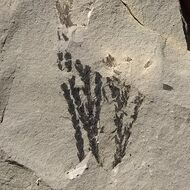
Sequoiadendron chaneyi branchlet; Nevada - Dendrobium winikaphyllum (in diatomite, New Zealand)[31]
- Droserapites (Taiwan)
- Droserapollis (Taiwan)
- Earina fouldenensis (in diatomite, New Zealand)[31]
- Globosites apicola (Dominican amber)[32]
- Hymenaea allendis (Late Oligocene - early Eocene; Mexican Amber)[33]
- Hymenaea mexicana (Late Oligocene - early Eocene; Mexican Amber)[33]
- Hymenaea protera (Dominican amber)
- Meliorchis caribea (Dominican amber)[34]
- Osmunda wehrii (Yakima Canyon Flora, North America)[35]
- Palaeoraphe (Dominican Republic)[36]
- Roystonea palaea (Dominican amber)[36]
- Rudiculites dominicana (Dominican amber)[32]
- Sequoiadendron chaneyi (Western North America)[37]
- Wessiea yakimaensis (Yakima Canyon Flora, North America)[38]

Pliocene
- Acer palaeorufinerve (Miocene - Pliocene; East Asia and possibly Alaska?)[5]
- Pinus matthewsii[39]
- Banksia kingii (Western Tasmania)
- Banksia strahanensis (Western Tasmania)
- Picea critchfieldii (North America)
Modern extinctions

- Acalypha rubrinervis (1870, Saint Helena)
- Aspalathus complicata (1940s, South Africa: Cape Flora) [40]
- Aspalathus cordicarpa (1950s, South Africa: Cape Flora) [40]
- Aspalathus variegata (1900, South Africa: Cape Flora) [40]
- Barleria natalensis (1900, South Africa) [40]
- Brachystelma schoenlandianum (1900, South Africa: Cape Flora) [40]
- Byttneria ivorensis (1896, Côte d'Ivoire)
- Cephalophyllum parvulum (1900, South Africa: Cape Flora) [40]
- Ceropegia antennifera (1910, South Africa) [40]
- Ceropegia bowkeri (1900, South Africa) [40]
- Coffea lemblinii (1907, Côte d'Ivoire)
- Conophytum semivestitum (1900, South Africa) [40]
- Corynanthe brachythyrsus (1898, Cameroon)
- Crassula subulata (1900, South Africa: Cape Flora) [40]
- Cyclopia filiformis (1900, South Africa: Cape Flora) [40]
- Disa forcipata (1900, South Africa: Cape Flora) [40]
- Dryopteris ascensionis (1889, Ascension Island)
- Erica alexandri subsp. acockii (1940, South Africa: Cape Flora) [40]
- Erica foliacea subsp. fulgens (1900, South Africa: Cape Flora) [40]
- Erica pyramidalis var. pyramidalis (1910, South Africa: Cape Flora) [40]
- Eugenia pusilla (1920, South Africa) [40]
- Helichrysum outeniquense (1950, South Africa: Cape Flora) [40]
- Heliotropium pannifolium (1808, Saint Helena)
- Isolepis bulbifera (1950, South Africa: Cape Flora) [40]
- Lampranthus vanzijliae (1920, South Africa: Cape Flora) [40]
- Leucadendron grandiflorum (1805, South Africa: Cape Flora) [40]
- Leucadendron spirale (1930, South Africa: Cape Flora) [40]
- Liparia graminifolia (1830, South Africa: Cape Flora) [40]
- Macledium pretoriense (1925, South Africa) [40]
- Macrostylis villosa subsp. minor (1980, South Africa: Cape Flora) [40]
- Nemesia micrantha (1900, South Africa: Cape Flora) [40]
- Nesiota elliptica (2003, Saint Helena)
- Oldenlandia adscensionis (1889, Ascension Island)
- Orchidea eupolyanthis (1910, Cameroon)
- Osteospermum hirsutum (1900, South Africa: Cape Flora) [40]
- Polhillia ignota (1950s, South Africa: Cape Flora) [40]
- Psoralea cataracta (1900, South Africa: Cape Flora) [40]
- Psoralea gueinzii (1930, South Africa: Cape Flora) [40]
- Silphium – Ferula ? (c. 50, Cyrene)
- Sporobolus durus (1886, Ascension Island)
- Thamnea depressa (1900, South Africa: Cape Flora) [40]
- Trochetiopsis melanoxylon (1771, Saint Helena)
- Vernonella africana (1900, South Africa) [40]
- Willdenowia affinis (1920, South Africa: Cape Flora) [40]
- Xysmalobium baurii (1900, South Africa) [40]
- Roan Mountain False Goat's-beard – Astilbe crenatiloba (1885, Roan Mountain, Tennessee)[41]
- Astragalus endopterus (Arizona)[41]
- Atriplex tularensis (California)[41]
- Galapagos Amaranth – Blutaparon rigidum (1999, Galápagos Ecuador)
- Boechera fruticosa (Wyoming)[41]
- Brickellia chenopodina (New Mexico)[41]
- Calochortus indecorus (Oregon)[41]
- Calochortus monanthus (California)[41]
- Castilleja leschkeana (California)[41]
- Castilleja uliginosa (California)[41]
- Rio de Janeiro Myrtle – Campomanesia lundiana (1825, Brazil)
- Casearia quinduensis (1997, Colombia)
- Rio de Janeiro Sapota – Chrysophyllum januariense (1997, Brazil)
- Cirsium praeteriens (California)[41]
- Havana Fragrant Tree – Cnidoscolus fragrans (1840, Cuba)
- Corispermum pallidum (Washington)[41]
- Crataegus austromontana (Alabama and Tennessee)[41]
- Cryptantha aptera (Colorado)[41]
- Cryptantha hooveri (California)[41]
- Cryptantha insolita (Nevada)[41]
- Dalea sabinalis (Texas)[41]
- Diplacus traskiae (California)[41]
- Eleocharis brachycarpa (Tamaulipas and Texas)[41]
- Elodea schweinitzii (New York and Pennsylvania)[41]
- Erigeron mariposanus (California)[41]
- Santa Cruz Bryophyte – Flabellidium spinosum (1911, Bolivia)
- Cuban Ruta Tree – Galipea ossana (1825, Cuba)
- Cuban Guettarda Tree – Guettarda retusa (1975, Cuba)
- Govenia floridana (Florida)[41]
- Hedeoma pilosa (Texas)[41]
- Helianthus praetermissus (Arizona and New Mexico)[41]
- Isocoma humilis (Utah)[41]
- Juncus pervetus (Massachusetts)[41]
- Lechea lakelae (Florida)[41]
- Licania caldasiana (1997, Colombia)
- Lycium verrucosum (California)[41]
- Marshallia grandiflora (North Carolina)[41]
- Micranthemum micranthemoides (Mid-atlantic United States)[41]
- Monardella leucocephala (California)[41]
- Monardella pringlei (California)[41]
- Mason River Myrtle – Myrcia skeldingii (1972, Jamaica)
- Appalachian Yellow Asphodel – Narthecium montanum (Henderson County, North Carolina)[42]
- Hastings County Neomacounia – Neomacounia nitida (1864, Canada)
- Bigleaf Scurfpea – Orbexilum macrophyllum (1899, Polk County, North Carolina)
- Falls-of-the-Ohio scurfpea – Orbexilum stipulatum (1881, Jefferson County, Kentucky)
- Paronychia maccartii (Texas)[41]
- Plagiobothrys lamprocarpus (Oregon)[41]
- Plagiobothrys lithocaryus (California)[41]
- Potentilla multijuga (California)[41]
- Potentilla uliginosa (California)[41]
- Rio de Janeiro Pouteria – Pouteria stenophylla (1997, Brazil)
- Cajamarca Pradosia – Pradosia argentea (1820, Peru)
- Rio de Janeiro Pradosia – Pradosia glaziovii (1997, Brazil)
- Colombian Pradosia – Pradosia mutisii (1925, Colombia)
- Proboscidea spicata (Texas)[41]
- Jamaican Psidium – Psidium dumetorum (1976, Jamaica)
- Quercus tardifolia (Coahuila and Texas)[41]
- Rumex tomentellus (New Mexico)[41]
- Juan Fernandez Santalum – Santalum fernandezianum (1908, Chile)
- Sesuvium trianthemoides (Texas)[41]
- Sphaeralcea procera (New Mexico)[41]
- Thismia americana – Thismia americana (1916, Chicago, IL, USA)
- Adiantum lianxianense (Guangdong, China)
- Kerala Legume Tree – Cynometra beddomei (1870, India)
- Sumatra Dipterocarpus – Dipterocarpus cinereus (1996, Sumatra, Indonesia)
- Arunchal Hopea Tree – Hopea shingkeng (1996, India)
- Nilgiri Holly – Ilex gardneriana (1859, India)
- Karnataka Sapota – Madhuca insignis (1900, India)
- Hainan Ormosia – Ormosia howii (1997, Southern China)
- Hainan Otophora – Otophora unilocularis (1935, Hainan, China)
- Pluchea glutinosa (19th Century, Yemen)
- Psiadia schweinfurthii (19th Century, Yemen)
- Sarawak Shorea – Shorea cuspidata (1996, Malaysia)
- Meghalaya Sterculia – Sterculia khasiana (1877, India)
- Valerianella affinis (19th century, Yemen)
- Courtallum Wendlandia – Wendlandia angustifolia (1997, India)
- Woolly-stalked Begonia – Begonia eiromischa (20th century, Penang, Malaysia)
- Ruzhildalani "Ruzhil" (1995, India)
- Cry Pansy – Viola cryana (1933, France)
- Hieracium purkynei (1912, Czech Republic)
- Hawaii Chaff Flower – Achyranthes atollensis (1964, Hawaiian Is.)
- Argyroxiphium virescens (1996, Hawaiian Is.)
- Balanops microstachya (New Caledonia)
- Casearia tinifolia (1976, Mauritius)
- Clermontia multiflora (1871, Hawaiian Is.)
- New Calodonia Sapinda – Cupaniopsis crassivalvis (1869, New Caledonia)
- Haleakala Cyanea Tree – Cyanea arborea (1928, Hawaiian Is.)
- Cyanea comata (late 19th century, Hawaiian Is.)
- Cyanea cylindrocalyx (1909, Hawaiian Is.)
- Cyanea dolichopoda (1990, Hawaiian Is.)
- Giffard's Cyanea Tree – Cyanea giffardii (1917, Hawaiian Is.)
- Mark's Cyanea Tree – Cyanea marksii (1900, Hawaiian Is.) - update in 2016: This plant is endemic to Hawaiʻi, where it has experienced severe and ongoing decline in habitat and numbers due to the impacts of invasive plants and animals. Previously it was believed to be Extinct, but the rediscovery of 12 plants (occurring in two separate subpopulations) resulted in it being downlisted to CR.[43]
- Pohaku Cyanea Tree – Cyanea pohaku (1910, Hawaiian Is.)
- Kohala Cyanea Tree – Cyanea pycnocarpa (1997, Hawaiian Is.)
- Oak-leaved Cyanea Tree – Cyanea quercifolia (1997, Hawaiian Is.)
- Dracaena umbraculifera (Mauritius)
- Taravai Aster Tree – Fitchia mangarevensis (1997, Taravai, French Polynesia)
- Moorea Laurel – Hernandia drakeana (1997, French Polynesia)
- Kawaihae Hibiscadelphus – Hibiscadelphus bombycinus (1868, Hawaiian Is.)
- Puhielelu Hibiscadelphus – Hibiscadelphus crucibracteatus (1981, Hawaiian Is.)
- Auwahi Hibiscadelphus – Hibiscadelphus wilderianus (1910, Hawaiian Is.)
- Oahu Kokia – Kokia lanceolata (1888, Hawaiian Is.)
- Cross-bearing Pelea – Melicope cruciata (1997, Hawaiian Is.)
- Maui Ruta Tree – Melicope haleakalae (1919, Hawaiian Is.)
- Obovate Melicope – Melicope obovata (1997, Hawaiian Is.)
- Nuku Hiva Neisosperma – Neisosperma brownii (1997, French Polynesia)
- Fatu Hiva Ochrosia – Ochrosia fatuhivensis (1997, French Polynesia)
- Nuku Hiva Ochrosia – Ochrosia nukuhivensis (1997, French Polynesia)
- Tahiti Ochrosia – Ochrosia tahitensis (1997, French Polynesia)
- Psychotria veillonii (New Caledonia)
- Koé Stenocarpus – Stenocarpus dumbeensis (1905, New Caledonia)
- Norfolk Island Streblorrhiza – Streblorrhiza speciosa (1997, Norfolk Island)
- Fijian Weinmannia – Weinmannia spiraeoides (1840, Fiji)
- Skottsberg's Wikstroemia – Wikstroemia skottsbergiana (1997, Hawaiian Is.)
- Hakeakala Wikstroemia – Wikstoemia villosa (1997, Hawaiian Is.)
- Prony Bay Xanthostemon – Xanthostemon sebertii (1869, New Caledonia)
Plants extinct in the wild
.JPG)

Africa
- St. Helena roundleaf gumwood – (Commidendrum rotundifolium) (Saint Helena)
- Encephalartos brevifoliolatus (South Africa) [40]
- Encephalartos nubimontanus (South Africa) [40]
- Encephalartos relictus (Swaziland)
- Encephalartos woodii (South Africa)[40]
- Erica bolusiae Salter var. cyathiformis (South Africa: Cape Flora)[40]
- Erica turgida (South Africa: Cape Flora) [40]
- Erica verticillata (South Africa: Cape Flora) [40]
- Pleiospilos simulans (South Africa) [40]
- Lotus berthelotii (Canary Islands)
- St. Helena redwood – (Trochetiopsis erythroxylon) (Saint Helena)
Americas
- Csapodya splendens (syn. Deppea splendens) (Mexico)
- Root-spine Palm – (Cryosophila williamsii) (Honduras)
- Cuban Erythroxylum – (Erythroxylum echinodendron) (Cuba)
- Franklin Tree – (Franklinia alatamaha) (Georgia, U.S.)
- Laelia gouldiana (Mexico)
- Biznaguita – (Mammillaria glochidiata) (Mexico)
- Biznaguita – (Mammillaria guillauminiana) (Mexico)
- Rio de Janeiro Terminalia – (Terminalia acuminata) (Brazil)
- Bastard gumwood (Commidendrum rotundifolium) (St. Helena)
Asia
- India Monocarpic Palm – (Corypha taliera) - (Bengal)
- Pallasana Spurge – (Euphorbia mayurnathanii) (India)
- Yunnan Malva – (Firmiana major) (Yunnan, China)
- Kalimantan Mango – (Mangifera casturi) (Kalimantan, Indonesia)
- Sarawak Mango – (Mangifera rubropetala) (Kalimantan & Sumatra)
- Kanehira Azalea – (Rhododendron kanehirai) (Taiwan)
- Tulipa sprengeri)
Europe
Oceania
- Cyanea pinnatifida (Hawaiian Is.)
- Royal Cyanea Tree – (Cyanea superba) (Hawaiian Is.)
- Punaluu Cyanea – (Cyanea truncata) (Hawaiian Is.)
- Fuzzyflower Cyrtandra – (Cyrtandra waiolani) (Hawaiian Is.)
- Hemiandra rutilans (Australia)
- Cooke's Kokia – (Kokia cookei) (Hawaiian Is)
- Toromiro – (Sophora toromiro) (Easter Island, Chile )
Extinct plant cultivars

- "Ansault" – pear cultivar
- Semper augustus – tulip traded during tulip mania
- "Taliaferro" – apple cultivar
- "Viceroy" – tulip traded during tulip mania
Plants previously thought extinct and subsequently rediscovered
See Lazarus species
- Badula ovalifolia – from Mauritius. Known in 1830s; collected in 1970 and 1997 but undetermined (Page and D'Argent 1997, IUCN report)/confirmed identity in 2008 (Florens et al., Kew Bulletin)
- Café marron (Ramosmania rodriguesii) – rediscovered on Rodrigues in 1979
- Jellyfish tree (Medusagyne oppositifolia) – rediscovered in Seychelles in the 1970s
- Sichuan Thuja (Thuja sutchuenensis) – rediscovered 1999 (Sichuan, China )
- Gibraltar Campion (Silene tomentosa) – rediscovered on Gibraltar in 1994
- Astragalus nitidiflorus (1909, Spain ) – rediscovered 2004 (Cartagena, Spain)
Extinct algae
- Bennett's Seaweed (Vanvoorstia bennettiana) – a red alga. (1886, Australia )
See also
- List of recently extinct plants
- List of extinct plants of the British Isles
- List of extinct animals
References
- ↑ F. H. Knowlton (1889), "New species of fossil wood (Araucarioxylon arizonicum) from Arizona and New Mexico", Proceedings of the United States National Museum
- ↑ 2.0 2.1 2.2 Mary Gordon Calder (1953). "A coniferous petrified forest in Patagonia". Bulletin of the British Museum (Natural History), Geology 2 (2): 243. doi:10.1038/173243b0. Bibcode: 1954Natur.173R.243.. https://archive.org/details/bulletinofbritis02geollond.
- ↑ Channing, A.; Zamuner, A.; Edwards, D.; Guido, D. (2011). "Equisetum thermale sp. nov. (Equisetales) from the Jurassic San Agustin hot spring deposit, Patagonia: Anatomy, paleoecology, and inferred paleoecophysiology.". American Journal of Botany 98 (4): 680–697. doi:10.3732/ajb.1000211. PMID 21613167.
- ↑ 4.0 4.1 Bogner, J.; Johnson, K. R.; Kvacek, Z.; Upchurch, G. R. (2007). "New fossil leaves of Araceae from the Late Cretaceous and Paleogene of western North America". Zitteliana A (47): 133–147. ISSN 1612-412X. https://digital.library.txstate.edu/bitstream/handle/10877/2570/fulltext.pdf?sequence=1.
- ↑ 5.00 5.01 5.02 5.03 5.04 5.05 5.06 5.07 5.08 5.09 5.10 5.11 5.12 5.13 5.14 5.15 5.16 5.17 5.18 5.19 5.20 5.21 Wolfe, J.A.; Tanai, T. (1987). "Systematics, Phylogeny, and Distribution of Acer (maples) in the Cenozoic of Western North America". Journal of the Faculty of Science, Hokkaido University. Series 4, Geology and Mineralogy 22 (1): 1–246. http://biblioteca.universia.net/html_bura/ficha/params/title/systematics-phylogeny-and-distribution-of-acer-maples-in-the-cenozoic/id/39790012.html. Retrieved 2013-01-18.
- ↑ Manchester, S.R.; Xiang, X-P.; Xiang, Q-Y (2010). "Fruits of Cornelian Cherries (Cornaceae: Cornus Subg. Cornus) in the Paleocene and Eocene of the Northern Hemisphere". International Journal of Plant Sciences 171 (8): 882–891. doi:10.1086/655771. ftp://www.flmnh.ufl.edu/Projects/PaleobotanyWyoFieldtripReadings/ManchesterReprints/2010 Cornelian Cherries Cornus.pdf.[yes|permanent dead link|dead link}}]
- ↑ 7.0 7.1 7.2 Hickey, Leo (1977). Stratigraphy and Paleobotany of the Golden Valley Formation (Early Tertiary) of Western North Dakota. Boulder, Colorado: Geological Society of America. ISBN 978-0-8137-1150-8. https://archive.org/details/stratigraphypale0000hick.
- ↑ Zhou, Z.; Quan, C.; Liu, Y-S (2012). "Tertiary Ginkgo ovulate organs with associated leaves from North Dakota, U.S.A., and their evolutionary significance". International Journal of Plant Sciences 173 (1): 67–80. doi:10.1086/662651. https://semanticscholar.org/paper/fd5338b012ad7bcef7b1d718e293183f2fbea4bb.
- ↑ Stockey, R. A.; Rothwell, G. W.; Falder, A. B. (2001). "Diversity among Taxodioid Conifers: Metasequoia foxii sp. nov. from the Paleocene of Central Alberta, Canada". International Journal of Plant Sciences 162 (1): 221–234. doi:10.1086/317914.
- ↑ 10.0 10.1 Herrera, F.A.; Jaramillo, C.A.; Dilcher, D.L.; Wing, S.L.; Gómez-N, C. (2007). "Fossil Araceae from a Paleocene neotropical rainforest in Colombia". American Journal of Botany 95 (12): 1569–1583. doi:10.3732/ajb.0800172. PMID 21628164. https://semanticscholar.org/paper/bde0d522d410d0f3c17275f1f99f1cd6b864d4a8.
- ↑ 11.0 11.1 11.2 11.3 11.4 11.5 11.6 11.7 11.8 Manchester, S.R. (1994). "Fruits and Seeds of the Middle Eocene Nut Beds Flora, Clarno Formation, Oregon". Palaeontographica Americana 58: 30–31.
- ↑ Arnold, C. A. (1955). "A Tertiary Azolla from British Columbia". Contributions from the Museum of Paleontology, University of Michigan 12 (4): 37–45. http://deepblue.lib.umich.edu/bitstream/2027.42/48289/2/ID129.pdf.
- ↑ Schorn, Howard; Wehr, Wesley (1986). "Abies milleri, sp. nov., from the Middle Eocene Klondike Mountain Formation, Republic, Ferry County, Washington". Burke Museum Contributions in Anthropology and Natural History (1): 1–7.
- ↑ Kotyk, M.E.A.; Basinger, J.F.; McIlver, E.E. (2003). "Early Tertiary Chamaecyparis Spach from Axel Heiberg Island, Canadian High Arctic". Canadian Journal of Botany 81 (2): 113–130. doi:10.1139/B03-007.
- ↑ 15.0 15.1 Radtke, M.G.; Pigg, K.B.; Wehr, W.C. (2005). "Fossil Corylopsis and Fothergilla Leaves (Hamamelidaceae) from the Lower Eocene Flora of Republic, Washington, U.S.A., and Their Evolutionary and Biogeographic Significance". International Journal of Plant Sciences 166 (2): 347–356. doi:10.1086/427483. https://semanticscholar.org/paper/3351a7515978ccb4f1e04caf60a347746993c982.
- ↑ Pigg, K.B.; Manchester S.R.; Wehr W.C. (2003). "Corylus, Carpinus, and Palaeocarpinus (Betulaceae) from the Middle Eocene Klondike Mountain and Allenby Formations of Northwestern North America". International Journal of Plant Sciences 164 (5): 807–822. doi:10.1086/376816. https://semanticscholar.org/paper/1c65b2920a6b743c1458f972b76bfd0ac5c621cf.
- ↑ Manchester, S.; Pigg, K. (2008). "The Eocene mystery flower of McAbee, British Columbia". Botany 86 (9): 1034–1038. doi:10.1139/B08-044.
- ↑ 18.0 18.1 18.2 18.3 Call, V.B.; Dilcher, D.L. (1997). "The fossil record of Eucommia (Eucommiaceae) in North America". American Journal of Botany 84 (6): 798–814. doi:10.2307/2445816. PMID 21708632. http://www.amjbot.org/cgi/reprint/84/6/798.pdf.
- ↑ Mustoe, G.E. (2002). "Eocene Ginkgo leaf fossils from the Pacific Northwest". Canadian Journal of Botany 80 (10): 1078–1087. doi:10.1139/b02-097.
- ↑ 20.0 20.1 20.2 20.3 Wolfe, J.A.; Wehr, W.C. (1987). "Middle Eocene dicotyledonous plants from Republic, northeastern Washington". United States Geological Survey Bulletin 1597: 1–25.
- ↑ MADELINE M. HARLEY A summary of fossil records for Arecaceae Botanical Journal of the Linnean Society, Volume 151, Issue 1
- ↑ DeVore, M.L.; Moore, S.M.; Pigg, K.B.; Wehr, W.C. (2004). "Fossil Neviusia leaves (Rosaceae: Kerrieae) from the Lower Middle Eocene of Southern British Columbia". Rhodora 12 (927): 197–209. https://www.biodiversitylibrary.org/page/32864720.
- ↑ Stockey, R.S. (1983). "Pinus driftwoodensis sp.n. from the early Tertiary of British Columbia". Botanical Gazette 144 (1): 148–156. doi:10.1086/337355.
- ↑ Heinrichs, J; Hedenäs, L; Schäfer-Verwimp, A; Feldberg, K; Schmidt, AR (2014). "An in situ preserved moss community in Eocene Baltic amber". Review of Palaeobotany and Palynology 210: 113–118. doi:10.1016/j.revpalbo.2014.08.005.
- ↑ Wolfe, J.A.; Wehr, W.C. (1988). "Rosaceous Chamaebatiaria-like foliage from the Paleogene of western North America". Aliso 12 (1): 177–200. doi:10.5642/aliso.19881201.14. https://pubs.er.usgs.gov/publication/70014287.
- ↑ Poinar, George; Rasmussen, Finn N. (March 2017). "Orchids from the past, with a new species in Baltic amber". Botanical Journal of the Linnean Society 183, Issue 3: 327–333. doi:10.1093/botlinnean/bow018. https://academic.oup.com/botlinnean/article/183/3/327/3092413?login=true.
- ↑ Pigg, K.B.; Dillhoff, R.M.; DeVore, M.L.; Wehr, W.C. (2007). "New diversity among the Trochodendraceae from the Early/Middle Eocene Okanogan Highlands of British Columbia, Canada, and Northeastern Washington State, United States". International Journal of Plant Sciences 168 (4): 521–532. doi:10.1086/512104. https://semanticscholar.org/paper/531fca5dc9186a37ed9a70128e755ae316e589b0.
- ↑ Pigg, K.B.; Wehr, W.C.; Ickert-Bond, S.M. (2001). "Trochodendron and Nordenskioldia (Trochodendraceae) from the Middle Eocene of Washington State, U.S.A.". International Journal of Plant Sciences 162 (5): 1187–1198. doi:10.1086/321927. https://semanticscholar.org/paper/f0db45fd0793ef8603da9461d0f6bb0b959376db.
- ↑ The floral change in the tertiary of the Rhön mountains (Germany) by Dieter Hans Mai - Acta Paleobotanica 47(1): 135-143, 2007.
- ↑ Manchester, S.R. (1987). "The fossil history of the Juglandaceae". Monographs in Systematic Botany 21: 1–137.
- ↑ 31.0 31.1 Conran, John G; Bannister, Jennifer M; Lee, Daphne E (February 2009). "Earliest Orchid Macrofossils: Early Miocene Dendrobium and Earina (Orchidaceae: Epidendroideae) from New Zealand". American Journal of Botany 96 (2): 466-474. doi:10.3732/ajb.0800269.
- ↑ 32.0 32.1 Poinar, George Jr. (March 2016). "Orchid pollinaria (Orchidaceae) attached to stingless bees (Hymenoptera: Apidae) in Dominican amber". Neues Jahrbuch für Geologie und Paläontologie - Abhandlungen 279 (3): 287–293. doi:10.1127/njgpa/2016/0556.
- ↑ 33.0 33.1 Calvillo-Canadell, L.; Cevallos-Ferriz, S.R.S.; Rico-Arce, L. (2010). "Miocene Hymenaea flowers preserved in amber from Simojovel de Allende, Chiapas, Mexico". Review of Palaeobotany and Palynology 160 (3–4): 126–134. doi:10.1016/j.revpalbo.2010.02.007.
- ↑ Santiago R. Ramírez; Barbara Gravendeel; Rodrigo B. Singer; Charles R. Marshall; Naomi E. Pierce (30 August 2007). "Dating the origin of the Orchidaceae from a fossil orchid with its pollinator". Nature 448 (7157): 1042–5. doi:10.1038/nature06039. PMID 17728756. Bibcode: 2007Natur.448.1042R.
- ↑ Miller, C.N. jr. (1982). "Osmunda wehrii, a New Species Based on Petrified Rhizomes from the Miocene of Washington". American Journal of Botany 69 (1): 116–121. doi:10.2307/2442836.
- ↑ 36.0 36.1 Poinar, G. (2002). "Fossil palm flowers in Dominican and Baltic amber". Botanical Journal of the Linnean Society 139 (4): 361–367. doi:10.1046/j.1095-8339.2002.00052.x.
- ↑ Axelrod, D. (1980). Contributions to the Neogene paleobotany of central California. 121. 1–212. ISBN 9780520096219. https://books.google.com/books?id=F_ijpCWD3UoC&q=Contributions+to+the+Neogene+paleobotany+of+central+California.
- ↑ Pigg, K.B. (2001). "Anatomically preserved Woodwardia virginica (Blechnaceae) and a new Filicalean fern from the Middle Miocene Yakima Canyon Flora of central Washington, USA". American Journal of Botany 88 (5): 777–787. doi:10.2307/2657030. PMID 11353703. http://www.amjbot.org/cgi/reprint/88/5/777.
- ↑ McKown, A.D.; Stockey, R.A.; Schweger, C.E. (2002). "A New Species of Pinus Subgenus Pinus Subsection Contortae From Pliocene Sediments of Ch'ijee's Bluff, Yukon Territory, Canada". International Journal of Plant Sciences 163 (4): 687–697. doi:10.1086/340425. http://www.mckown.ca/PDF/McKownetal2002.pdf. Retrieved 2013-01-18.
- ↑ 40.00 40.01 40.02 40.03 40.04 40.05 40.06 40.07 40.08 40.09 40.10 40.11 40.12 40.13 40.14 40.15 40.16 40.17 40.18 40.19 40.20 40.21 40.22 40.23 40.24 40.25 40.26 40.27 40.28 40.29 40.30 40.31 40.32 40.33 40.34 40.35 40.36 40.37 40.38 40.39 http://redlist.sanbi.org/index.php Red List of South African Plants
- ↑ 41.00 41.01 41.02 41.03 41.04 41.05 41.06 41.07 41.08 41.09 41.10 41.11 41.12 41.13 41.14 41.15 41.16 41.17 41.18 41.19 41.20 41.21 41.22 41.23 41.24 41.25 41.26 41.27 41.28 41.29 41.30 41.31 41.32 41.33 41.34 41.35 41.36 41.37 41.38 41.39 41.40 Knapp, Wes; Frances, Anne; Noss, Reed; Naczi, Robert; Weakley, Alan; Gann, George; Baldwin, Bruce; Miller, James et al. (28 August 2020). "Vascular plant extinction in the continental United States and Canada". Conservation Biology. doi:10.1111/cobi.13621. PMID 32860266.
- ↑ http://sabs.appstate.edu/sites/sabs.appstate.edu/files/chinquapin-issues/Chinq 16-4.pdf Newsletter of the Southern Appalachia Botanical Society
- ↑ IUCN (2016-09-04). "Four out of six great apes one step away from extinction – IUCN Red List". http://iucnworldconservationcongress.org/news/20160904/article/four-out-six-great-apes-one-step-away-extinction-iucn-red-list.
External links
| Phenomena |  | ||||
|---|---|---|---|---|---|
| Models | |||||
| Causes | |||||
| Theories and concepts | |||||
| Extinction events |
| ||||
| Extinct species | |||||
| Organizations | |||||
| See also | |||||


 |
Categories: [Lists of extinct plants] [Extinct plants] [Lists of plants]
↧ Download as ZWI file | Last modified: 08/08/2026 00:20:54 | 12 views
☰ Source: https://handwiki.org/wiki/Biology:List_of_extinct_plants | License: CC BY-SA 3.0
✘
ZWI is not signed. [what is this?]
ZWI viewer
by the  KSF
KSF
KSF