Geforce 9 Series
 From Handwiki
  | |
| Release date | February 21, 2008 |
|---|---|
| Codename | G9x |
| Architecture | Tesla |
| Models | GeForce series
|
| Transistors | 210M 65 nm (G98)
|
| Cards | |
| Entry-level |
|
| Mid-range |
|
| High-end | 9800 GT/GTX/GTX+ |
| Enthusiast | 9800 GX2 |
| API support | |
| Direct3D | Direct3D 10.0 Shader Model 4.0 |
| OpenCL | OpenCL 1.1 |
| OpenGL | OpenGL 3.3 |
| History | |
| Predecessor | GeForce 8 series |
| Variant | GeForce 100 series |
| Successor | GeForce 200 series |
The GeForce 9 series is the ninth generation of Nvidia's GeForce series of graphics processing units, the first of which was released on February 21, 2008. Products are based on a slightly repolished[clarification needed] Tesla microarchitecture, adding PCIe 2.0 support, improved color and z-compression, and built on a 65 nm process, later using 55 nm process to reduce power consumption and die size (GeForce 8 G8x GPUs only supported PCIe 1.1 and were built on 90 nm process or 80 nm process).
GeForce 9300 Series
Geforce 9100 G
- 65 nm G98 GPU
- PCI-E x16
- 64-bit bus
- 4 raster operations pipelines (ROP), 8 unified shaders
- 540 MHz core clock
- 256 MB DDR2, 400 MHz memory clock
- 1300 MHz shader clock
- 5.1 G texels/s fill rate
- 7.6 GB/s memory bandwidth
- Supports DirectX 10, SM 4.0
- OpenGL 2.1 compliance
- Supports 1st generation PureVideo HD technology with partial VC1 decoding
Geforce 9300 GS
On May 1, 2008, the GeForce 9300 GS was officially launched.[1]
- 80 nm G86 GPU
- PCI-E x16
- 64-bit bus
- 8 ROP, 16 unified shaders
- 450 MHz core clock
- 512 MB DDR2, 400 MHz memory clock
- 900 MHz shader clock
- 3.6 Gtexels/s fill rate
- 6.4 GB/s memory bandwidth
- Supports DirectX 10, SM 4.0
- OpenGL 2.1 compliance
GeForce 9400 Series
GeForce 9400 GT
On August 27, 2008, the GeForce 9400 GT was officially launched.
- 65 nm G96 GPU
- 16 stream processors
- 550 MHz core, with a 1350 MHz unified shader clock
- 4.4 Gtexels/s fillrate
- 256/512/1024 MB 800 MHz DDR2 or 256 MB 1600 MHz GDDR3,[2] both with a 128-bit memory bus
- 12.8 GB/s memory bandwidth for boards configured with DDR2 800 MHz memory
- Supports DirectX 10, Shader Model 4.0, OpenGL 3.3, and PCI-Express 2.0
- Supports 2nd generation PureVideo HD technology with partial VC1 decoding and HybridPower technology.[3][4][5]
- Minimum of 300 watt power supply
GeForce 9500 Series
GeForce 9500 GT

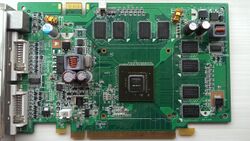
On July 29, 2008, the GeForce 9500 GT was officially launched.
- 65 nm G96 GPU
- 32 stream processors (32 CUDA cores)
- 4 multi processors (each multi processor has 8 cores)
- 550 MHz core, with a 1400 MHz unified shader clock
- 8.8 Gtexels/s fillrate
- 256/512/1024 MB 1,600 MHz GDDR3 memory or 256 MB/512 MB 1,000 MHz GDDR2 memory, both with a 128-bit memory bus
- 25.6 GB/s memory bandwidth for boards configured with GDDR3 800 MHz memory
- Supports DirectX 10, Shader Model 4.0, OpenGL 3.3, and PCI-Express 2.0
- Supports 2nd generation PureVideo HD technology with partial VC1 decoding[6][7]
- NVIDIA SLI-ready technology
- DVI support
GeForce 9500 GS
The 9500 GS is an OEM card that is based on the 9500 GT but geared towards the mainstream audience.
- 65 nm G96 GPU
- 32 stream processors
- 8 ROP units
- 550 MHz core, with a 1375 MHz defined unified shader clock
- 8.8 Gtexels/s fillrate
- 128/512 MB 1000 MHz DDR2 memory with a 128-bit memory bus
- 16.0 GB/s memory bandwidth
- Supports DirectX 10, Shader Model 4.0, OpenGL 3.3, and PCI-Express 2.0
- Supports 2nd generation PureVideo HD technology with partial VC1 decoding
- NVIDIA SLI-ready technology
- DVI support
GeForce 9600 series
GeForce 9600 GT


On February 21, 2008, the GeForce 9600 GT was officially launched. It was an upgrade of 8600 GTS.
- 65 nm G94 GPU
- 64 stream processors
- 16 raster operation (ROP) units, 32 texture address (TA) / texture filter (TF) units
- 20.8 Gtexels/s fill rate
- 650 MHz core clock, with a 1625 MHz unified shader clock
- 1008 MHz memory (2016 MHz datarate), 256-bit interface for 64.5GB/s of bandwidth. (57.6 GB/s for 1800 MHz configuration)
- 512–2048 MB of GDDR3 or DDR2 memory
- 505M transistor count
- DirectX 10.0, Shader Model 4.0, OpenGL 2.1,[8] and PCI-Express 2.0[9]
- Supports second-generation PureVideo HD technology with partial VC1 decoding
- Is HDCP compatible, but its implementation depends on the manufacturer
- Supports CUDA and the Quantum Effects physics processing engine
- Almost double the performance of the previous Nvidia mid-range card, the GeForce 8600GTS
GeForce 9600 GS

The GeForce 9600GS is a Hewlett Packard OEM card. It is based on a G94a core clocked at 500 MHz. It features 768 MB of DDR2 memory on a 192-bit bus.
GeForce 9600 GSO
The GeForce 9600 GSO was essentially a renamed 8800 GS. This tactic has been seen before in products such as the GeForce 7900 GTO to clear unsold stock when it is made obsolete by the next generation. Just like the 8800 GS, the 9600 GSO features 96 stream processors, a 550 MHz core clock with shaders clocked at 1,375 MHz, and either 384 or 768 MB of memory clocked at 800 MHz on a 192-bit memory bus. Some manufacturers have mistakenly listed some of their 768 MB models that have 96 stream processors as being based on the G94 chip, rather than the G92.[10]
GeForce 9600 GSO 512
After clearing the old 8800 GS stock, Nvidia revised the specification with a new core, and 512 MB of memory clocked at 900 MHz on a 256-bit bus.[11] For these cards, the number of stream processors is halved to 48, with the core frequency increased to 650 MHz and the shader frequency increased to 1625 MHz. Some of these cards have 1024 megabytes of memory while still being a 512 model. The revised version is considered inferior in performance to the old version.[according to whom?]
GeForce 9600 GTX
XFX released a 9600 GTX based on the G92 chip featuring 96 stream processors, a 580 MHz core clock, 1450 MHz shaders and 512 MB of GDDR3 running at 1400 MHz on a 256-bit bus. Other than clock speeds, it is functionally the desktop equivalent version of the 9800M GT.[12]
GeForce 9800 Series
The GeForce 9800 series contains the GX2 (dual GPU), GTX, GTX+ and GT variants.[13]
GeForce 9800 GX2

On March 18, 2008, the GeForce 9800 GX2 was officially launched.
The GeForce 9800 GX2 has the following specifications:[14][15]
- Dual PCBs, dual GPU design
- 197 W power consumption.[16]
- Two 65nm process GPUs, with 256 total stream processors (128 per PCB).[17]
- Supports Quad SLI
- Power of Two underclocked GeForce 8800 GTS 512 (G92) video cards in SLI Mode
- 1 GiB (512 MiB per PCB) GDDR3 memory
- Supports DirectX 10, Shader Model 4, OpenGL 3.3, and PCI-Express 2.0
- Supports 2nd generation PureVideo HD technology with partial VC1 decoding
- Outputs include two DVI ports, an HDMI output, and S/PDIF in connector on board for routing audio through the HDMI cable[18]
- An 8-pin and a 6-pin power connector
- Clocks (Core/Shader/Memory): 600 MHz/1500 MHz/2000 MHz[19]
- 256-bit memory interface[19]
- 128 GB/s memory bandwidth[19]
- Release date: March 18, 2008
- Launch price of $666.99[20]
GeForce 9800 GTX
On April 1, 2008, the GeForce 9800 GTX was officially launched.
Taken from an eVGA specification sheet:[21]
- 128 CUDA cores
- Clocks (Core/Shader/Memory): 675 MHz/1688 MHz/1100 MHz
- 256-bit memory interface
- 512 MB of GDDR3 memory
- 70.4 GB/s memory bandwidth
- Texture Fill Rate of 43.2 (billion/s)
- DirectX 10, Shader Model 4.0, OpenGL 3.3, and PCI-Express 2.0
- Supports 2nd generation PureVideo HD technology with partial VC1 decoding
- Outputs include two DVI ports, an HDMI output (using Nvidia DVI to HDMI adapter (included)), and S/PDIF in connector on board for routing audio through the HDMI cable
- Release date: 2008-04-01[22]
- Launch Price of $349[23]
In July 2008 Nvidia released a refresh of the 9800 GTX: the 9800 GTX+ (55 nm manufacturing process). It has faster core (738 MHz) and shader (1836 MHz) clocks. Since March 2009 this design is manufactured as GeForce GTS 250.
GeForce 9800 GT
The 9800GT is identical to an 8800GT, although some were manufactured using a 55 nm technology instead of the 65 nm technology debuted on the 8800GT.[24] The newer (55 nm) version supports HybridPower while the 65 nm version does not.
ASUSTeK have released a 9800GT with Tri-SLI support.[25]
Taken from the Nvidia product detail page.[26]
- 112 CUDA cores
- 512–1024 MB of GDDR3 memory
- 256-bit memory interface width
- 600 MHz graphics clock
- 1500 MHz processor clock
- 900 MHz memory clock
- 33.6 Gtexel/s texture fill rate
- 57.6 GB/s memory bandwidth
- Supports DirectX 10, Shader Model 4.0, OpenGL 3.3, and PCI-Express 2.0
- Supports 2nd generation PureVideo HD technology with partial VC1 decoding
Technical Summary of Desktop G9x GPUs
- 1 Unified shaders : Texture mapping units : Render output units
| Model | Year | Code name | Fab (nm) | Transistors (Million) | Die size (mm2) | Bus interface | Config core1 | Clock rate | Fillrate | Memory | API support (version) | Processing Power G FLOPs | TDP (watts) | Comments | ||||||||
|---|---|---|---|---|---|---|---|---|---|---|---|---|---|---|---|---|---|---|---|---|---|---|
| Core (MHz) | Shader (MHz) | Memory (MHz) | Pixel (GP/s) | Texture (GT/s) | Size (MB) | Bandwidth (GB/s) | Bus type | Bus width (bit) | DirectX | OpenGL | Vulkan | |||||||||||
| GeForce 9300 mGPU | October 2008 | MCP7A-S | 65 | 282 | 162 | PCIe 2.0 x16 | 16:8:4 | 450 | 1200 | 800 1333 |
1.8 | 3.6 | Up to 512 from system memory | 6.4/12.8 10.664/21.328 |
DDR2 DDR3 |
64/128 | 10.0 | 3.3 | N/A | 57.6 | based on 8400 GS | |
| GeForce 9400 mGPU | October 2008 | MCP7A-U | 65 | 282 | 162 | PCIe 2.0 x16 | 16:8:4 | 580 | 1400 | 800 1333 |
2.32 | 4.64 | Up to 512 from system memory | 6.4/12.8 10.664/21.328 |
DDR2 DDR3 |
64/128 | 67.2 | 12 | based on 8400 GS | |||
| GeForce 9300 GE[27] | June 2008 | G98 | 65 | ? | 86 | PCIe 2.0 x16 | 8:8:4 | 540 | 1300 | 500 | 2.16 | 4.3 | 256 | 8 | DDR2 | 64 | 31.2 | 25 | ||||
| GeForce 9300 GS[27] | June 2008 | G98 | 65 | ? | 86 | PCIe 2.0 x16 | 8:8:4 | 567 | 1400 | 500 | 2.268 | 4.5 | 512 | 8 | DDR2 | 64 | 33.6 | ?? | ||||
| GeForce 9400 GT | August 27, 2008 | G96a/b | 65/55 | 314 | 144 | PCIe 2.0 x16, PCI | 16:8:4 | 550 | 1400 | 800 1600 |
2.2 | 4.4 | 256, 512, 1024 | 12.8 25.6 |
GDDR2 GDDR3 |
128 | 67.2 | 50 | ||||
| GeForce 9500 GT | July 29, 2008 | G96a/b | 65/55 | 314 | 144 | PCIe 2.0 x16, PCI | 32:16:8 | 550 | 1400 | 1000 1600 |
4.4 | 8.8 | 256, 512, 1024 | 16.0 25.6 |
DDR2 GDDR3 |
128 | 134.4 | 50 | ||||
| GeForce 9600 GSO | May 2008 | G92 | 65 | 754 | 324 | PCIe 2.0 x16 | 96:48:12 | 550 | 1375 | 1600 | 6.6 | 26.4 | 384, 768, 1536 | 38.4 | GDDR3 | 192 | 396 | 84 | ||||
| GeForce 9600 GSO 512 | October 2008 | G94a/b | 65/55 | 505 | 240/196? | PCIe 2.0 x16 | 48:24:16 | 650 | 1625 | 1800 | 10.4 | 15.6 | 512 | 57.6 | GDDR3 | 256 | 234 | 90 | ||||
| GeForce 9600 GT Green Edition | 2009 | G94b | 55 | 505 | 196? | PCIe 2.0 x16 | 64:32:16 | 600 625 |
1500 1625 |
1400/1800 1800 |
9.6 10 |
19.2 20 |
512, 1024 | 44.8/57.6 57.6 |
GDDR3 | 256 | 288 312 |
59 | Core Voltage 1.0V | |||
| GeForce 9600 GT | February 21, 2008 | G94a/b | 65/55 | 505 | 240/196? | PCIe 2.0 x16 | 64:32:16 | 650 | 1625 | 1800 | 10.4 | 20.8 | 512, 1024, 2048 | 57.6 | GDDR3 | 256 | 312 | 95 | ||||
| GeForce 9800 GT Green Edition | 2009 | G92b | 55 | 754 | 260 | PCIe 2.0 x16 | 112:56:16 | 550 | 1375 | 1400 1600 1800 |
8.8 | 30.8 | 512, 1024 | 44.8 51.2 57.6 |
GDDR3 | 256 | 462 | 75 | Core Voltage 1.0V | |||
| GeForce 9800 GT | July 2008 | G92a/b/a2 | 65/55/65 | 754 | 324/260/324 | PCIe 2.0 x16 | 112:56:16 | 600/600/550 | 1500/1500/1375 | 1800 | 9.6 | 33.6 | 512, 1024 | 57.6 | GDDR3 | 256 | 504/504/465 | 125/105/75 | Some 65 nm cards are rebranded 8800 GT cards.
G92a2 Core Voltage 1.0V | |||
| GeForce 9800 GTX | April 1, 2008 | G92 | 65 | 754 | 324 | PCIe 2.0 x16 | 128:64:16 | 675 | 1688 | 2200 | 10.8 | 43.2 | 512 | 70.4 | GDDR3 | 256 | 648.192 | 140 | ||||
| GeForce 9800 GTX+ | July 16, 2008 | G92b | 55 | 754 | 260 | PCIe 2.0 x16 | 128:64:16 | 738 | 1836 | 2200 | 11.808 | 47.232 | 512, 1024 | 70.4 | GDDR3 | 256 | 705.024 | 141 | ||||
| GeForce 9800 GX2 | March 18, 2008 | 2× G92 | 65 | 2× 754 | 2× 324 | PCIe 2.0 x16 | 2× 128:64:16 | 600 | 1500 | 2000 | 2× 9.6 | 2× 38.4 | 2× 512 | 2× 64.0 | GDDR3 | 2× 256 | 2× 576 | 197 | ||||
| Model | Year | Codename | Fab (nm) | Transistors (Million) | Die size (mm2) | Bus interface | Config core1 | Core (MHz) | Shader (MHz) | Memory (MHz) | Pixel (GP/s) | Texture (GT/s) | Size (MiB) | Bandwidth (GB/s) | Bus type | Bus width (bit) | DirectX | OpenGL | Vulkan | Processing Power G FLOPs | TDP (watts) | Comments |
Features
- Compute Capability: 1.1 has support for Atomic functions, which are used to write thread-safe programs.
| Model | Features | |||||||
|---|---|---|---|---|---|---|---|---|
| Scalable Link Interface (SLI) | Coverage Sample AA |
Angle Independent AF |
128 bit OpenEXR | PureVideo 2 with VP2
Engine: (BSP and 128 AES) | ||||
| GeForce 9400 GT | Yes | Yes | ||||||
| GeForce 9500 GT | ||||||||
| GeForce 9600 GSO | ||||||||
| GeForce 9600 GT | ||||||||
| GeForce 9800 GT | ||||||||
| GeForce 9800 GTX | Yes 3-way (link 3 GTXs) | |||||||
| GeForce 9800 GTX+ | ||||||||
| GeForce 9800 GX2 | Yes Quad (link 2 GX2s) | |||||||
GeForce 9M Series
All graphical processing units in the GeForce 9M series feature:
- Increased performance for similar power draw compared to GeForce 8M series for midrange and mid-high range notebooks
- DirectX 10.0 and OpenGL 3.3 compatibility
- 16X antialiasing and PCI-Express 2.0 connectivity
- Full HD DVD / Blu-ray hardware decoding
9100M G
- 1 TMU per pipeline
- 4 ROPs
- 8 stream processors
- 16 (v4.0) shader unified
- 26 GigaFLOPS
- 450 MHz core clock
- 1100 MHz shader clock
- Integrated RAMDAC clock at 400 MHz
- Memory clock depends on system memory
- Up to 256 MB shared memory, 512 MB with Turbo Cache in Windows XP
- 64 bit memory interface (single-channel mode) / 128 bit memory interface (dual-channel mode)
- Memory bandwidth depend on System Memory
- 1.8 Gtexels/s texture fill rate
- (Specification based on Acer Aspire 4530 using EVEREST Ultimate Edition Version 4.60.1500PX and TechPowerUp GPU-Z v0.4.6)[28]
9200M GS
- 8 stream processors
- 529 MHz core clock
- 1300 MHz shader clock
- 400 MHz memory clock
- Up to 256 MB memory
- 64-bit memory interface
- 6.4 GB/s memory bandwidth
- 27.1 Gpixel/s pixel fill rate
- 4.2 Gtexel/s texture fill rate[29]
9300M G
- 16 stream processors
- 400 MHz core clock
- 800 MHz shader clock
- 600 MHz memory clock
- Up to 512 MB memory
- 64-bit memory interface
- 1.8 GB/s memory bandwidth
- 3.2 Gtexels/s texture fill rate
9300M GS
- 8 stream processors
- 580 MHz core clock
- 1450 MHz shader clock
- 800 MHz memory clock
- Up to 512 MB memory
- 64-bit memory interface
- 6.9 GB/s memory bandwidth
- 4.6 Gtexels/s texture fill rate
9400M G
- 16 stream processors
- Memory clock depends on system memory
- 64 bit memory interface (single-channel mode) / 128 bit memory interface (dual-channel mode)
- Memory bandwidth depends on System Memory
- 3.6 Gtexels/s texture fill rate
9500M G
- 16 Processors
- ? Gtexels/s texture fill rate
9500M GS
- 32 stream processors
- 475 MHz core clock
- 950 MHz shader clock
- 700 MHz memory clock
- Up to 512 MB memory
- 128-bit memory interface
- 22.4 GB/s memory bandwidth
- 7.6 Gtexels/s texture fill rate
9600M GS
- 064A/8 core (G96)
- 32 stream processors
- 430 MHz core clock
- 1075 MHz shader clock
- 800/1600 MHz memory clock (effective)
- Up to 1024 MB memory
- 128-bit memory interface
- 12.8 GB/s (with DDR2 type) or 25.6 GB/s (with GDDR3 type) memory bandwidth
- 6.8 Gtexels/s texture fill rate
- 103 GigaFLOPS
9600M GT
- 32 stream processors
- 500 MHz core clock
- 1250 MHz shader clock
- 800 MHz memory clock
- Up to 1024 MB memory
- 128-bit memory interface
- 25.6 GB/s memory bandwidth
- 8.0 Gtexels/s texture fill rate
9650M GT
- G96 core (65/55 nm)
- 32 stream processors
- 550 MHz core clock
- 1325 MHz shader clock
- 800 MHz memory clock
- Up to 1024 MB memory
- 128 bit memory interface
- 25.6 GB/s memory bandwidth
- 8.8 Gtexels/s texture fill rate
9700M GT
- G96 core
- 32 stream processors
- 625 MHz core clock
- 1550 MHz shader clock
- 800 MHz memory clock
- 128 bit memory interface
- 25.6 GB/s memory bandwidth
- 10.0 Gtexels/s texture fill rate
- 148.8 GigaFLOPS
9700M GTS
- G94 core
- 48 stream processors
- 530 MHz core clock
- 1325 MHz shader clock
- 800 MHz memory clock
- 256 bit memory interface
- 51.2 GB/s memory bandwidth
- 12.7 Gtexels/s texture fill rate
- 190.8 GigaFLOPS
9800M GS
- G94 core
- 64 stream processors
- 530 MHz core clock
- 1325 MHz shader clock
- 800 MHz memory clock
- 256 bit memory interface
- 51.2 GB/s memory bandwidth
- 17.0 Gtexels/s texture fill rate
- 254 GigaFLOPS
9800M GTS
- G94 core
- 64 stream processors
- 600 MHz core clock
- 1500 MHz shader clock
- 800 MHz memory clock
- 256 bit memory interface
- 51.2 GB/s memory bandwidth
- 19.2 Gtexels/s texture fill rate
- 288 GigaFLOPS
9800M GT
- G94 core
- 96 stream processors
- 500 MHz core clock
- 1250 MHz shader clock
- 800 MHz memory clock
- 256 bit memory interface
- 51.2 GB/s memory bandwidth
- 24.0 Gtexels/s texture fill rate
- 360 GigaFLOPS
9800M GTX
- G92 core
- 112 stream processors
- 500 MHz core clock
- 1250 MHz shader clock
- 800 MHz memory clock
- 256 bit memory interface
- 51.2 GB/s memory bandwidth
- 28.0 Gtexels/s texture fill rate
- 420 GigaFLOPS
Technical summary
| Model | Release Date | Codename | Interface | Fabrication process (nm) | Core clock max (MHz) | Peak fillrate | Shaders | Memory | Texture Units | Raster Operators | Power Consumption (Watts) | Transistor Count (Millions) | Theoretical Shader Processing Rate (GigaFLOPS) | ||||||||
|---|---|---|---|---|---|---|---|---|---|---|---|---|---|---|---|---|---|---|---|---|---|
| Billion pixel/s | Billion bilinear texel/s | Billion bilinear FP16 texel/s | Billion FP32 pixel/s | CUDA cores | Clock (MHz) | Bandwidth max (GB/s) | DRAM type | Bus width (bit) | Size (MB) | Effective DDR Clock (MHz) | |||||||||||
| GeForce 9100M G | ? | MCP77MH MCP79MH | PCI | 65 | 450 | ? | ? | ? | ? | 8 | 1080 | 21GB/s | DDR2 from RAM | depend RAM configuration | depend RAM configuration | depend RAM configuration | ? | 4 | ? | ? | 26 |
| GeForce 9200M GS | G98 | 65 | 530 | ? | ? | ? | 8 | 1300 | GDDR2 GDDR3 | 256 | ? | ? | ? | ? | 31 | ||||||
| GeForce 9300M G | G98 | 65 | 400 | ? | 3.2 | ? | ? | 16 | 800 | 9.6 | 64 | 256 | 1200 (600) | ? | ? | ? | ? | 38 | |||
| GeForce 9300M GS | G98 | 65 | ? | ? | ? | ? | ? | 16 | 1400 | ? | GDDR2 GDDR3 | 64 | 256 | 1400 (700) | ? | ? | ? | ? | 34 | ||
| GeForce 9400M G | MCP79MX | 65 | 450 | ? | ? | ? | ? | 16 | 1100 | ? | 128 | ? | ? | 12 | 282 | 54 | |||||
| GeForce 9500M G | 65 | ? | ? | ? | ? | ? | 16 | 1250 | ? | GDDR2 GDDR3 | 128 | 256, 512, 1024 | 1600 (800) | ? | ? | ? | ? | 60 | |||
| GeForce 9500M GS | G84 | 65 | 479 | ? | 7.6 | ? | ? | 32 | 950 | 22.4 | 128 | 512 | 1400 (700) | ? | 8 | ? | 289 | ? | |||
| GeForce 9600M GS | G96 | 65 | 430 | ? | ? | ? | ? | 32 | 1075 | 25.3 | GDDR2 GDDR3 | 128 | 1024 | 1600 (800) | ? | ? | ? | 314 | 103 | ||
| GeForce 9600M GT | G96 | 65 | 500 | ? | ? | ? | ? | 32 | 1250 | ? | GDDR2 GDDR3 | 128 | 256, 512, 1024 | 1600 (800) | ? | ? | 23 | 314 | 120 | ||
| GeForce 9650M GS | 65 | 625 | ? | 10 | ? | ? | 32 | 1250 | 25.6 | 128 | 512 | 1600 (800) | ? | ? | 29 | 289 | 120 | ||||
| GeForce 9700M GT | G96 | 625 | ? | 10 | ? | ? | 32 | 1550 | 25.6 | GDDR3 | 128 | 512 | 1600 (800) | ? | ? | ? | ? | 148.8 | |||
| GeForce 9700M GTS | G94 | 530 | ? | 12.7 | ? | ? | 48 | 1325 | 51.2 | 256 | ? | 1600 (800) | ? | ? | ? | ? | 190.8 | ||||
| GeForce 9800M GTS | G94 | 600 | ? | 19.2 | ? | ? | 64 | 1500 | 51.2 | 256 | 512 | 1600 (800) | ? | ? | ? | ? | 288 | ||||
| GeForce 9800M GT | G94 | 500 | ? | 24 | ? | ? | 96 | 1250 | 51.2 | 256 | 512 | 1600 (800) | ? | ? | ? | ? | 360 | ||||
| GeForce 9800M GTX | G92 | 500 | ? | 28.0 | ? | ? | 112 | 1375 | 51.2 | 256 | 512 | 1600 (800) | ? | 75 | ? | ? | 420 | ||||
Discontinued support
NVIDIA has ceased driver support for GeForce 9 series on April 1, 2016.[30]
- Windows XP 32-bit & Media Center Edition: version 340.52 released on July 29, 2014; Download
- Windows XP 64-bit: version 340.52 released on July 29, 2014; Download
- Windows Vista, 7, 8, 8.1 32-bit: version 342.01 (WHQL) released on December 14, 2016; Download
- Windows Vista, 7, 8, 8.1 64-bit: version 342.01 (WHQL) released on December 14, 2016; Download
- Windows 10, 32-bit: version 342.01 (WHQL) released on December 14, 2016; Download
- Windows 10, 64-bit: version 342.01 (WHQL) released on December 14, 2016; Download
See also
- Comparison of Nvidia graphics processing units
- GeForce 8 series
- GeForce 100 series
- GeForce 200 series
- GeForce 300 series
- Nvidia Quadro – NVIDIA's workstation graphics solution
- Nvidia Tesla – NVIDIA's first dedicated general purpose GPU (graphical processor unit)
References
- ↑ http://www.gpureview.com/GeForce-9300-GS-card-581.html
- ↑ "Galaxy Technology 9400GT news page"[yes|permanent dead link|dead link}}], August 27, 2008. (Accessed August 28, 2008.)
- ↑ "Firing Squad", August 26, 2008. (Accessed August 26, 2008.)
- ↑ "Geforce 9200GS/9400GT reviewed", "Geeks of 3D", August 27, 2008.
- ↑ "TechARP forums", August 27, 2008.
- ↑ Albatron Plans 9500GT PCIe x1 Card For SFF/HTPC, VR-Zone
- ↑ ZOTAC Unleashes Silent GeForce 9500 GT, bit-tech.net
- ↑ http://www.geforce.com/hardware/desktop-gpus/geforce-9600-gt/specifications
- ↑ (in Chinese) "??????1??!G94??GeForce 9600GT??????", "pconline", January 14, 2008. (Accessed January 14, 2008.)
- ↑ http://www.nvidia.com/object/product_geforce_9600_gso_us.html
- ↑ http://www.nvidia.com/object/product_geforce_9600_gso_512_us.html
- ↑ "Archived copy". http://www.xfxforce.com/en-us/products/graphiccards/9series/9600GTX.aspx#2.
- ↑ nVidia GeForce Family, retrieved February 25, 2008
- ↑ "GeForce 9800 GX2 Exclusive Pics & Specs" , "Hard OCP", January 3, 2008. (Accessed January 4, 2008.)
- ↑ "Exclusive: Nvidia GeForce 9800GX2", "Tom's Hardware", January 4, 2010. (Accessed January 4, 2008.)
- ↑ Nvidia's GeForce 9800 GX2 Launches, "Washington Post", March 18, 2008. (Accessed February 15, 2008.)
- ↑ "Geforce 9800GX2 has two G92GTS", "Fudzilla", February 11, 2008. (Accessed March 19, 2008.)
- ↑ "GeForce 9600GT to include DisplayPort" , "TweakTown", February 14, 2008. (Accessed February 15, 2008.)
- ↑ 19.0 19.1 19.2 "NVIDIA GeForce 9800M GX2", "Hardware.no". (Accessed February 18, 2008
- ↑ "Amazon.com: EVGA 9800 gx2", "Amazon", March 18, 2008. (Accessed March 18, 2008.)
- ↑ "eVGA GeForce 9800 GTX Product Specification Sheet", "eVGA Spec Sheet". (Accessed March 17, 2008.)
- ↑ "9800GTX pushed to April", "Fudzilla". (Accessed March 21, 2008.)
- ↑ "9800GTX listed for $350", "Fudzilla". (Accessed March 21, 2008.)
- ↑ 9800GT Product Specs., "Hexus.net" (Retrieved November 9, 2008.)
- ↑ Tri-SLI compatible 9800GT (Retrieved November 9, 2008.)
- ↑ "GeForce 9800GT Product Specifications", "nVidia Product Specifications". (Retrieved November 9, 2008.)
- ↑ 27.0 27.1 Nvidia Corporation (2008). "Nvidia GeForce 9300 GE". http://www.pcinpact.com/affichage/43963-NVIDIA-9600GT-9300GE-9300GS/58125.htm.
- ↑ "NVIDIA GeForce 9100M G", "NVIDIA". (Accessed July 23, 2008.)
- ↑ "NVIDIA GeForce 9200M GS", "NVIDIA". (Accessed July 23, 2008.)
- ↑ EOL driver support for legacy products
External links
- GeForce 9800 GX2
- GeForce 9800 GTX+
- GeForce 9800 GTX
- GeForce 9800 GT
- GeForce 9600 GT
- GeForce 9500 GT
- GeForce 9400 GT
- Nvidia Nsight
 |
Categories: [Video cards]
↧ Download as ZWI file | Last modified: 11/05/2025 19:09:53 | 4 views
☰ Source: https://handwiki.org/wiki/Engineering:GeForce_9_series | License: CC BY-SA 3.0
 KSF
KSF