Chromium(Vi) Oxide Peroxide
 From Handwiki
| |
| Names | |
|---|---|
| Other names
chromium(VI) oxide peroxide,
chromium pentoxide | |
| Identifiers | |
CAS Number
|
|
3D model (JSmol)
|
|
PubChem CID
|
|
InChI
| |
SMILES
| |
| Properties | |
Chemical formula
|
CrO5 |
| Molar mass | 131.991 g·mol−1 |
Solubility in water
|
soluble (decomposes without stabilisers) |
Except where otherwise noted, data are given for materials in their standard state (at 25 °C [77 °F], 100 kPa). | |
 verify (what is verify (what is   ?) ?)
| |
| Infobox references | |
Chromium(VI) peroxide or chromium oxide peroxide is an unstable compound with the formula CrO5. This compound contains one oxo ligand and two peroxo ligands, making a total of five oxygen atoms per chromium atom.
Preparation and properties
Chromium(VI) peroxide is formed by the addition of acidified hydrogen peroxide solutions to solutions of metal chromates or dichromates, such as sodium chromate or potassium dichromate. The generally yellow chromates or orange dichromates turn to dark blue as chromium(VI) peroxide is formed. Chromate or dichromate reacts with hydrogen peroxide and an acid to give chromium peroxide and water.
- CrO42− + 2 H2O2 + 2 H+ → CrO5 + 3 H2O
With this method, the chromium(VI) peroxide will decompose after a few seconds, turning green as chromium(III) compounds are formed.[1]
- 2 CrO5 + 7 H2O2 + 6 H+ → 2 Cr3+ + 10 H2O + 7 O2
To avoid this decomposition, it is possible to stabilize chromium(VI) oxide peroxide in water-immiscible organic solvents such as diethyl ether, butan-1-ol, ethyl acetate or amyl acetate by adding a layer of the organic solvent above the chromate/dichromate solution and shaking during the addition of hydrogen peroxide. In this way, the chromium(VI) peroxide (unstable in the aqueous phase in which it is newly formed) is dissolved in the immiscible organic solvent. In this condition, it can be observed over a much longer period.
CrO5 is unstable and decomposes on standing to form CrO3. It is incompatible with ketones and primary alcohols, as it oxidizes them to aldehydes and carboxylic acids while being itself reduced to Cr3+. Therefore, CrO5 is a good oxidizing agent, even better than chromates and dichromates due to the presence of two reactive peroxo ligands, but due to its low stability it is not used in organic syntheses.[citation needed]
Derivatives
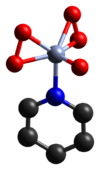
The etherate, bipyridyl and pyridyl complexes of this compound have been found to be effective oxidants in organic chemistry.[2] The structure of the pyridyl complex has been determined crystallographically.[3]
Gallery
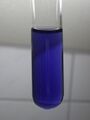
An aqueous solution of chromium peroxide
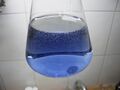
A very dilute solution of chromium peroxide
_oxide_peroxide_(stabilized_in_ether_phase).jpg)
chromium(VI) oxide peroxide stabilized in ether phase (above) and chromium(III) aqueous solution (below).
See also
- Tetraperoxochromate - an similarly-synthesized analogous chromium(V) peroxide complex
References
- ↑ Holleman, Arnold F.; Wiberg, Egon; Wiberg, Nils; (1985). "Chromium" (in German). Lehrbuch der Anorganischen Chemie (91–100 ed.). Walter de Gruyter. pp. 1081–1095. ISBN:3-11-007511-3."
- ↑ Firouzabadi, H.; Iranpoor, N.; Kiaeezadeh, F.; Toofan, J. (1986). "Chromium(VI) based oxidants-1 Chromium peroxide complexes as versatile, mild, and efficient oxidants in organic synthesis". Tetrahedron 42: 719. doi:10.1016/S0040-4020(01)87476-7.
- ↑ Stomberg, Rolf (1962). "Crystal Structure of Peroxochromates, CrO5⋅C5H5N". Nature 196 (4854): 570–571. doi:10.1038/196570b0.
External links
- Experimental details and photo (in German)
- Losing fingers to chemistry on YouTube (8 November 2012). Professor Martyn Poliakoff of the University of Nottingham demonstrates the synthesis on Periodic Videos.
 |  |
Categories: [Peroxides] [Chromates] [Transition metal oxides]
↧ Download as ZWI file | Last modified: 11/12/2023 19:32:26 | 2 views
☰ Source: https://handwiki.org/wiki/Chemistry:Chromium(VI)_oxide_peroxide | License: CC BY-SA 3.0
 ZWI signed:
 KSF
KSF