Eco-Anxiety
 From Handwiki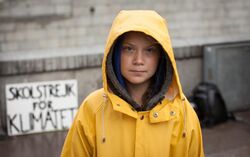
Eco-anxiety is anxiety about ecological disasters and threats to the natural environment such as pollution and climate change.[1][2][3] Variations to the definition exist such as the broader description explaining it as the "worry or agitation caused by concerns about the present and future state of the environment."[4]
Such anxiety is mirrored by apocalyptic treatment of the theme in movies such as The Road, in which a father and son scavenge in a bleak world set after a major extinction event. People may have nightmares about such ideas and become very worried. For example, one child was so concerned about the threat of drought caused by climate change that he refused to drink water, lest millions die as a result.[5]
Some cite that eco-anxiety is not related to maladaptive forms of worrying nor a pathological expression of anxiety but a constructive or adaptive reaction associated with pro-environmental attitudes and actions.[6] An account, however, states that this condition can involve immobilization, manic re/activity, exhaustion, and insomnia.[7] This indicates that, like general anxiety, eco-anxiety occurs on a spectrum and can be beneficial or harmful to the individual's life depending on the strength of the emotion.
Swedish schoolgirl Greta Thunberg, who started the school strike for climate, warned to be extremely concerned about the matter: "...I don’t want you to be hopeful, I want you to panic."[2] When she was younger, she fell into a depression and she has claimed that this was because of her worries about climate change.[8][9]. A Danish reporter stated that he intended to report Greta's mother Marlena to the Swedish authorities for abusing Greta with eco-anxiety.[10]
The term eco-angst has also been suggested.[11]
Causes
Although many focus on the effect of climate change on the environment and the physical health, studies have shown that climate change can also affect the mental health.
Eco-anxiety can be a direct consequence of a natural disaster, such as a post-traumatic stress disorder from living a traumatic experience. But it can also be due to a constant fear of possible natural disasters when living in an area at risk. Moreover, eco-anxiety can be related to long-term events, a slower consequences of climate changes and pollution, such as those impacting agriculture or the livability of an area.[12]
Eco-psychology
In response to eco-anxiety there is an emerging field of eco-psychology that differs from the well establish field of environmental psychology. Eco-therapy is the form of therapy used in this field specifically to treat those with eco-anxiety. These therapists include Lorin Lindner, Melissa Pickett, and Thomas Doherty. A highly emphasized treatment method of eco-therapy is to inspire patients to take action on environmental issues by doing things like becoming more educated or reducing their carbon foot prints.[13]
Climate change and its impact on human health
Climate disruptions
Nationally known and community-focused psychiatrist David Pollack, provides insight as to how climate change impacts human health in his article in the Psychiatric Times journal called "Climate Change and Its Impacts on Mental Health." Pollack refers to specific instances of climate disruption including excessive CO2 levels, rising sea levels and global temperatures, droughts, and other extreme weather events that merge to threaten the worldwide stability of individuals, communities, and nations.[14] Pollack emphasizes how mental health consequences of climate disruption typically last longer and require close attention and understanding of psychiatry to effectively identify and treat. Pollack continues to further define the term eco-anxiety with a cluster of related terms such as "eco-paralysis", "climate anxiety", and "climate grief", which all could be considered psychoterratic syndromes. "Psychoterratic" has developed as the term that covers all forms of earth-related mental health issues.
Impact on human health
Justin Nobel's 2007 entry in The Philadelphia Inquirer provides insight regarding the specific symptoms felt by individuals impacted by eco-anxiety. Melissa Pickett, an eco-therapist practicing in Santa Fe, claims she treats between forty to eighty eco-anxious patients a month. [15] Symptoms include irritability, sleeplessness, loss of appetite, bouts of weakness, panic attacks, and twitching. Pickett recommends a couple therapeutic remedies involving incorporating natural objects into everyday life and making environmentally friendly lifestyle changes.
Consequences and vulnerabilities
From the University of Nigeria, authors JohnBosco Chika Chukwuorji, Chuka Mike Ifeagwazi, and Steven Kator Iorfa collaborate on the issue of mental health and climate change consequences in an article called "Mental health emergency of climate change: Consequences and vulnerabilities" in the March 2015 issue of International Journal of Communication. They discuss how as a consequence of climate change, new disorders have emerged in mental health lexicon including weather phobias, ecoanxiety and solastalgia. Mitigation and adaptation are fundamental issues of relevance in the discussion of climate change impacts. Mitigation refers to the efforts being made to reduce the impact of greenhouse gas emissions and initiatives to remove carbon from the atmosphere. Adaptation involves the changes that cannot be prevented through mitigation. To lessen the impact on health and the environment, adaptation takes place through a range of technological, physiological, and behavioral mechanisms.[16]
See also
- Doomwatch
- Ecological grief
- Ecopsychology
- Solastalgia
- Effects of global warming on human health
- Long-term effects of global warming
References
- ↑ Clayton, Susan; Manning, Christie; Krygsman, Kirra; Speiser, Meighen (March 2017), Mental Health and Our Changing Climate: Impacts, Implications, and Guidance, American Psychological Association, https://www.apa.org/news/press/releases/2017/03/mental-health-climate.pdf
- ↑ 2.0 2.1 Fawbert, Dave (27 March 2019), 'Eco-anxiety': how to spot it and what to do about it, BBC, https://www.bbc.co.uk/bbcthree/article/b2e7ee32-ad28-4ec4-89aa-a8b8c98f95a5
- ↑ Ro, Christine (20 June 2018), How to cure the eco-anxious, Wellcome Collection, https://wellcomecollection.org/articles/Ww2BOCEAAMsAioTE
- ↑ Smith, Andrew; Hughes, William (2013). Ecogothic. Manchester, UK: Manchester University Press. pp. 148. ISBN 9780719086571.
- ↑ Carr, Emily (2013), "A Gothic apocalypse", EcoGothic (Manchester University Press): p. 148–154, ISBN 9780719086571
- ↑ Albrecht, Glenn A. (2019). Earth Emotions: New Words for a New World. Ithaca, NY: Cornell University Press. pp. 77. ISBN 9781501715228.
- ↑ Kaplan, Rachel; Blume, K. Ruby (2011). Urban Homesteading: Heirloom Skills for Sustainable Living. New York: Skyhorse Publishing Inc.. pp. 255. ISBN 9781616080549.
- ↑ Jon Queally (19 December 2018). "Depressed and Then Diagnosed With Autism" (in English). Common Dreams. https://www.commondreams.org/news/2018/12/19/depressed-and-then-diagnosed-autism-greta-thunberg-explains-why-hope-cannot-save. Retrieved 26 June 2019.
- ↑ Jonathan Watts (11 March 2019). "Greta Thunberg, schoolgirl climate change warrior" (in English). Guardian. https://www.theguardian.com/world/2019/mar/11/greta-thunberg-schoolgirl-climate-change-warrior-some-people-can-let-things-go-i-cant. Retrieved 26 June 2019.
- ↑ Petring, Louise (27 May 2019). "Slagter Greta Thunberg-bog: 'Jeg har lyst til at melde moren til politiet'" (in da). Climate debate. B.T. (Michael Dyrby) (Translation: "I want to report the mother"). https://www.bt.dk/anmeldelser/slagter-greta-thunberg-bog-jeg-har-lyst-til-at-melde-moren-til-politiet. Retrieved 30 October 2019.
- ↑ Pihkala, Panu (2018). "Eco-Anxiety, Tragedy, and Hope: Psychological and Spiritual Dimensions of Climate Change" (in en). Zygon 53 (2): 545–569. doi:10.1111/zygo.12407. ISSN 1467-9744.
- ↑ Davies, Jonathan (2019). "Suffering From Eco-anxiety? Embrace it! Here is Why…". https://www.beeco.green/blog/how-to-embrace-eco-anxiety/.
- ↑ Cossman, Brenda (2013). "Anxiety Governance". Law & Social Inquiry 38 (4): 892–919. doi:10.1111/lsi.12027. ISSN 0897-6546.
- ↑ David A. Pollack, M. D. (2018-10-12). "Climate Change and Its Impacts on Mental Health" (in en). https://www.psychiatrictimes.com/article/climate-change-and-its-impacts-mental-health.
- ↑ Nobel, Justin. "Eco-anxiety: Something else to worry about" (in en-US). https://www.inquirer.com/philly/health/20070409_Eco-anxiety__Something_else_to_worry_about.html.
- ↑ Chukwuorji, JohnBosco Chika; Ifeagwazi, Chuka Mike; Iorfa, Steven Kator (March 2015). "Mental health emergency of climate change: Consequences and vulnerabilities". International Journal of Communication: 110–131. https://www.researchgate.net/publication/278016311.
 |
Categories: [Environmental social science] [Anxiety]
↧ Download as ZWI file | Last modified: 06/11/2024 16:48:57 | 8 views
☰ Source: https://handwiki.org/wiki/Social:Eco-anxiety | License: CC BY-SA 3.0
 KSF
KSF