374 Burgundia
 From Handwiki
 Short description: Main-belt asteroid
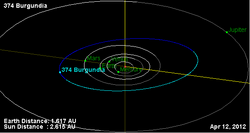 Orbital diagram | |
| Discovery | |
|---|---|
| Discovered by | Auguste Charlois |
| Discovery date | 18 September 1893 |
| Designations | |
MPC designation | (374) Burgundia |
| Pronunciation | /bɜːrˈɡʌndiə/[1] |
| Named after | Burgundy |
Alternative designations | 1893 AK |
| Minor planet category | Main belt |
| Orbital characteristics[2] | |
| Epoch 31 July 2016 (JD 2457600.5) | |
| Uncertainty parameter 0 | |
| Observation arc | 112.39 yr (41051 d) |
| |{{{apsis}}}|helion}} | 3.00578 astronomical unit|AU (449.658 Gm) |
| |{{{apsis}}}|helion}} | 2.5566 AU (382.46 Gm) |
Semi-major axis | 2.7812 AU (416.06 Gm) |
| Eccentricity | 0.080763 |
| Orbital period | 4.64 yr (1694.1 d) |
| Mean anomaly | 295.379° |
| Mean motion | 0° 12m 45s / day |
| Inclination | 8.9881° |
| Longitude of ascending node | 219.030° |
|{{{apsis}}}|helion}} | 25.153° |
| Physical characteristics | |
| Dimensions | 44.67±1.3 km |
| Rotation period | 6.972 h (0.2905 d) |
| Geometric albedo | 0.3014±0.018 |
Spectral type | S |
| Absolute magnitude (H) | 8.67,[2] 8.68[3] |
Burgundia (minor planet designation: 374 Burgundia) is a typical main belt asteroid that was discovered by Auguste Charlois on 18 September 1893 in Nice. It was named for the former French region of Burgundy. It is one of seven of Charlois's discoveries that was expressly named by the Astromomisches Rechen-Institut (Astronomical Calculation Institute).[4]
Burgundia was long thought to be a member of the now defunct Ceres asteroid family, but it was found to be an unrelated interloper in that group based on its non-matching composition.[5]
References
- ↑ Burgundian (3rd ed.), Oxford University Press, September 2005, http://oed.com/search?searchType=dictionary&q=Burgundian (Subscription or UK public library membership required.)
- ↑ 2.0 2.1 Yeomans, Donald K., "374 Burgundia", JPL Small-Body Database Browser (NASA Jet Propulsion Laboratory), https://ssd.jpl.nasa.gov/sbdb.cgi?sstr=374, retrieved 11 May 2016.
- ↑ Warner, Brian D. (December 2007), "Initial Results of a Dedicated H-G Project", The Minor Planet Bulletin 34: pp. 113–119, Bibcode: 2007MPBu...34..113W.
- ↑ Schmadel Lutz D. Dictionary of Minor Planet Names (fifth edition), Springer, 2003. ISBN:3-540-00238-3.
- ↑ Cellino, A . et al. "Spectroscopic Properties of Asteroid Families", in Asteroids III, University of Arizona Press, pp. 633-643 (2002).
External links
- 374 Burgundia at AstDyS-2, Asteroids—Dynamic Site
- Ephemeris · Observation prediction · Orbital info · Proper elements · Observational info
- 374 Burgundia at the JPL Small-Body Database
- Close approach · Discovery · Ephemeris · Orbit diagram · Orbital elements · Physical parameters
 |  |
Categories: [Background asteroids] [Named minor planets] [S-type asteroids (Tholen)] [S-type asteroids (SMASS)]
↧ Download as ZWI file | Last modified: 11/21/2024 11:20:51 | 4 views
☰ Source: https://handwiki.org/wiki/Astronomy:374_Burgundia | License: CC BY-SA 3.0
✘
ZWI is not signed. [what is this?]
ZWI viewer
by the  KSF
KSF
KSF