United States House Election In Alaska (August 21, 2018 Republican Primary)
 From Ballotpedia
 - General election: Nov. 6
- Voter registration deadline: Oct. 7
- Early voting: Oct. 22 - Nov. 5
- Absentee voting deadline: Postmark Nov. 6
- Online registration: Yes
- Same-day registration: No
- Voter ID: Non-photo ID required
- Poll times: 7:00 a.m. to 8:00 p.m.
2020 →
← 2016
|
| Alaska's At-Large Congressional District |
|---|
 |
| Democratic primary Republican primary General election |
| Election details |
| Filing deadline: June 1, 2018 |
| Primary: August 21, 2018 General: November 6, 2018 Pre-election incumbent: Don Young (Republican) |
| How to vote |
| Poll times: 7 a.m. to 8 p.m. Voting in Alaska |
| Race ratings |
Sabato's Crystal Ball: Likely Republican Inside Elections: Solid Republican |
| Ballotpedia analysis |
| U.S. Senate battlegrounds U.S. House battlegrounds Federal and state primary competitiveness Ballotpedia's Election Analysis Hub, 2018 |
| See also |
At-large Alaska elections, 2018 U.S. Congress elections, 2018 U.S. Senate elections, 2018 U.S. House elections, 2018 |
A Republican Party primary election took place on August 21, 2018, in Alaska to determine which Republican would run in the state's November 6, 2018, general election.
This page focuses on the Republican primary. For an overview of the election in general, click here.
Candidates and election results[edit]
Incumbent Don Young defeated Thomas Nelson and Jed Whittaker in the Republican primary for U.S. House Alaska At-large District on August 21, 2018.
Republican primary for U.S. House Alaska At-large District
Candidate |
% |
Votes |
||
| ✔ |
|
Don Young |
70.8
|
49,667 |
|
|
Thomas Nelson |
15.6
|
10,913 | |
|
|
Jed Whittaker |
13.6
|
9,525 | |

|
Total votes: 70,105 | |||
 = candidate completed the Ballotpedia Candidate Connection survey. = candidate completed the Ballotpedia Candidate Connection survey. | ||||
Do you want a spreadsheet of this type of data? Contact our sales team. |
||||

District analysis[edit]
- See also: The Cook Political Report's Partisan Voter Index
- See also: FiveThirtyEight's elasticity scores
The 2017 Cook Partisan Voter Index for this district is R+9, meaning that in the previous two presidential elections, this district's results were 9 percentage points more Republican than the national average. This made Alaska's At-Large Congressional District the 141st most Republican nationally.[1]
District demographics[edit]
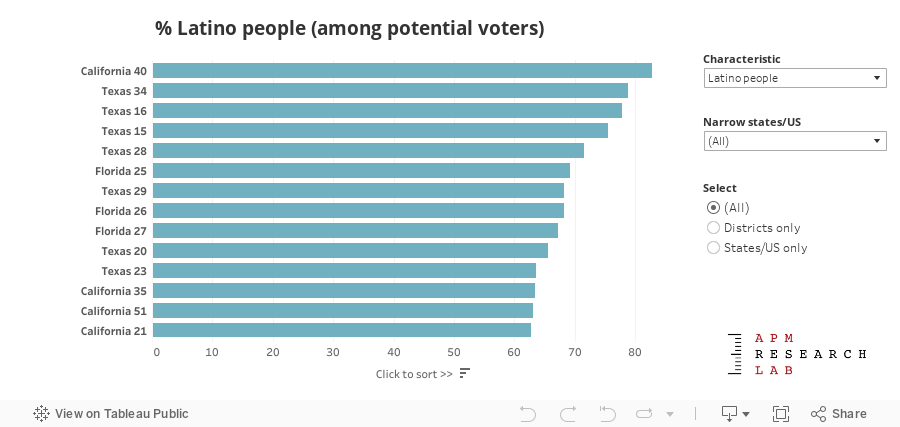
The table below presents demographic data in Congressional Districts from the U.S. Census Bureau. Use the drop-down boxes on the right side of the table to sort the data by characteristic information and state. The tables were provided by the American Public Media Research Lab.
Campaign finance[edit]
The table below contains data from FEC Quarterly October 2017 reports. It includes only candidates who reported at least $10,000 in campaign contributions as of September 30, 2017.[2]
 Republicans
State overview[edit]
Partisan control[edit]
This section details the partisan control of federal and state positions in Alaska heading into the 2018 elections.
Congressional delegation[edit]
- Following the 2016 elections, Republicans held both U.S. Senate seats in Alaska.
- A Republican held the U.S. House seat in Alaska.
State executives[edit]
- As of August 2018, independents held two of 11 state executive positions, Democrats one, and the remaining positions were nonpartisan.
- The governor of Alaska was independent Bill Walker. The state held elections for governor and lieutenant governor on November 6, 2018.
State legislature[edit]
- Republicans controlled both chambers of the Alaska State Legislature. They had a 23-16 majority in the state House and a 14-6 majority in the state Senate.
Trifecta status[edit]
- Alaska was under divided government, meaning that one party did not control the state government. Bill Walker (I) served as governor, while Republicans controlled the state legislature.
2018 elections[edit]
- See also: Alaska elections, 2018
Alaska held elections for the following positions in 2018:
- U.S. House
- Governor
- Other state executive
- State Senate
- State House
- Local judges
- School boards
- Municipal government
- Recalls
Demographics[edit]
| Demographic data for Alaska | ||
|---|---|---|
| Alaska | U.S. | |
| Total population: | 737,709 | 316,515,021 |
| Land area (sq mi): | 570,641 | 3,531,905 |
| Race and ethnicity** | ||
| White: | 66% | 73.6% |
| Black/African American: | 3.4% | 12.6% |
| Asian: | 5.9% | 5.1% |
| Native American: | 13.8% | 0.8% |
| Pacific Islander: | 1.2% | 0.2% |
| Two or more: | 8.4% | 3% |
| Hispanic/Latino: | 6.5% | 17.1% |
| Education | ||
| High school graduation rate: | 92.1% | 86.7% |
| College graduation rate: | 28% | 29.8% |
| Income | ||
| Median household income: | $72,515 | $53,889 |
| Persons below poverty level: | 11.3% | 11.3% |
| Source: U.S. Census Bureau, "American Community Survey" (5-year estimates 2010-2015) Click here for more information on the 2020 census and here for more on its impact on the redistricting process in Alaska. **Note: Percentages for race and ethnicity may add up to more than 100 percent because respondents may report more than one race and the Hispanic/Latino ethnicity may be selected in conjunction with any race. Read more about race and ethnicity in the census here. | ||
As of July 2016, Alaska's three largest cities were Anchorage (pop. est. 294,000), Juneau (pop. est. 32,000), and Fairbanks (pop. est. 32,000).[3]
State election history[edit]
This section provides an overview of federal and state elections in Alaska from 2000 to 2016. All data comes from the Alaska Division of Elections.
Historical elections[edit]
Presidential elections, 2000-2016[edit]
This chart shows the results of the presidential election in Alaska every year from 2000 to 2016.
| Election results (President of the United States), Alaska 2000-2016 | |||||
|---|---|---|---|---|---|
| Year | First-place candidate | First-place candidate votes (%) | Second-place candidate | Second-place candidate votes (%) | Margin of victory (%) |
| 2016 | Donald Trump |
51% |  Hillary Clinton Hillary Clinton |
37% | 14% |
| 2012 | Mitt Romney |
55% | Barack Obama |
41% | 14% |
| 2008 | John McCain |
59% | Barack Obama |
38% | 21% |
| 2004 | George W. Bush |
61% | John Kerry |
36% | 25% |
| 2000 | George W. Bush |
59% | Al Gore |
28% | 31% |
U.S. Senate elections, 2000-2016[edit]
This chart shows the results of U.S. Senate races in Alaska from 2000 to 2016. Every state has two Senate seats, and each seat goes up for election every six years. The terms of the seats are staggered so that roughly one-third of the seats are up every two years.
| Election results (U.S. Senator), Alaska 2000-2016 | |||||
|---|---|---|---|---|---|
| Year | First-place candidate | First-place candidate votes (%) | Second-place candidate | Second-place candidate votes (%) | Margin of victory (%) |
| 2016 | Lisa Murkowski |
44% |  Joe Miller Joe Miller |
29% | 15% |
| 2014 | Dan Sullivan |
48% | Mark Begich |
46% | 2% |
| 2010 |  Lisa Murkowski Lisa Murkowski |
39% | Joe Miller |
35% | 4% |
| 2008 | Mark Begich |
48% | Ted Stevens |
47% | 1% |
| 2004 | Lisa Murkowski |
49% | Tony Knowles |
46% | 3% |
| 2002 | Ted Stevens |
78% | Frank Vondersaar |
11% | 67% |
Gubernatorial elections, 2000-2016[edit]
This chart shows the results of the four gubernatorial elections held between 2000 and 2016. Gubernatorial elections are held every four years in Alaska.
| Election results (Governor), Alaska 2000-2016 | |||||
|---|---|---|---|---|---|
| Year | First-place candidate | First-place candidate votes (%) | Second-place candidate | Second-place candidate votes (%) | Margin of victory (%) |
| 2014 | Bill Walker |
48% | Sean Parnell |
46% | 2% |
| 2010 | Sean Parnell |
59% | Ethan Berkowitz |
38% | 21% |
| 2006 | Sarah Palin |
48% | Tony Knowles |
41% | 7% |
| 2002 | Frank Murkowski |
56% | Fran Ulmer |
41% | 15% |
Congressional delegation, 2000-2016[edit]
This chart shows the number of Democrats and Republicans who were elected to represent Alaska in the U.S. House from 2000 to 2016. Elections for U.S. House seats are held every two years.
| Congressional delegation, Alaska 2000-2016 | |||||
|---|---|---|---|---|---|
| Year | Republicans | Republicans (%) | Democrats | Democrats (%) | Balance of power |
| 2016 | 1 |
100% | 0 |
0% | R+1 |
| 2014 | 1 |
100% | 0 |
0% | R+1 |
| 2012 | 1 |
100% | 0 |
0% | R+1 |
| 2010 | 1 |
100% | 0 |
0% | R+1 |
| 2008 | 1 |
100% | 0 |
0% | R+1 |
| 2006 | 1 |
100% | 0 |
0% | R+1 |
| 2004 | 1 |
100% | 0 |
0% | R+1 |
| 2002 | 1 |
100% | 0 |
0% | R+1 |
| 2000 | 1 |
100% | 0 |
0% | R+1 |
Trifectas, 1992-2017[edit]
A state government trifecta occurs when one party controls both chambers of the state legislature and the governor's office.
Alaska Party Control: 1992-2022
No Democratic trifectas • Six years of Republican trifectas
Scroll left and right on the table below to view more years.
| Year | 92 | 93 | 94 | 95 | 96 | 97 | 98 | 99 | 00 | 01 | 02 | 03 | 04 | 05 | 06 | 07 | 08 | 09 | 10 | 11 | 12 | 13 | 14 | 15 | 16 | 17 | 18 | 19 | 20 | 21 | 22 |
|---|---|---|---|---|---|---|---|---|---|---|---|---|---|---|---|---|---|---|---|---|---|---|---|---|---|---|---|---|---|---|---|
| Governor | I | I | R | D | D | D | D | D | D | D | D | R | R | R | R | R | R | R | R | R | R | R | R | I | I | I | I | R | R | R | R |
| Senate | S | R | R | R | R | R | R | R | R | R | R | R | R | R | R | D | D | D | D | D | D | R | R | R | R | R | R | R | R | R | R |
| House | D | D | D | R | R | R | R | R | R | R | R | R | R | R | R | R | R | R | R | R | R | R | R | R | R | D | D | S | S | S | S |
See also[edit]
- United States House of Representatives election in Alaska, 2018
- United States House election in Alaska (August 21, 2018 Democratic primary)
- United States House of Representatives elections, 2018
Footnotes[edit]

| |||||||||||
Categories: [Alaska elections, 2018] [Republican primary elections, U.S. House, 2018]
↧ Download as ZWI file | Last modified: 09/19/2022 06:40:06 | 19 views
☰ Source: https://ballotpedia.org/United_States_House_election_in_Alaska_(August_21,_2018_Republican_primary) | License: CC BY-SA 3.0
 ZWI signed:
 KSF
KSF